
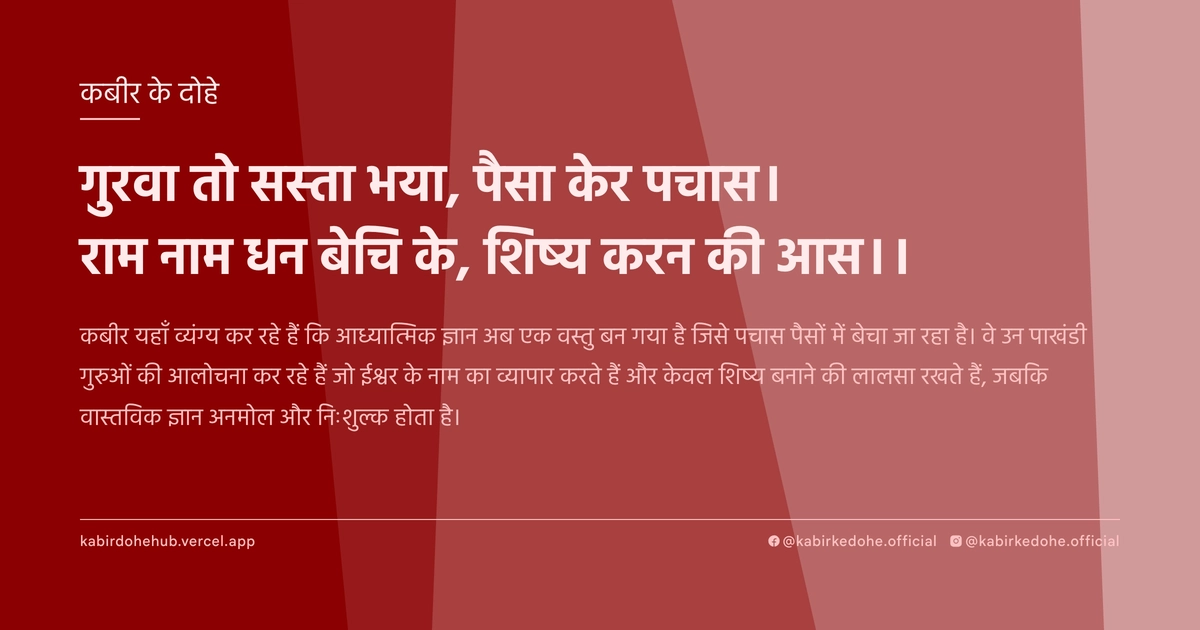
गुरवा तो सस्ता भया, पैसा केर पचास।
राम नाम धन बेचि के, शिष्य करन की आस।।
Gurva to sasta bhaya, paisa ker pachaas. Ram naam dhan bechi ke, shishya karan ki aas.
इस पृष्ठ पर इस कबीर दोहे का अर्थ (meaning), हिंदी व्याख्या और अंग्रेज़ी अनुवाद, दार्शनिक विश्लेषण और व्यावहारिक जीवन सीख दी गई है। यह दोहा गुरु महत्व (The Guru's Importance) विषय से जुड़ा है — Kabir doha meaning and explanation in Hindi and English.
अर्थ (Meaning):
कबीर यहाँ व्यंग्य कर रहे हैं कि आध्यात्मिक ज्ञान अब एक वस्तु बन गया है जिसे पचास पैसों में बेचा जा रहा है। वे उन पाखंडी गुरुओं की आलोचना कर रहे हैं जो ईश्वर के नाम का व्यापार करते हैं और केवल शिष्य बनाने की लालसा रखते हैं, जबकि वास्तविक ज्ञान अनमोल और निःशुल्क होता है।
Kabir employs sharp irony to describe how spiritual guidance has become a cheap commodity, sold for a mere fifty paise. He criticizes hypocritical teachers who trade the divine name of Ram for money, driven by the desire to accumulate disciples rather than the genuine intent to liberate souls.
व्याख्या (Interpretation):
शाब्दिक रूप से यह दोहा गुरुओं द्वारा ली जाने वाली मामूली फीस पर प्रहार करता है। आध्यात्मिक स्तर पर, यह 'ज्ञान के बाजारीकरण' की चेतावनी है। कबीर समझाते हैं कि जब सत्य को खरीदा या बेचा जा सकता है, तो वह सत्य नहीं बल्कि माया का एक विस्तार है। निर्गुण भक्ति में, परमात्मा किसी बाहरी माध्यम या भुगतान से नहीं, बल्कि अहंकार के विसर्जन से प्राप्त होता है। यहाँ 'पचास पैसा' उस तुच्छ भौतिक लाभ का प्रतीक है जिसे लोग मोक्ष के बदले मांगते हैं। यह विरोधाभास दर्शाता है कि जो वस्तु सबसे मूल्यवान है (आत्म-ज्ञान), उसे सबसे सस्ते दाम पर बेचा जा रहा है, जो वास्तव में उसकी पवित्रता के विनाश का संकेत है।
Literally, this couplet attacks the trivial fees charged by self-proclaimed gurus. On a deeper level, it is a warning against the 'commodification of enlightenment.' Kabir asserts that when Truth is bought or sold, it ceases to be Truth and becomes an extension of Maya (illusion). In Nirgun Bhakti, the formless Divine is not accessed through external intermediaries or financial transactions, but through the dissolution of the ego. The 'fifty paise' symbolizes the petty material gain that charlatans seek in exchange for spiritual promises. This paradox highlights that the most priceless treasure—self-realization—is being traded for a pittance, signaling the degradation of spiritual authenticity.
दार्शनिक विश्लेषण (Philosophical Analysis):
कबीर का यह दोहा उनके युग के सामाजिक और धार्मिक पाखंड के विरुद्ध एक सशक्त विद्रोह है। उस समय, धर्म के नाम पर शोषण चरम पर था, जहाँ पंडित और पीर स्वयं को ईश्वर का प्रतिनिधि बताकर आम जनता से धन वसूलते थे। कबीर इसे 'व्यापार' कहते हैं, न कि 'धर्म'।
अद्वैत वेदांत के दृष्टिकोण से, गुरु वह है जो शिष्य के भीतर के अज्ञान को मिटाकर उसे यह अहसास कराए कि वह स्वयं ब्रह्म है। यदि गुरु धन की मांग करता है, तो वह द्वैत (duality) को बढ़ावा दे रहा है—एक देने वाला और एक लेने वाला। यह संबंध प्रेम और समर्पण का होना चाहिए, न कि लेन-देन का।
सूफी मत में 'मुर्शिद' (गुरु) का स्थान सर्वोच्च है, लेकिन वह निःस्वार्थ प्रेम (Ishq) पर आधारित होता है। कबीर यहाँ उन लोगों को निशाना बनाते हैं जिन्होंने सूफीवाद और भक्ति की आड़ में अपनी आजीविका चलाना शुरू कर दिया था। वे स्पष्ट करते हैं कि राम नाम कोई वस्तु नहीं है जिसे बेचा जा सके; यह एक आंतरिक अनुभव है।
मनोवैज्ञानिक स्तर पर, यह दोहा शिष्य की उस मानसिकता पर भी प्रहार करता है जो सोचता है कि वह पैसे देकर मोक्ष 'खरीद' सकता है। यह एक मानसिक आलस्य है जहाँ व्यक्ति साधना के कठिन मार्ग के बजाय एक शॉर्टकट चाहता है।
अंततः, कबीर यह स्थापित करते हैं कि वास्तविक गुरु वह है जो आपको आपसे मिला दे, न कि वह जो आपको अपनी निर्भरता में रखे। ritualism और बाहरी आडंबरों का त्याग ही वास्तविक भक्ति का मार्ग है, क्योंकि सत्य किसी बाजार में नहीं, बल्कि शून्य (Sunyata) और मौन में मिलता है।
This couplet is a powerful rebellion against the social and religious hypocrisy of Kabir's era. During his time, exploitation in the name of religion was rampant, with priests and peers claiming to be representatives of God to extort money from the masses. Kabir labels this as 'commerce,' not 'faith.'
From the perspective of Advaita Vedanta, a true Guru is one who erases the disciple's ignorance, revealing that the self is identical to Brahman. If a teacher demands payment, they are reinforcing duality—the separation between the giver and the receiver. The relationship should be rooted in selfless love and surrender, not a commercial transaction.
In Sufism, the role of the 'Murshid' (guide) is paramount, but it is based on 'Ishq' (divine love). Kabir targets those who used the cloak of Sufism and Bhakti to sustain their livelihoods. He clarifies that the name of Ram is not a commodity to be traded; it is an internal realization.
Psychologically, this verse attacks the disciple's mindset—the belief that salvation can be 'purchased.' This represents a spiritual laziness where the individual seeks a shortcut rather than enduring the rigorous path of internal discipline (Sadhana).
Ultimately, Kabir establishes that a genuine Guru is one who connects you to your own inner self, rather than making you dependent on them. The rejection of ritualism and outward show is the only path to true devotion, as Truth is found not in a marketplace, but in the void (Sunyata) and silence.
मूल संदेश (Core Message):
- सत्य कोई वस्तु नहीं है जिसे खरीदा जा सके।
- बाहरी आडंबरों और महंगे अनुष्ठानों से दूर रहें।
- ईश्वर का नाम व्यापार का साधन नहीं होना चाहिए।
- वास्तविक ज्ञान निःस्वार्थ और निःशुल्क होता है।
- अहंकार का त्याग ही सबसे बड़ा दान है।
- आंतरिक खोज ही एकमात्र वास्तविक मार्ग है।
- Truth is not a commodity to be purchased.
- Distance yourself from external pomp and expensive rituals.
- The divine name must never be a tool for commerce.
- Genuine wisdom is selfless and free of charge.
- The surrender of ego is the greatest offering.
- Internal inquiry is the only authentic path.
व्यावहारिक उदाहरण (Practical Example):
एक समय की बात है, वाराणसी के घाटों पर रहने वाला एक वृद्ध बुनकर था, जिसका नाम माधव था। माधव अपनी पूरी जिंदगी सादगी से बिता चुका था, लेकिन उसके मन में शांति नहीं थी।
एक दिन उसने देखा कि शहर में एक नए 'महात्मा' आए हैं, जो दावा करते थे कि वे मात्र कुछ सिक्कों के बदले व्यक्ति के सभी पाप धो सकते हैं और उसे मोक्ष का रास्ता दिखा सकते हैं।
माधव ने अपनी जीवन भर की जमापूंजी, जो केवल कुछ सौ पैसे थे, उस महात्मा के चरणों में रख दिए। उसने उम्मीद की कि अब उसे जीवन का परम सत्य मिल जाएगा।
महात्मा ने उसे एक मंत्र दिया और कहा कि हर दिन इस मंत्र का जाप करो और हर महीने कुछ दान देते रहो, तो तुम ईश्वर के करीब पहुँच जाओगे।
माधव महीनों तक यह करता रहा, लेकिन उसे महसूस हुआ कि वह अब और अधिक तनाव में है क्योंकि वह अपनी छोटी सी कमाई का बड़ा हिस्सा उस महात्मा को दे रहा था।
एक शाम, माधव की मुलाकात एक साधारण से व्यक्ति से हुई जो घाट पर चुपचाप बैठा था। उस व्यक्ति ने माधव की व्याकुलता को देखा और मुस्कुराया।
उस व्यक्ति ने माधव से कहा, 'तुम उस सत्य को क्यों खोज रहे हो जिसे कोई बेच रहा है? क्या कभी किसी ने सूरज को बेचने की कोशिश की है?'
माधव चौंक गया। उसने पूछा, 'तो फिर मैं सत्य कैसे पाऊं?' उस व्यक्ति ने उत्तर दिया, 'अपने भीतर के लालच और डर को देखो। जब तुम यह मान लोगे कि तुम स्वयं पूर्ण हो, तब तुम्हें किसी बाहरी विक्रेता की आवश्यकता नहीं होगी।'
माधव को कबीर की बात याद आई कि जो सत्य बिकता है, वह सत्य नहीं होता। उसने तुरंत उस महात्मा के प्रभाव को त्याग दिया।
उस दिन के बाद, माधव ने अपनी बुनाई को ही अपनी प्रार्थना बना लिया। उसने महसूस किया कि ईमानदारी से किया गया कार्य और निस्वार्थ सेवा ही वास्तविक मोक्ष है।
Once, in the ghats of Varanasi, lived an elderly weaver named Madhav. Madhav had spent his entire life in simplicity, yet his mind lacked peace.
One day, he noticed a new 'Mahatma' had arrived in the city, claiming that for a few coins, he could wash away a person's sins and show them the path to liberation.
Madhav placed his life savings—a few hundred paise—at the Mahatma's feet, hoping that he would finally attain the ultimate truth of existence.
The Mahatma gave him a mantra and instructed him to chant it daily and donate a portion of his earnings every month to grow closer to God.
Madhav followed this for months, but he realized he was becoming more stressed, as a large part of his meager income was now going to the Mahatma.
One evening, Madhav encountered a simple man sitting silently by the river. The man observed Madhav's restlessness and smiled.
He asked Madhav, 'Why are you searching for a truth that is being sold? Has anyone ever tried to sell the sun?'
Madhav was startled. He asked, 'Then how do I find the truth?' The man replied, 'Look at the greed and fear within you. When you realize you are already complete, you will no longer need an external vendor.'
Madhav recalled the essence of Kabir's wisdom: that which is sold cannot be the Truth. He immediately severed his ties with the fraudulent Mahatma.
From that day forward, Madhav turned his weaving into his prayer. He realized that honest labor and selfless service were the only true paths to liberation.
अभ्यास मार्गदर्शन (Practice Guidance):
- प्रतिदिन 20 मिनट मौन बैठें और विचार करें कि आप बाहरी दुनिया में किन 'गुरुओं' या 'विशेषज्ञों' पर अपनी खुशी के लिए निर्भर हैं।
- एक जर्नल लिखें जिसमें उन क्षणों का विवरण हो जब आपने आध्यात्मिक या मानसिक शांति के लिए किसी बाहरी वस्तु या व्यक्ति का सहारा लिया और वह विफल रहा।
- व्यवहार परिवर्तन: किसी भी ऐसे आध्यात्मिक दावे पर संदेह करें जो वित्तीय लाभ या किसी विशेष सदस्यता (membership) की मांग करता हो।
- निदान चेकलिस्ट: क्या मैं सत्य को 'प्राप्त' करने की कोशिश कर रहा हूँ या उसे 'खोज' रहा हूँ? क्या मेरा विश्वास डर पर आधारित है या प्रेम पर? क्या मैं अपनी आध्यात्मिक प्रगति को बाहरी प्रमाणों से मापता हूँ?
- Sit in silence for 20 minutes daily and contemplate which external 'gurus' or 'experts' you rely on for your happiness.
- Maintain a journal detailing moments when you sought spiritual or mental peace through external objects or people and found it lacking.
- Behavioral Change: Develop a healthy skepticism toward any spiritual claim that demands financial gain or a specific membership.
- Diagnostic Checklist: Am I trying to 'acquire' truth or 'discover' it? Is my faith based on fear or love? Do I measure my spiritual progress by external validations?
चिंतन प्रश्न (Reflection Questions):
- क्या मैं अपनी आध्यात्मिक यात्रा में किसी 'शॉर्टकट' की तलाश कर रहा हूँ?
- मेरे जीवन में 'गुरु' की परिभाषा क्या है—एक मार्गदर्शक या एक ऐसा व्यक्ति जो मेरी समस्याओं को 'ठीक' कर दे?
- मैं अपनी पहचान को डिजिटल दुनिया में कैसे प्रस्तुत करता हूँ, और क्या वह मेरी वास्तविक आंतरिक स्थिति से अलग है?
- क्या मैं धर्म का उपयोग दूसरों से श्रेष्ठ दिखने के लिए कर रहा हूँ?
- यदि मुझे कोई बाहरी मान्यता न मिले, तो क्या मेरी साधना का कोई मूल्य रहेगा?
- मैं किन सूक्ष्म पूर्वाग्रहों के कारण कुछ लोगों को 'पवित्र' और कुछ को 'अपवित्र' मानता हूँ?
- Am I searching for a 'shortcut' in my spiritual journey?
- What is my definition of a 'Guru'—a guide or someone who 'fixes' my problems?
- How do I project my identity in the digital world, and how does it differ from my internal reality?
- Am I using religion as a tool to feel superior to others?
- If I received no external validation, would my spiritual practice still hold value?
- What subtle biases lead me to categorize some people as 'holy' and others as 'unholy'?