
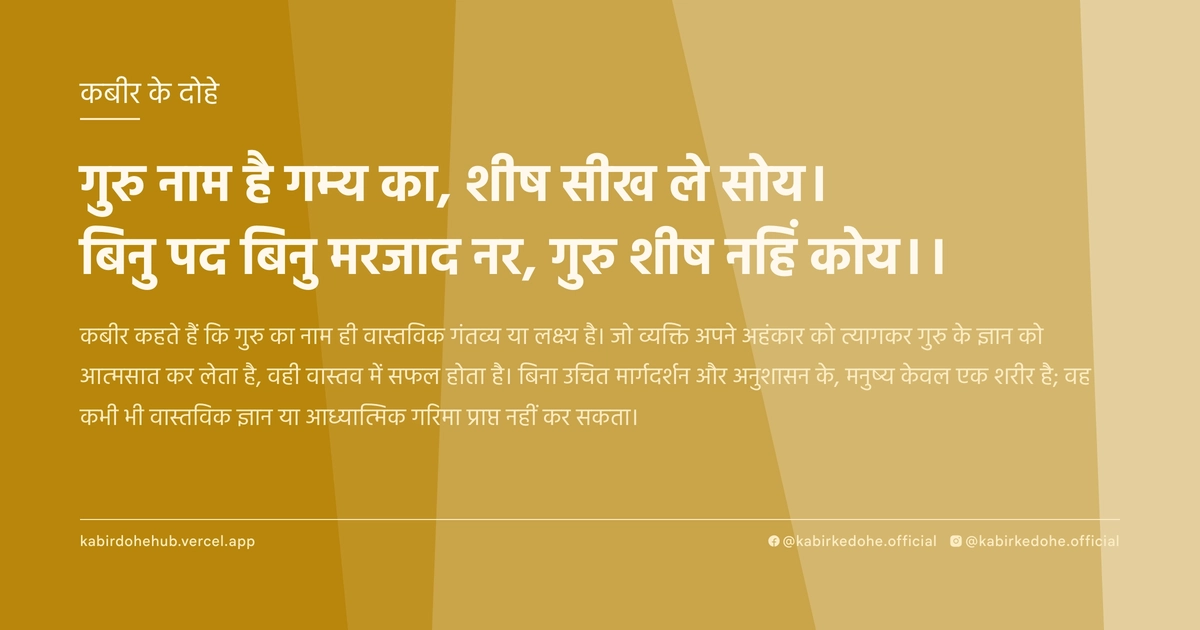
गुरु नाम है गम्य का, शीष सीख ले सोय।
बिनु पद बिनु मरजाद नर, गुरु शीष नहिं कोय।।
Guru naam hai gamya ka, sheesh seekh le soy. Binu pad binu marjaad nar, guru sheesh nahin koy.
इस पृष्ठ पर इस कबीर दोहे का अर्थ (meaning), हिंदी व्याख्या और अंग्रेज़ी अनुवाद, दार्शनिक विश्लेषण और व्यावहारिक जीवन सीख दी गई है। यह दोहा गुरु महत्व (The Guru's Importance) विषय से जुड़ा है — Kabir doha meaning and explanation in Hindi and English.
अर्थ (Meaning):
कबीर कहते हैं कि गुरु का नाम ही वास्तविक गंतव्य या लक्ष्य है। जो व्यक्ति अपने अहंकार को त्यागकर गुरु के ज्ञान को आत्मसात कर लेता है, वही वास्तव में सफल होता है। बिना उचित मार्गदर्शन और अनुशासन के, मनुष्य केवल एक शरीर है; वह कभी भी वास्तविक ज्ञान या आध्यात्मिक गरिमा प्राप्त नहीं कर सकता।
Kabir asserts that the Guru's name—representing the essence of divine guidance—is the ultimate destination. He who bows their head in surrender and learns the truth attains liberation. Without the guidance of a master and the discipline of spiritual conduct, a human remains an empty vessel, devoid of true spiritual stature or enlightenment.
व्याख्या (Interpretation):
इस दोहे का शाब्दिक अर्थ है कि गुरु ही वह मार्ग और मंजिल है जिसे प्राप्त करना चाहिए। यहाँ 'शीष' (सिर) का झुकना केवल शारीरिक क्रिया नहीं, बल्कि अहंकार का पूर्ण विसर्जन है। यह निर्गुण भक्ति की उस अवस्था को दर्शाता है जहाँ साधक अपनी व्यक्तिगत पहचान को गुरु के ज्ञान में विलीन कर देता है। माया का पर्दा तभी हटता है जब शिष्य अपनी सीमित बुद्धि को त्यागकर उस असीम ज्ञान के प्रति समर्पित होता है। यह अद्वैत वेदांत के उस सिद्धांत को पुष्ट करता है कि आत्मा और परमात्मा के बीच का सेतु केवल एक जागृत गुरु ही बन सकता है। अंततः, यह दोहा इस विरोधाभास को उजागर करता है कि पूर्ण ज्ञान प्राप्त करने के लिए पहले पूर्ण अज्ञान और समर्पण की स्थिति में आना आवश्यक है।
Literally, the verse claims the Guru is the destination. However, the 'bowing of the head' is a profound metaphor for the annihilation of the ego (Ahamkara). In the context of Nirgun Bhakti, the Guru is not necessarily a physical person but the principle of divine consciousness that awakens the dormant Atman. The 'lack of status or etiquette' refers to the spiritual bankruptcy of one who attempts to reach the Truth through intellectual pride rather than humble surrender. This aligns with Advaita Vedanta, where the Guru acts as the catalyst to dissolve the illusion of duality (Maya). The central paradox presented is that one must first become 'nothing'—stripping away all social and mental labels—to become 'everything' in the realization of Brahman. The Guru is thus the mirror reflecting the seeker's own inherent divinity.
दार्शनिक विश्लेषण (Philosophical Analysis):
कबीर का यह दोहा उस समय के सामाजिक और धार्मिक परिवेश पर एक गहरा प्रहार है जहाँ गुरु की पात्रता को केवल जाति, कुल या बाहरी आडंबरों से मापा जाता था। कबीर ने ritualism (कर्मकांड) का खंडन करते हुए यह स्पष्ट किया कि वास्तविक गुरु वह है जो आत्मा को परमात्मा से जोड़े, न कि वह जो केवल शास्त्रों का रटंत ज्ञान दे। यह दृष्टिकोण सूफी मत के 'पीर' और 'मुरीद' के संबंध के समान है, जहाँ पूर्ण समर्पण ही सत्य की प्राप्ति का एकमात्र मार्ग है।
दार्शनिक स्तर पर, यह दोहा 'अहं' के विलोपन की बात करता है। जब तक मनुष्य अपनी सामाजिक स्थिति (पद) और बाहरी मर्यादाओं के अहंकार में रहता है, वह सत्य से दूर रहता है। कबीर यहाँ यह समझा रहे हैं कि आध्यात्मिक उन्नति के लिए बाहरी प्रतिष्ठा का कोई मूल्य नहीं है; केवल आंतरिक विनम्रता ही काम आती है।
यह शिक्षण अद्वैत वेदांत के इस विचार से मेल खाता है कि जब तक 'मैं' (individual ego) मौजूद है, तब तक 'वह' (Universal Truth) ओझल रहता है। गुरु का कार्य इसी 'मैं' को मिटाना है। कबीर का विद्रोह उन पाखंडी गुरुओं के खिलाफ था जो धर्म के नाम पर शोषण करते थे, और उन्होंने एक ऐसे आंतरिक गुरु की वकालत की जो हृदय की शुद्धता पर आधारित हो।
मनोवैज्ञानिक रूप से, यह प्रक्रिया 'unlearning' की है। हम जीवन भर जो सामाजिक मुखौटे पहनते हैं, गुरु हमें उन्हें उतारने की चुनौती देता है। यह एक दर्दनाक प्रक्रिया हो सकती है क्योंकि यह हमारी पहचान को नष्ट करती है, लेकिन यही विनाश वास्तविक सृजन का आधार है।
अंततः, कबीर यह स्थापित करते हैं कि बिना अनुशासन (मरजाद) और मार्गदर्शन के, मनुष्य केवल भौतिक जगत में भटकता रहता है। वास्तविक 'पद' वह नहीं है जो समाज देता है, बल्कि वह है जो आत्म-साक्षात्कार के बाद प्राप्त होता है। यह दोहा ज्ञान मार्ग और भक्ति मार्ग का एक सुंदर समन्वय है।
Kabir’s verse emerges from a historical era rife with rigid caste hierarchies and hollow ritualism. By emphasizing the Guru as the 'destination,' Kabir dismantles the notion that spiritual liberation is reserved for the priestly class or those born into high castes. He rejects the performative aspects of religion, arguing that true guidance transcends scriptures and rituals, focusing instead on the direct experience of the Formless (Nirgun).
Philosophically, this connects deeply with Sufism, specifically the concept of 'Fana' (annihilation of the self). The 'bowing of the head' is the psychological act of surrendering the ego to a higher consciousness. In Sufi traditions, the Pir (guide) is essential because the path to God is fraught with the traps of the Nafs (lower self). Kabir mirrors this by suggesting that without a guide, the seeker is blind to their own delusions.
From the lens of Advaita Vedanta, the Guru is the 'Jnana-Guru' who removes the veil of Avidya (ignorance). The mention of 'binu pad' (without status) is a critique of the social ego. Kabir argues that as long as a person identifies with their social rank or professional prestige, they remain trapped in Maya. The only 'status' that matters in the spiritual realm is the state of absolute humility.
Psychologically, the relationship between the Guru and the disciple is one of radical transformation. It is not about adding new information to the mind, but about stripping away the false identifications. The 'marjaad' (discipline) mentioned is not an external set of rules, but an internal alignment of will with the divine flow, leading to the cessation of mental conflict.
Ultimately, Kabir corrects the literalist misconception that a Guru is merely a teacher of texts. He presents the Guru as a living embodiment of the Truth, a bridge across the chasm of duality. The annihilation of the ego is not a loss, but the discovery of the universal self, where the distinction between the seeker, the path, and the goal vanishes.
मूल संदेश (Core Message):
- अहंकार ही सत्य और साधक के बीच की सबसे बड़ी दीवार है।
- वास्तविक ज्ञान पुस्तकों में नहीं, बल्कि पूर्ण समर्पण में निहित है।
- सामाजिक प्रतिष्ठा आध्यात्मिक प्रगति में एक बाधा बन सकती है।
- गुरु कोई व्यक्ति नहीं, बल्कि वह चेतना है जो हमें स्वयं से मिलाती है।
- विनम्रता वह द्वार है जिससे होकर ही परमात्मा का प्रकाश भीतर आता है।
- बिना अनुशासन और मार्गदर्शन के आध्यात्मिक प्रयास दिशाहीन होते हैं।
- The ego is the primary wall separating the seeker from the Truth.
- True wisdom resides not in texts, but in absolute surrender.
- Social prestige can become a formidable obstacle to spiritual growth.
- The Guru is not merely a person, but the consciousness that reveals the Self.
- Humility is the only portal through which divine light can enter.
- Spiritual efforts without discipline and guidance remain directionless.
व्यावहारिक उदाहरण (Practical Example):
वाराणसी के घाटों पर रहने वाला एक वृद्ध विधवा, जिसे समाज ने हाशिए पर धकेल दिया था, अपनी दिनचर्या में केवल एक ही काम करती थी—गंगा की लहरों को देखना और मन ही मन एक अज्ञात शक्ति को पुकारना। वह अनपढ़ थी, उसे कोई शास्त्र नहीं आता था, लेकिन उसके भीतर एक गहरी तड़प थी।
उसी शहर में एक बहुत बड़े विद्वान पंडित रहते थे, जिन्हें अपनी विद्वत्ता और कुल का बहुत अहंकार था। वे हर समय दूसरों को उपदेश देते थे और अपनी श्रेष्ठता सिद्ध करने में लगे रहते थे।
एक दिन, पंडित जी ने देखा कि वह वृद्ध महिला अत्यंत शांत और आनंदित अवस्था में बैठी है, जबकि वे स्वयं मानसिक तनाव और क्रोध से घिरे हुए थे। उन्होंने अहंकारवश उससे पूछा, "तुम कौन से मंत्र पढ़ती हो? तुमने कौन सी विधि अपनाई है?"
उस महिला ने सरलता से उत्तर दिया, "मैं कोई मंत्र नहीं जानती। मैंने बस अपना सिर उस परमात्मा के चरणों में रख दिया और अपनी 'मैं' को गंगा में बहा दिया। मेरे लिए मेरा समर्पण ही मेरा गुरु है।"
पंडित जी को पहले तो यह बात हास्यास्पद लगी। उन्होंने सोचा कि बिना शास्त्रों के कोई कैसे मुक्त हो सकता है? लेकिन उस महिला की आँखों में जो असीम शांति थी, उसने पंडित जी के अहंकार को झकझोर दिया।
उन्हें एहसास हुआ कि वे वर्षों से केवल शब्दों को पढ़ रहे थे, जबकि वह महिला सत्य को जी रही थी। उनकी सारी डिग्रियाँ और सामाजिक पद उस महिला की एक मुस्कान के सामने फीके पड़ गए।
उस क्षण, पंडित जी का अहंकार टूट गया। उन्होंने पहली बार महसूस किया कि वे अब तक केवल एक 'पद' थे, 'शिष्य' नहीं। उन्होंने उस वृद्ध महिला के सामने अपना सिर झुकाया और उनसे पूछा कि इस शांति का मार्ग क्या है।
यह 'कबीर ट्विस्ट' था—जहाँ एक तथाकथित गुरु (पंडित) एक अनपढ़ महिला के सामने शिष्य बन गया। पंडित जी ने बाहरी आडंबर छोड़ दिए और अंतर्मुखी होने का अभ्यास शुरू किया।
उनका जीवन बदल गया। अब वे उपदेश नहीं देते थे, बल्कि सेवा करते थे। उन्होंने समझा कि जब तक सिर झुकता नहीं, तब तक ज्ञान भीतर प्रवेश नहीं करता।
इस प्रकार, एक अहंकारी विद्वान एक सच्चे साधक में परिवर्तित हो गया, क्योंकि उसने 'पद' और 'मर्यादा' के भ्रम को त्यागकर वास्तविक समर्पण को चुना।
In the ancient alleys of Varanasi lived an elderly widow, cast aside by society and stripped of all familial ties. She possessed no literacy and knew no scriptures, yet she spent her days in a state of profound stillness, watching the currents of the Ganges and whispering to an unseen Presence.
In the same city resided a renowned scholar, a Pandit of immense fame, whose ego was as vast as his library. He spent his hours debating theology and asserting his superiority over others, believing his social status and knowledge were the keys to liberation.
One afternoon, the Pandit noticed the widow. Despite her rags and poverty, she radiated a luminous peace that he, in all his luxury and learning, completely lacked. Irritated by her serenity, he asked condescendingly, "What secret mantras do you chant? Which complex ritual have you mastered to achieve such calm?"
The woman replied with a gentle smile, "I know no mantras, sir. I have simply bowed my head to the Formless One and washed my 'I' away in the river. For me, my total surrender is my Guru."
The Pandit laughed, dismissing her words as the ramblings of an ignorant mind. He believed that without formal study and a lineage of prestige, spiritual height was impossible.
However, as he looked into her eyes, he saw a reflection of a truth he had only read about in books but never felt. He realized that while he was a master of words, she was a master of Silence. His intellectual pride suddenly felt like a heavy, suffocating cloak.
In that moment of sudden clarity—the 'Kabir Twist'—the Pandit's ego shattered. He realized that his 'status' (pad) was actually a barrier, a wall preventing him from experiencing the very Truth he claimed to teach.
Overcome with emotion, the great scholar bowed his head before the illiterate widow. He asked her not for a mantra, but for the strength to surrender his ego.
From that day forward, the Pandit ceased his public debates and abandoned his pursuit of prestige. He began to serve the poorest in the city, treating every living being as a manifestation of the Divine.
He discovered that true knowledge does not enter through the ears of a proud man, but through the heart of a humble one. By becoming 'nothing,' he finally became everything.
अभ्यास मार्गदर्शन (Practice Guidance):
- दैनिक समर्पण अभ्यास: प्रतिदिन 15 मिनट मौन बैठें और कल्पना करें कि आपका अहंकार एक पुराने वस्त्र की तरह उतर रहा है।
- आत्म-पूछताछ जर्नल: प्रतिदिन लिखें—'आज मैंने कहाँ अपनी श्रेष्ठता सिद्ध करने की कोशिश की?' और 'किस स्थिति में मैं वास्तव में विनम्र था?'
- व्यवहार परिवर्तन: दिन में कम से कम एक बार किसी ऐसे व्यक्ति से कुछ सीखने का प्रयास करें जिसे समाज 'निम्न' या 'अयोग्य' मानता है।
- निदान चेकलिस्ट: यदि आप दूसरों की आलोचना करते समय स्वयं को श्रेष्ठ महसूस कर रहे हैं, तो समझें कि आप अभी भी 'पद' के भ्रम में हैं। यदि आप आलोचना सुनकर भी शांत हैं, तो आप गुरु-तत्व की ओर बढ़ रहे हैं।
- Daily Surrender Practice: Spend 15 minutes in silence, visualizing your ego shedding like an old garment, leaving only the pure essence of being.
- Self-Inquiry Journaling: Daily prompt: 'Where did I attempt to assert my superiority today?' and 'In which moment was I genuinely humble?'
- Behavioral Shift: Consciously seek to learn something from someone whom society deems 'unqualified' or 'lowly' at least once a day.
- Diagnostic Checklist: If you feel a surge of superiority while criticizing others, you are still trapped in 'status' (pad). If you remain undisturbed by criticism, you are aligning with the Guru-principle.
चिंतन प्रश्न (Reflection Questions):
- क्या मेरा 'विनम्र' दिखना भी मेरे अहंकार का एक सूक्ष्म रूप है?
- मैं अपनी पहचान के लिए किन सामाजिक या डिजिटल लेबल्स (पद) पर सबसे अधिक निर्भर हूँ?
- यदि मेरी सारी उपलब्धियाँ और पद छीन लिए जाएँ, तो मेरे भीतर क्या बचेगा?
- क्या मैं वास्तव में सत्य की खोज में हूँ, या मैं केवल 'सत्य जानने वाले' की छवि चाहता हूँ?
- मेरे जीवन में वह कौन सा 'अदृश्य गुरु' है जिसने मुझे मेरी सबसे बड़ी गलती का अहसास कराया?
- क्या मैं अपनी मान्यताओं को चुनौती देने वाले व्यक्ति को स्वीकार कर सकता हूँ, या मेरा अहंकार उसे शत्रु मान लेता है?
- Is my outward display of 'humility' actually a subtle form of ego?
- Which social or digital labels (status) do I rely on most for my identity?
- If all my achievements and titles were stripped away, what would remain of me?
- Am I truly seeking the Truth, or am I merely seeking the image of 'one who knows the Truth'?
- Who is the 'invisible Guru' in my life who forced me to confront my greatest flaw?
- Can I accept someone who challenges my core beliefs, or does my ego immediately label them an enemy?