
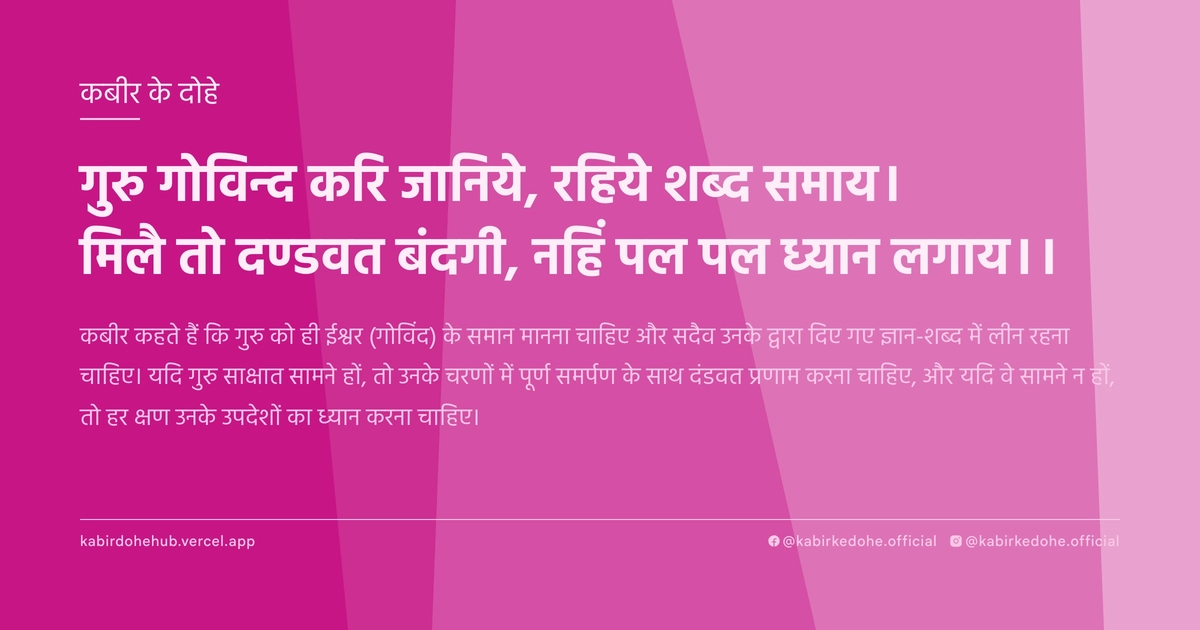
गुरु गोविन्द करि जानिये, रहिये शब्द समाय।
मिलै तो दण्डवत बंदगी, नहिं पल पल ध्यान लगाय।।
Guru Govind kari jaaniye, rahiye shabd samaye. Milai to dandavat bandagi, nahin pal pal dhyaan lagaye.
इस पृष्ठ पर इस कबीर दोहे का अर्थ (meaning), हिंदी व्याख्या और अंग्रेज़ी अनुवाद, दार्शनिक विश्लेषण और व्यावहारिक जीवन सीख दी गई है। यह दोहा गुरु महत्व (The Guru's Importance) विषय से जुड़ा है — Kabir doha meaning and explanation in Hindi and English.
अर्थ (Meaning):
कबीर कहते हैं कि गुरु को ही ईश्वर (गोविंद) के समान मानना चाहिए और सदैव उनके द्वारा दिए गए ज्ञान-शब्द में लीन रहना चाहिए। यदि गुरु साक्षात सामने हों, तो उनके चरणों में पूर्ण समर्पण के साथ दंडवत प्रणाम करना चाहिए, और यदि वे सामने न हों, तो हर क्षण उनके उपदेशों का ध्यान करना चाहिए।
Kabir instructs that the Guru should be regarded as identical to the Divine (Govind), and one should remain immersed in the 'Shabad' or the spiritual word imparted by them. If the Guru is physically present, offer total surrender through prostration; if absent, maintain an unwavering, moment-by-moment meditation on their teachings.
व्याख्या (Interpretation):
यह दोहा गुरु और ईश्वर की अद्वैतता को रेखांकित करता है। यहाँ 'गोविंद' केवल एक देवता नहीं, बल्कि वह परम चेतना है जिसे गुरु के माध्यम से ही अनुभव किया जा सकता है। 'शब्द' का अर्थ यहाँ केवल वाणी नहीं, बल्कि वह नाद या आंतरिक ध्वनि है जो साधक को माया के बंधनों से मुक्त करती है। जब शिष्य गुरु को गोविंद मानता है, तो वह बाहरी कर्मकांडों से ऊपर उठकर आंतरिक समर्पण की स्थिति में पहुँच जाता है। यह निर्गुण भक्ति का सार है, जहाँ गुरु वह सेतु है जो सीमित आत्मा (Atman) को असीमित ब्रह्म (Brahman) से जोड़ता है। दंडवत बंदगी अहंकार के पूर्ण विसर्जन का प्रतीक है, क्योंकि जब तक 'मैं' जीवित है, तब तक 'गुरु' का ज्ञान प्रवेश नहीं कर सकता। अंततः, यह दोहा सिखाता है कि गुरु की भौतिक उपस्थिति से अधिक महत्वपूर्ण उनकी शिक्षाओं का निरंतर मानसिक साक्षात्कार है।
This couplet underscores the non-duality (Advaita) between the Guru and the Divine. Here, 'Govind' is not merely a deity but the Supreme Consciousness accessible only through the Guru's grace. The 'Shabad' refers not to mere words, but to the primordial sound or internal vibration that liberates the seeker from the illusions of Maya. By equating the Guru with Govind, the disciple transcends external rituals to enter a state of absolute internal surrender. This is the essence of Nirgun Bhakti, where the Guru serves as the bridge connecting the finite Atman to the infinite Brahman. The act of 'dandavat' (prostration) symbolizes the total annihilation of the ego; as long as the 'I' exists, the Guru's wisdom cannot permeate. Ultimately, the verse teaches that the constant mental realization of the Guru's teachings is more vital than their physical presence.
दार्शनिक विश्लेषण (Philosophical Analysis):
कबीर का यह दृष्टिकोण मध्यकालीन भारत के उस समय का है जब धर्म बाहरी आडंबरों, जातिगत भेदभाव और कठोर कर्मकांडों में जकड़ा हुआ था। कबीर ने 'गुरु' को किसी विशेष जाति या संप्रदाय के पुरोहित के रूप में नहीं, बल्कि एक आध्यात्मिक मार्गदर्शक के रूप में स्थापित किया। उनका दर्शन सूफीवाद के 'मुर्शिद' और वेदांत के 'आचार्य' का संगम है, जहाँ गुरु का कार्य शिष्य के भीतर सोई हुई चेतना को जगाना है।
यहाँ गुरु को गोविंद मानना इस बात का प्रमाण है कि कबीर किसी बाहरी ईश्वर की खोज के बजाय आंतरिक रूपांतरण पर बल देते हैं। यदि ईश्वर निराकार (Nirgun) है, तो वह किसी मंदिर या मस्जिद में नहीं, बल्कि उस ज्ञान में मिलता है जो गुरु द्वारा दिया जाता है। यह दृष्टिकोण ब्राह्मणवादी श्रेष्ठता और मुल्लाओं के कट्टरपंथ दोनों को चुनौती देता है, क्योंकि यह ज्ञान को जन्म या पद के बजाय पात्रता और समर्पण से जोड़ता है।
मनोवैज्ञानिक स्तर पर, यह दोहा 'अहंकार के विलोपन' की प्रक्रिया है। जब शिष्य दंडवत प्रणाम करता है, तो वह अपनी सामाजिक पहचान, अपनी विद्वत्ता और अपने गर्व को त्याग देता है। यह 'शून्य' होने की प्रक्रिया है, क्योंकि केवल खाली पात्र में ही ज्ञान भरा जा सकता है। कबीर का 'शब्द' यहाँ एक मानसिक लंगर की तरह है जो साधक को संसार की चंचलता से बचाकर स्थिरता प्रदान करता है।
अद्वैत वेदांत के संदर्भ में, गुरु वह दर्पण है जिसमें शिष्य अपनी वास्तविक स्वरूप (ब्रह्म) को देखता है। गुरु स्वयं अंततः ओझल हो जाता है, केवल वह सत्य शेष रहता है जिसे उसने दिखाया था। कबीर इस सत्य को 'शब्द समाय' कहते हैं, जिसका अर्थ है कि सत्य शब्दों में नहीं, बल्कि उस अवस्था में है जहाँ शब्द मौन हो जाते हैं और केवल अनुभव बचता है।
अंततः, कबीर यह स्पष्ट करते हैं कि भक्ति केवल मंदिर जाने या माला जपने का नाम नहीं है। वास्तविक भक्ति वह है जहाँ गुरु का निर्देश जीवन की हर सांस में समाहित हो। यह एक निरंतर जागरूकता (Mindfulness) की स्थिति है, जहाँ हर पल का ध्यान ही वास्तविक पूजा है।
Kabir's perspective emerges from a medieval Indian era where religion was stifled by external pomposity, caste hierarchies, and rigid ritualism. He establishes the 'Guru' not as a priest of a specific caste or sect, but as a spiritual catalyst. His philosophy is a confluence of the Sufi 'Murshid' and the Vedantic 'Acharya,' where the Guru's primary function is to awaken the dormant consciousness within the disciple.
Equating the Guru with Govind proves that Kabir emphasizes internal transformation over the search for an external deity. Since the Divine is formless (Nirgun), it is found not in temples or mosques, but in the wisdom transmitted by the Guru. This stance challenges both Brahmanical superiority and the orthodoxy of the Mullahs, linking spiritual attainment to eligibility and surrender rather than birth or rank.
Psychologically, this Doha describes the process of 'ego-annihilation.' When a disciple performs dandavat, they relinquish their social identity, intellectual pride, and vanity. It is a process of becoming 'zero,' for only an empty vessel can be filled with divine wisdom. Kabir's 'Shabad' acts as a mental anchor, shielding the seeker from the volatility of the material world and providing profound stability.
In the context of Advaita Vedanta, the Guru is the mirror in which the disciple perceives their true nature as Brahman. The Guru eventually fades away, leaving only the Truth they revealed. Kabir refers to this as 'Shabad Samay,' implying that Truth is not in the words themselves, but in the state where words dissolve into pure experience.
Ultimately, Kabir clarifies that devotion is not about visiting shrines or reciting beads. True devotion is when the Guru's instruction is integrated into every breath. It is a state of continuous awareness—a mindfulness where the moment-by-moment remembrance of the Truth is the only authentic form of worship.
मूल संदेश (Core Message):
- अहंकार का विसर्जन ही वास्तविक ज्ञान का द्वार है।
- गुरु केवल व्यक्ति नहीं, बल्कि सत्य तक पहुँचने का मार्ग हैं।
- बाहरी पूजा से अधिक महत्वपूर्ण आंतरिक 'शब्द' का ध्यान है।
- समर्पण वह कुंजी है जो आत्मा और परमात्मा के भेद को मिटाती है।
- निरंतर जागरूकता ही वास्तविक भक्ति और साधना है।
- The dissolution of ego is the only gateway to true knowledge.
- The Guru is not merely a person, but the path to the Absolute Truth.
- Internal meditation on the 'Shabad' outweighs all external rituals.
- Surrender is the key that erases the duality between Atman and Brahman.
- Continuous mindfulness is the highest form of devotion and discipline.
व्यावहारिक उदाहरण (Practical Example):
वाराणसी के घाटों पर रहने वाले एक वृद्ध बुनकर, माधव, का जीवन केवल धागों को जोड़ने और कपड़े बुनने तक सीमित था। वह स्वभाव से अत्यंत जिद्दी और अहंकारी था, उसे लगता था कि उसकी बुनाई की कला अद्वितीय है और कोई उसे सिखा नहीं सकता। वह अक्सर अन्य बुनकरों का उपहास करता था।
एक दिन उसकी मुलाकात एक फकीर से हुई, जिसने माधव को केवल एक वाक्य कहा: 'धागा तो तूने जोड़ लिया, पर क्या तूने खुद को उस परमात्मा से जोड़ा है जिसने तुझे धागा दिया?' माधव को पहले तो यह बात बेकार लगी, लेकिन फकीर की आंखों की गहराई ने उसे झकझोर दिया।
माधव ने उस फकीर को अपना गुरु मान लिया। शुरुआत में माधव को अपनी श्रेष्ठता का मोह था, वह गुरु के सामने भी अपनी कला की बातें करता था। लेकिन गुरु ने उसे चुप रहने और केवल 'शब्द' (मौन और आंतरिक ध्वनि) पर ध्यान देने को कहा।
एक समय ऐसा आया जब माधव ने महसूस किया कि उसकी कला का अहंकार उसे अकेला कर रहा है। उसने गुरु के चरणों में दंडवत प्रणाम किया और अपना सारा गर्व उस मिट्टी में मिला दिया। उसने महसूस किया कि वह अब तक केवल कपड़े बुन रहा था, जबकि गुरु उसे जीवन बुनना सिखा रहे थे।
अब माधव जब भी करघे पर बैठता, वह केवल धागों को नहीं देखता था, बल्कि उस 'शब्द' का ध्यान करता जो गुरु ने उसे दिया था। उसकी बुनाई में अब एक अजीब सी शांति और प्रेम झलकने लगा था।
उसकी जिद खत्म हो गई। वह अब अन्य बुनकरों की मदद करने लगा और उन्हें सिखाने लगा कि कला केवल कौशल नहीं, बल्कि समर्पण है।
गाँव के लोग हैरान थे कि जो माधव कभी किसी की बात नहीं सुनता था, वह अब इतना विनम्र कैसे हो गया। माधव जानता था कि यह बदलाव गुरु के प्रति उसके समर्पण और उनके शब्दों के निरंतर ध्यान का परिणाम था।
उसने सीखा कि जब तक वह खुद को 'बड़ा बुनकर' समझता रहा, वह छोटा था; लेकिन जब उसने खुद को गुरु के चरणों की धूल समझा, तब वह वास्तव में महान बन गया।
माधव का जीवन अब एक जीवित प्रार्थना बन गया था, जहाँ हर ताना-बाना गुरु के प्रति उसकी कृतज्ञता का प्रतीक था।
अंत में, माधव ने पाया कि गुरु और गोविंद अलग नहीं हैं; गुरु ने ही उसे उस गोविंद से मिलवाया जो उसके अपने ही भीतर छिपा था।
Madhav, an elderly weaver living on the ghats of Varanasi, spent his life merely connecting threads and weaving cloth. He was inherently stubborn and arrogant, believing his weaving art was peerless and that no one could teach him anything new. He often mocked other weavers.
One day, he encountered a wandering fakir who told him a single sentence: 'You have joined the threads, but have you joined yourself to the Divine who gave you the thread?' Initially, Madhav dismissed this as nonsense, but the depth in the fakir's eyes shook him to his core.
Madhav accepted the fakir as his Guru. At first, Madhav clung to his sense of superiority, constantly boasting about his craft even in the Guru's presence. However, the Guru commanded him to remain silent and focus solely on the 'Shabad'—the inner silence and primordial sound.
There came a moment when Madhav realized that his ego was isolating him. He performed a full prostration (dandavat) at the Guru's feet, grinding his pride into the dust. He realized that while he had been weaving cloth, the Guru was teaching him how to weave a life.
From then on, whenever Madhav sat at his loom, he didn't just see threads; he meditated on the 'Shabad' imparted by his Guru. A strange peace and love began to emanate from his weaving.
His stubbornness vanished. He began helping other weavers, teaching them that art is not merely about skill, but about surrender.
The villagers were astonished that Madhav, who once listened to no one, had become so humble. Madhav knew this transformation was the result of his surrender to the Guru and the constant remembrance of his teachings.
He learned that as long as he considered himself a 'great weaver,' he remained small; but when he viewed himself as the dust at the Guru's feet, he truly became great.
Madhav's life became a living prayer, where every warp and weft of the fabric symbolized his gratitude toward the Guru.
Ultimately, Madhav discovered that the Guru and Govind are not separate; it was the Guru who introduced him to the Divine that had been hidden within him all along.
अभ्यास मार्गदर्शन (Practice Guidance):
- दैनिक अभ्यास: प्रतिदिन 20 मिनट मौन बैठें और गुरु के किसी एक उपदेश या 'शब्द' को अपने हृदय में गहराई से महसूस करें।
- आत्म-पूछताछ जर्नल: लिखें कि आज दिन भर में कितनी बार मेरा 'अहंकार' (मैं सही हूँ, मैं श्रेष्ठ हूँ) सामने आया और मैंने उसे कैसे विसर्जित किया।
- व्यवहार परिवर्तन: किसी ऐसे व्यक्ति की बात को पूरी विनम्रता से सुनें जिसे आप खुद से कमतर समझते हैं, और उसमें भी उसी 'गोविंद' को देखने का प्रयास करें।
- निदान चेकलिस्ट: क्या मैं अभी भी केवल बाहरी रीति-रिवाजों पर निर्भर हूँ? क्या गुरु की शिक्षाएं मेरे व्यवहार में दिखती हैं या केवल मेरी बातों में? क्या मैं आलोचना सुनकर विचलित होता हूँ या उसे गुरु का प्रसाद मानता हूँ?
- Daily Practice: Sit in silence for 20 minutes daily, deeply feeling a single teaching or 'Shabad' from your Guru within your heart.
- Self-Inquiry Journal: Document instances throughout the day where your 'ego' (the feeling of 'I am right' or 'I am superior') surfaced and how you consciously dissolved it.
- Behavioral Shift: Listen with absolute humility to someone you perceive as inferior, attempting to recognize the same 'Govind' (Divine) within them.
- Diagnostic Checklist: Am I still relying solely on external rituals? Are the Guru's teachings visible in my actions or only in my speech? Do I react with agitation to criticism, or do I accept it as the Guru's grace?
चिंतन प्रश्न (Reflection Questions):
- क्या मेरा 'गुरु' केवल एक व्यक्ति है, या मैंने उस मार्गदर्शन को अपने भीतर महसूस किया है?
- जब मैं किसी के सामने झुकता हूँ, तो क्या वह केवल सामाजिक शिष्टाचार है या मेरे अहंकार का वास्तविक विसर्जन?
- मेरी डिजिटल पहचान (सोशल मीडिया) मेरे वास्तविक आध्यात्मिक स्वरूप को कितना ढक रही है?
- क्या मैं सत्य को केवल शब्दों में खोज रहा हूँ, या मैं उस मौन को अनुभव करने का साहस रखता हूँ जहाँ शब्द समाप्त हो जाते हैं?
- मेरे जीवन का वह कौन सा हिस्सा है जहाँ मैं अभी भी 'मैं' (अहंकार) को 'गोविंद' से ऊपर रखता हूँ?
- Is my 'Guru' merely a physical person, or have I experienced that guidance as an internal resonance?
- When I bow before another, is it mere social etiquette or a genuine dissolution of my ego?
- To what extent does my digital identity (social media) obscure my authentic spiritual nature?
- Am I seeking Truth only in words, or do I have the courage to experience the silence where words cease to exist?
- In which area of my life do I still place the 'I' (ego) above the 'Govind' (Divine)?