
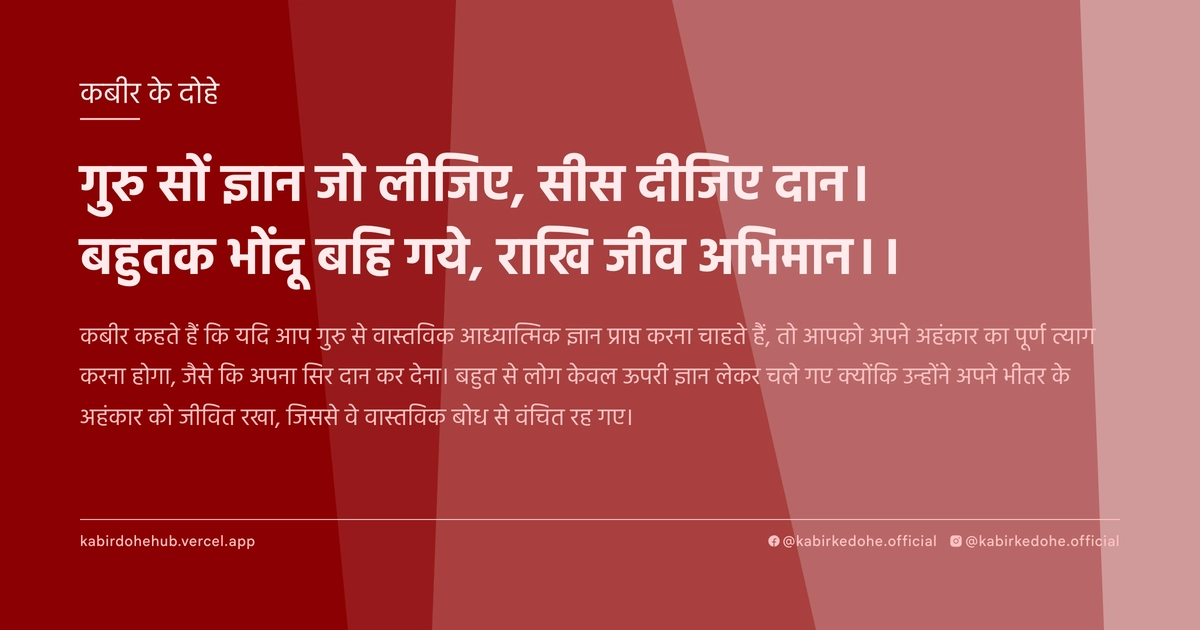
गुरु सों ज्ञान जो लीजिए, सीस दीजिए दान।
बहुतक भोंदू बहि गये, राखि जीव अभिमान।।
Guru son gyan jo leeje, sees deeje daan. Bahutak bhondu bahi gaye, rakhi jeev abhimaan.
इस पृष्ठ पर इस कबीर दोहे का अर्थ (meaning), हिंदी व्याख्या और अंग्रेज़ी अनुवाद, दार्शनिक विश्लेषण और व्यावहारिक जीवन सीख दी गई है। यह दोहा गुरु महत्व (The Guru's Importance) विषय से जुड़ा है — Kabir doha meaning and explanation in Hindi and English.
अर्थ (Meaning):
कबीर कहते हैं कि यदि आप गुरु से वास्तविक आध्यात्मिक ज्ञान प्राप्त करना चाहते हैं, तो आपको अपने अहंकार का पूर्ण त्याग करना होगा, जैसे कि अपना सिर दान कर देना। बहुत से लोग केवल ऊपरी ज्ञान लेकर चले गए क्योंकि उन्होंने अपने भीतर के अहंकार को जीवित रखा, जिससे वे वास्तविक बोध से वंचित रह गए।
Kabir asserts that if one seeks true spiritual knowledge from a Guru, one must offer their ego as a sacrifice, symbolized by the donation of one's head. Many superficial seekers have wandered away unsatisfied because they clung to their intellectual pride and ego, preventing the actual descent of divine wisdom.
व्याख्या (Interpretation):
इस दोहे का शाब्दिक अर्थ है कि ज्ञान के बदले सिर का दान देना आवश्यक है, परंतु यहाँ 'सिर' शारीरिक अंग नहीं बल्कि 'अहंकार' का प्रतीक है। यह निरगुण भक्ति की उस अवस्था को दर्शाता है जहाँ साधक अपनी व्यक्तिगत पहचान (I-ness) को मिटा देता है। जब तक 'मैं' जीवित है, तब तक 'वह' (ब्रह्म) प्रकट नहीं हो सकता। माया हमें यह विश्वास दिलाती है कि हम अपनी बुद्धि से सत्य को पा सकते हैं, जबकि सत्य केवल पूर्ण समर्पण से आता है। यह अद्वैत वेदांत के उस सिद्धांत को पुष्ट करता है जहाँ ज्ञाता और ज्ञेय का भेद समाप्त हो जाता है। अहंकार वह पर्दा है जो आत्मा और परमात्मा के बीच खड़ा है; जब यह पर्दा गिरता है, तभी वास्तविक ज्ञान का उदय होता है।
Literally, the verse suggests sacrificing one's head for knowledge, but metaphorically, the 'head' represents the ego and the intellectual pride of the seeker. This reflects the core of Nirgun Bhakti, where the practitioner must dissolve the individual identity to experience the Formless Divine. As long as the 'I' persists, the 'Absolute' remains hidden. Maya creates the illusion that truth can be captured through intellectual accumulation, whereas truth is only accessible through total surrender. This aligns with Advaita Vedanta, where the duality between the knower and the known must vanish. The ego is the veil separating the Atman from Brahman; only when this veil is torn does authentic enlightenment occur.
दार्शनिक विश्लेषण (Philosophical Analysis):
कबीर का यह संदेश उस युग की प्रतिक्रिया है जहाँ धर्म केवल कर्मकांडों और शास्त्रार्थों तक सीमित था। वे उन 'भोंदू' या ढोंगियों पर प्रहार करते हैं जो केवल शब्दों का संग्रह करते हैं लेकिन अपने स्वभाव को नहीं बदलते। यहाँ 'सीस देना' सूफी परंपरा के 'फना' (Fana) के समान है, जहाँ साधक ईश्वर की इच्छा में स्वयं को पूरी तरह विलीन कर देता है।
दार्शनिक स्तर पर, कबीर तर्क देते हैं कि ज्ञान सूचना (Information) नहीं है, बल्कि एक रूपांतरण (Transformation) है। सूचना अहंकार को बढ़ाती है, जबकि ज्ञान उसे नष्ट करता है। जब एक व्यक्ति यह सोचता है कि 'मैं ज्ञान प्राप्त कर रहा हूँ', तो वह वास्तव में अपने अहंकार को और पुष्ट कर रहा होता है।
यह दोहा जाति और वर्ग के भेदों को भी चुनौती देता है। यदि ज्ञान के लिए अहंकार का त्याग अनिवार्य है, तो कोई भी—चाहे वह ब्राह्मण हो या चर्मकार—समान स्तर पर खड़ा है। यहाँ केवल पात्रता का पैमाना 'विनम्रता' है, न कि जन्म या कुल।
अद्वैत वेदांत के परिप्रेक्ष्य में, यह 'अहं ब्रह्मास्मि' तक पहुँचने का मार्ग है। लेकिन इस सत्य को जानने के लिए पहले 'मैं' के मिथ्या बोध को नष्ट करना पड़ता है। कबीर यहाँ चेतावनी देते हैं कि बिना समर्पण के किया गया अध्ययन केवल बौद्धिक व्यायाम है, आध्यात्मिक प्रगति नहीं।
अंततः, यह मनोवैज्ञानिक रूपांतरण की बात है। जब तक व्यक्ति अपनी पुरानी पहचान और धारणाओं से चिपका रहता है, वह नया सत्य ग्रहण नहीं कर सकता। पूर्ण समर्पण वह शून्य है जिसमें परमात्मा का अनंत प्रकाश समा सकता है।
Kabir's message is a sharp reaction to an era where religion was confined to ritualism and sterile scholastic debates. He attacks the 'bhondu'—the pretenders who accumulate scriptural quotes but fail to transform their inner nature. The act of 'giving the head' is analogous to the Sufi concept of 'Fana' (annihilation), where the seeker completely dissolves their existence into the Divine Will.
Philosophically, Kabir argues that true knowledge is not information, but transformation. Information often inflates the ego, whereas genuine wisdom annihilates it. When a seeker thinks, 'I am acquiring knowledge,' they are inadvertently strengthening the very ego that blocks the truth.
This verse also challenges caste and class hierarchies. If the prerequisite for knowledge is the surrender of ego, then everyone—regardless of being a Brahmin or a tanner—stands on equal ground. The only criterion for eligibility is humility, not lineage or social status.
From the perspective of Advaita Vedanta, this is the path toward 'Aham Brahmasmi' (I am Brahman). However, to realize this truth, the false notion of the individual 'I' must first be destroyed. Kabir warns that study without surrender is merely intellectual gymnastics, not spiritual evolution.
Ultimately, this is about psychological transmutation. As long as a person clings to their old identity and preconceived notions, they cannot absorb the New Truth. Total surrender creates the void necessary for the infinite light of the Divine to enter.
मूल संदेश (Core Message):
- अहंकार ज्ञान का सबसे बड़ा अवरोध है।
- सच्चा ज्ञान सूचनाओं का संग्रह नहीं, बल्कि स्वयं का विसर्जन है।
- समर्पण ही वह द्वार है जहाँ से सत्य प्रवेश करता है।
- बौद्धिक गर्व आध्यात्मिक अंधापन पैदा करता है।
- जब 'मैं' मिटता है, तभी 'परमात्मा' प्रकट होता है।
- विनम्रता केवल व्यवहार नहीं, बल्कि एक आध्यात्मिक आवश्यकता है।
- Ego is the primary obstacle to authentic knowledge.
- True wisdom is not the accumulation of data, but the dissolution of self.
- Surrender is the only portal through which Truth enters.
- Intellectual pride creates a form of spiritual blindness.
- Only when the 'I' vanishes does the 'Divine' manifest.
- Humility is not just a mannerism, but a spiritual necessity.
व्यावहारिक उदाहरण (Practical Example):
वाराणसी के एक पुराने घाट पर रहने वाले एक वृद्ध विधवा, जानकी, का जीवन अत्यंत कठिन था। वह मंदिर की सफाई करती और लोगों से मिलने वाली छोटी-मोटी मदद पर जीवित रहती थी। जानकी ने बचपन से ही सुना था कि मोक्ष केवल कठिन तपस्या और शास्त्रों के गहन अध्ययन से मिलता है, इसलिए वह हमेशा खुद को 'अज्ञानी' और 'पापी' मानकर ग्लानि में रहती थी।
एक दिन उसकी मुलाकात एक घुमंतू संत से हुई, जो किसी मंदिर या आश्रम से नहीं जुड़े थे। जानकी ने उनसे पूछा, 'महाराज, मैं अनपढ़ हूँ, मैंने कभी वेद नहीं पढ़े, क्या मुझे कभी ईश्वर का ज्ञान होगा?' संत ने मुस्कुराकर कहा, 'पुत्री, तुम ज्ञान पाने की कोशिश कर रही हो, लेकिन क्या तुम उस 'मैं' को त्यागने को तैयार हो जो खुद को अज्ञानी मानकर दुखी है?'
जानकी को लगा कि संत उसकी मानसिक स्थिति की बात कर रहे हैं। वह अब तक यह मानती थी कि उसकी 'अज्ञानता' उसकी पहचान है। वह अपनी इस पहचान से इतनी गहराई से जुड़ी थी कि वह वास्तव में अपनी 'अहंकारित विनम्रता' (Ego of Humility) में फंसी थी।
संत ने उसे एक सरल अभ्यास दिया: 'जब भी तुम सफाई करो, यह मत सोचो कि तुम मंदिर साफ कर रही हो, बल्कि यह सोचो कि तुम अपने भीतर के अहंकार के टुकड़ों को झाड़ रही हो।' जानकी ने इस बात को गहराई से लिया। उसने अपनी उस पहचान को 'दान' कर दिया कि वह एक 'बेचारी विधवा' है।
धीरे-धीरे, उसकी आंतरिक स्थिति बदलने लगी। वह अब खुद को किसी श्रेणी में नहीं देखती थी। उसने महसूस किया कि जब वह खुद को 'कुछ नहीं' मान लेती है, तो वह वास्तव में 'सब कुछ' बन जाती है। उसकी सेवा में अब करुणा थी, ग्लानि नहीं।
एक दिन, एक उच्च कोटि का विद्वान पंडित उसके पास आया और उसकी शांति देखकर आश्चर्यचकित रह गया। पंडित ने पूछा, 'आपने कौन सा शास्त्र पढ़ा कि इतनी शांति प्राप्त हुई?' जानकी ने सहजता से उत्तर दिया, 'मैंने शास्त्र नहीं पढ़े, बस अपना वह सिर दान कर दिया जो मुझे यह बताता था कि मैं कुछ हूँ या कुछ नहीं हूँ।'
पंडित स्तब्ध रह गया। उसे समझ आया कि वह वर्षों से ग्रंथों का अध्ययन कर रहा था, लेकिन उसका 'विद्वान' होने का अहंकार उसे उसी सत्य से दूर रख रहा था जिसे एक अनपढ़ महिला ने पा लिया था।
यह 'कबीर ट्विस्ट' था—जहाँ ज्ञान किताबों से नहीं, बल्कि पहचान के विसर्जन से आया। जानकी अब केवल एक सफाईकर्मी नहीं थी, वह एक जीवित बोध बन चुकी थी, जिसने अपनी सीमित पहचान को अनंत में विलीन कर दिया था।
In the ancient ghats of Varanasi lived an elderly widow named Janaki. Her life was arduous; she cleaned temple premises and survived on meager offerings. Since childhood, she had been told that liberation comes only through rigorous penance and deep study of scriptures. Consequently, she lived in a state of perpetual guilt, viewing herself as 'ignorant' and 'sinful'.
One day, she encountered a wandering saint who belonged to no specific temple or ashram. Janaki asked him, 'Maharaj, I am illiterate and have never read the Vedas; will I ever attain divine knowledge?' The saint smiled and replied, 'Daughter, you are striving for knowledge, but are you ready to surrender the 'I' that suffers by calling itself ignorant?'
Janaki realized the saint was addressing her mental state. She had clung to her identity as an 'ignorant person' so tightly that she was trapped in an 'ego of humility'. She believed her lack of knowledge was her defining characteristic.
The saint gave her a simple practice: 'Whenever you clean the temple, do not think you are cleaning a building; think you are sweeping away the fragments of your own ego.' Janaki took this to heart. She 'donated' the identity of being a 'pitiful widow'.
Gradually, her internal state shifted. She stopped categorizing herself. She discovered that when she accepted herself as 'nothing', she actually became 'everything'. Her service was now fueled by compassion, not guilt.
One day, a high-ranking scholarly priest visited the ghat and was astonished by her profound peace. He asked, 'Which scriptures have you studied to attain such tranquility?' Janaki replied simply, 'I read no scriptures; I simply donated the head that told me I was someone or something.'
The priest was stunned. He realized that while he had spent years studying texts, his ego as a 'scholar' had kept him distant from the very truth that an illiterate woman had embraced.
This was the 'Kabir Twist'—knowledge did not come from books, but from the dissolution of identity. Janaki was no longer just a cleaner; she had become a living embodiment of awareness, having merged her limited self into the infinite.
अभ्यास मार्गदर्शन (Practice Guidance):
- दैनिक आत्म-निरीक्षण: दिन के अंत में यह विश्लेषण करें कि आज कितनी बार 'मैं' (मेरा विचार, मेरी जीत, मेरी चोट) हावी रहा।
- समर्पण ध्यान: 15 मिनट के लिए मौन बैठें और कल्पना करें कि आपकी सारी उपलब्धियां, पद और पहचान एक कागज की तरह जल रही हैं, और अंत में केवल एक शून्य शेष है।
- सेवा का अभ्यास: किसी ऐसे व्यक्ति की मदद करें जिससे आप घृणा करते हों, और यह महसूस करें कि आप उनकी नहीं, बल्कि अपने भीतर के अहंकार की सेवा कर रहे हैं।
- डायरी लेखन: उन तीन स्थितियों को लिखें जहाँ आपकी 'बुद्धि' ने आपको सत्य देखने से रोका और आपने अपनी जिद को ज्ञान समझा।
- डायग्नोस्टिक चेकलिस्ट: क्या मैं दूसरों को छोटा महसूस कराता हूँ? क्या मैं अपनी उपलब्धियों का श्रेय खुद लेता हूँ? क्या मैं आलोचना सुनकर विचलित होता हूँ? (यदि हाँ, तो अहंकार अभी जीवित है)।
- Daily Self-Observation: At the end of the day, analyze how many times the 'I' (my opinion, my victory, my hurt) dominated your interactions.
- Surrender Meditation: Sit in silence for 15 minutes and visualize all your achievements, titles, and identities burning like a piece of paper, leaving only a void.
- Practice of Service: Help someone you dislike, consciously feeling that you are not serving them, but dismantling the ego within yourself.
- Journaling: Record three instances where your 'intellect' prevented you from seeing the truth and where you mistook stubbornness for knowledge.
- Diagnostic Checklist: Do I make others feel inferior? Do I take sole credit for my achievements? Do I feel disturbed by criticism? (If yes, the ego is still alive).
चिंतन प्रश्न (Reflection Questions):
- क्या मेरी विनम्रता वास्तव में विनम्रता है, या यह दूसरों से प्रशंसा पाने का एक सूक्ष्म तरीका है?
- यदि मेरी सारी डिग्रियां, पद और सामाजिक प्रतिष्ठा आज छीन ली जाएं, तो मेरे पास क्या बचेगा?
- मैं किन धारणाओं को 'सत्य' मानकर उनसे चिपका हुआ हूँ, जबकि वे केवल मेरी कंडीशनिंग हैं?
- क्या मैं वास्तव में सत्य को जानना चाहता हूँ, या मैं केवल यह साबित करना चाहता हूँ कि मैं सही हूँ?
- मेरे जीवन का वह कौन सा हिस्सा है जहाँ मेरा अहंकार सबसे अधिक सक्रिय है—मेरा ज्ञान, मेरा धर्म, या मेरा नैतिकता का दावा?
- क्या मैं अपने गुरु या मार्गदर्शक की बात इसलिए मानता हूँ क्योंकि वह सत्य है, या इसलिए क्योंकि मैं एक 'आज्ञाकारी शिष्य' दिखना चाहता हूँ?
- Is my humility genuine, or is it a subtle tool to elicit admiration from others?
- If all my degrees, titles, and social status were stripped away today, what would remain of me?
- Which beliefs am I clinging to as 'Truth' when they are merely products of my social conditioning?
- Do I truly desire to know the Truth, or do I simply want to prove that I am right?
- In which area of my life is my ego most active—my knowledge, my religion, or my claim to morality?
- Do I follow my guide because their words are True, or because I want to be seen as a 'devout disciple'?