
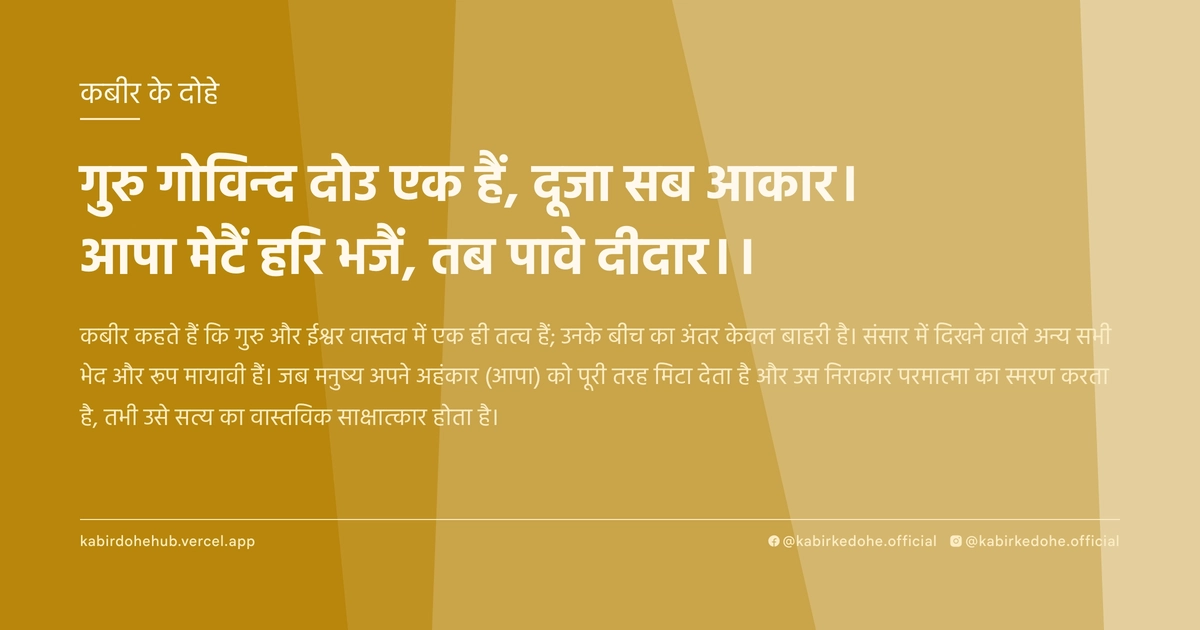
गुरु गोविन्द दोउ एक हैं, दूजा सब आकार।
आपा मेटैं हरि भजैं, तब पावे दीदार।।
Guru Govind dou ek hain, dooja sab aakaar. Aapa metain Hari bhajain, tab paave deedaar.
इस पृष्ठ पर इस कबीर दोहे का अर्थ (meaning), हिंदी व्याख्या और अंग्रेज़ी अनुवाद, दार्शनिक विश्लेषण और व्यावहारिक जीवन सीख दी गई है। यह दोहा गुरु महत्व (The Guru's Importance) विषय से जुड़ा है — Kabir doha meaning and explanation in Hindi and English.
अर्थ (Meaning):
कबीर कहते हैं कि गुरु और ईश्वर वास्तव में एक ही तत्व हैं; उनके बीच का अंतर केवल बाहरी है। संसार में दिखने वाले अन्य सभी भेद और रूप मायावी हैं। जब मनुष्य अपने अहंकार (आपा) को पूरी तरह मिटा देता है और उस निराकार परमात्मा का स्मरण करता है, तभी उसे सत्य का वास्तविक साक्षात्कार होता है।
Kabir asserts that the Guru and the Divine are essentially one and the same; any perceived difference is merely superficial. All other forms and distinctions in the world are illusory. Only when a seeker annihilates their ego (the sense of separate 'I') and devotes themselves to the Formless Truth can they achieve the ultimate vision of the Divine.
व्याख्या (Interpretation):
यह दोहा अद्वैत की पराकाष्ठा को दर्शाता है। यहाँ 'गुरु' केवल एक व्यक्ति नहीं, बल्कि वह चेतना है जो अंधकार से प्रकाश की ओर ले जाती है। 'गोविन्द' उस परम सत्य का प्रतीक है। कबीर तर्क देते हैं कि यदि गुरु और ईश्वर अलग होते, तो गुरु कभी ईश्वर तक नहीं पहुँचा पाता। 'दूजा सब आकार' का अर्थ है कि दुनिया के तमाम धार्मिक अनुष्ठान, मूर्ति पूजा और बाहरी आडंबर केवल भ्रम हैं। 'आपा मेटना' सबसे कठिन प्रक्रिया है क्योंकि अहंकार ही वह पर्दा है जो आत्मा को ब्रह्म से अलग करता है। जब यह 'मैं' मिटता है, तो केवल 'वह' बचता है। यह विलोपन ही वास्तविक मिलन है, जहाँ भक्त और भगवान का द्वैत समाप्त हो जाता है और केवल शुद्ध अस्तित्व शेष रहता है।
This couplet represents the pinnacle of Non-duality (Advaita). Here, the 'Guru' is not merely a physical teacher but the awakening consciousness that leads from darkness to light. 'Govind' symbolizes the Ultimate Truth. Kabir argues that if the Guru and the Divine were separate, the Guru could never lead the seeker to the Divine. 'Dooja sab aakaar' implies that all worldly rituals, idol worship, and external formalities are mere illusions (Maya). 'Aapa metai' (annihilating the ego) is the most grueling process because the ego is the veil that separates the Atman from Brahman. When the 'I' is erased, only 'That' remains. This dissolution is the true union, where the duality between the devotee and the Deity vanishes, leaving only pure, undifferentiated existence.
दार्शनिक विश्लेषण (Philosophical Analysis):
कबीर का यह दर्शन तत्कालीन समाज की जटिल धार्मिक संरचनाओं पर एक प्रहार था। उन्होंने देखा कि लोग गुरुओं और देवताओं के बीच भेद करके उन्हें अलग-अलग श्रेणियों में बाँट रहे थे, जिससे धर्म एक व्यापार बन गया था। कबीर ने निर्गुण भक्ति का मार्ग चुना, जहाँ ईश्वर किसी मंदिर या मस्जिद में नहीं, बल्कि मनुष्य के भीतर स्थित है। यह विचार सूफी मत के 'फना' (अहंकार का विनाश) और वेदांत के 'अहं ब्रह्मास्मि' के बहुत करीब है।
ऐतिहासिक रूप से, कबीर ने जाति और पंथ के भेदभाव को नकारते हुए यह स्थापित किया कि आध्यात्मिक ज्ञान किसी विशेष वर्ग की बपौती नहीं है। उनके लिए, गुरु वह है जो आपको आपके अपने भीतर के ईश्वर से मिला दे। यदि गुरु स्वयं अहंकार से ग्रस्त है, तो वह केवल एक मार्गदर्शक नहीं, बल्कि एक बाधा है। अतः, गुरु और गोविन्द की एकता का अर्थ है कि ज्ञान और सत्य एक ही सिक्के के दो पहलू हैं।
दार्शनिक स्तर पर, 'आपा' या अहंकार वह मनोवैज्ञानिक अवरोध है जो हमें यह विश्वास दिलाता है कि हम ब्रह्मांड से अलग हैं। यह अलगाव ही दुख का मूल कारण है। कबीर का 'हरि' कोई व्यक्ति नहीं, बल्कि वह सार्वभौमिक ऊर्जा है जो हर कण में व्याप्त है। जब साधक अपनी व्यक्तिगत पहचान को इस सार्वभौमिक पहचान में विलीन कर देता है, तो वह 'दीदार' या साक्षात्कार प्राप्त करता है।
यह विश्लेषण स्पष्ट करता है कि कबीर कर्मकांडों के विरोधी थे। वे मानते थे कि माला जपने या तीर्थ यात्रा करने से अधिक महत्वपूर्ण है अपने भीतर के 'अहं' को मारना। बिना अहंकार के विनाश के, कोई भी पूजा केवल एक मानसिक व्यायाम है, आध्यात्मिक रूपांतरण नहीं।
अंततः, यह दोहा हमें सिखाता है कि सत्य की खोज बाहर नहीं, बल्कि भीतर की यात्रा है। जब हम यह समझ जाते हैं कि जिसे हम बाहर खोज रहे हैं, वह वास्तव में हमारे भीतर का ही प्रतिबिंब है, तब सारी खोज समाप्त हो जाती है और केवल अनुभव शेष रह जाता है।
Kabir's philosophy serves as a profound critique of the complex religious structures of his era. He observed people categorizing Gurus and Deities into separate hierarchies, turning spirituality into a transactional business. By embracing Nirgun Bhakti (devotion to the Formless), Kabir posited that the Divine resides not in temples or mosques, but within the human heart. This aligns closely with the Sufi concept of 'Fana' (annihilation of the self) and the Vedantic realization of 'Aham Brahmasmi' (I am Brahman).
Historically, Kabir dismantled caste and sectarian divides, asserting that spiritual enlightenment is not the monopoly of any specific class. For him, a true Guru is one who mirrors the Divine within the seeker. If a Guru is clung to ego, they become an obstacle rather than a bridge. Thus, the unity of Guru and Govind signifies that Knowledge and Truth are two aspects of the same reality.
On a philosophical level, 'Aapa' or ego is the psychological barrier that convinces us we are separate from the universe. This perceived separation is the root of all human suffering. Kabir's 'Hari' is not a personified god, but the universal energy permeating every atom. When the seeker merges their individual identity into this cosmic consciousness, they achieve 'Deedaar' or the ultimate vision.
This analysis highlights Kabir's rejection of ritualism. He believed that chanting beads or visiting pilgrimage sites is meaningless if the internal 'I' remains intact. Without the death of the ego, worship is merely a mental exercise, not a spiritual transformation.
Ultimately, this couplet teaches that the quest for Truth is an inward journey. Once we realize that the entity we seek externally is actually a reflection of our own inner essence, the search ends and only pure experience remains.
मूल संदेश (Core Message):
- गुरु और ईश्वर के बीच का भेद केवल अज्ञानता है।
- बाहरी रूपों की पूजा आंतरिक सत्य को ढक लेती है।
- अहंकार का विलोपन ही आध्यात्मिक जागृति की एकमात्र कुंजी है।
- समर्पण ही वह सेतु है जो जीव को शिव से जोड़ता है।
- सत्य बाहर नहीं, बल्कि स्वयं के विसर्जन में निहित है।
- The distinction between the Guru and the Divine is a product of ignorance.
- Worship of external forms often obscures the internal Truth.
- The annihilation of ego is the sole key to spiritual awakening.
- Surrender is the bridge that connects the individual soul to the Universal.
- Truth lies not in acquisition, but in the dissolution of the self.
व्यावहारिक उदाहरण (Practical Example):
वाराणसी के एक पुराने घाट पर माधव नाम का एक अत्यंत कुशल बुनकर रहता था। माधव अपनी कला में इतना निपुण था कि पूरे शहर में उसके कपड़ों की चर्चा थी। लेकिन इस कुशलता ने उसके भीतर एक गहरा अहंकार भर दिया था। वह मानता था कि उसकी कला ईश्वरीय है और वह स्वयं को अन्य बुनकरों से श्रेष्ठ समझने लगा था। वह अक्सर कहता, 'मुझ जैसा कोई नहीं है, मेरी उंगलियों में जादू है।'
एक दिन, एक फकीर उसके पास आया। फकीर ने माधव के काम की प्रशंसा नहीं की, बल्कि उसकी एक छोटी सी गलती की ओर इशारा किया जिसे केवल एक पारखी देख सकता था। माधव क्रोधित हो गया और उसने फकीर का अपमान किया। फकीर ने शांति से कहा, 'बेटा, तूने धागों को तो जोड़ लिया, लेकिन अपने अहंकार के धागे को नहीं तोड़ा। जब तक तू खुद को 'बुनकर' समझता रहेगा, तू उस महान बुनकर (ईश्वर) को कभी नहीं देख पाएगा जिसने इस सृष्टि को बुना है।'
माधव को पहले तो यह बात समझ नहीं आई, लेकिन फकीर की आँखों में एक ऐसी शांति थी जिसने माधव को बेचैन कर दिया। वह सोचने लगा कि क्या उसकी कला वास्तव में उसकी अपनी है, या वह केवल एक माध्यम है? उसने महसूस किया कि उसका 'मैं' उसकी कला के बीच में आ रहा था।
अगले कुछ महीनों तक, माधव ने अपनी कला को 'अपनी' कहना छोड़ दिया। उसने हर कपड़े को एक प्रार्थना की तरह बुनना शुरू किया। जब भी उसके मन में यह विचार आता कि 'मैं श्रेष्ठ हूँ', वह तुरंत रुक जाता और याद करता कि वह केवल एक यंत्र है।
धीरे-धीरे, उसका व्यवहार बदल गया। वह अब अन्य बुनकरों की मदद करने लगा और उन्हें अपनी तकनीक सिखाने लगा, बिना किसी श्रेष्ठता के भाव के। उसने महसूस किया कि जब उसने 'मैं' को मिटाया, तो उसकी कला और अधिक निखर गई।
एक दिन, एक साधारण से कपड़े को बुनते समय, उसे एक ऐसी शांति का अनुभव हुआ जिसे उसने पहले कभी महसूस नहीं किया था। उसे लगा कि वह और उसका काम, और वह अदृश्य शक्ति एक ही हैं।
उसने महसूस किया कि फकीर ने उसे वही सिखाया जो कबीर ने कहा था—कि जब तक 'आपा' (अहंकार) रहता है, तब तक सत्य का दीदार नहीं होता।
अब माधव केवल एक बुनकर नहीं था; वह एक ऐसा साधक बन गया था जिसने अपनी कला के माध्यम से परमात्मा को पा लिया था। उसका जीवन अब अहंकार की खोज नहीं, बल्कि समर्पण का उत्सव था।
In the ancient ghats of Varanasi lived a weaver named Madhav, renowned for his extraordinary skill. His fabrics were praised across the city, but this mastery bred a deep-seated ego. Madhav began to believe his art was divine and that he was superior to all other weavers. He would often boast, 'There is no one like me; magic resides in my fingers.'
A wandering fakir once visited his workshop. Instead of praising the work, the fakir pointed out a tiny flaw that only a master's eye could detect. Infuriated, Madhav insulted the fakir. The fakir replied calmly, 'Son, you have joined the threads of the cloth, but you have not broken the thread of your ego. As long as you believe yourself to be the 'weaver,' you will never see the Great Weaver who wove this entire universe.'
Initially, Madhav was confused, but the profound peace in the fakir's eyes left him restless. He began to wonder: Was his art truly his own, or was he merely a medium? He realized that his 'I' was standing in the way of his art.
For the next few months, Madhav stopped claiming the art as 'his.' He began weaving every piece of cloth as if it were a prayer. Whenever the thought 'I am the best' surfaced, he would stop immediately and remind himself that he was merely an instrument.
Gradually, his behavior shifted. He started helping other weavers and sharing his techniques without any sense of superiority.
One day, while weaving a simple piece of fabric, he experienced a stillness he had never known. He felt that he, his work, and the invisible Divine power were one and the same.
He realized that the fakir had taught him exactly what Kabir preached—that as long as the 'Aapa' (ego) exists, the vision of Truth remains obscured.
Madhav was no longer just a weaver; he became a seeker who found the Divine through his craft. His life was no longer a quest for recognition, but a celebration of surrender.
अभ्यास मार्गदर्शन (Practice Guidance):
- प्रतिदिन 20 मिनट मौन ध्यान करें, जहाँ आप केवल अपने श्वास पर ध्यान केंद्रित करें और हर सांस के साथ 'मैं' के विचार को विसर्जित करें।
- एक 'अहंकार डायरी' लिखें: दिन भर में उन क्षणों को नोट करें जब आपको लगा कि आप दूसरों से श्रेष्ठ हैं या जब आपको प्रशंसा की तीव्र इच्छा हुई।
- सेवा का अभ्यास: सप्ताह में एक बार ऐसा कार्य करें जिसमें आपकी पहचान गुप्त रहे और आपको किसी भी प्रकार की मान्यता न मिले।
- निदानात्मक चेकलिस्ट: क्या मैं दूसरों की आलोचना करते समय खुद को श्रेष्ठ महसूस करता हूँ? क्या मेरी खुशी दूसरों की प्रशंसा पर निर्भर है? यदि हाँ, तो 'आपा' अभी जीवित है।
- Practice 20 minutes of silent meditation daily, focusing on the breath and consciously releasing the concept of 'I' with every exhale.
- Maintain an 'Ego Journal': Note moments throughout the day when you felt superior to others or experienced an intense craving for validation.
- Practice Anonymous Service: Once a week, perform an act of kindness where your identity remains hidden and you receive no recognition.
- Diagnostic Checklist: Do I feel superior while criticizing others? Is my happiness dependent on external praise? If yes, the 'Aapa' is still active.
चिंतन प्रश्न (Reflection Questions):
- मेरे जीवन में 'गुरु' कौन है—एक व्यक्ति, या वह सत्य जो मुझे चुनौती देता है?
- यदि मेरी सारी उपलब्धियाँ और पदवियाँ छीन ली जाएँ, तो मेरा 'मैं' क्या बचेगा?
- मैं अपनी डिजिटल पहचान (सोशल मीडिया) के माध्यम से किस प्रकार के अहंकार को पोषण दे रहा हूँ?
- क्या मैं वास्तव में ईश्वर की खोज कर रहा हूँ, या केवल अपनी इच्छाओं की पूर्ति के लिए एक माध्यम ढूँढ रहा हूँ?
- मेरे भीतर का वह कौन सा हिस्सा है जो अभी भी 'अलग' होने का दावा करता है?
- Who is the 'Guru' in my life—a person, or the Truth that challenges my complacency?
- If all my achievements and titles were stripped away, what would remain of my 'I'?
- How am I feeding my ego through my digital identity and social media presence?
- Am I truly seeking the Divine, or am I merely looking for a medium to fulfill my desires?
- Which part of my being still clings to the illusion of being 'separate' from the whole?