
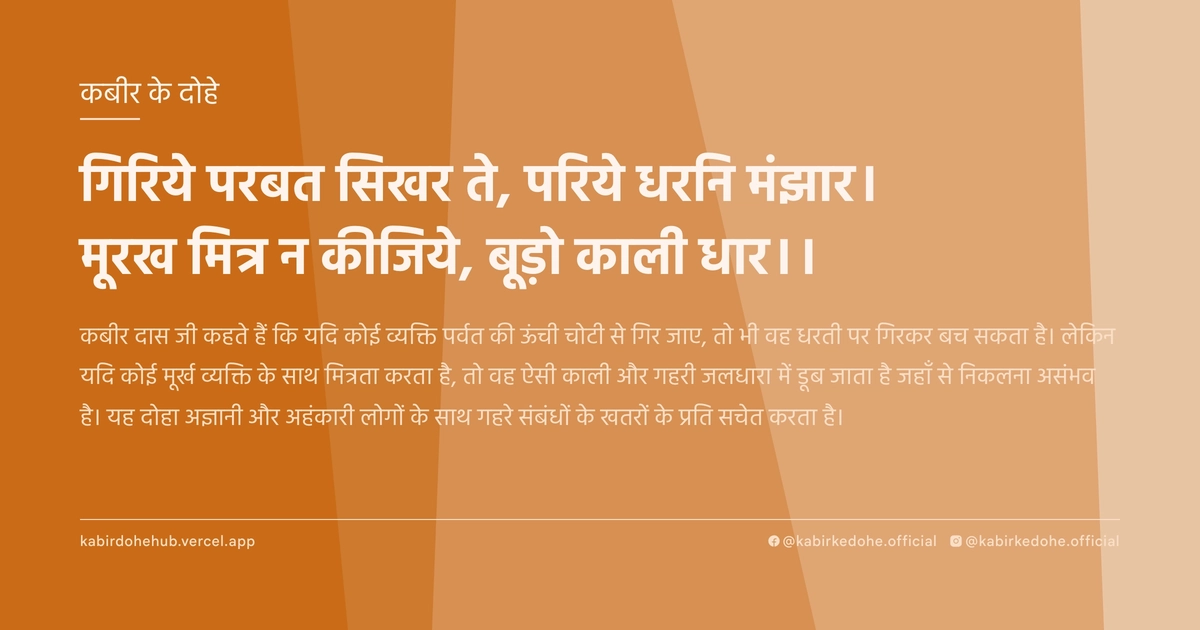
गिरिये परबत सिखर ते, परिये धरनि मंझार।
मूरख मित्र न कीजिये, बूड़ो काली धार।।
Girye parbat sikhar te, parye dharani manjhaar. Moorkh mitra na kijiye, boodo kaali dhaar.
इस पृष्ठ पर इस कबीर दोहे का अर्थ (meaning), हिंदी व्याख्या और अंग्रेज़ी अनुवाद, दार्शनिक विश्लेषण और व्यावहारिक जीवन सीख दी गई है। यह दोहा सत्संग (Satsang) विषय से जुड़ा है — Kabir doha meaning and explanation in Hindi and English.
अर्थ (Meaning):
कबीर दास जी कहते हैं कि यदि कोई व्यक्ति पर्वत की ऊंची चोटी से गिर जाए, तो भी वह धरती पर गिरकर बच सकता है। लेकिन यदि कोई मूर्ख व्यक्ति के साथ मित्रता करता है, तो वह ऐसी काली और गहरी जलधारा में डूब जाता है जहाँ से निकलना असंभव है। यह दोहा अज्ञानी और अहंकारी लोगों के साथ गहरे संबंधों के खतरों के प्रति सचेत करता है।
Kabir suggests that falling from the highest peak of a mountain may only result in landing on the earth, which is a survivable physical fall. However, befriending a fool is akin to drowning in a dark, relentless current of a river. The literal message warns that the spiritual and mental devastation caused by the company of the ignorant is far more lethal than any physical accident.
व्याख्या (Interpretation):
इस दोहे का शाब्दिक अर्थ शारीरिक पतन और मानसिक पतन के बीच तुलना करना है। यहाँ 'पर्वत' भौतिक ऊंचाई और 'काली धार' अज्ञानता के गहरे अंधकार का प्रतीक है। आध्यात्मिक स्तर पर, मूर्ख वह नहीं है जिसके पास शिक्षा नहीं है, बल्कि वह है जो अहंकार (Maya) में अंधा है और सत्य को नकारता है। निर्गुण भक्ति के संदर्भ में, ऐसा मित्र व्यक्ति को आत्म-साक्षात्कार (Atman) से दूर ले जाता है। यह द्वैतवाद की स्थिति है जहाँ व्यक्ति अपनी वास्तविक पहचान को भूलकर बाहरी भ्रमों में फंस जाता है। अंततः, यह दोहा चेतावनी देता है कि गलत संगति आत्मा की उन्नति को रोककर उसे संसार के मोह और अज्ञान की गहराई में डुबो देती है।
The literal meaning contrasts a physical fall with a spiritual descent. The 'mountain' represents physical height, while the 'dark current' symbolizes the depths of ignorance and ego. In the context of Nirgun Bhakti, a 'fool' is not someone lacking formal education, but one blinded by Maya (illusion) and spiritual arrogance. Such companionship anchors the seeker in duality, distancing them from the non-dual realization of Atman-Brahman. The paradox here is that while a physical fall has a landing point (the earth), the descent into ignorance is a bottomless void. It highlights how the wrong associations act as a spiritual anchor, dragging the soul away from the formless Truth and into the turbulence of worldly delusions.
दार्शनिक विश्लेषण (Philosophical Analysis):
कबीर का यह दृष्टिकोण उनके समय के सामाजिक और धार्मिक पाखंडों के विरुद्ध एक कड़ा प्रहार था। उन्होंने देखा कि लोग अक्सर बाहरी आडंबरों और उन गुरुओं के पीछे चलते थे जो केवल कर्मकांडों पर जोर देते थे, जबकि आंतरिक शुद्धि शून्य थी। यह विश्लेषण अद्वैत वेदांत से जुड़ता है, जहाँ अज्ञान (Avidya) को ही बंधन का मूल कारण माना गया है। जब हम एक ऐसे व्यक्ति से जुड़ते हैं जो सत्य के प्रति अंधा है, तो हम अनजाने में उसी अज्ञान को अपना लेते हैं।
सूफी मत के नजरिए से, यह 'नफ्स' (अहंकार) के प्रभाव की बात है। एक मूर्ख मित्र वह है जो आपके अहंकार को सहलाता है, न कि उसे चुनौती देता है। कबीर यहाँ 'सत्संग' के विपरीत 'कुसंग' के विनाशकारी प्रभाव को रेखांकित कर रहे हैं। उनके लिए, सत्य की खोज एक एकांत यात्रा है, लेकिन इसमें साथ चलने वाले लोग या तो सीढ़ी बनते हैं या बाधा।
ritualism (कर्मकांड) के प्रति उनकी घृणा यहाँ स्पष्ट है; वे उन लोगों को 'मूर्ख' कहते हैं जो पत्थर पूजने या बाहरी दिखावे में समय गँवाते हैं जबकि ईश्वर उनके भीतर है। यह मनोवैज्ञानिक रूपांतरण की मांग करता है—जहाँ व्यक्ति बाहरी प्रशंसा के बजाय आंतरिक सत्य को प्राथमिकता दे।
अहंकार का विनाश (Annihilation of Ego) ही मोक्ष का मार्ग है। यदि मित्र ऐसा है जो आपको आपके अहंकार की पुष्टि करता है, तो वह आपको 'काली धार' में धकेल रहा है। वास्तविक मित्र वह है जो आपको आपके भ्रमों का दर्पण दिखाए।
अक्सर लोग इस दोहे को केवल सामाजिक सलाह मानते हैं, लेकिन यह वास्तव में चेतना के स्तर की बात है। यह चेतावनी है कि अपनी चेतना को उन लोगों के साथ न मिलाएं जो केवल भौतिकता और द्वैत में विश्वास रखते हैं, क्योंकि इससे आपकी आध्यात्मिक जागृति की संभावना समाप्त हो जाती है।
Kabir’s perspective is a sharp critique of the social and religious hypocrisies of his era. He observed people blindly following guides who emphasized ritualism over internal purity. This connects deeply with Advaita Vedanta, where Avidya (ignorance) is identified as the root cause of bondage. By associating with those blinded by illusion, a seeker inadvertently adopts that same ignorance, reinforcing the veil of Maya.
From a Sufi perspective, this relates to the influence of the 'Nafs' (the lower self/ego). A 'foolish friend' is one who validates your ego rather than challenging it. Kabir emphasizes the destructive power of 'Kusang' (bad company) as opposed to 'Satsang' (truthful company). For him, the quest for the Formless (Nirgun) is an internal journey, but the companions we choose either act as a ladder or a weight.
His rejection of ritualism is evident here; he labels those who prioritize external symbols over internal realization as 'fools.' This demands a psychological transformation—a shift from seeking external validation to pursuing internal truth. The annihilation of the ego is the only path to liberation, and a friend who feeds the ego is essentially pushing the seeker into a spiritual abyss.
Common literalist interpretations mistake this for simple social advice, but it is actually about the frequency of consciousness. It warns against merging one's awareness with those who exist solely in duality and materialism, as such an alignment stifles the possibility of spiritual awakening.
Ultimately, the 'dark current' represents the subconscious pull of collective ignorance. To escape it, one must cultivate a discernment (Viveka) that separates the superficial from the substantial, ensuring that the heart is anchored in the Eternal rather than the ephemeral.
मूल संदेश (Core Message):
- अज्ञानता का साथ आत्मघाती होता है।
- अहंकार को सहलाने वाले मित्र वास्तव में शत्रु हैं।
- भौतिक पतन से मानसिक पतन अधिक घातक है।
- सत्य की खोज के लिए विवेकपूर्ण संगति अनिवार्य है।
- आंतरिक मौन ही अज्ञान की धारा से बचने का मार्ग है।
- भ्रम का त्याग ही वास्तविक जागृति की शुरुआत है।
- Association with ignorance is spiritually fatal.
- Friends who stroke your ego are actually your enemies.
- Mental descent is far more lethal than physical falls.
- Discriminating companionship is essential for the quest of Truth.
- Internal silence is the only escape from the current of ignorance.
- Renouncing delusion is the first step toward true awakening.
व्यावहारिक उदाहरण (Practical Example):
वाराणसी के एक पुराने घाट पर माधव नाम का एक वृद्ध बुनकर रहता था। माधव अपनी सादगी और सत्यनिष्ठा के लिए जाना जाता था। उसी बस्ती में सोमदत्त नाम का एक व्यक्ति था, जो खुद को बहुत बड़ा विद्वान मानता था और लोगों को केवल बाहरी दिखावे और महंगे अनुष्ठानों से मोक्ष मिलने का लालच देता था।
सोमदत्त ने माधव की सज्जनता का लाभ उठाकर उसे अपना 'करीबी मित्र' बना लिया। वह माधव को समझाता कि यदि वह अपनी सारी जमापूंजी सोमदत्त द्वारा बताए गए विशेष 'गुप्त अनुष्ठानों' में लगाए, तो उसे स्वर्ग का मार्ग मिल जाएगा। माधव, जो स्वभाव से सरल था, सोमदत्त की बातों में आ गया।
धीरे-धीरे माधव ने अपने काम पर ध्यान देना कम कर दिया। वह सोमदत्त के साथ बैठकर उन चर्चाओं में समय बिताने लगा जहाँ केवल दूसरों की बुराई और अपनी श्रेष्ठता का बखान होता था। माधव की आंतरिक शांति गायब होने लगी और वह मानसिक तनाव और लालच के घेरे में आ गया।
एक दिन माधव ने देखा कि सोमदत्त जिन लोगों को 'मोक्ष' का मार्ग दिखा रहा था, वे सभी कर्ज में डूबे हुए थे और उनके परिवारों में कलह था। माधव को अहसास हुआ कि वह एक ऐसे व्यक्ति के प्रभाव में था जो स्वयं भ्रमित था।
तभी माधव की मुलाकात एक मौन साधु से हुई, जिन्होंने केवल एक वाक्य कहा—'जो तुम्हें तुम्हारी कमियों से दूर ले जाए, वह मित्र नहीं, जाल है।' यह बात माधव के लिए 'कबीर ट्विस्ट' साबित हुई।
माधव ने तुरंत सोमदत्त का साथ छोड़ा। उसने महसूस किया कि सोमदत्त के साथ उसकी मित्रता उस 'काली धार' की तरह थी जो उसे उसकी अपनी आत्मा की सच्चाई से दूर ले जा रही थी।
उसने फिर से अपने करघे पर ध्यान केंद्रित किया, लेकिन इस बार उसका काम केवल जीविका नहीं, बल्कि एक ध्यान बन गया। उसने सीखा कि मौन रहना, एक मूर्ख की बातों को सुनने से कहीं बेहतर है।
माधव ने अपनी शेष आयु उन लोगों की मदद करने में बिताई जो पाखंडियों के जाल में फंस चुके थे। उसने अपनी सादगी को ही अपनी सबसे बड़ी शक्ति बनाया।
अंत में, माधव ने पाया कि सच्ची मित्रता वह है जो आपको आपके अहंकार से मुक्त करे, न कि वह जो आपके अहंकार को पोषण दे।
उसका जीवन अब उस पर्वत की चोटी की तरह स्थिर था, जहाँ से वह पूरी दुनिया को देख सकता था, लेकिन अब वह किसी अंधी धारा में बहने का डर नहीं रखता था।
In the ancient alleys of Varanasi lived an elderly weaver named Madhav, known for his simplicity and unwavering integrity. In the same neighborhood lived Somdutt, a man who claimed to be a great scholar and lured people with the promise of salvation through expensive rituals and external displays of piety.
Somdutt, exploiting Madhav's gentle nature, befriended him. He convinced Madhav that by investing all his meager savings into specific 'secret rituals' guided by Somdutt, he would secure a path to heaven. Madhav, being simple-hearted, fell for these claims.
Gradually, Madhav began neglecting his loom. He spent his days in discussions with Somdutt, where the primary topics were the belittling of others and the glorification of their own perceived superiority. Madhav's inner peace vanished, replaced by mental anxiety and a budding greed for spiritual shortcuts.
One day, Madhav noticed that the people Somdutt had 'guided' were all drowning in debt, and their homes were filled with strife. He realized he was under the influence of a man who was himself lost in a labyrinth of delusions.
During this crisis, Madhav encountered a silent monk who uttered a single sentence: 'He who leads you away from your own flaws is not a friend, but a trap.' This was the 'Kabir Twist' for Madhav.
Madhav immediately severed ties with Somdutt. He realized that his friendship with the scholar was like the 'dark current'—a relentless pull dragging him away from the truth of his own soul.
He returned to his loom, but this time, weaving was no longer just a livelihood; it became a form of meditation. He learned that maintaining a sacred silence is far superior to engaging in the empty chatter of the ignorant.
Madhav spent the rest of his years helping others who had fallen prey to pretenders. He transformed his simplicity into his greatest spiritual strength.
Eventually, he discovered that true friendship is that which liberates you from your ego, rather than that which feeds it.
His life became as stable as a mountain peak, allowing him to observe the world with clarity, no longer fearing the pull of any blind current.
अभ्यास मार्गदर्शन (Practice Guidance):
- संगति का विश्लेषण: प्रतिदिन 10 मिनट यह विचार करें कि आपके करीबी मित्र आपकी चेतना को ऊपर उठा रहे हैं या आपको आपके अहंकार (Ego) की पुष्टि करने वाले भ्रमों में उलझा रहे हैं।
- मौन का अभ्यास: जब आप किसी ऐसे व्यक्ति के साथ हों जो केवल नकारात्मकता या पाखंड फैला रहा हो, तो प्रतिक्रिया देने के बजाय आंतरिक मौन का अभ्यास करें।
- आत्म-पूछताछ जर्नल: लिखें कि किन स्थितियों में आपने 'सामाजिक स्वीकृति' के लिए अपनी अंतरात्मा की आवाज को दबाया और उस समय आपके साथ कौन था।
- निदान चेकलिस्ट: क्या आप दूसरों की चापलूसी से खुश होते हैं? क्या आप सत्य सुनने पर क्रोधित होते हैं? यदि हाँ, तो आप 'काली धार' में बह रहे हैं।
- विवेक का विकास: किसी भी नए संबंध में गहराई से उतरने से पहले यह देखें कि क्या वह व्यक्ति स्वयं के प्रति ईमानदार है और क्या वह सत्य की खोज में विनम्र है।
- Association Analysis: Spend 10 minutes daily reflecting on whether your close companions are elevating your consciousness or anchoring you in delusions that merely validate your ego.
- Practice of Silence: When in the company of those spreading negativity or hypocrisy, practice internal silence instead of reacting or engaging in the cycle of ignorance.
- Self-Inquiry Journal: Document instances where you suppressed your inner voice for 'social acceptance' and identify who was influencing you during those moments.
- Diagnostic Checklist: Do you feel gratified by flattery? Do you react with anger when faced with an uncomfortable truth? If yes, you are drifting into the 'dark current.'
- Cultivating Discernment: Before deepening any new relationship, observe if the person is honest with themselves and humble in their pursuit of Truth.
चिंतन प्रश्न (Reflection Questions):
- मेरे जीवन में वह कौन सा 'मित्र' है जो मुझे मेरी गलतियों को सुधारने के बजाय उन्हें सही ठहराने में मदद करता है?
- क्या मेरी डिजिटल पहचान (Social Media) मुझे एक ऐसे 'मूर्ख' समूह की ओर ले जा रही है जहाँ केवल प्रशंसा की भूख है?
- मैं अपनी बौद्धिक श्रेष्ठता के अहंकार में किन लोगों को 'मूर्ख' मानकर उनके भीतर छिपे सत्य को अनदेखा कर रहा हूँ?
- क्या मैं सत्य सुनने के साहस से अधिक महत्व झूठी सांत्वना को देता हूँ?
- मेरे जीवन की 'काली धार' क्या है—वह कौन सी आदत या संबंध है जो मुझे धीरे-धीरे नीचे खींच रहा है?
- यदि मैं आज अपने सभी बाहरी मुखौटों को उतार दूँ, तो क्या मेरे पास कोई ऐसा मित्र बचेगा जो मेरे वास्तविक स्वरूप को जानता हो?
- Who in my life is the 'friend' who helps me justify my mistakes rather than correcting them?
- Is my digital identity leading me toward a 'foolish' collective where only the hunger for validation exists?
- In my ego of intellectual superiority, whom have I labeled as 'fools,' thereby ignoring the truth they might hold?
- Do I value false consolation more than the courage to hear a harsh truth?
- What is the 'dark current' in my life—which habit or relationship is slowly dragging me down?
- If I stripped away all my external masks today, would I have a single friend left who knows my authentic self?