
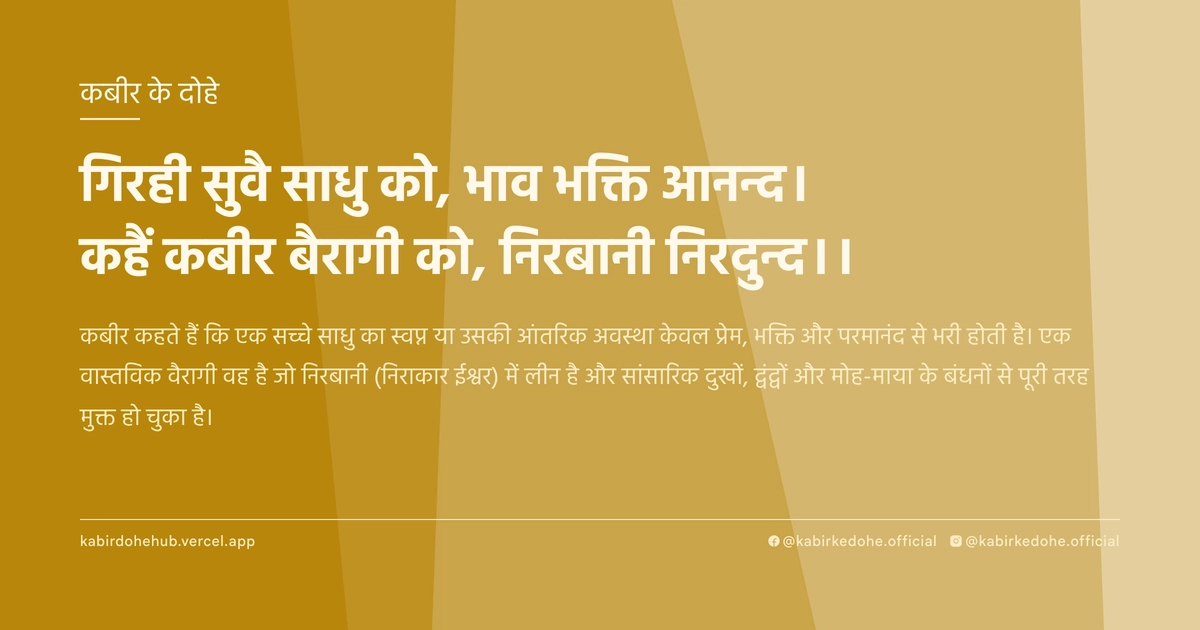
गिरही सुवै साधु को, भाव भक्ति आनन्द।
कहैं कबीर बैरागी को, निरबानी निरदुन्द।।
Girhi suvai sadhu ko, bhav bhakti aanand. Kahein Kabir bairagi ko, nirbani nirdund.
इस पृष्ठ पर इस कबीर दोहे का अर्थ (meaning), हिंदी व्याख्या और अंग्रेज़ी अनुवाद, दार्शनिक विश्लेषण और व्यावहारिक जीवन सीख दी गई है। यह दोहा भक्ति (Bhakti) विषय से जुड़ा है — Kabir doha meaning and explanation in Hindi and English.
अर्थ (Meaning):
कबीर कहते हैं कि एक सच्चे साधु का स्वप्न या उसकी आंतरिक अवस्था केवल प्रेम, भक्ति और परमानंद से भरी होती है। एक वास्तविक वैरागी वह है जो निरबानी (निराकार ईश्वर) में लीन है और सांसारिक दुखों, द्वंद्वों और मोह-माया के बंधनों से पूरी तरह मुक्त हो चुका है।
Kabir asserts that the inner vision or the 'dream' of a true seeker is saturated with divine love, devotion, and eternal bliss. A genuine ascetic is one who is anchored in the Nirvani (the Formless Absolute) and remains utterly untouched by the dualities of worldly suffering and the shackles of attachment.
व्याख्या (Interpretation):
इस दोहे में 'सुवै' का अर्थ केवल नींद का सपना नहीं, बल्कि साधक की चेतना की अवस्था है। कबीर यहाँ भौतिक सुखों के बजाय 'भाव' और 'आनंद' को प्राथमिकता देते हैं, जो केवल निगुर्भ भक्ति के माध्यम से प्राप्त होते हैं। वैरागी वह नहीं है जिसने केवल वस्त्र त्यागे हैं, बल्कि वह है जिसने 'निरबानी' यानी उस निराकार ब्रह्म को पा लिया है। 'निरदुन्द' शब्द द्वंद्वों के अभाव को दर्शाता है—जहाँ सुख-दुख, लाभ-हानि और मान-अपमान का भेद मिट जाता है। यह अद्वैत वेदांत की उस स्थिति की ओर संकेत है जहाँ आत्मा और परमात्मा का मिलन होता है और माया का पर्दा गिर जाता है। यहाँ विरोधाभास यह है कि संसार को त्यागने वाला वैरागी वास्तव में संपूर्ण ब्रह्मांड को अपने भीतर पाकर सबसे समृद्ध हो जाता है।
In this couplet, 'Suvai' refers not merely to a nocturnal dream, but to the sustained state of consciousness of a seeker. Kabir prioritizes 'Bhaav' (divine emotion) and 'Aanand' (bliss) over material acquisitions, suggesting these are the fruits of Nirgun Bhakti. The 'Bairagi' (ascetic) is not defined by the renunciation of clothes, but by the realization of 'Nirbani'—the Formless Absolute. The term 'Nirdund' signifies the cessation of dualities, where the polarity of pleasure and pain, gain and loss, or honor and dishonor dissolves. This aligns with Advaita Vedanta, where the illusion of separation between Atman and Brahman vanishes. The central paradox presented is that the ascetic, by renouncing the perceived world, actually attains the totality of existence, transforming void into fullness.
दार्शनिक विश्लेषण (Philosophical Analysis):
कबीर का यह दोहा उस समय की सामाजिक और धार्मिक पृष्ठभूमि में लिखा गया जब कर्मकांड और बाहरी आडंबरों का बोलबाला था। कबीर ने स्पष्ट किया कि मोक्ष किसी विशेष पोशाक या मंदिर-मस्जिद जाने से नहीं, बल्कि आंतरिक रूपांतरण से मिलता है। यह विचार सूफी मत के 'फना' (अहंकार का विनाश) और वेदांत के 'अद्वैत' के करीब है, जहाँ साधक अपनी व्यक्तिगत पहचान को ईश्वर की विराट चेतना में विलीन कर देता है।
यहाँ 'निरबानी' शब्द अत्यंत महत्वपूर्ण है। यह उस ईश्वर की बात करता है जिसका कोई रूप, रंग या नाम नहीं है, जिसे केवल अनुभव किया जा सकता है। कबीर ritualism (कर्मकांड) का विरोध करते हुए कहते हैं कि असली वैराग्य मन का होता है, शरीर का नहीं। यदि मन अभी भी इच्छाओं में जकड़ा है, तो जंगल जाना भी व्यर्थ है।
मनोवैज्ञानिक स्तर पर, यह दोहा 'इगो' (अहंकार) के विसर्जन की प्रक्रिया है। जब मनुष्य अपनी पहचान को 'मैं' और 'मेरा' से हटाकर 'परम' से जोड़ता है, तो वह मानसिक तनाव और अवसाद से मुक्त हो जाता है। यह 'निरदुन्द' अवस्था ही वास्तविक मानसिक शांति है।
कबीर यहाँ यह भी समझाते हैं कि भक्ति कोई बोझ नहीं, बल्कि एक आनंदमयी यात्रा है। जब भक्ति 'भाव' बन जाती है, तो वह प्रयास नहीं रहती, बल्कि एक स्वाभाविक प्रवाह बन जाती है। यह प्रेम की वह पराकाष्ठा है जहाँ प्रेमी और प्रियतम एक हो जाते हैं।
अंततः, यह दर्शन हमें सिखाता है कि संसार में रहते हुए भी संसार से अलग रहना ही असली वैराग्य है। यह 'स्थितप्रज्ञ' होने की कला है, जहाँ व्यक्ति बाहरी तूफानों के बीच भी अपने आंतरिक केंद्र में स्थिर रहता है।
This doha was composed during an era dominated by rigid ritualism and external religious displays. Kabir challenges the notion that liberation is achieved through specific attire or pilgrimage, asserting instead that it is a result of profound internal transformation. This philosophy mirrors the Sufi concept of 'Fana' (annihilation of the self) and the Vedantic principle of 'Advaita' (non-duality), where the individual ego merges into the universal consciousness.
The term 'Nirbani' is pivotal here. It refers to the Formless Absolute—a deity without shape, color, or name, accessible only through direct experiential realization. Kabir rejects ritualism, arguing that true renunciation (Vairagya) is a state of mind, not a physical relocation. If the mind remains shackled by desire, retreating to a forest is a futile exercise.
Psychologically, the poem describes the process of ego-dissolution. When a human shifts their identity from the 'I' and 'Mine' to the 'Universal,' they are liberated from the chronic stress of existential longing and depression. This state of 'Nirdund' (freedom from duality) is the pinnacle of mental equilibrium.
Kabir further emphasizes that devotion is not a chore but a joyful journey. When Bhakti evolves into 'Bhaav' (pure emotional essence), it ceases to be an effort and becomes a natural flow. This represents the zenith of love where the lover and the beloved become indistinguishable.
Ultimately, the philosophy teaches the art of being 'in the world but not of it.' It is the practice of becoming a 'Sthitapragya' (one of steady wisdom), remaining anchored in one's internal center despite the chaotic storms of external existence.
मूल संदेश (Core Message):
- बाहरी त्याग व्यर्थ है यदि मन भीतर से मुक्त नहीं है।
- सच्चा आनंद भौतिक वस्तुओं में नहीं, बल्कि निराकार के अनुभव में है।
- भक्ति जब भाव बन जाती है, तो जीवन एक उत्सव बन जाता है।
- द्वंद्वों का अंत ही वास्तविक मानसिक और आध्यात्मिक स्वतंत्रता है।
- अहंकार का विसर्जन ही परमात्मा से मिलन का एकमात्र मार्ग है।
- External renunciation is futile if the mind remains imprisoned.
- True bliss resides in the experience of the Formless, not in material gain.
- When devotion evolves into pure emotion, life becomes a celebration.
- The cessation of dualities is the only path to genuine spiritual freedom.
- The dissolution of the ego is the sole gateway to union with the Divine.
व्यावहारिक उदाहरण (Practical Example):
वाराणसी के एक पुराने घाट पर माधव नाम का एक वृद्ध नाविक रहता था। माधव का जीवन केवल नाव चलाने और यात्रियों को पार उतारने तक सीमित था। वह स्वभाव से शांत था, लेकिन उसके मन में एक गहरी टीस थी—अपनी पत्नी और संतान को एक महामारी में खोने का दुख। वह अक्सर देखता कि लोग गंगा किनारे बैठकर घंटों मंत्र जपते और कठिन तपस्या करते, पर उनके चेहरों पर वही तनाव और क्रोध होता जो आम दुनिया में है।
एक दिन माधव की नाव पर एक फकीर सवार हुआ। फकीर ने माधव की आँखों में छिपा वह पुराना दुख पहचान लिया। माधव ने पूछा, 'बाबा, मैं जीवन भर सेवा करता रहा, फिर भी यह मन शांत क्यों नहीं होता? क्या मुझे भी उन संन्यासियों की तरह सब कुछ छोड़कर जंगलों में जाना होगा?'
फकीर मुस्कुराया और बोला, 'माधव, वैराग्य कपड़ों में नहीं, दृष्टि में होता है। तू नाव चला रहा है, पर क्या तू नाव का मालिक है या नाव का गुलाम? जिस दिन तू यह मान लेगा कि तू और यह नदी, यह नाव और ये यात्री सब एक ही निराकार शक्ति के खेल हैं, उस दिन तेरा दुख मिट जाएगा।'
माधव को बात समझ नहीं आई, लेकिन उसने एक प्रयोग किया। उसने तय किया कि वह अब नाव केवल पैसे के लिए नहीं, बल्कि हर यात्री की सेवा के भाव से चलाएगा। उसने अपनी नाव को ही अपना मंदिर मान लिया। जब कोई यात्री क्रोधित होता, तो माधव उसे अपना क्रोध नहीं देता, बल्कि सोचता कि यह व्यक्ति अपने भीतर के किसी दुख से लड़ रहा है।
धीरे-धीरे माधव के भीतर एक बदलाव आया। वह अब केवल एक नाविक नहीं था; वह एक साक्षी बन गया था। उसे महसूस हुआ कि उसकी पत्नी और बच्चों का जाना भी उसी विराट प्रकृति का हिस्सा था। उसने दुख को पकड़ना छोड़ दिया और उसे 'भाव' में बदल दिया।
एक शाम, जब सूरज ढल रहा था, माधव ने महसूस किया कि उसे अब किसी बाहरी सुख की चाह नहीं है। वह अपनी नाव पर बैठा था, लेकिन उसका मन उस अनंत आकाश में विलीन था। उसके चेहरे पर एक ऐसी शांति थी जिसे देखकर लोग उससे पूछने लगे कि उसने कौन सा गुप्त मंत्र सीखा है।
माधव ने बस इतना कहा, 'मैंने बस यह जान लिया कि मैं कुछ नहीं हूँ, और जो कुछ भी है, वही मैं हूँ।'
उसकी यह अवस्था 'निरदुन्द' थी। वह अब न तो सुख में पागल होता था और न ही दुख में टूटता था। उसने संसार के बीच रहकर ही वैराग्य को पा लिया था। उसकी नाव अब केवल नदी पार नहीं कराती थी, बल्कि लोगों को शांति का मार्ग दिखाती थी।
On the ancient ghats of Varanasi lived an elderly boatman named Madhav. His life was a repetitive cycle of rowing and ferrying passengers. Though gentle, Madhav carried a deep, silent ache—the grief of losing his wife and children to a plague years ago. He often observed pilgrims chanting mantras for hours, yet their faces remained etched with the same stress and anger found in the mundane world.
One day, a wandering dervish boarded his boat. The dervish recognized the dormant sorrow in Madhav's eyes. Madhav asked, 'Baba, I have served others my whole life, yet why does my mind remain restless? Must I also abandon everything and flee to the forests like the ascetics?'
The dervish smiled and replied, 'Madhav, renunciation is not in the clothes you wear, but in the lens through which you see. You row the boat, but are you the master of the boat or its slave? The day you realize that you, the river, the boat, and the passengers are all expressions of one Formless Power, your grief will vanish.'
Madhav didn't fully grasp the concept, but he decided to experiment. He resolved to row his boat not for money, but as an act of selfless service. He transformed his boat into his temple. Whenever a passenger was rude, Madhav didn't react with anger; instead, he viewed the passenger as someone battling their own internal demons.
Gradually, a shift occurred within Madhav. He ceased to be just a boatman; he became a witness. He realized that the loss of his family was part of the vast, impersonal dance of nature. He stopped clinging to his grief and transmuted it into 'Bhaav' (divine emotion).
One evening, as the sun dipped below the horizon, Madhav felt a profound detachment from all external desires. Sitting in his boat, his consciousness felt merged with the infinite sky. A serenity radiated from him that prompted strangers to ask what secret mantra he had mastered.
Madhav simply replied, 'I have only realized that I am nothing, and that which is Everything, is me.'
This was the state of 'Nirdund.' He was no longer swayed by pleasure nor shattered by pain. He had achieved Vairagya while remaining in the heart of the world. His boat no longer just crossed the river; it became a vessel guiding others toward peace.
अभ्यास मार्गदर्शन (Practice Guidance):
- दैनिक ध्यान: प्रतिदिन 20 मिनट मौन बैठें और विचार करें कि आपकी पहचान आपके नाम, पेशे या रिश्तों से परे एक निराकार चेतना है।
- भाव-जागरूकता: दिन भर में किसी भी कार्य को करते समय (जैसे खाना बनाना या चलना), उसे एक 'सेवा' या 'भक्ति' के रूप में करें, न कि एक बोझ के रूप में।
- आत्म-पूछताछ जर्नल: हर रात लिखें कि आज किस बात ने आपको विचलित किया और फिर पूछें—'क्या यह दुख मेरी आत्मा का है या मेरे अहंकार का?'
- डायग्नोस्टिक चेकलिस्ट: यदि आप छोटी बातों पर क्रोधित हो रहे हैं या दूसरों से तुलना कर रहे हैं, तो आप 'द्वंद्व' (Dund) में हैं। यदि आप विपरीत परिस्थितियों में भी एक आंतरिक मुस्कान बनाए रख सकते हैं, तो आप 'निरदुन्द' की ओर बढ़ रहे हैं।
- Daily Meditation: Spend 20 minutes in silence, contemplating that your identity exists beyond your name, profession, or relationships as a formless consciousness.
- Bhaav-Awareness: While performing any mundane task (like cooking or walking), treat it as an act of 'Seva' (service) or 'Bhakti' (devotion) rather than a chore.
- Self-Inquiry Journal: Every night, record what disturbed you and ask—'Does this suffering belong to my soul or to my ego?'
- Diagnostic Checklist: If you find yourself reacting with anger to trivialities or comparing yourself to others, you are in 'Dund' (duality). If you can maintain an internal smile amidst adversity, you are moving toward 'Nirdund'.
चिंतन प्रश्न (Reflection Questions):
- क्या मेरी आध्यात्मिक खोज वास्तव में सत्य की प्यास है, या केवल मानसिक शांति पाने का एक तरीका?
- मैं अपनी सार्वजनिक छवि (Public Image) को बनाए रखने के लिए अपने वास्तविक स्वरूप को कितना दबाता हूँ?
- मेरे जीवन का वह कौन सा 'द्वंद्व' है जिसे मैं छोड़ने से सबसे ज्यादा डरता हूँ?
- यदि आज मेरी सारी उपलब्धियाँ और पहचान छीन ली जाएँ, तो मेरे भीतर क्या बचेगा?
- क्या मैं दूसरों की मदद इसलिए करता हूँ क्योंकि मैं दयालु हूँ, या इसलिए ताकि मैं खुद को 'अच्छा' महसूस करा सकूँ?
- Is my spiritual quest a genuine thirst for Truth, or merely a coping mechanism for mental peace?
- How much of my authentic self do I suppress to maintain my curated public identity?
- Which specific duality in my life am I most terrified of relinquishing?
- If all my achievements and labels were stripped away today, what would remain of me?
- Do I help others because of genuine compassion, or to reinforce a self-image of being 'a good person'?