
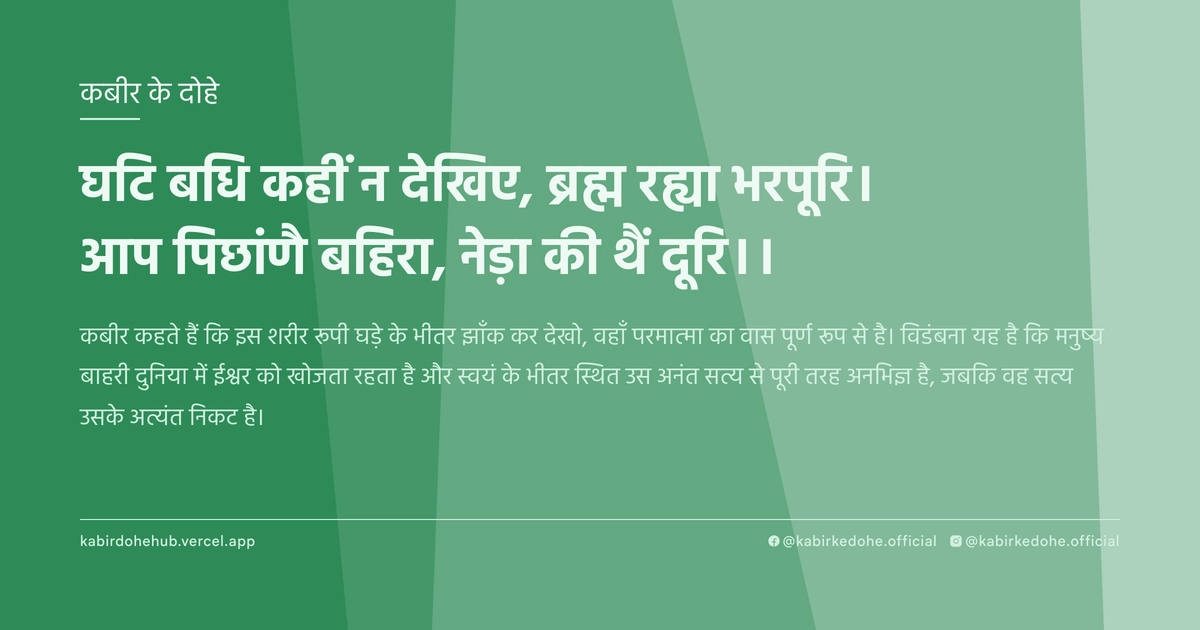
घटि बधि कहीं न देखिए, ब्रह्म रह्या भरपूरि।
आप पिछांणै बहिरा, नेड़ा की थैं दूरि।।
Ghati badhi kahin na dekhiye, braham rahya bharpoori. Aap pichhanai bahira, neda ki thain doori.
इस पृष्ठ पर इस कबीर दोहे का अर्थ (meaning), हिंदी व्याख्या और अंग्रेज़ी अनुवाद, दार्शनिक विश्लेषण और व्यावहारिक जीवन सीख दी गई है। यह दोहा निर्गुण ब्रह्म (Nirguna Brahman) विषय से जुड़ा है — Kabir doha meaning and explanation in Hindi and English.
अर्थ (Meaning):
कबीर कहते हैं कि इस शरीर रूपी घड़े के भीतर झाँक कर देखो, वहाँ परमात्मा का वास पूर्ण रूप से है। विडंबना यह है कि मनुष्य बाहरी दुनिया में ईश्वर को खोजता रहता है और स्वयं के भीतर स्थित उस अनंत सत्य से पूरी तरह अनभिज्ञ है, जबकि वह सत्य उसके अत्यंत निकट है।
Kabir asserts that if one looks within the vessel of the human body, they will find the Divine permeating every atom. The tragedy of human existence is that the seeker remains blind to this internal presence, searching for God in distant lands and external rituals, while the Absolute Truth resides closer than their own breath.
व्याख्या (Interpretation):
यहाँ 'घटि' का अर्थ शरीर और हृदय दोनों है। कबीर यह स्पष्ट कर रहे हैं कि ब्रह्म कोई बाहरी सत्ता नहीं है जिसे तीर्थों या ग्रंथों में खोजा जाए, बल्कि वह 'भरपूरि' है—अर्थात सर्वव्यापी है। यह अद्वैत वेदांत के उस सिद्धांत को दर्शाता है जहाँ आत्मा और परमात्मा एक ही हैं। 'बहिरा' शब्द यहाँ केवल शारीरिक बहरेपन को नहीं, बल्कि आध्यात्मिक जड़ता को दर्शाता है। मनुष्य माया के प्रभाव में इतना अंधा हो गया है कि वह अपने ही भीतर गूँज रहे सत्य की ध्वनि को नहीं सुन पा रहा। यह विरोधाभास है कि जो सबसे निकट है, वह हमें सबसे दूर प्रतीत होता है क्योंकि हमारा अहंकार एक पर्दे की तरह कार्य करता है।
The term 'Ghati' refers simultaneously to the physical body and the spiritual heart. Kabir emphasizes that Brahman is not an external entity to be sought in pilgrimages or scriptures, but is 'Bharpoori'—all-pervading. This aligns with the Advaita Vedanta principle of non-duality, where the Atman (individual soul) and Brahman (universal soul) are identical. The word 'Bahira' signifies not physical deafness, but spiritual inertia. Under the veil of Maya (illusion), the human consciousness becomes deaf to the internal resonance of Truth. The central paradox is that the Divine is the closest possible reality, yet feels distant because the ego acts as an opaque barrier between the seeker and the Self.
दार्शनिक विश्लेषण (Philosophical Analysis):
कबीर का यह दोहा निर्गुण भक्ति की पराकाष्ठा है, जहाँ ईश्वर को किसी विशेष आकार, मूर्ति या स्थान में सीमित नहीं किया गया है। उनके समय में धर्म बाहरी आडंबरों, जातिगत श्रेष्ठता और कठिन अनुष्ठानों में फँसा हुआ था। कबीर ने इस व्यवस्था पर प्रहार करते हुए यह प्रतिपादित किया कि मोक्ष का मार्ग मंदिर या मस्जिद से नहीं, बल्कि अंतर्मुखी होने से प्रशस्त होता है।
दार्शनिक स्तर पर, यह सूफी मत के 'अनल हक़' (मैं ही सत्य हूँ) और वेदांत के 'अहम् ब्रह्मास्मि' का संगम है। कबीर तर्क देते हैं कि यदि परमात्मा सर्वव्यापी है, तो वह मनुष्य के भीतर भी होना चाहिए। यदि हम उसे बाहर खोजते हैं, तो हम अनजाने में यह मान लेते हैं कि वह हमसे अलग है, जो कि द्वैतवाद है।
अहंकार का विलोपन ही वह एकमात्र कुंजी है जिससे यह आंतरिक द्वार खुलता है। जब तक 'मैं' (अहंकार) जीवित है, तब तक ब्रह्म की अनुभूति संभव नहीं है। कबीर के अनुसार, ज्ञान केवल सूचना नहीं है, बल्कि एक अनुभव है जो तब घटित होता है जब व्यक्ति अपनी बाहरी पहचान को त्याग कर आंतरिक शून्य में उतरता है।
यहाँ ritualism का विरोध केवल सामाजिक नहीं, बल्कि मनोवैज्ञानिक है। कर्मकांड व्यक्ति को बाहरी दुनिया में व्यस्त रखते हैं, जिससे वह अपनी आंतरिक शून्यता को भरने के लिए और अधिक बाहरी सहारे खोजता है। यह एक अंतहीन चक्र है।
अंततः, कबीर यह संदेश देते हैं कि सत्य की खोज बाहर की यात्रा नहीं, बल्कि भीतर की वापसी है। जब साधक यह जान लेता है कि वह स्वयं वह है जिसे वह खोज रहा था, तब खोज समाप्त हो जाती है और केवल 'होना' शेष रह जाता है।
This couplet represents the pinnacle of Nirgun Bhakti, where the Divine is neither confined to a specific form, idol, nor location. During Kabir's era, religion was heavily entangled in external pomposity, caste hierarchies, and rigid rituals. Kabir challenged this structure, asserting that the path to liberation is paved not through temples or mosques, but through introversion and self-realization.
Philosophically, this is a convergence of the Sufi concept of 'Ana al-Haqq' (I am the Truth) and the Vedantic 'Aham Brahmasmi' (I am Brahman). Kabir argues that if the Divine is omnipresent, it must necessarily reside within the human being. To seek God externally is to implicitly assume a separation between the Creator and the created, which is the fundamental error of dualism.
The annihilation of the ego is the only key to unlocking this internal portal. As long as the 'I' (the false ego) persists, the realization of Brahman remains obscured. For Kabir, spiritual knowledge is not an accumulation of information but an experiential shift that occurs when one sheds their external identity to dive into the internal void.
His critique of ritualism is not merely social but psychological. Rituals keep the individual preoccupied with the external world, prompting them to seek more external crutches to fill an internal void. This creates a cycle of perpetual longing and dissatisfaction.
Ultimately, Kabir teaches that the quest for Truth is not a journey outward, but a return inward. When the seeker realizes that they are the very essence they were searching for, the search ceases, and only pure 'Being' remains.
मूल संदेश (Core Message):
- बाहरी खोज एक भ्रम है जो हमें स्वयं से दूर ले जाती है।
- परमात्मा कोई गंतव्य नहीं, बल्कि हमारा वास्तविक स्वभाव है।
- अहंकार वह पर्दा है जो हमें आंतरिक प्रकाश देखने से रोकता है।
- सच्ची भक्ति मंदिर जाने में नहीं, बल्कि अंतर्मुखी होने में है।
- जब 'मैं' मिटता है, तब केवल 'वह' (ब्रह्म) शेष रहता है।
- निकटतम सत्य को पहचानने के लिए केवल मौन की आवश्यकता है।
- External searching is an illusion that alienates us from our own essence.
- The Divine is not a destination, but our original nature.
- The ego is the veil that obscures the internal light of consciousness.
- True devotion lies not in visiting shrines, but in turning inward.
- When the 'I' dissolves, only the Absolute (Brahman) remains.
- Recognizing the closest truth requires only the practice of silence.
व्यावहारिक उदाहरण (Practical Example):
एक समय की बात है, वाराणसी के घाटों पर रहने वाला एक वृद्ध बुनकर था, जिसका नाम माधव था। माधव दिन भर सूत कातता और कपड़े बुनता, लेकिन उसका मन हमेशा अशांत रहता था। उसने सुना था कि मोक्ष पाने के लिए कठिन तपस्या और दूरदराज के तीर्थों की यात्रा करनी पड़ती है।
माधव ने अपनी जीवन भर की जमा पूँजी इकट्ठी की और हिमालय की ओर निकल पड़ा। उसने कई गुफाओं में समय बिताया, कठोर उपवास किए और कई संतों के चरणों में सिर झुकाया। वह हर जगह यही पूछता, "ईश्वर कहाँ है? मुझे वह रास्ता बताइए जिससे मैं परमात्मा को पा सकूँ।"
हर कोई उसे अलग-अलग दिशाओं में भेजता। कोई कहता गंगा स्नान करो, कोई कहता कैलाश की यात्रा करो। वर्षों बीत गए, माधव बूढ़ा और कमजोर हो गया, लेकिन उसे वह शांति नहीं मिली जिसकी वह तलाश कर रहा था। वह निराश होकर वापस अपने गाँव लौट आया।
एक दिन, वह अपने करघे पर बैठा था और उसकी आँखें थकान से बंद थीं। अचानक उसे महसूस हुआ कि करघे की लयबद्ध आवाज़ उसके अपने दिल की धड़कन से मिल रही है। उसने अपनी आँखें बंद कीं और अपना ध्यान बाहरी शोर से हटाकर अपने भीतर की शांति पर केंद्रित किया।
उसे महसूस हुआ कि जिस शांति को वह पहाड़ों और नदियों में खोज रहा था, वह तो उसके अपने भीतर एक गहरी नदी की तरह बह रही थी। वह जिसे 'बाहर' खोज रहा था, वह तो उसके हर सांस में, हर धड़कन में मौजूद था।
उसे याद आया कि उसने जीवन भर केवल 'रास्तों' को देखा, कभी 'मंजिल' को नहीं, क्योंकि मंजिल उसके भीतर ही थी। यह एक 'कबीर मोड़' था—अचानक उसका पूरा नजरिया बदल गया।
अब माधव तीर्थों पर नहीं जाता था। वह अपने काम को ही पूजा मानने लगा। वह अब केवल कपड़े नहीं बुनता था, बल्कि हर धागे में उस परमात्मा के प्रेम को पिरोने लगा।
गाँव के लोग हैरान थे कि माधव के चेहरे पर अब एक अलौकिक चमक थी। जब लोगों ने उससे पूछा कि उसने ईश्वर को कहाँ पाया, तो वह बस मुस्कुराकर अपने हृदय पर हाथ रखता और कहता, "घड़े के भीतर ही अमृत है, बस देखने वाली आँख चाहिए।"
माधव का जीवन अब संघर्ष नहीं, बल्कि एक उत्सव बन गया था। उसने जान लिया था कि सबसे लंबी यात्रा वास्तव में स्वयं से स्वयं तक की यात्रा होती है।
Once, in the ghats of Varanasi, lived an elderly weaver named Madhav. Madhav spent his days spinning yarn and weaving cloth, yet his mind was perpetually restless. He had been told that liberation required rigorous penance and pilgrimages to distant lands.
Gathering all his life savings, Madhav set out toward the Himalayas. He spent years in secluded caves, observed harsh fasts, and bowed before numerous saints. At every stop, he asked the same question: "Where is God? Show me the path to reach the Divine."
Every guide pointed him in a different direction. Some urged him to bathe in the Ganges; others told him to trek to Mount Kailash. Years passed, and Madhav grew frail and old, yet the peace he sought remained elusive. Disheartened, he eventually returned to his village.
One afternoon, while sitting at his loom, his eyes closed in exhaustion. Suddenly, he noticed that the rhythmic clacking of the loom was synchronizing with his own heartbeat. He closed his eyes and shifted his attention away from the external noise, focusing instead on the silence within.
He realized that the peace he had chased across mountains and rivers was flowing within him like a deep, subterranean stream. The entity he sought 'out there' was present in every breath and every pulse.
He understood that he had spent his life studying the 'roads' but had ignored the 'destination,' for the destination was his own center. This was the 'Kabir Twist'—a sudden, radical shift in perception.
Madhav stopped seeking external shrines. He began to treat his daily work as a form of worship. He no longer just wove cloth; he wove the love of the Divine into every single thread.
Villagers were amazed by the celestial glow on Madhav's face. When asked where he had finally found God, he would simply smile, place his hand over his heart, and say, "The nectar is inside the pot; one only needs the eyes to see it."
Madhav's life ceased to be a struggle and became a celebration. He had learned that the longest journey is the one from the self, back to the Self.
अभ्यास मार्गदर्शन (Practice Guidance):
- प्रतिदिन 20 मिनट 'साक्षी भाव' का अभ्यास करें: चुपचाप बैठें और अपने विचारों को बिना किसी निर्णय के केवल देखें, जैसे आप किसी और को देख रहे हों।
- स्व-पूछताछ जर्नल: प्रतिदिन एक प्रश्न लिखें—"आज मैंने किस बाहरी चीज़ में अपनी खुशी खोजी, और वह मेरे भीतर कहाँ मौजूद थी?"
- मौन व्रत: सप्ताह में एक बार कुछ घंटों के लिए पूर्ण मौन धारण करें। बाहरी शब्दों का त्याग कर आंतरिक संवाद को सुनने का प्रयास करें।
- डायग्नोस्टिक चेकलिस्ट: यदि आप तनाव में हैं, तो पूछें—"क्या मैं अभी अपनी पहचान बाहरी उपलब्धियों से जोड़ रहा हूँ? क्या मैं यह भूल गया हूँ कि मेरा मूल स्वरूप शांत और पूर्ण है?"
- Practice 'Witness Consciousness' for 20 minutes daily: Sit in silence and observe your thoughts without judgment, as if you are watching a stranger.
- Self-Inquiry Journaling: Write one daily prompt—"Where did I seek happiness in external things today, and where did that same essence exist within me?"
- Vow of Silence: Observe complete silence for a few hours once a week. Cease external chatter to listen to the internal resonance.
- Diagnostic Checklist: When stressed, ask—"Am I currently anchoring my identity to external achievements? Have I forgotten that my fundamental nature is peaceful and complete?"
चिंतन प्रश्न (Reflection Questions):
- मैं अपनी सार्वजनिक छवि (Public Image) को बनाए रखने के लिए अपने वास्तविक स्वरूप का कितना गला घोंटता हूँ?
- यदि मेरी सभी बाहरी उपलब्धियाँ और पद छीन लिए जाएँ, तो मेरे भीतर क्या बचेगा?
- क्या मेरी ईश्वर की खोज वास्तव में सत्य को पाने की इच्छा है, या केवल अपनी असुरक्षाओं को शांत करने का एक तरीका?
- मैं किन मानसिक दीवारों के पीछे अपने वास्तविक 'स्व' को छुपा कर रखता हूँ?
- क्या मैं दूसरों में कमियाँ इसलिए देखता हूँ क्योंकि मैं अपने भीतर के उसी अंधेरे को स्वीकार नहीं कर पा रहा हूँ?
- मेरी डिजिटल पहचान (Social Media Ego) मेरे वास्तविक आंतरिक मौन से कितनी दूर है?
- How much of my authentic self do I suffocate to maintain my public image?
- If all my external achievements and titles were stripped away, what would remain within me?
- Is my search for the Divine a genuine quest for Truth, or merely a way to soothe my insecurities?
- Behind which mental walls do I hide my true 'Self'?
- Do I perceive flaws in others because I cannot accept the same shadows within myself?
- How far is my digital identity (social media ego) from my actual internal silence?