
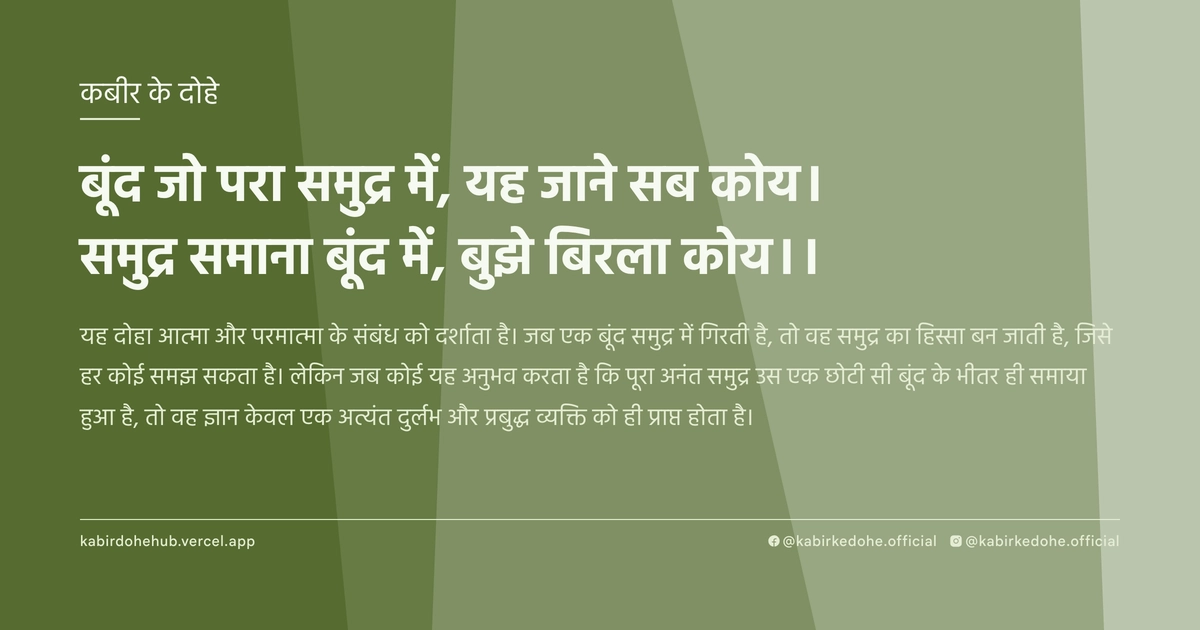
बूंद जो परा समुद्र में, यह जाने सब कोय।
समुद्र समाना बूंद में, बुझे बिरला कोय।।
Boond jo para samudra mein, yeh jaane sab koy. Samudra samana boond mein, bujhe birla koy.
इस पृष्ठ पर इस कबीर दोहे का अर्थ (meaning), हिंदी व्याख्या और अंग्रेज़ी अनुवाद, दार्शनिक विश्लेषण और व्यावहारिक जीवन सीख दी गई है। यह दोहा निर्गुण ब्रह्म (Nirguna Brahman) विषय से जुड़ा है — Kabir doha meaning and explanation in Hindi and English.
अर्थ (Meaning):
यह दोहा आत्मा और परमात्मा के संबंध को दर्शाता है। जब एक बूंद समुद्र में गिरती है, तो वह समुद्र का हिस्सा बन जाती है, जिसे हर कोई समझ सकता है। लेकिन जब कोई यह अनुभव करता है कि पूरा अनंत समुद्र उस एक छोटी सी बूंद के भीतर ही समाया हुआ है, तो वह ज्ञान केवल एक अत्यंत दुर्लभ और प्रबुद्ध व्यक्ति को ही प्राप्त होता है।
This couplet illustrates the profound relationship between the individual soul and the Universal Consciousness. While everyone understands that a single drop merging into the ocean becomes part of the vast sea, very few realize the inverse paradox: that the entire infinite ocean is contained within a single drop. It speaks to the immanence of the Divine within the self.
व्याख्या (Interpretation):
शाब्दिक अर्थ यह है कि बूंद का समुद्र में मिलना सरल है, परंतु समुद्र का बूंद में होना रहस्यमय है। यहाँ 'बूंद' जीवात्मा का प्रतीक है और 'समुद्र' निर्गुण ब्रह्म या परमात्मा का। यह निरुपण अद्वैत वेदांत के उस सिद्धांत की ओर इशारा करता है जहाँ जीव और ईश्वर के बीच का भेद केवल माया के कारण है। जब अहंकार मिटता है, तो यह बोध होता है कि आत्मा वास्तव में सीमित नहीं, बल्कि पूर्ण है। यह विरोधाभास दर्शाता है कि परमात्मा कहीं बाहर खोजने की वस्तु नहीं, बल्कि स्वयं के भीतर गहराई में उतरने का अनुभव है। इस प्रकार, यह दोहा सूक्ष्म में विराट की खोज का आह्वान करता है।
Literally, the drop merging into the ocean is an obvious event, but the ocean residing within the drop is a mystical secret. Here, the 'drop' symbolizes the Jivatma (individual soul) and the 'ocean' represents the Nirgun Brahman (the formless Absolute). This analysis aligns with Advaita Vedanta, suggesting that the perceived separation between the soul and God is merely a veil of Maya (illusion). When the ego dissolves, the realization dawns that the soul is not a fragment of the Divine, but the Divine itself in a condensed form. This paradox highlights that the Absolute is not a distant entity to be sought, but an immanent reality to be discovered within. It is a call to find the macrocosm within the microcosm.
दार्शनिक विश्लेषण (Philosophical Analysis):
कबीर का यह दृष्टिकोण उनके समय के कट्टरपंथी धार्मिक ढांचों और बाहरी कर्मकांडों के प्रति एक सशक्त विद्रोह था। उन्होंने यह स्थापित किया कि ईश्वर किसी मंदिर, मस्जिद या तीर्थ में नहीं, बल्कि मनुष्य के अपने हृदय में स्थित है। यह विचार सूफीवाद के 'वहदत-अल-वजूद' (अस्तित्व की एकता) के सिद्धांत से गहराई से मेल खाता है, जहाँ प्रेमी और प्रियतम एक हो जाते हैं।
दार्शनिक स्तर पर, कबीर यहाँ द्वैतवाद (Dualism) को चुनौती दे रहे हैं। अधिकांश लोग मानते हैं कि आत्मा को परमात्मा में विलीन होना है (Sadhana), लेकिन कबीर कहते हैं कि आत्मा पहले से ही परमात्मा है, बस उसे इस सत्य का 'बोध' होना बाकी है। यह 'बोध' ही वह बिंदु है जहाँ 'बिरला' या दुर्लभ व्यक्ति पहुँचता है।
सामाजिक रूप से, यह दर्शन जाति और वर्ण व्यवस्था की जड़ों पर प्रहार करता है। यदि हर बूंद में पूरा समुद्र है, तो कोई भी व्यक्ति छोटा, नीच या अछूत नहीं हो सकता। हर मनुष्य में वही दैवीय प्रकाश है जो ब्रह्मांड के निर्माता में है।
मनोवैज्ञानिक रूप से, यह अहंकार के विसर्जन की प्रक्रिया है। जब तक व्यक्ति स्वयं को एक 'अलग बूंद' मानता है, वह भय और अकेलेपन में जीता है। जैसे ही वह स्वयं को 'समुद्र' के रूप में देखता है, उसका भय समाप्त हो जाता है और वह अनंत शांति का अनुभव करता है।
अंततः, कबीर यह समझाते हैं कि आध्यात्मिक यात्रा बाहर से भीतर की ओर है। बाहरी दुनिया का विस्तार एक भ्रम है; वास्तविक विस्तार आंतरिक चेतना का है। जो इस सत्य को जान लेता है, वह संसार में रहते हुए भी उससे ऊपर उठ जाता है।
Kabir's perspective represents a powerful rebellion against the rigid religious structures and external rituals of his era. He established that the Divine does not reside in temples, mosques, or pilgrimage sites, but within the very heart of the human being. This philosophy resonates deeply with the Sufi concept of 'Wahdat-al-Wujud' (Unity of Existence), where the lover and the Beloved eventually merge into one.
On a philosophical level, Kabir challenges Dualism. While most believe the soul must strive to merge into God (a process of striving), Kabir suggests that the soul is already the Absolute; it simply lacks the 'awareness' of this fact. This realization is the threshold that only the 'Birla' or the rare seeker crosses.
Socially, this philosophy strikes at the roots of the caste system and social hierarchy. If every drop contains the entire ocean, then no human being can be considered inferior, low-born, or untouchable. Every individual possesses the same divine spark that animates the entire universe.
Psychologically, this is a process of ego-annihilation. As long as an individual perceives themselves as a 'separate drop,' they live in a state of fear, lack, and loneliness. The moment they recognize themselves as the 'ocean,' fear vanishes, replaced by an expansive sense of peace and wholeness.
Ultimately, Kabir teaches that the spiritual journey is an inward movement. The expansion of the external world is a distraction; the true expansion occurs within consciousness. One who realizes this truth lives in the world but is not of the world, transcending the limitations of the physical form.
मूल संदेश (Core Message):
- बाहरी खोज एक भ्रम है; सत्य केवल भीतर है।
- अहंकार का विसर्जन ही विराटता का एकमात्र द्वार है।
- आत्मा सीमित नहीं, बल्कि अनंत का प्रतिबिंब है।
- द्वैत का अंत ही वास्तविक आध्यात्मिक जागृति है।
- सूक्ष्मता में ही संपूर्ण ब्रह्मांड का रहस्य छिपा है।
- External searching is an illusion; truth exists only within.
- The dissolution of ego is the only gateway to vastness.
- The soul is not limited, but a reflection of the infinite.
- The end of duality is the only true spiritual awakening.
- The secret of the entire universe is hidden in the subtle.
व्यावहारिक उदाहरण (Practical Example):
वाराणसी के घाटों पर रहने वाली एक वृद्ध विधवा, जानकी, का जीवन अत्यंत कठिन था। वह दूसरों के घरों में बर्तन मांजती और दिन भर तिरस्कार सहती। वह मानती थी कि उसका जीवन एक छोटी सी बूंद की तरह है, जो दुखों के समुद्र में डूब गई है और जिसका कोई मूल्य नहीं है। वह अक्सर मंदिर की सीढ़ियों पर बैठकर रोती और ईश्वर से पूछती कि उसने उसे इतना तुच्छ क्यों बनाया।
एक दिन उसकी मुलाकात एक घुमंतू फकीर से हुई, जिसने उसे कबीर का यह दोहा सुनाया। फकीर ने उससे कहा, "माई, तुम खुद को एक छोटी बूंद समझकर रो रही हो, लेकिन क्या तुमने कभी सोचा है कि यह पूरा ब्रह्मांड तुम्हारे भीतर सिमटा है? तुम्हारी पीड़ा तुम्हारी अपनी नहीं, बल्कि संसार की पीड़ा है क्योंकि तुम खुद को अलग मानती हो।"
जानकी को पहले यह बात समझ नहीं आई। उसे लगा कि यह केवल शब्दों का खेल है। लेकिन फकीर ने उसे एक प्रयोग दिया: "जब भी तुम किसी के बर्तन मांजो, तो यह मत सोचो कि तुम एक नौकरानी हो, बल्कि यह सोचो कि तुम उस व्यक्ति के भीतर बैठे उसी परमात्मा की सेवा कर रही हो जो तुम्हारे भीतर भी है।"
जानकी ने इस अभ्यास को शुरू किया। धीरे-धीरे उसका नजरिया बदलने लगा। जहाँ पहले उसे तिरस्कार दिखता था, अब उसे हर इंसान में एक साझा दर्द और एक साझा दिव्यता दिखने लगी। उसने महसूस किया कि जिस 'समुद्र' (ईश्वर) को वह बाहर खोज रही थी, वह उसकी अपनी करुणा और प्रेम में ही मौजूद है।
एक समय ऐसा आया जब जानकी के चेहरे पर एक ऐसी शांति छा गई कि जो लोग उसे दुत्कारते थे, वे उसके पास सुकून की तलाश में आने लगे। वह अब खुद को 'बेचारी' नहीं मानती थी। उसने पाया कि उसकी छोटी सी झोपड़ी अब उसे किसी महल से बड़ी लगती थी क्योंकि उसका आंतरिक विस्तार हो चुका था।
उसने सीखा कि उसकी पहचान केवल एक 'विधवा' या 'नौकरानी' के रूप में नहीं थी, बल्कि वह उस अनंत चेतना का हिस्सा थी। उसका अहंकार, जो उसे 'छोटा' महसूस कराता था, अब पूरी तरह मिट चुका था।
जब एक दिन शहर के एक बड़े पंडित ने उससे उसकी शांति का रहस्य पूछा, तो उसने मुस्कुराकर केवल इतना कहा, "मैंने बूंद बनकर समुद्र में डूबने की कोशिश छोड़ दी, और पाया कि समुद्र मेरे भीतर ही था।"
जानकी का जीवन अब सेवा और प्रेम का पर्याय बन गया था। उसने साबित कर दिया कि जब व्यक्ति अपनी सूक्ष्मता में विराटता को पहचान लेता है, तो बाहरी परिस्थितियाँ अपना प्रभाव खो देती हैं।
Janaki, an elderly widow living on the ghats of Varanasi, led a life of extreme hardship. She scrubbed utensils in other people's homes and endured constant disdain. She viewed her life as a tiny drop drowned in an ocean of sorrow, believing herself to be utterly insignificant. She would often sit on the temple steps, weeping and asking God why she was created so small and wretched.
One day, she encountered a wandering fakir who recited this specific couplet of Kabir to her. The fakir said, "Mother, you weep because you see yourself as a mere drop, but have you considered that the entire universe is contained within you? Your pain is not yours alone, but the pain of the world, because you perceive yourself as separate."
Janaki did not understand at first; she thought it was merely a play of words. However, the fakir gave her a practice: "Whenever you scrub someone's pots, do not think of yourself as a servant. Instead, realize that you are serving the same Divine within that person which also resides within you."
Janaki began this practice. Slowly, her perspective shifted. Where she once saw contempt, she began to see a shared pain and a shared divinity in every human being. She realized that the 'ocean' (God) she had been searching for externally was present in her own compassion and love.
Eventually, a profound peace settled upon Janaki's face, such that the very people who once shunned her began visiting her in search of solace. She no longer identified as 'pitiful.' She found that her tiny hut felt larger than any palace because her internal consciousness had expanded.
She learned that her identity was not defined by being a 'widow' or a 'servant,' but as a manifestation of the infinite consciousness. The ego that had made her feel 'small' had completely dissolved.
When a prominent priest of the city asked her the secret of her peace, she simply smiled and said, "I stopped trying to drown as a drop in the ocean, and discovered that the ocean was already within me."
Janaki's life became a synonym for service and love. She proved that when a person recognizes the vastness within their own subtlety, external circumstances lose their power to cause suffering.
अभ्यास मार्गदर्शन (Practice Guidance):
- प्रतिदिन 20 मिनट मौन ध्यान करें, जहाँ आप अपनी सांसों को एक छोटी बूंद की तरह देखें और धीरे-धीरे महसूस करें कि यह सांस पूरे ब्रह्मांड की लय से जुड़ी हुई है।
- स्व-अन्वेषण जर्नल: प्रतिदिन एक ऐसी घटना लिखें जहाँ आपने स्वयं को 'छोटा' या 'अधूरा' महसूस किया, और फिर विश्लेषण करें कि कैसे वह भावना आपके अहंकार (Ego) के कारण थी, न कि आपकी वास्तविक प्रकृति के कारण।
- व्यवहार परिवर्तन: दिन भर में कम से कम तीन बार, किसी अजनबी या शत्रु को देखते समय मन में कहें, "जो विराट चेतना मुझमें है, वही इसमें भी है।"
- डायग्नोस्टिक चेकलिस्ट: क्या आप अभी भी बाहरी प्रशंसा या आलोचना से विचलित होते हैं? क्या आप स्वयं को दूसरों से श्रेष्ठ या निम्न महसूस करते हैं? यदि हाँ, तो आप अभी भी 'बूंद' के भ्रम में हैं; यदि आप तटस्थ हैं, तो आप 'समुद्र' के बोध की ओर बढ़ रहे हैं।
- Practice 20 minutes of silent meditation daily, visualizing your breath as a tiny drop and gradually feeling how this breath is synchronized with the rhythm of the entire universe.
- Self-Inquiry Journaling: Daily record an instance where you felt 'small' or 'incomplete,' and analyze how that feeling stemmed from the ego rather than your true nature.
- Behavioral Shift: At least three times a day, while looking at a stranger or an enemy, mentally affirm: "The same vast consciousness that is in me, is also in them."
- Diagnostic Checklist: Do you still fluctuate based on external praise or criticism? Do you feel superior or inferior to others? If yes, you are still under the illusion of the 'drop'; if you remain equanimous, you are moving toward the realization of the 'ocean'.
चिंतन प्रश्न (Reflection Questions):
- क्या मेरी 'छवि' (Image) जिसे मैं दुनिया को दिखाता हूँ, वास्तव में मेरी आत्मा का विस्तार है या केवल एक छोटा सा मुखौटा?
- मैं किन परिस्थितियों में खुद को 'छोटा' महसूस करता हूँ, और वह छोटापन मुझे किस चीज से बचाने की कोशिश करता है?
- यदि मैं इस शरीर और नाम से अलग हूँ, तो वह 'मैं' कौन है जो इस समय यह प्रश्न पढ़ रहा है?
- क्या मेरा प्रेम केवल उन लोगों के लिए है जो मेरे जैसे हैं, या मैं उस 'समुद्र' को देख पा रहा हूँ जो मेरे विरोधियों में भी है?
- मेरी डिजिटल पहचान (Social Media Ego) मुझे वास्तविक आंतरिक शांति से दूर ले जा रही है या करीब?
- Is the 'image' I present to the world a true expansion of my soul, or merely a tiny mask?
- In which situations do I feel 'small,' and what is that feeling of smallness trying to protect me from?
- If I am separate from this body and name, who is the 'I' that is currently reading this question?
- Is my love reserved only for those like me, or can I perceive the 'ocean' that exists even within my adversaries?
- Is my digital identity (social media ego) pulling me away from real inner peace or bringing me closer to it?