
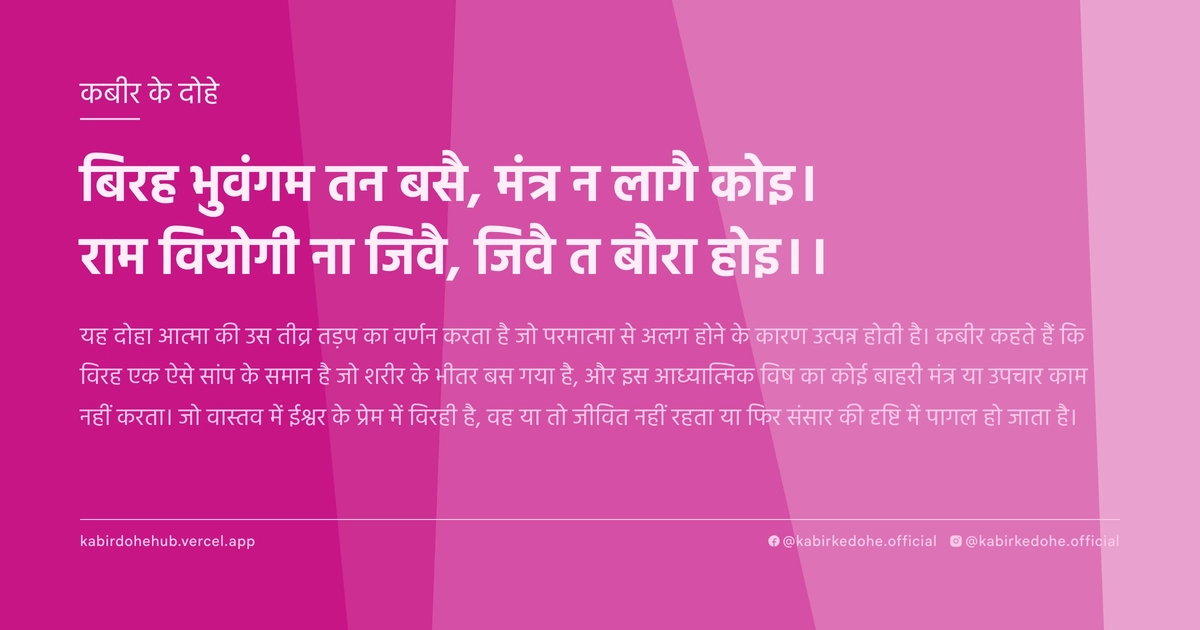
बिरह भुवंगम तन बसै, मंत्र न लागै कोइ।
राम वियोगी ना जिवै, जिवै त बौरा होइ।।
Birah bhuvangam tan basai, mantra na laagai koi. Ram viyogi na jivai, jivai ta baura hoye.
इस पृष्ठ पर इस कबीर दोहे का अर्थ (meaning), हिंदी व्याख्या और अंग्रेज़ी अनुवाद, दार्शनिक विश्लेषण और व्यावहारिक जीवन सीख दी गई है। यह दोहा भक्ति (Bhakti) विषय से जुड़ा है — Kabir doha meaning and explanation in Hindi and English.
अर्थ (Meaning):
यह दोहा आत्मा की उस तीव्र तड़प का वर्णन करता है जो परमात्मा से अलग होने के कारण उत्पन्न होती है। कबीर कहते हैं कि विरह एक ऐसे सांप के समान है जो शरीर के भीतर बस गया है, और इस आध्यात्मिक विष का कोई बाहरी मंत्र या उपचार काम नहीं करता। जो वास्तव में ईश्वर के प्रेम में विरही है, वह या तो जीवित नहीं रहता या फिर संसार की दृष्टि में पागल हो जाता है।
This couplet describes the intense longing of the soul resulting from its separation from the Divine. Kabir asserts that the pain of separation (Viraha) is like a serpent coiled within the body, and no external mantra or remedy can cure this spiritual venom. One who is truly consumed by the longing for the Divine either ceases to exist in the worldly sense or lives as a madman in the eyes of society.
व्याख्या (Interpretation):
यहाँ 'बिरह' केवल मानवीय प्रेम का विछोह नहीं, बल्कि जीवात्मा का परमात्मा से विलग होने का आदि-दुःख है। 'भुवंगम' या सांप का रूपक यह दर्शाता है कि यह विरह भीतर ही भीतर व्यक्ति को जलाता है और धीरे-धीरे अहंकार को नष्ट करता है। जब कबीर कहते हैं कि 'मंत्र न लागै', तो उनका तात्पर्य है कि बौद्धिक ज्ञान, कर्मकांड या बाहरी उपचार इस आंतरिक तड़प को शांत नहीं कर सकते। यह अवस्था 'निर्गुण भक्ति' की पराकाष्ठा है जहाँ साधक रूप और नाम से ऊपर उठकर केवल उस शून्य या पूर्ण की खोज करता है। 'बौरा' या पागल होना वास्तव में उस अवस्था को दर्शाता है जहाँ सामाजिक मर्यादाएं और सांसारिक तर्क समाप्त हो जाते हैं और केवल ईश्वरीय प्रेम शेष रहता है। यह द्वैत (separation) से अद्वैत (union) की ओर जाने वाली एक अत्यंत कष्टदायक लेकिन आवश्यक प्रक्रिया है।
Here, 'Viraha' is not merely the grief of human separation but the primordial sorrow of the Jivatma (individual soul) being severed from the Paramatma (Supreme Soul). The metaphor of the 'Bhuvangam' or serpent signifies that this longing consumes the individual from within, systematically eroding the ego. When Kabir states that 'no mantra works,' he implies that intellectual knowledge, rituals, or external remedies cannot soothe this internal ache. This state represents the pinnacle of 'Nirgun Bhakti,' where the seeker transcends form and name to seek the Void or the Absolute. To become 'Baura' or mad is, in reality, to reach a state where social conventions and worldly logic dissolve, leaving only divine love. It is a painful yet necessary transition from duality (separation) to non-duality (union).
दार्शनिक विश्लेषण (Philosophical Analysis):
कबीर का यह दोहा मध्यकालीन भारत के उस सामाजिक-धार्मिक परिवेश में रचा गया जहाँ धर्म केवल बाहरी कर्मकांडों और जातिगत श्रेष्ठता तक सीमित था। कबीर ने इन कृत्रिम दीवारों को तोड़ते हुए 'प्रेम' को ही एकमात्र मोक्ष मार्ग बताया। उनका दर्शन 'अद्वैत वेदांत' के करीब है, जहाँ आत्मा और ब्रह्म की एकता की बात की गई है, लेकिन उन्होंने इसे शुष्क दर्शन के बजाय एक भावनात्मक अनुभव (Bhakti) के रूप में प्रस्तुत किया।
यहाँ विरह का सांप वास्तव में 'माया' के विपरीत कार्य करता है। जहाँ माया हमें संसार से जोड़कर सत्य से दूर करती है, वहीं विरह हमें संसार से विरक्त कर सत्य की ओर धकेलता है। यह एक प्रकार की 'रूहानी तड़प' है जिसे सूफी मत में 'इश्क-ए-हकीकी' कहा गया है। सूफी संतों की तरह कबीर भी मानते हैं कि जब तक हृदय में तड़प नहीं होगी, तब तक परमात्मा का साक्षात्कार संभव नहीं है।
यह दोहा अहंकार के विसर्जन की प्रक्रिया को स्पष्ट करता है। जब विरह का विष शरीर में फैलता है, तो वह सबसे पहले 'मैं' (अहंकार) को मारता है। जिस व्यक्ति का अहंकार मर जाता है, वह संसार की नजरों में 'पागल' हो जाता है क्योंकि वह अब उन मूल्यों को महत्व नहीं देता जिन्हें समाज सफलता या सम्मान मानता है।
कबीर ritualism (कर्मकांड) का विरोध करते हुए यह समझाते हैं कि मंदिर, मस्जिद या तीर्थ यात्राएं उस विरह को शांत नहीं कर सकतीं। केवल आत्म-साक्षात्कार और पूर्ण समर्पण ही इस विष का उपचार है। यह एक मनोवैज्ञानिक रूपांतरण है जहाँ साधक अपनी पहचान को मिटाकर सार्वभौमिक चेतना में विलीन हो जाता है।
अंततः, यह दोहा इस विरोधाभास को उजागर करता है कि आध्यात्मिक पूर्णता प्राप्त करने के लिए पहले पूर्णतः टूटना पड़ता है। विरह वह अग्नि है जो सोने को तपाकर शुद्ध करती है। बिना इस तड़प के, भक्ति केवल एक बौद्धिक व्यायाम है, वास्तविक अनुभव नहीं।
This couplet was composed within the socio-religious milieu of medieval India, where religion was largely confined to external rituals and caste hierarchies. Kabir shattered these artificial barriers, proposing 'Love' as the sole path to liberation. His philosophy aligns closely with 'Advaita Vedanta,' which posits the oneness of Atman and Brahman, yet he presents this not as dry metaphysics but as a visceral emotional experience (Bhakti).
In this context, the serpent of separation acts as the antithesis to 'Maya.' While Maya binds us to the world and blinds us to the Truth, Viraha detaches us from the world and propels us toward the Truth. This is a form of spiritual longing known in Sufism as 'Ishq-e-Haqiqi' (Divine Love). Like the Sufi saints, Kabir believes that without this agonizing yearning, the realization of the Divine is impossible.
The couplet elucidates the process of ego dissolution. As the venom of separation spreads, it first kills the 'I' (the ego). Once the ego is annihilated, the individual appears 'mad' to the world because they no longer value the metrics of success or honor defined by society.
Opposing ritualism, Kabir explains that temples, mosques, or pilgrimages cannot soothe this specific ache. Only self-realization and total surrender serve as the antidote. This is a psychological transformation where the seeker erases their individual identity to merge into the universal consciousness.
Ultimately, the couplet highlights the paradox that to achieve spiritual wholeness, one must first be completely broken. Viraha is the fire that purifies gold. Without this longing, devotion is merely an intellectual exercise rather than a lived experience.
मूल संदेश (Core Message):
- आंतरिक तड़प ही आध्यात्मिक जागृति का वास्तविक द्वार है।
- बाहरी कर्मकांड आत्मा की गहरी प्यास को कभी नहीं बुझा सकते।
- अहंकार का विनाश ही परमात्मा से मिलन की पहली शर्त है।
- संसार की दृष्टि में 'पागलपन' वास्तव में ईश्वरीय प्रेम की पराकाष्ठा है।
- द्वैत का दुःख ही अद्वैत के आनंद की ओर ले जाने वाला मार्ग है।
- Internal longing is the true gateway to spiritual awakening.
- External rituals can never quench the deep thirst of the soul.
- The annihilation of the ego is the primary condition for divine union.
- What the world calls 'madness' is actually the peak of divine love.
- The sorrow of duality is the only path leading to the bliss of non-duality.
व्यावहारिक उदाहरण (Practical Example):
एक समय की बात है, वाराणसी के घाटों पर माधव नाम का एक वृद्ध बुनकर रहता था। वह दिन भर कपड़े बुनता, लेकिन उसका मन हमेशा एक अनजानी खोज में रहता था। वह अक्सर कहता था कि उसके भीतर कुछ खाली है जिसे दुनिया की कोई भी चीज़ नहीं भर सकती।
माधव ने कई तीर्थ यात्राएं कीं, बड़े-बड़े पंडितों से मंत्र सीखे और कठिन व्रत रखे। उसने सोचा कि शायद इन बाहरी क्रियाओं से उसके मन की बेचैनी शांत हो जाएगी। लेकिन जैसे-जैसे वह अधिक धार्मिक होता गया, उसकी आंतरिक तड़प और बढ़ती गई।
एक दिन वह घाट पर बैठा था, तभी उसने एक फकीर को देखा जो बिना किसी कारण के जोर-जोर से हंस रहा था और कभी अचानक रोने लगता था। लोग उसे पागल कह रहे थे। माधव ने उससे पूछा, "बाबा, आप इस तरह क्यों व्यवहार कर रहे हैं? क्या आप मानसिक रूप से बीमार हैं?"
फकीर ने माधव की आँखों में देखा और मुस्कुराते हुए कहा, "बेटा, मैं बीमार नहीं हूँ, मैं बस उस प्रेमी की तरह हूँ जिसका प्रिय उससे मिल गया है, फिर भी उसकी यादें उसे चैन नहीं लेने देतीं। जिसे तुम पागलपन कह रहे हो, वह वास्तव में उस परमात्मा के विरह का आनंद है।"
माधव को अचानक महसूस हुआ कि वह अब तक केवल 'उपचार' खोज रहा था, जबकि उसे उस 'बीमारी' (विरह) को गले लगाना चाहिए था। उसने महसूस किया कि उसकी बेचैनी कोई समस्या नहीं थी, बल्कि वह तो परमात्मा का बुलावा था।
उस दिन के बाद माधव ने मंत्रों और कर्मकांडों का सहारा लेना छोड़ दिया। उसने अपने काम को ही प्रार्थना बना लिया। वह अब भी कपड़े बुनता था, लेकिन अब वह हर धागे में उस परमात्मा का नाम महसूस करता था।
वह अब समाज की नजरों में थोड़ा 'अजीब' हो गया था। वह कभी काम करते-करते गुनगुनाने लगता या शून्य में ताकने लगता। लोग कहते, "माधव अब पागल हो गया है।"
लेकिन माधव के भीतर एक असीम शांति थी। उसने जान लिया था कि विरह का सांप जब तक शरीर में रहता है, वह हमें जगाए रखता है। जिस दिन वह सांप अपनी पूरी तीव्रता के साथ काटता है, उसी दिन अहंकार मरता है और आत्मा परमात्मा में विलीन हो जाती है।
माधव का जीवन अब एक उत्सव बन गया था। उसने पाया कि जब आप दुनिया के लिए 'पागल' होने को तैयार हो जाते हैं, तभी आप वास्तव में होश में आते हैं।
Once, on the ghats of Varanasi, lived an elderly weaver named Madhav. He spent his days weaving cloth, yet his mind was always adrift in an unknown search. He often felt a void within him that no worldly possession could fill.
Madhav embarked on numerous pilgrimages, learned complex mantras from learned pundits, and observed rigorous fasts. He believed these external practices would soothe his inner restlessness. However, the more 'religious' he became, the deeper his internal longing grew.
One day, while sitting by the river, he noticed a fakir who would suddenly burst into laughter and then collapse into tears without any apparent cause. People around him whispered that he was insane.
Madhav approached him and asked, "Baba, why do you behave this way? Are you mentally ill?"
The fakir looked into Madhav's eyes and smiled, saying, "Son, I am not ill; I am merely like a lover whose beloved has been found, yet whose memories still refuse to let him rest. What you call madness is actually the ecstasy of longing for the Divine."
Madhav suddenly realized that he had been searching for a 'cure,' whereas he should have embraced the 'disease' (Viraha). He understood that his restlessness was not a problem to be solved, but a calling from the Divine.
From that day on, Madhav abandoned the reliance on mantras and rituals. He turned his daily labor into a prayer. He continued weaving, but now he felt the presence of the Divine in every single thread.
He became 'strange' in the eyes of society. He would often hum to himself while working or stare blankly into the void. People would say, "Madhav has finally lost his mind."
But within Madhav, there was an infinite peace. He had realized that as long as the serpent of separation dwells within, it keeps the soul awake. The moment that serpent strikes with full intensity, the ego dies, and the soul merges with the Divine.
Madhav's life became a celebration. He discovered that only when one is willing to be 'mad' in the eyes of the world does one truly awaken to consciousness.
अभ्यास मार्गदर्शन (Practice Guidance):
- प्रतिदिन 20 मिनट मौन रहकर अपने भीतर की उस 'तड़प' या 'खालीपन' को महसूस करें, उसे दबाने के बजाय उसे अपनाएं।
- एक 'विरह जर्नल' लिखें: उन क्षणों को दर्ज करें जब आप अकेलापन महसूस करते हैं, और विचार करें कि क्या यह अकेलापन वास्तव में परमात्मा के लिए एक पुकार है।
- व्यवहार परिवर्तन: जब भी क्रोध या अहंकार महसूस हो, तो स्वयं से पूछें, "क्या यह 'मैं' वास्तव में अस्तित्व में है, या यह केवल एक भ्रम है जो मुझे मेरे मूल स्रोत से अलग कर रहा है?"
- डायग्नोस्टिक चेकलिस्ट: यदि आप अभी भी बाहरी प्रशंसा के लिए तड़प रहे हैं, तो आप 'माया' में हैं। यदि आप केवल आंतरिक शांति और परमात्मा के मिलन के लिए व्याकुल हैं, तो आप 'विरह' के मार्ग पर हैं।
- Spend 20 minutes in silence daily, feeling the 'longing' or 'void' within; embrace it rather than trying to suppress it.
- Maintain a 'Viraha Journal': Record moments of loneliness and reflect on whether this loneliness is actually a call from the Divine.
- Behavioral Shift: Whenever anger or ego arises, ask yourself, "Does this 'I' truly exist, or is it a mere illusion separating me from my original source?"
- Diagnostic Checklist: If you still crave external validation, you are in 'Maya.' If you are restless only for internal peace and union with the Divine, you are on the path of 'Viraha.'
चिंतन प्रश्न (Reflection Questions):
- क्या मेरा 'अकेलापन' वास्तव में सामाजिक अलगाव है, या यह मेरी आत्मा की परमात्मा के लिए एक पुकार है?
- मैं अपनी सार्वजनिक छवि (Public Identity) को बचाने के लिए कितनी ऊर्जा खर्च करता हूँ, और क्या यह छवि मुझे सत्य से दूर रख रही है?
- यदि मैं समाज की नजरों में 'पागल' कहलाने के डर को छोड़ दूँ, तो मेरा जीवन कितना बदल जाएगा?
- मेरे जीवन में ऐसा कौन सा 'विष' है जिसे मैं मंत्रों या दवाओं से ठीक करना चाहता हूँ, जबकि वह वास्तव में मुझे बदलने के लिए आया है?
- क्या मैं वास्तव में परमात्मा को पाना चाहता हूँ, या मैं केवल उस शांति को चाहता हूँ जो अहंकार की संतुष्टि से आती है?
- Is my 'loneliness' truly social isolation, or is it my soul's call for the Divine?
- How much energy do I spend maintaining my public identity, and is this mask keeping me away from the Truth?
- If I were to let go of the fear of being called 'mad' by society, how would my life change?
- What is the 'venom' in my life that I am trying to cure with mantras or medicine, when it has actually come to transform me?
- Do I truly desire the Divine, or do I only seek the peace that comes from the satisfaction of the ego?