
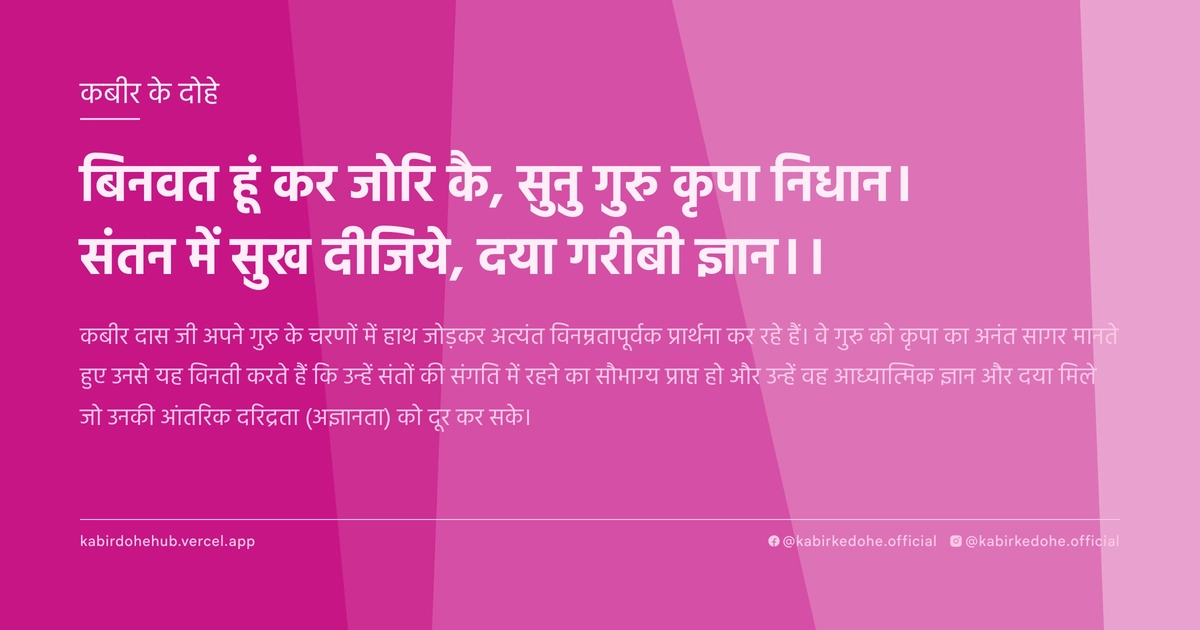
बिनवत हूं कर जोरि कै, सुनु गुरु कृपा निधान।
संतन में सुख दीजिये, दया गरीबी ज्ञान।।
Binvat hun kar jori kai, sunu guru kripa nidhaan. Santan me sukh deeje, daya gareebi gyaan.
इस पृष्ठ पर इस कबीर दोहे का अर्थ (meaning), हिंदी व्याख्या और अंग्रेज़ी अनुवाद, दार्शनिक विश्लेषण और व्यावहारिक जीवन सीख दी गई है। यह दोहा विनम्रता (Humility) विषय से जुड़ा है — Kabir doha meaning and explanation in Hindi and English.
अर्थ (Meaning):
कबीर दास जी अपने गुरु के चरणों में हाथ जोड़कर अत्यंत विनम्रतापूर्वक प्रार्थना कर रहे हैं। वे गुरु को कृपा का अनंत सागर मानते हुए उनसे यह विनती करते हैं कि उन्हें संतों की संगति में रहने का सौभाग्य प्राप्त हो और उन्हें वह आध्यात्मिक ज्ञान और दया मिले जो उनकी आंतरिक दरिद्रता (अज्ञानता) को दूर कर सके।
Kabir bows with folded hands in profound humility, addressing his Guru as the eternal reservoir of grace. He prays to be granted the bliss of the company of saints and asks for the gift of compassion and spiritual wisdom to alleviate the 'poverty' of his soul—the void created by ignorance.
व्याख्या (Interpretation):
यह दोहा केवल एक भौतिक प्रार्थना नहीं है, बल्कि आत्मा की परमात्मा के प्रति गहरी तड़प का प्रतीक है। यहाँ 'कर जोरि कै' अहंकार के पूर्ण विसर्जन को दर्शाता है। 'गरीबी' शब्द का प्रयोग यहाँ आर्थिक अभाव के लिए नहीं, बल्कि आध्यात्मिक रिक्तता और अज्ञान के लिए किया गया है। कबीर यह स्पष्ट करते हैं कि वास्तविक दरिद्रता वह है जहाँ मनुष्य स्वयं को और सत्य को नहीं जानता। संतों का साथ वह वातावरण है जहाँ माया का पर्दा हटता है और साधक को यह अनुभव होता है कि वह और ब्रह्म एक ही हैं। यह Nirgun Bhakti का सार है, जहाँ गुरु केवल एक व्यक्ति नहीं, बल्कि वह प्रकाश है जो अंधकार को मिटाता है।
This couplet transcends a simple plea, symbolizing the soul's intense longing for the Divine. The act of 'folding hands' represents the total dissolution of the ego, the primary barrier to enlightenment. 'Poverty' here is not material lack but spiritual bankruptcy—the void of self-awareness. Kabir posits that the greatest indigence is ignorance of the Atman. The 'company of saints' serves as the catalyst for piercing the veil of Maya, leading the seeker toward the non-dual realization of Advaita Vedanta. The Guru is not merely a human instructor but the embodiment of the formless light that guides the seeker from the illusion of separation to the truth of oneness.
दार्शनिक विश्लेषण (Philosophical Analysis):
कबीर का यह दोहा उस युग की प्रतिक्रिया है जहाँ धर्म केवल कर्मकांडों और बाहरी आडंबरों तक सीमित था। उन्होंने यह स्थापित किया कि मोक्ष किसी मंदिर या मस्जिद में नहीं, बल्कि आंतरिक रूपांतरण और गुरु की कृपा में निहित है। यह विचार सूफी मत के 'पीर' और वेदांत के 'गुरु' के सिद्धांतों का संगम है, जहाँ समर्पण (Surrender) ही ज्ञान का एकमात्र द्वार है।
यहाँ 'गरीबी' का दार्शनिक अर्थ 'अविद्या' है। जब तक मनुष्य यह मानता है कि वह एक अलग इकाई है, वह आध्यात्मिक रूप से दरिद्र है। कबीर का दर्शन यह है कि अहंकार का विसर्जन ही वास्तविक संपदा है। वे जाति और वर्ग के भेदभाव को नकारते हुए कहते हैं कि ज्ञान किसी विशेष कुल का अधिकार नहीं, बल्कि पात्रता और विनम्रता का फल है।
यह दोहा 'शून्यता' की अवधारणा को पुष्ट करता है। जब साधक स्वयं को पूरी तरह खाली कर देता है (जैसे एक खाली बर्तन), तभी गुरु की कृपा का अमृत उसमें समा सकता है। यह मनोवैज्ञानिक रूप से एक 'unlearning' की प्रक्रिया है, जहाँ पुराने पूर्वाग्रहों को मिटाकर सत्य को स्वीकार किया जाता है।
भक्ति आंदोलन के संदर्भ में, यह दोहा 'साधु संगति' के महत्व को रेखांकित करता है। संतों का साथ व्यक्ति के अवचेतन मन को शुद्ध करता है और उसे सांसारिक मोह-माया से ऊपर उठाकर निर्गुण ब्रह्म की ओर ले जाता है।
अंततः, कबीर यह संदेश देते हैं कि ज्ञान केवल सूचना नहीं है, बल्कि एक अनुभव है जो दया और करुणा के साथ आता है। बिना दया के ज्ञान केवल अहंकार को बढ़ाता है, जबकि कृपा से मिला ज्ञान आत्मा को मुक्त करता है।
Kabir's verse emerges as a critique of an era dominated by rigid ritualism and external piety. He asserts that liberation is found not in shrines, but in internal transformation and the grace of a realized master. This aligns with the Sufi concept of the 'Pir' and the Vedantic 'Guru', where absolute surrender is the only gateway to Truth.
The philosophical core of 'poverty' here is 'Avidya' (ignorance). As long as the individual perceives themselves as a separate entity from the Whole, they remain spiritually bankrupt. Kabir suggests that the annihilation of the ego is the only true wealth. He dismantles caste and class hierarchies, arguing that wisdom is not a birthright but a fruit of humility and readiness.
This teaching reinforces the concept of 'Sunyata' or emptiness. Only when the seeker becomes completely empty—stripping away the layers of identity—can the nectar of grace be poured in. Psychologically, this is a process of 'unlearning', where preconceived notions are discarded to make room for direct experience.
Within the Bhakti movement, this emphasizes 'Satsang' (company of the truth-seekers). The influence of realized souls purifies the subconscious, lifting the practitioner above the illusions of Maya toward the formless Nirgun Brahman.
Ultimately, Kabir posits that knowledge is not intellectual accumulation but a lived experience intertwined with compassion. Knowledge without grace fuels the ego; knowledge born of grace liberates the soul.
मूल संदेश (Core Message):
- अहंकार का समर्पण ही ज्ञान का एकमात्र द्वार है।
- वास्तविक दरिद्रता धन का अभाव नहीं, बल्कि आत्म-बोध की कमी है।
- गुरु की कृपा केवल बाहरी मार्गदर्शन नहीं, बल्कि आंतरिक जागरण है।
- सत्संग वह दर्पण है जो हमारी आत्मा की धूल साफ करता है।
- दया और विनम्रता के बिना आध्यात्मिक ज्ञान व्यर्थ है।
- The surrender of ego is the only gateway to true wisdom.
- True poverty is not the lack of wealth, but the absence of self-realization.
- The Guru's grace is not mere guidance, but an internal awakening.
- Satsang is the mirror that clears the dust from the soul.
- Spiritual knowledge is void without the presence of compassion and humility.
व्यावहारिक उदाहरण (Practical Example):
एक समय की बात है, बनारस के घाटों पर माधव नाम का एक वृद्ध बुनकर रहता था। माधव अपने काम में निपुण था, लेकिन उसका मन हमेशा अशांत रहता था। वह मानता था कि उसकी गरीबी उसके दुर्भाग्य का कारण है और वह ईश्वर से शिकायत करता था कि उसे पर्याप्त धन क्यों नहीं मिला।
वह अक्सर एक शांत संत के पास जाता जो गंगा के किनारे बैठते थे। माधव उनसे कहता, "महाराज, मुझे धन पाने का कोई मंत्र बताइये ताकि मेरी दरिद्रता मिट जाए।"
संत उसकी बात सुनकर मुस्कुराते और उसे केवल मौन रहने का निर्देश देते। कई महीनों तक माधव ने यह किया, लेकिन उसे कोई धन नहीं मिला। वह निराश होकर एक दिन चिल्लाया, "आप मुझे केवल चुप रहना सिखा रहे हैं, जबकि मेरी भूख और गरीबी बढ़ती जा रही है!"
संत ने शांति से कहा, "माधव, तुम्हारी भूख पेट की नहीं, तुम्हारी आत्मा की है। तुम धन की कमी को गरीबी कह रहे हो, जबकि तुम्हारी असली गरीबी यह है कि तुम इस क्षण में शांति नहीं पा सकते।"
माधव को पहली बार महसूस हुआ कि उसकी असली समस्या उसकी बाहरी स्थिति नहीं, बल्कि उसका आंतरिक असंतोष और अहंकार था जो उसे यह विश्वास दिलाता था कि वह 'अधूरा' है।
उसने अपनी हथेलियाँ जोड़ीं और पहली बार धन के लिए नहीं, बल्कि उस शांति के लिए प्रार्थना की जिसे वह अब तक अनदेखा कर रहा था। उसने महसूस किया कि वह अब तक केवल अपनी इच्छाओं का गुलाम था।
उस दिन के बाद, माधव ने अपने काम को पूजा बना लिया। वह अब केवल कपड़े नहीं बुनता था, बल्कि हर धागे में उस अनंत शांति को बुनने लगा।
उसका व्यवहार बदल गया। वह अब दूसरों की मदद करने लगा और उसके चेहरे पर एक ऐसा तेज आ गया जिसे देखकर लोग उसे 'धनवान' कहने लगे, भले ही उसके पास अब भी उतने ही पुराने कपड़े थे।
उसने जान लिया कि गुरु की कृपा उसे सोना नहीं, बल्कि वह दृष्टि देती है जिससे वह मिट्टी में भी सोना देख सके।
Once in the ghats of Varanasi, there lived an elderly weaver named Madhav. Though skilled in his craft, Madhav's mind was a storm of restlessness. He believed his material poverty was a curse and constantly complained to the Divine about his lack of wealth.
He frequently visited a serene saint who sat by the Ganges. Madhav would plead, "Maharaj, give me a mantra to acquire wealth so that my poverty may end."
The saint would only smile and instruct him to practice silence. For months, Madhav obeyed, but no gold appeared. One day, driven by frustration, he cried out, "You only teach me to be silent while my hunger and poverty grow!"
The saint replied calmly, "Madhav, your hunger is not of the belly, but of the soul. You call the lack of coins poverty, but your true poverty is the inability to find peace in this moment."
For the first time, Madhav realized that his struggle was not with his external circumstances, but with an internal void—an ego that whispered he was 'incomplete'.
He folded his hands, not to ask for gold, but for the grace to see the peace he had ignored. He realized he had been a slave to his own endless desires.
From that day, Madhav transformed his weaving into a meditation. He no longer just wove fabric; he wove the silence of the infinite into every thread.
His behavior shifted. He began helping others, and a radiance settled on his face. People began calling him 'wealthy', despite him wearing the same tattered clothes.
He understood that the Guru's grace does not provide gold, but the vision to see the gold within the clay of existence.
अभ्यास मार्गदर्शन (Practice Guidance):
- प्रतिदिन 20 मिनट मौन साधना करें, जहाँ आप केवल अपने भीतर की 'रिक्तता' को महसूस करें और उसे स्वीकार करें।
- एक डायरी लिखें जिसमें आप उन क्षणों को दर्ज करें जब आपका अहंकार (मैं, मेरा) आपको दूसरों से अलग करता है।
- व्यवहार परिवर्तन: दिन में कम से कम एक बार किसी ऐसे व्यक्ति की निस्वार्थ मदद करें जिससे आपको कोई लाभ न हो, ताकि 'दया' का भाव जागृत हो।
- निदान चेकलिस्ट: क्या मैं अभी भी अपनी समस्याओं के लिए बाहरी परिस्थितियों को दोष दे रहा हूँ? क्या मैं ज्ञान को केवल सूचना मान रहा हूँ या अनुभव? क्या मेरी प्रार्थनाएँ केवल माँगने के लिए हैं या समर्पण के लिए?
- Practice 20 minutes of daily silent meditation, focusing on observing the 'void' within and accepting it without judgment.
- Maintain a journal to record moments where the ego ('I', 'Mine') creates a sense of separation between you and others.
- Behavioral Shift: Perform one act of selfless service daily for someone who cannot reciprocate, cultivating the quality of 'Daya' (compassion).
- Diagnostic Checklist: Am I still blaming external circumstances for my unrest? Do I treat knowledge as mere information or as a lived experience? Are my prayers based on demand or on surrender?
चिंतन प्रश्न (Reflection Questions):
- मेरे जीवन में 'गरीबी' का क्या अर्थ है—क्या यह केवल भौतिक है या मैं भावनात्मक और आध्यात्मिक रूप से रिक्त हूँ?
- जब मैं प्रार्थना करता हूँ, तो क्या मैं वास्तव में समर्पण कर रहा हूँ या केवल अपनी इच्छाओं की सूची दे रहा हूँ?
- मेरे भीतर का वह कौन सा अहंकार है जो मुझे दूसरों को 'नीचा' या 'ऊँचा' देखने पर मजबूर करता है?
- क्या मैं ज्ञान का उपयोग दूसरों को प्रभावित करने के लिए करता हूँ या स्वयं को बदलने के लिए?
- यदि मेरी सारी सामाजिक पहचान (पद, प्रतिष्ठा, संबंध) छीन ली जाए, तो मेरे पास क्या बचेगा?
- What does 'poverty' mean in my life—is it merely material, or am I emotionally and spiritually void?
- When I pray, am I truly surrendering, or am I simply presenting a list of demands?
- Which part of my ego compels me to perceive others as either 'superior' or 'inferior'?
- Do I use knowledge to impress others or as a tool for my own transformation?
- If all my social identities—rank, reputation, relationships—were stripped away, what would remain of me?