
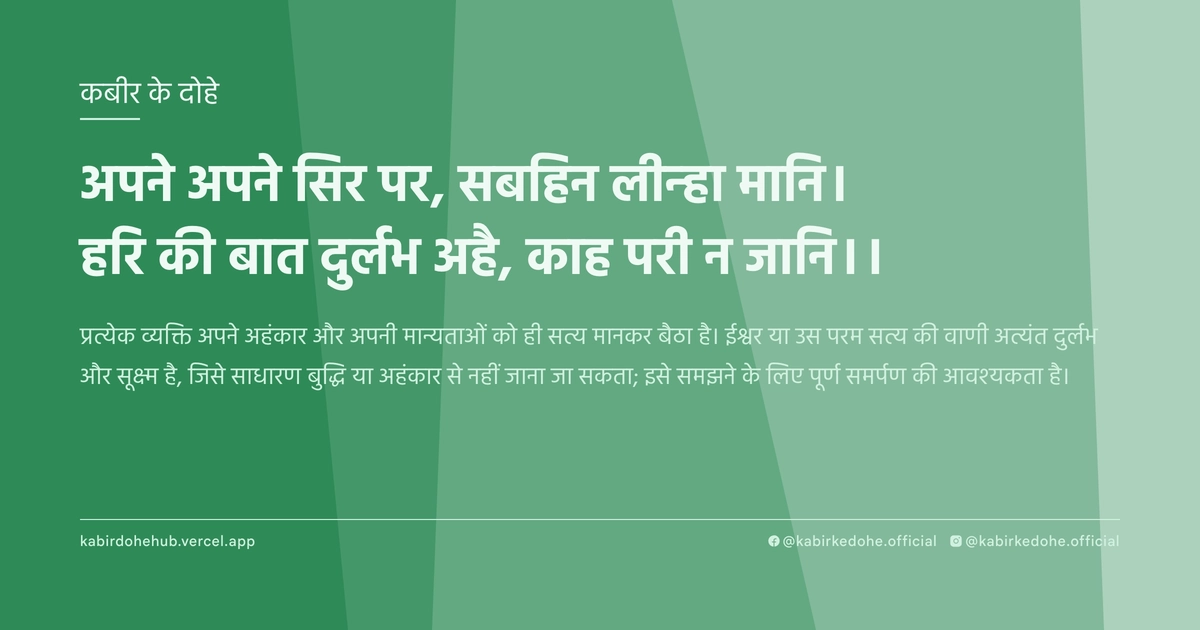
अपने अपने सिर पर, सबहिन लीन्हा मानि।
हरि की बात दुर्लभ अहै, काह परी न जानि।।
Apne apne sir par, sabhin línha maani. Hari ki baat durlabh ahai, kaah pari na jaani.
इस पृष्ठ पर इस कबीर दोहे का अर्थ (meaning), हिंदी व्याख्या और अंग्रेज़ी अनुवाद, दार्शनिक विश्लेषण और व्यावहारिक जीवन सीख दी गई है। यह दोहा अहंकार (The Ego) विषय से जुड़ा है — Kabir doha meaning and explanation in Hindi and English.
अर्थ (Meaning):
प्रत्येक व्यक्ति अपने अहंकार और अपनी मान्यताओं को ही सत्य मानकर बैठा है। ईश्वर या उस परम सत्य की वाणी अत्यंत दुर्लभ और सूक्ष्म है, जिसे साधारण बुद्धि या अहंकार से नहीं जाना जा सकता; इसे समझने के लिए पूर्ण समर्पण की आवश्यकता है।
Every individual clings to their own pride and perceived truths as the ultimate reality. The word of the Divine is rare and subtle, remaining elusive to those who approach it with a closed mind or an inflated ego; it requires a total dissolution of the self to be truly understood.
व्याख्या (Interpretation):
इस दोहे का शाब्दिक अर्थ है कि लोग अपने ज्ञान और प्रतिष्ठा के मद में चूर हैं। आध्यात्मिक स्तर पर, यह 'अहंकार' (Ego) की उस दीवार की ओर संकेत करता है जो जीव और ब्रह्म के बीच खड़ी है। कबीर यहाँ 'मान' को उस मानसिक अवरोध के रूप में देखते हैं जो व्यक्ति को केवल अपनी सीमित दृष्टि तक सीमित रखता है। निर्गुण भक्ति के अनुसार, जब तक 'मैं' का अस्तित्व है, तब तक 'हरि' (परम तत्व) का अनुभव असंभव है। यह अद्वैत वेदांत के उस सिद्धांत को पुष्ट करता है जहाँ अविद्या (अज्ञान) ही बंधन का कारण है। यहाँ 'दुर्लभ' शब्द यह दर्शाता है कि सत्य बाहरी खोज का विषय नहीं, बल्कि आंतरिक मौन की उपलब्धि है। अंततः, यह दोहा मनुष्य की उस विडंबना को उजागर करता है जहाँ वह सत्य की खोज तो करता है, परंतु उसे अपने साथ लेकर चलने वाले अहंकार को त्यागने को तैयार नहीं होता।
Literally, the verse describes people clinging to their own prestige and beliefs. Metaphorically, it addresses the 'Ahamkara' or ego—the psychic wall separating the individual soul from the Universal Consciousness. In the framework of Nirgun Bhakti, Kabir identifies 'Maana' (pride) as the primary cognitive filter that traps a person within their own limited perspective. This aligns with Advaita Vedanta, where 'Avidya' (ignorance) is the root cause of bondage. The term 'Durlabh' (rare) suggests that the Divine Truth is not an external object to be acquired, but an internal silence to be realized. The central paradox presented is that the seeker desires the Truth but refuses to surrender the very instrument—the ego—that prevents the Truth from being seen. Thus, the Divine remains elusive not because it is hidden, but because the seeker is blinded by their own perceived importance.
दार्शनिक विश्लेषण (Philosophical Analysis):
कबीर का यह दोहा उस सामाजिक और धार्मिक वातावरण की प्रतिक्रिया है जहाँ पंडित और मुल्ला अपनी शास्त्रगत श्रेष्ठता का दावा करते थे। कबीर ने देखा कि धर्म केवल बाहरी कर्मकांडों और बौद्धिक अहंकार का खेल बन गया है। वे ritualism का पुरजोर विरोध करते हैं क्योंकि उनके अनुसार, मंदिर या मस्जिद जाने से अधिक महत्वपूर्ण है अपने भीतर के 'मैं' को मिटाना।
दार्शनिक रूप से, यह सूफी मत के 'फना' (अहंकार का विनाश) और अद्वैत के 'अहं ब्रह्मास्मि' के बीच का सेतु है। जब तक व्यक्ति स्वयं को कर्ता मानता है, वह सत्य से दूर रहता है। कबीर तर्क देते हैं कि सत्य कोई ऐसी वस्तु नहीं है जिसे तर्क या शास्त्र से जीता जा सके, बल्कि यह एक अनुभव है जो केवल तब घटित होता है जब तर्क शांत हो जाता है।
यहाँ 'हरि' शब्द किसी विशेष देवता के लिए नहीं, बल्कि उस निराकार चेतना (Nirgun Brahman) के लिए प्रयुक्त हुआ है जो सर्वव्यापी है। कबीर का प्रहार उन लोगों पर है जो धर्म को एक उपलब्धि या पदक की तरह पहनते हैं। उनके लिए, आध्यात्मिक प्रगति का अर्थ अधिक ज्ञान प्राप्त करना नहीं, बल्कि कम अहंकार रखना है।
मनोवैज्ञानिक स्तर पर, यह 'कन्फर्मेशन बायस' की बात करता है—हम वही देखते हैं जो हम देखना चाहते हैं। जब हम अपनी मान्यताओं को 'सिर पर' धारण कर लेते हैं, तो हम सत्य के प्रति अंधे हो जाते हैं। यह मानसिक जड़ता ही है जो मनुष्य को उसकी वास्तविक प्रकृति से अलग करती है।
अंततः, कबीर यह संदेश देते हैं कि सत्य की प्राप्ति के लिए 'अन-लर्निंग' (unlearning) की प्रक्रिया आवश्यक है। जब तक हम अपनी पुरानी धारणाओं के बोझ से दबे हैं, हम उस सूक्ष्म ईश्वरीय संगीत को नहीं सुन सकते जो निरंतर बज रहा है। यह दोहा हमें बौद्धिक अहंकार से भावनात्मक सरलता की ओर ले जाने का आह्वान है।
Kabir's verse is a sharp critique of the socio-religious climate of his era, where priests and clerics claimed spiritual superiority based on scriptural literacy. He observed that religion had devolved into a performance of rituals and a contest of intellectual vanity. Kabir rejects ritualism because he believes that the act of visiting a temple or mosque is meaningless if the 'I' within remains untouched and arrogant.
Philosophically, this teaching bridges the Sufi concept of 'Fana' (the annihilation of the self) and the Advaitic realization of 'Aham Brahmasmi'. As long as the individual perceives themselves as the primary doer and owner of knowledge, they remain estranged from the Truth. Kabir argues that the Divine is not a trophy to be won through logic or scholarship, but an experience that manifests only when the intellect falls silent.
In this context, 'Hari' does not refer to a sectarian deity but to the formless, omnipresent consciousness (Nirgun Brahman). Kabir attacks the tendency to wear religion as a badge of honor or a social status. For him, spiritual evolution is not about accumulating more knowledge, but about shedding the layers of ego that obscure the innate purity of the soul.
Psychologically, the verse addresses the phenomenon of confirmation bias—the human tendency to see only what aligns with existing beliefs. When we 'carry our pride on our heads,' we create a cognitive filter that blocks any truth that contradicts our self-image. This mental rigidity is the primary obstacle to liberation.
Ultimately, Kabir suggests that the path to truth requires a process of 'unlearning.' Until we discard the heavy burden of our preconceived notions, we cannot hear the subtle, eternal vibration of the Divine. The verse is a call to move from the complexity of intellectual arrogance to the simplicity of heartfelt surrender.
मूल संदेश (Core Message):
- अहंकार सत्य और साधक के बीच की सबसे बड़ी दीवार है।
- ज्ञान का संचय नहीं, बल्कि अहंकार का विसर्जन ही वास्तविक उपलब्धि है।
- सत्य तर्क से नहीं, बल्कि पूर्ण आत्म-समर्पण से प्राप्त होता है।
- विनम्रता वह द्वार है जिससे ईश्वरीय चेतना भीतर प्रवेश करती है।
- अपनी मान्यताओं को सत्य मानने के बजाय, सत्य को खोजने के लिए खुला रहें।
- The ego is the primary wall separating the seeker from the Truth.
- True achievement is not the accumulation of knowledge, but the dissolution of pride.
- Truth is not captured by logic, but realized through total surrender.
- Humility is the portal through which Divine Consciousness enters the soul.
- Instead of clinging to your beliefs as truth, remain open to discovering the Truth.
व्यावहारिक उदाहरण (Practical Example):
एक समय की बात है, वाराणसी के घाटों पर माधव नाम का एक वृद्ध बुनकर रहता था। माधव अपने शहर का सबसे कुशल बुनकर माना जाता था और उसे अपनी कला पर बहुत गर्व था। वह अक्सर अन्य बुनकरों को नीचा दिखाता था और कहता था कि उसके जैसा महीन कपड़ा कोई और नहीं बुन सकता।
एक दिन एक फकीर उसके पास आया और माधव के कपड़े की प्रशंसा की। माधव अहंकार से फूल गया और कहने लगा, "मेरी कला ही मेरी पूजा है, और मैं इस कला में सर्वश्रेष्ठ हूँ।"
फकीर ने मुस्कुराते हुए एक साधारण सा सूती कपड़ा निकाला और कहा, "माधव, इस कपड़े को देखो। इसमें कोई बारीकी नहीं है, कोई चमक नहीं है, लेकिन इसमें वह शांति है जो तुम्हारे रेशमी कपड़ों में नहीं है।"
माधव ने उपहास करते हुए कहा, "यह तो एक साधारण rags है! इसमें क्या महानता है?"
फकीर ने शांति से उत्तर दिया, "इस कपड़े को बुनने वाले ने अपनी कुशलता का प्रदर्शन नहीं किया, बल्कि उसने अपनी पूरी चेतना को धागों में समर्पित कर दिया। तुमने कपड़ा अपनी श्रेष्ठता सिद्ध करने के लिए बुना, उसने कपड़ा स्वयं को मिटाने के लिए बुना।"
माधव को पहले तो यह बात समझ नहीं आई, लेकिन उस रात उसे नींद नहीं आई। उसे महसूस हुआ कि वह अपनी कला का उपयोग दूसरों की सेवा या ईश्वर की स्तुति के लिए नहीं, बल्कि अपनी प्रशंसा के लिए कर रहा था।
अगले दिन, माधव ने अपनी सबसे महंगी साड़ियों को किनारे रखा और एक साधारण चादर बुनना शुरू किया। इस बार उसने यह नहीं सोचा कि लोग क्या कहेंगे या वह कितना श्रेष्ठ दिखेगा। उसने केवल उस शून्य में डूबकर काम किया।
जैसे-जैसे दिन बीते, माधव का क्रोध और अहंकार कम होने लगा। उसने महसूस किया कि जब वह 'सर्वश्रेष्ठ बुनकर' होने का बोझ उतार फेंकता है, तो वह वास्तव में बुनने की प्रक्रिया का आनंद लेने लगता है।
एक दिन, एक गरीब बीमार व्यक्ति उसके पास आया। माधव ने बिना किसी संकोच के अपनी सबसे अच्छी चादर उसे मुफ्त में दे दी। उस समय उसे जो सुख मिला, वह उसकी किसी भी पुरस्कार विजेता कृति से कहीं अधिक था।
माधव अब समझ चुका था कि 'हरि की बात' उसकी कुशलता में नहीं, बल्कि उसकी विनम्रता में छिपी थी। उसने अपने सिर से 'मान' का बोझ उतारा और जीवन की वास्तविक सुंदरता को पाया।
Once, on the ghats of Varanasi, lived an elderly weaver named Madhav. Madhav was regarded as the most skilled weaver in the city, and he took immense pride in his craft. He often belittled other weavers, claiming that no one could match the finesse of his fabric.
One day, a wandering dervish visited him and praised Madhav's work. Madhav, swelling with pride, declared, "My art is my worship, and I am the undisputed master of this craft."
The dervish smiled and produced a simple, coarse cotton cloth, saying, "Madhav, look at this fabric. It has no intricacy, no luster, yet it possesses a peace that is absent from your silk robes."
Madhav scoffed, "This is merely a rag! Where is the greatness in this?"
The dervish replied calmly, "The one who wove this did not seek to demonstrate skill; instead, he surrendered his entire consciousness into the threads. You wove your cloth to prove your superiority; he wove his to erase himself."
At first, Madhav did not understand, but he found himself unable to sleep that night. He realized that he had been using his art not as a service to others or a tribute to the Divine, but as a tool for self-glorification.
The next morning, Madhav set aside his most expensive silks and began weaving a simple sheet. This time, he didn't think about public acclaim or his status as a master. He simply immersed himself in the void of the process.
As days passed, Madhav's anger and arrogance began to dissolve. He discovered that by dropping the burden of being the 'best weaver,' he could finally experience the pure joy of creation.
One day, a poor, ailing man came to his door. Without hesitation, Madhav gave him his finest sheet for free. The surge of peace he felt in that moment far exceeded the pleasure of any award-winning masterpiece.
Madhav finally understood that the 'Word of the Divine' was not hidden in his technical skill, but in his humility. By casting off the crown of pride from his head, he discovered the true beauty of existence.
अभ्यास मार्गदर्शन (Practice Guidance):
- प्रतिदिन 20 मिनट मौन अभ्यास करें, जहाँ आप अपने विचारों को केवल साक्षी भाव से देखें, बिना किसी निर्णय के।
- एक 'अहंकार डायरी' लिखें: दिन भर में उन क्षणों को नोट करें जब आपको लगा कि आप दूसरों से श्रेष्ठ हैं या जब आपको अपनी बात मनवाने की तीव्र इच्छा हुई।
- सचेत सेवा: सप्ताह में एक बार ऐसा कार्य करें जिसमें आपकी पहचान गुप्त रहे और आपको कोई श्रेय न मिले।
- निदान चेकलिस्ट: क्या मैं दूसरों की सलाह सुनते समय अंदर से चिढ़ महसूस करता हूँ? क्या मैं अपनी उपलब्धियों का बार-बार जिक्र करता हूँ? यदि हाँ, तो यह 'मान' की उपस्थिति का संकेत है।
- Practice 20 minutes of daily silence, observing your thoughts as a witness without judgment or attachment.
- Maintain an 'Ego Journal': Note moments throughout the day when you felt superior to others or felt an intense need to prove yourself right.
- Anonymous Service: Once a week, perform an act of kindness where your identity remains hidden and you receive no credit.
- Diagnostic Checklist: Do I feel internal irritation when listening to others' advice? Do I frequently mention my achievements? If yes, this indicates the presence of 'Maana' (pride).
चिंतन प्रश्न (Reflection Questions):
- मेरे व्यक्तित्व का वह कौन सा हिस्सा है जिसे मैं दुनिया के सामने 'श्रेष्ठ' दिखाने की कोशिश करता हूँ, और उसके पीछे का डर क्या है?
- यदि मेरी सारी डिग्रियाँ, पद और उपलब्धियाँ छीन ली जाएँ, तो क्या मेरे पास कोई पहचान बचेगी?
- क्या मैं वास्तव में सत्य की खोज कर रहा हूँ, या मैं केवल अपनी मौजूदा मान्यताओं की पुष्टि करने वाले प्रमाण ढूँढ रहा हूँ?
- मेरे जीवन में वह कौन सा व्यक्ति है जिसे मैं 'अज्ञानी' मानता हूँ, और क्या संभव है कि वह मुझे कुछ ऐसा सिखा सके जो मैं नहीं जानता?
- जब कोई मेरी आलोचना करता है, तो मुझे क्रोध क्यों आता है? वह 'कौन' है जिसे चोट पहुँच रही है?
- Which part of my identity do I strive to project as 'superior' to the world, and what is the underlying fear driving this need?
- If all my degrees, titles, and achievements were stripped away, would any sense of identity remain?
- Am I truly seeking the Truth, or am I merely searching for evidence that confirms my existing biases?
- Who is the person in my life I consider 'ignorant,' and is it possible they possess a truth that I am blind to?
- When someone criticizes me, why do I feel anger? Who is the 'I' that is being wounded?