
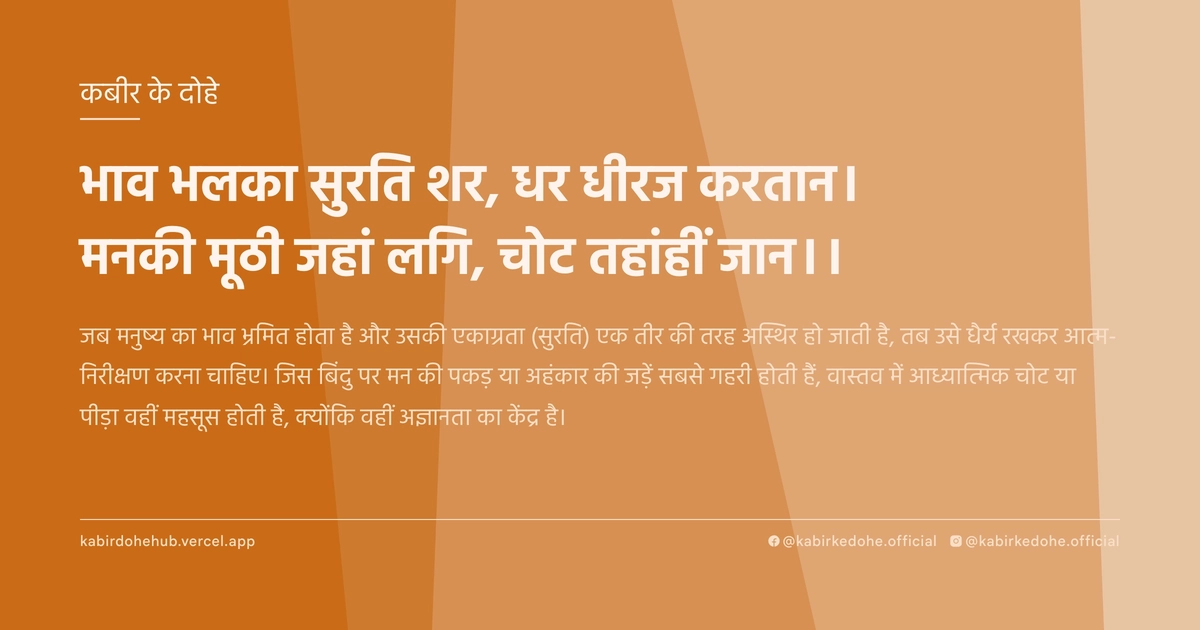
भाव भलका सुरति शर, धर धीरज करतान।
मनकी मूठी जहां लगि, चोट तहांहीं जान।।
Bhav bhalka surati shar, dhar dheeraj kartan. Manki muthi jahan lagi, chot tahahin jaan.
इस पृष्ठ पर इस कबीर दोहे का अर्थ (meaning), हिंदी व्याख्या और अंग्रेज़ी अनुवाद, दार्शनिक विश्लेषण और व्यावहारिक जीवन सीख दी गई है। यह दोहा ध्यान (Meditation) विषय से जुड़ा है — Kabir doha meaning and explanation in Hindi and English.
अर्थ (Meaning):
जब मनुष्य का भाव भ्रमित होता है और उसकी एकाग्रता (सुरति) एक तीर की तरह अस्थिर हो जाती है, तब उसे धैर्य रखकर आत्म-निरीक्षण करना चाहिए। जिस बिंदु पर मन की पकड़ या अहंकार की जड़ें सबसे गहरी होती हैं, वास्तव में आध्यात्मिक चोट या पीड़ा वहीं महसूस होती है, क्योंकि वहीं अज्ञानता का केंद्र है।
When one's emotional state is clouded and attention becomes as erratic as a flying arrow, one must exercise patience in the process of spiritual churning. The pain we feel is not external; it is located exactly where the grip of the mind's ego is tightest, marking the precise spot where our ignorance resides.
व्याख्या (Interpretation):
यह दोहा मन की चंचलता और आध्यात्मिक पीड़ा के अंतर्संबंध को दर्शाता है। 'सुरति शर' का अर्थ है वह ध्यान जो लक्ष्य से भटक गया है। कबीर यहाँ समझा रहे हैं कि हम जिसे बाहरी दुख समझते हैं, वह वास्तव में हमारी अपनी मानसिक पकड़ (मूठी) का परिणाम है। यह निर्गुण भक्ति का सार है, जहाँ साधक को यह समझना होता है कि माया ने उसे भ्रमित किया है। जब हम धैर्य (धीरज) धारण करते हैं, तब हमें बोध होता है कि चोट कहीं बाहर से नहीं लगी, बल्कि हमारे अपने अहंकार के जुड़ाव ने ही हमें घायल किया है। यह आत्मा और ब्रह्म के बीच के उस पर्दे को हटाने की प्रक्रिया है जिसे हम 'मैं' कहते हैं।
This couplet illustrates the intricate link between mental restlessness and spiritual suffering. 'Surati shar' refers to attention that has become as volatile and piercing as an arrow, missing its divine mark. Kabir suggests that the pain we attribute to external circumstances is actually the result of the 'muthi'—the tight, suffocating grip of the ego. In the context of Nirgun Bhakti, this is a realization that Maya (illusion) creates a false sense of separation. By practicing 'Dhiraj' (patience), the seeker discovers that the wound is located precisely where they are most attached. It is a paradoxical journey where the site of the greatest pain is actually the gateway to liberation, provided one recognizes the non-duality of the observer and the observed.
दार्शनिक विश्लेषण (Philosophical Analysis):
कबीर का यह दर्शन उनके युग के कर्मकांडीय आडंबरों के विरुद्ध एक सशक्त प्रहार है। जहाँ तत्कालीन समाज बाहरी तीर्थों और पूजा-पाठ में शांति खोज रहा था, कबीर ने 'अंतर्मुखी' होने का मार्ग दिखाया। यह दृष्टिकोण अद्वैत वेदांत के करीब है, जो कहता है कि जगत मिथ्या है और केवल ब्रह्म सत्य है। यहाँ 'मन की मूठी' उस अविद्या (ignorance) का प्रतीक है जो जीव को बंधन में रखती है।
सूफीवाद के 'फना' (अहंकार का विनाश) के सिद्धांत से इसकी गहरी समानता है। जब तक साधक अपनी पहचान को शरीर या सामाजिक स्थिति से जोड़ता है, वह पीड़ा महसूस करता है। कबीर तर्क देते हैं कि यह पीड़ा वास्तव में एक संकेत है। यदि आप जान लें कि चोट कहाँ लगी है, तो आप उस जड़ को काट सकते हैं।
ऐतिहासिक रूप से, कबीर ने जाति और धर्म की दीवारों को तोड़कर एक ऐसी भाषा चुनी जिसे आम आदमी समझ सके। उन्होंने यह स्थापित किया कि ईश्वर मंदिर या मस्जिद में नहीं, बल्कि उस 'शून्य' में है जहाँ मन की पकड़ समाप्त हो जाती है। यह मनोवैज्ञानिक रूपांतरण की प्रक्रिया है, जहाँ व्यक्ति अपनी पीड़ा को शिकायत के बजाय एक उपकरण (tool) की तरह उपयोग करता है।
अक्सर लोग इस दोहे का अर्थ केवल मानसिक तनाव से जोड़ते हैं, लेकिन इसका गहरा अर्थ 'चित्त शुद्धि' से है। जब तक मन बाहरी दुनिया के प्रति आसक्त है, वह एक तीर की तरह इधर-उधर भटकता रहेगा। धैर्य का अर्थ यहाँ केवल प्रतीक्षा करना नहीं, बल्कि सजगता के साथ अपनी आंतरिक उथल-पुथल को देखना है।
अंततः, यह दोहा हमें सिखाता है कि मुक्ति का मार्ग बाहरी संघर्षों को जीतने में नहीं, बल्कि आंतरिक पकड़ को ढीला करने में है। जब 'मूठी' खुलती है, तब वह जो पकड़ रहा था, वह स्वयं ब्रह्म में विलीन हो जाता है।
Kabir's philosophy here serves as a potent critique of the ritualistic superficiality of his era. While the society of his time sought solace in external pilgrimages and rigid ceremonies, Kabir advocated for an 'inward turn.' This perspective aligns closely with Advaita Vedanta, which posits that the perceived world is Maya (illusion) and only Brahman is the ultimate reality. The 'grip of the mind' (manki muthi) symbolizes Avidya, the primordial ignorance that keeps the soul bound to the cycle of suffering.
There is a profound resonance here with the Sufi concept of 'Fana'—the annihilation of the ego. As long as the seeker identifies with the physical body or a social persona, they remain susceptible to pain. Kabir argues that this pain is not a curse but a diagnostic signal. By locating the exact point of the 'hit,' the seeker can identify the root of their attachment and dismantle it.
Historically, Kabir bypassed the linguistic and social barriers of caste and creed, using the language of the common folk to convey esoteric truths. He established that the Divine is not housed in temples or mosques, but in the 'Shunya' (void) that emerges when the ego's grip is released. This is a process of psychological alchemy, transforming suffering into a tool for awakening.
Common literalist interpretations often mistake this for a simple lesson on stress management. However, the deeper implication is 'Chitta Shuddhi' (purification of the consciousness). When the mind is attached to the transient, it behaves like a stray arrow—erratic and destructive. Patience, in this context, is not passive waiting but an active, mindful observation of one's internal turbulence.
Ultimately, the couplet teaches that liberation is not achieved by conquering external enemies, but by loosening the internal grip. When the 'muthi' opens, the distinction between the seeker and the sought vanishes, leading to the realization of non-duality.
मूल संदेश (Core Message):
- भ्रमित मन एक भटकते हुए तीर की तरह है जो केवल चोट पहुँचाता है।
- पीड़ा बाहरी नहीं, बल्कि आंतरिक आसक्ति का परिणाम है।
- धैर्य वह उपकरण है जो मानसिक शोर को शांति में बदलता है।
- जहाँ सबसे अधिक दर्द है, वहीं मुक्ति का द्वार छिपा है।
- अहंकार की पकड़ को ढीला करना ही वास्तविक आध्यात्मिक प्रगति है।
- स्वयं को पीड़ित मानना सबसे बड़ी मानसिक गुलामी है।
- A clouded mind is like a stray arrow that only causes injury.
- Suffering is not external; it is the result of internal attachment.
- Patience is the tool that transforms mental noise into stillness.
- The point of greatest pain hides the gateway to liberation.
- Loosening the grip of the ego is the only true spiritual progress.
- Identifying as a victim is the ultimate form of mental bondage.
व्यावहारिक उदाहरण (Practical Example):
एक समय की बात है, वाराणसी के घाटों पर रहने वाली एक वृद्ध विधवा, जानकी, थी। उसका जीवन अभावों और अकेलेपन से भरा था। वह हर दिन गंगा किनारे बैठकर अपनी किस्मत को कोसती और मानती कि उसकी पीड़ा का कारण उसके मृत पति का समय से पहले चले जाना और समाज की उपेक्षा है। वह अपनी उदासी को एक ढाल की तरह पहनती थी।
एक दिन उसकी मुलाकात एक घुमक्कड़ फकीर से हुई, जिसने उसे कबीर का यह दोहा सुनाया। फकीर ने उससे पूछा, "तुम्हें दर्द कहाँ महसूस होता है?" जानकी ने कहा, "मेरे सीने में, जहाँ मेरी यादें और मेरा अकेलापन बसता है।"
फकीर मुस्कुराया और बोला, "वही तुम्हारी 'मूठी' है। तुम अपने दुख को पकड़कर बैठी हो क्योंकि तुम्हें लगता है कि यह दुख ही तुम्हारी एकमात्र पहचान है। तुमने अपनी पीड़ा को ही अपना गहना बना लिया है।"
जानकी को पहले यह बात समझ नहीं आई। लेकिन उसने फकीर की सलाह पर एक प्रयोग किया। जब भी उसे दुख की लहर महसूस होती, वह यह नहीं सोचती कि "मैं दुखी हूँ," बल्कि वह यह देखती कि "मन ने किस चीज़ को कसकर पकड़ा हुआ है?"
उसने पाया कि वह वास्तव में अपने पति के जाने के दुख को नहीं, बल्कि उस 'सम्मान' और 'सुरक्षा' को पकड़कर बैठी थी जो उसे उस रिश्ते से मिलती थी। वह अपनी पहचान एक 'बेचारी विधवा' के रूप में बनाए रखने की कोशिश कर रही थी ताकि लोग उसे सहानुभूति दें।
यह अहसास उसके लिए एक बिजली के झटके जैसा था। उसने महसूस किया कि उसकी चोट बाहरी दुनिया ने नहीं, बल्कि उसकी अपनी उस पकड़ ने दी थी जिसने उसे एक पीड़ित की छवि में कैद कर रखा था।
धीरे-धीरे, जानकी ने उस 'मूठी' को खोलना शुरू किया। उसने घाट पर आने वाले अन्य असहाय लोगों की मदद करना शुरू किया। उसने पाया कि जब उसने अपनी पीड़ा को पकड़ना छोड़ा, तो वह पीड़ा गायब हो गई और उसकी जगह एक गहरी शांति ने ले ली।
उसका व्यवहार बदल गया। वह अब शिकायत नहीं करती थी, बल्कि मुस्कुराकर लोगों का स्वागत करती थी। उसकी आंतरिक चोट अब उसके लिए एक मार्गदर्शक बन गई थी, जिसने उसे सिखाया कि असली बंधन बाहरी समाज नहीं, बल्कि मन का मोह है।
अंत में, जानकी ने जाना कि जिस बिंदु पर वह सबसे अधिक टूट रही थी, वही बिंदु उसके आध्यात्मिक जागरण का द्वार था। उसने अपनी पहचान को 'पीड़ित' से बदलकर 'साक्षी' (witness) बना लिया।
Once, on the ghats of Varanasi, lived an elderly widow named Janaki. Her life was defined by scarcity and profound loneliness. Every day, she sat by the Ganges, cursing her fate, believing her suffering was caused by her husband's untimely death and the indifference of society. She wore her sorrow like a heavy cloak.
One day, she encountered a wandering fakir who recited this specific Doha by Kabir. The fakir asked her, "Where exactly do you feel the pain?" Janaki replied, "In my chest, where my memories and my loneliness reside."
The fakir smiled and said, "That is your 'muthi'—your tight grip. You are clinging to your sorrow because you believe this pain is your only remaining identity. You have turned your suffering into an ornament."
Janaki didn't understand at first. However, following the fakir's advice, she began an experiment. Whenever a wave of grief hit her, instead of saying "I am sad," she would ask herself, "What exactly is the mind gripping so tightly right now?"
She discovered that she wasn't actually clinging to the memory of her husband, but to the 'status' and 'security' that the relationship had provided. She realized she was subconsciously holding onto the identity of a 'pitiful widow' to elicit sympathy from others.
This realization hit her like a bolt of lightning. She understood that her wound was not inflicted by the external world, but by her own grip on a fabricated image of herself as a victim.
Slowly, Janaki began to loosen that grip. She started helping other destitute people who came to the ghats. She found that as she stopped clutching her pain, the pain itself vanished, replaced by a profound, steady peace.
Her behavior transformed. She no longer complained; instead, she welcomed others with a genuine smile. Her internal wound became a guide, teaching her that the real bondage was not social, but mental attachment.
In the end, Janaki realized that the very point where she felt most broken was actually the gateway to her spiritual awakening. She shifted her identity from the 'victim' to the 'witness.'
अभ्यास मार्गदर्शन (Practice Guidance):
- प्रतिदिन 20 मिनट 'साक्षी भाव' का अभ्यास करें: जब भी मन में कोई तीव्र भावना (क्रोध, दुख, ईर्ष्या) उठे, तो उसे दबाएँ नहीं, बल्कि यह देखें कि मन ने किस विचार को 'पकड़' रखा है।
- स्व-पूछताछ जर्नल: हर रात लिखें—"आज मुझे सबसे अधिक मानसिक चोट कहाँ लगी? क्या यह बाहरी कारण से था या मेरी किसी अपेक्षा (expectation) की पकड़ के कारण?"
- धैर्य का अभ्यास: किसी भी तनावपूर्ण स्थिति में तुरंत प्रतिक्रिया देने के बजाय, 10 गहरी साँसें लें और स्वयं से पूछें, "मेरा 'सुरति शर' (ध्यान) इस समय कहाँ भटक रहा है?"
- निदान चेकलिस्ट (Diagnostic Checklist): यदि आप बार-बार एक ही तरह की शिकायत कर रहे हैं, तो समझ लें कि आपकी 'मूठी' अभी भी कसी हुई है। यदि आप स्थिति को बिना निर्णय के देख पा रहे हैं, तो आप इस ज्ञान को जी रहे हैं।
- Practice 'Witness Consciousness' for 20 minutes daily: When an intense emotion (anger, grief, jealousy) arises, do not suppress it; instead, observe what specific thought or desire the mind is 'gripping.'
- Self-Inquiry Journaling: Every night, write—"Where did I feel the most mental pain today? Was it due to an external cause or because of the grip of my own expectations?"
- The Practice of Patience: In stressful situations, instead of reacting instantly, take 10 deep breaths and ask yourself, "Where is my 'surati shar' (attention) wandering right now?"
- Diagnostic Checklist: If you find yourself repeating the same complaints, recognize that your 'muthi' (grip) is still tight. If you can observe a situation without judgment, you are successfully living this wisdom.
चिंतन प्रश्न (Reflection Questions):
- मैं अपनी सार्वजनिक छवि को बनाए रखने के लिए किन आंतरिक संघर्षों को छिपा रहा हूँ?
- मेरे जीवन का वह कौन सा 'दुख' है जिसे मैं अनजाने में अपनी पहचान बना चुका हूँ?
- क्या मेरी डिजिटल उपस्थिति (सोशल मीडिया) मेरे 'सुरति शर' को वास्तविकता से दूर ले जा रही है?
- जब मैं दूसरों की आलोचना करता हूँ, तो मैं वास्तव में अपने भीतर के किस घाव को प्रतिबिंबित कर रहा होता हूँ?
- यदि मैं अपनी सभी उपलब्धियों और दुखों की 'पकड़' छोड़ दूँ, तो वास्तव में 'मैं' कौन बचूँगा?
- क्या मेरा धैर्य वास्तव में समर्पण है, या केवल एक छिपा हुआ आलस्य?
- What internal conflicts am I hiding in order to maintain my public persona?
- Which 'sorrow' in my life have I unconsciously turned into my primary identity?
- Is my digital presence (social media) leading my 'surati shar' away from actual reality?
- When I criticize others, which internal wound of my own am I actually reflecting?
- If I let go of the grip on all my achievements and sorrows, who is the 'I' that remains?
- Is my patience truly a form of surrender, or is it merely a disguised laziness?