
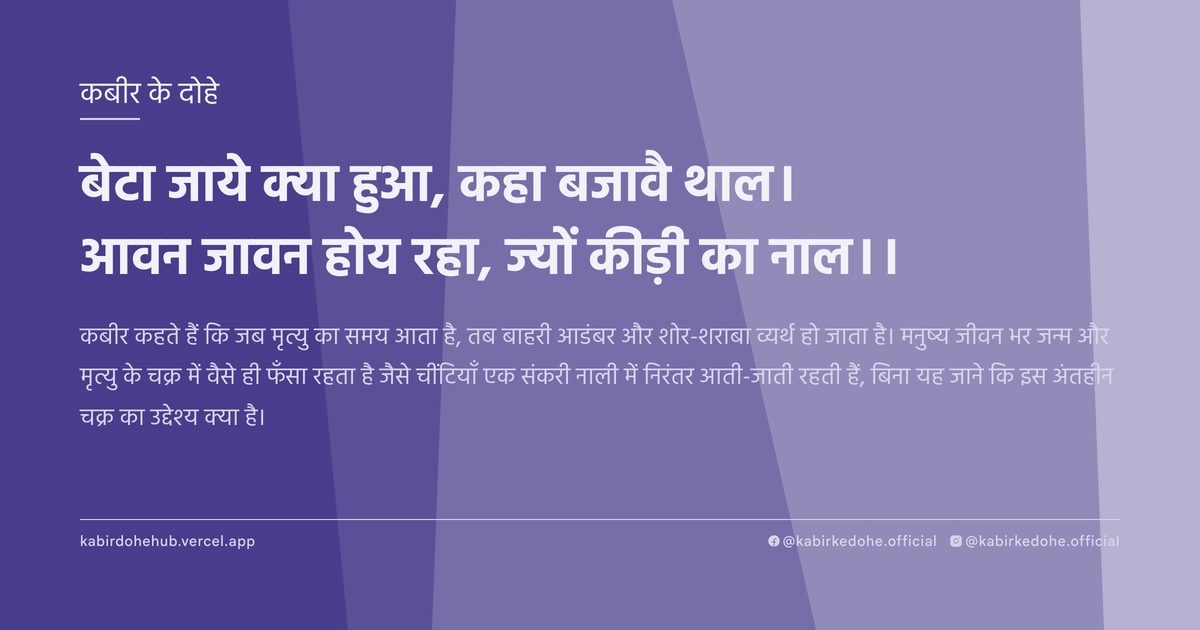
बेटा जाये क्या हुआ, कहा बजावै थाल।
आवन जावन होय रहा, ज्यों कीड़ी का नाल।।
Beta jaaye kya hua, kaha bajavai thaal. Aavan jaavan hoye raha, jyon keedi ka naal.
इस पृष्ठ पर इस कबीर दोहे का अर्थ (meaning), हिंदी व्याख्या और अंग्रेज़ी अनुवाद, दार्शनिक विश्लेषण और व्यावहारिक जीवन सीख दी गई है। यह दोहा पुनर्जन्म (Reincarnation) विषय से जुड़ा है — Kabir doha meaning and explanation in Hindi and English.
अर्थ (Meaning):
कबीर कहते हैं कि जब मृत्यु का समय आता है, तब बाहरी आडंबर और शोर-शराबा व्यर्थ हो जाता है। मनुष्य जीवन भर जन्म और मृत्यु के चक्र में वैसे ही फँसा रहता है जैसे चींटियाँ एक संकरी नाली में निरंतर आती-जाती रहती हैं, बिना यह जाने कि इस अंतहीन चक्र का उद्देश्य क्या है।
Kabir asserts that when the moment of departure arrives, all external rituals and clamorous displays become futile. Human existence is trapped in a relentless cycle of birth and death, mirroring the mindless movement of ants in a narrow channel, oblivious to the purpose of this endless recurrence.
व्याख्या (Interpretation):
इस दोहे का शाब्दिक अर्थ है कि मृत्यु के समय थाल बजाने या शोर मचाने से कुछ हासिल नहीं होता। रूपकात्मक स्तर पर, 'थाल बजाना' उन धार्मिक कर्मकांडों और सामाजिक प्रतिष्ठा का प्रतीक है जिन्हें मनुष्य जीवन भर संजोता है। निर्गुण भक्ति के परिप्रेक्ष्य में, यह संसार एक मायावी जाल है जहाँ आत्मा अज्ञानता के कारण पुनर्जन्म के चक्र में बंधी है। अद्वैत वेदांत के अनुसार, जब तक जीव स्वयं को शरीर मानता है, वह इस 'कीड़ी की नाल' यानी संकीर्ण अस्तित्व में फँसा रहता है। मुक्ति तब होती है जब व्यक्ति यह पहचान ले कि वह शरीर नहीं, बल्कि वह अविनाशी ब्रह्म है। यहाँ विरोधाभास यह है कि मनुष्य जिसे जीवन कहता है, वह वास्तव में एक अंतहीन प्रतीक्षा और दोहराव है, जब तक कि आत्म-साक्षात्कार न हो जाए।
Literally, the verse suggests that clashing cymbals or creating a ruckus is useless at the hour of death. Metaphorically, 'striking the plate' symbolizes the religious rituals and social prestige humans accumulate throughout their lives. In the context of Nirgun Bhakti, the world is a veil of Maya where the soul, blinded by ignorance, remains shackled to the cycle of rebirth. According to Advaita Vedanta, as long as the individual identifies with the physical body, they remain trapped in the 'ant's channel'—a narrow, repetitive existence. Liberation occurs only when one realizes they are not the transient body but the eternal Brahman. The central paradox lies in the fact that what we perceive as 'living' is actually a mindless repetition until the awakening of consciousness occurs.
दार्शनिक विश्लेषण (Philosophical Analysis):
कबीर का यह दोहा उनके युग के उस गहरे सामाजिक और धार्मिक पाखंड पर प्रहार है जहाँ मृत्यु के बाद भी कर्मकांडों को महत्व दिया जाता था। वे स्पष्ट करते हैं कि मोक्ष किसी बाहरी क्रिया से नहीं, बल्कि आंतरिक रूपांतरण से आता है। यह विचार सूफी मत के 'फना' (अहंकार का विनाश) के करीब है, जहाँ व्यक्ति को अपनी तुच्छ पहचान को मिटाकर परमात्मा में विलीन होना होता है।
ऐतिहासिक रूप से, कबीर ने जाति और धर्म के नाम पर होने वाले भेदभाव को नकारते हुए एक सार्वभौमिक सत्य की बात की। उनके लिए, मंदिर, मस्जिद या पूजा की थाल केवल मानसिक अवरोध हैं जो मनुष्य को वास्तविक सत्य से दूर रखते हैं। वे तर्क देते हैं कि यदि मनुष्य जीवित रहते हुए सत्य को नहीं खोजता, तो मृत्यु के समय किए गए अनुष्ठान केवल शोक मनाने वालों के लिए होते हैं, मरने वाले के लिए नहीं।
दार्शनिक स्तर पर, यह दोहा 'संसार' की अवधारणा को एक संकीर्ण नाली के रूप में चित्रित करता है। यह अद्वैत वेदांत के उस सिद्धांत को पुष्ट करता है कि अविद्या (अज्ञान) ही बंधन का कारण है। जब तक हम द्वैत में विश्वास करते हैं—कि मैं अलग हूँ और ईश्वर अलग है—तब तक हम उसी चींटी की तरह रहेंगे जो केवल आने-जाने के चक्र को ही अपना भाग्य मान लेती है।
मनोवैज्ञानिक रूप से, कबीर यहाँ 'अहंकार' के विनाश की बात कर रहे हैं। 'थाल बजाना' उस सामाजिक मुखौटे का प्रतीक है जिसे हम दुनिया को दिखाने के लिए पहनते हैं। मृत्यु इस मुखौटे को उतार देती है। कबीर चेतावनी देते हैं कि यदि हमने जीवन में अपने आंतरिक 'स्व' को नहीं पहचाना, तो हम केवल एक सांख्यिकीय दोहराव बनकर रह जाएंगे।
अंततः, यह शिक्षण हमें भौतिकवाद और कर्मकांडवाद से हटाकर 'साक्षी भाव' की ओर ले जाता है। यह हमें यह सोचने पर मजबूर करता है कि क्या हमारा जीवन वास्तव में सार्थक है या हम केवल आदतों और सामाजिक अपेक्षाओं के गुलाम हैं। यह केवल मृत्यु का भय नहीं है, बल्कि जीवन की निरर्थकता के प्रति एक चेतावनी है ताकि हम जागृत हो सकें।
This couplet is a searing critique of the religious hypocrisy of Kabir's era, where ritualistic displays were prioritized even during death. He clarifies that liberation is not achieved through external acts but through internal transformation. This aligns closely with the Sufi concept of 'Fana' (annihilation of the ego), where the individual must dissolve their petty identity to merge with the Divine.
Historically, Kabir rejected caste and sectarian divides, advocating for a universal truth. For him, temples, mosques, or the ritualistic 'plates' are merely mental barriers that distance humans from the Absolute. He argues that if a person does not seek the truth while alive, the rituals performed after death serve only the survivors, offering nothing to the departed soul.
Philosophically, the verse depicts 'Samsara' as a narrow channel. This reinforces the Advaita Vedanta principle that 'Avidya' (ignorance) is the root cause of bondage. As long as we believe in duality—that the self and the Divine are separate—we remain like the ant, perceiving the repetitive cycle of birth and death as an inevitable fate.
Psychologically, Kabir addresses the dissolution of the ego. 'Striking the plate' symbolizes the social mask we wear to gain validation. Death strips away this mask. Kabir warns that if we fail to recognize our inner 'Self' during life, we become mere statistical repetitions in a cosmic loop.
Ultimately, this teaching shifts our focus from materialism and ritualism toward the 'Witness Consciousness' (Sakshi). It forces us to question whether our lives are truly meaningful or if we are simply slaves to habit and social expectation. It is not merely a fear of death, but a warning against the futility of an unexamined life, urging an immediate spiritual awakening.
मूल संदेश (Core Message):
- बाहरी शोर आंतरिक शून्यता को नहीं भर सकता।
- कर्मकांड केवल मानसिक भ्रम हैं, सत्य अनुभव है।
- अहंकार का त्याग ही पुनर्जन्म के चक्र से मुक्ति है।
- जीवन की सार्थकता प्रदर्शन में नहीं, आत्म-साक्षात्कार में है।
- मौन ही वह द्वार है जहाँ आत्मा परमात्मा से मिलती है।
- External noise cannot fill the internal void.
- Rituals are mere mental illusions; Truth is an experience.
- Surrendering the ego is the only escape from the cycle of rebirth.
- Life's meaning lies in self-realization, not in social performance.
- Silence is the only gateway where the soul meets the Divine.
व्यावहारिक उदाहरण (Practical Example):
वाराणसी के एक पुराने घाट पर माधव नाम का एक वृद्ध व्यक्ति रहता था, जो जीवन भर धर्मगुरुओं की सेवा और भव्य पूजा-पाठ के आयोजन में लगा रहा। वह शहर के सबसे प्रतिष्ठित पंडितों के साथ थाल सजाता और घंटों मंत्रोच्चार करता था, यह विश्वास करते हुए कि ये बाहरी क्रियाएं उसे मोक्ष दिलाएंगी। उसका पूरा जीवन 'दिखावे' की पवित्रता में बीता।
माधव का एक बेटा था, जो एक साधारण बुनकर था और कबीर के पदों को चुपचाप सुनता था। बेटा अक्सर कहता, 'पिताजी, यह शोर बाहरी है, भीतर की शांति खोजिए।' लेकिन माधव इसे अज्ञानता मानता था और अपने कर्मकांडों पर गर्व करता था। वह मानता था कि जितना बड़ा अनुष्ठान होगा, ईश्वर उतना ही प्रसन्न होगा।
एक दिन माधव गंभीर रूप से बीमार पड़ा। उसके चारों ओर सबसे बड़े विद्वान एकत्र हुए, महंगे अनुष्ठान शुरू हुए और सोने के थालों में आरती की गई। पूरा कमरा शोर और धुएं से भर गया। लेकिन माधव की आंखों में शांति नहीं, बल्कि एक गहरा भय था। उसे महसूस हुआ कि यह सारा शोर उसके और उसकी आत्मा के बीच एक दीवार बन गया है।
उसने देखा कि उसके बेटे का चेहरा शांत था। बेटा केवल उसके हाथ को थामे हुए था और मौन प्रार्थना कर रहा था। उस क्षण माधव को कबीर का वह दोहा याद आया जो उसके बेटे ने कभी सुनाया था—'कहा बजावै थाल'। उसे समझ आया कि उसने जीवन भर केवल 'थाल बजाया' था, लेकिन अपने भीतर के शून्य को कभी नहीं देखा।
उसे एहसास हुआ कि उसकी सारी सामाजिक प्रतिष्ठा, उसके द्वारा किए गए हजारों यज्ञ और उसकी धार्मिक पहचान उस समय पूरी तरह व्यर्थ थी। वह खुद को उस चींटी की तरह महसूस करने लगा जो केवल एक ही रास्ते पर गोल-गोल घूम रही थी, बिना यह जाने कि बाहर एक विशाल खुला आकाश है।
अचानक, माधव ने उन सभी पंडितों से कहा कि वे शांत हो जाएं। उसने शोर को बंद करवाया और केवल मौन में डूबने का प्रयास किया। उसने पहली बार अपनी सांसों के प्रति जागरूकता महसूस की और उस 'अहंकार' को छोड़ दिया जो उसे 'महान भक्त' होने का भ्रम दे रहा था।
उसने अपने बेटे की ओर देखा और मुस्कुराया। उसने महसूस किया कि वास्तविक भक्ति किसी थाल को बजाने में नहीं, बल्कि उस मौन में है जहाँ 'मैं' और 'तू' का भेद मिट जाता है। उसने अपनी पूरी संपत्ति का त्याग कर गरीबों में बांटने का निर्णय लिया, क्योंकि अब उसे पता था कि साथ कुछ नहीं जाता।
माधव के जीवन का अंतिम समय अब भय से नहीं, बल्कि एक गहरी स्वीकृति से भरा था। उसने जान लिया था कि जन्म-मृत्यु की नाली से निकलने का एकमात्र रास्ता 'अहंकार का विसर्जन' है। उसने अपनी अंतिम सांसें उस शांति में लीं जिसे वह जीवन भर शोर में ढूंढ रहा था।
यह परिवर्तन उसके परिवार और आसपास के लोगों के लिए एक सबक बन गया। उन्होंने देखा कि कैसे एक व्यक्ति जो केवल कर्मकांडों में विश्वास करता था, अंत में एक सहज और सरल साधक बन गया। माधव की मृत्यु एक अंत नहीं, बल्कि एक वास्तविक मुक्ति की शुरुआत थी।
इस प्रकार, माधव ने उस 'कीड़ी की नाल' को पार कर लिया, क्योंकि उसने बाहरी शोर को छोड़कर आंतरिक संगीत को सुनना सीख लिया था।
On an ancient ghat in Varanasi lived an elderly man named Madhav, who spent his entire life serving religious leaders and organizing grand rituals. He spent hours decorating ritual plates and chanting mantras, believing these external acts would guarantee him salvation. His whole existence was centered on the 'performance' of piety.
Madhav had a son, a simple weaver who quietly listened to the verses of Kabir. The son would often say, 'Father, this noise is external; seek the silence within.' But Madhav dismissed this as ignorance, taking pride in his elaborate rituals, believing that the grander the ceremony, the more pleased the Divine would be.
One day, Madhav fell gravely ill. The most renowned scholars gathered around him, expensive rituals commenced, and aartis were performed with golden plates. The room was filled with noise and incense. Yet, in Madhav's eyes, there was no peace, only a profound fear. He felt that all this clamor had become a wall between him and his soul.
He noticed his son's face was serene. The son simply held his hand, praying in silence. In that moment, Madhav recalled the verse his son had once recited—'Kaha bajave thaal.' He realized he had spent his life merely 'striking the plate,' never once gazing into the void within himself.
He understood that his social prestige, the thousands of sacrifices he had performed, and his religious identity were utterly useless at this hour. He felt like that ant, circling the same narrow path, unaware that a vast, open sky existed beyond the channel.
Suddenly, Madhav asked all the priests to stop. He silenced the noise and attempted to sink into stillness. For the first time, he felt an awareness of his breath and let go of the 'ego' that had deceived him into believing he was a 'great devotee.'
He looked at his son and smiled. He realized that true devotion does not lie in clashing plates, but in the silence where the distinction between 'I' and 'Thou' vanishes. He decided to give away his remaining wealth to the poor, knowing now that nothing material accompanies the soul.
Madhav's final days were no longer filled with fear, but with a deep acceptance. He had learned that the only way to escape the 'ant's channel' of birth and death is the dissolution of the ego.
This transformation became a lesson for his family and community. They witnessed how a man who believed only in rituals eventually became a simple, spontaneous seeker. Madhav's death was not an end, but the beginning of a true liberation.
Thus, Madhav transcended the 'ant's channel' because he learned to stop the external noise and listen to the internal music of the soul.
अभ्यास मार्गदर्शन (Practice Guidance):
- प्रतिदिन 20 मिनट 'मौन साधना' करें, जहाँ आप केवल अपनी सांसों को देखें और किसी भी विचार या बाहरी शोर को बिना प्रतिक्रिया के गुजरने दें।
- एक 'अहंकार डायरी' लिखें: दिन भर में उन क्षणों को नोट करें जब आपने अपनी श्रेष्ठता सिद्ध करने के लिए 'दिखावा' किया या किसी को नीचा दिखाया।
- व्यवहार परिवर्तन: किसी भी धार्मिक या सामाजिक कार्य को करते समय स्वयं से पूछें—'क्या मैं यह आंतरिक शांति के लिए कर रहा हूँ या बाहरी प्रशंसा के लिए?'
- निदान चेकलिस्ट: यदि आप अभी भी दूसरों की राय से विचलित होते हैं या अपनी उपलब्धियों के बिना अधूरा महसूस करते हैं, तो आप अभी भी 'कीड़ी की नाल' (अहंकार के चक्र) में हैं।
- Practice 20 minutes of 'Silent Meditation' daily, observing your breath and allowing thoughts or external noises to pass without reaction.
- Maintain an 'Ego Journal': Note moments during the day when you performed an action for external validation or to assert superiority over others.
- Behavioral Shift: While performing any religious or social act, ask yourself—'Am I doing this for inner peace or for external applause?'
- Diagnostic Checklist: If you are still easily swayed by others' opinions or feel incomplete without your achievements, you are still trapped in the 'ant's channel' (the cycle of ego).
चिंतन प्रश्न (Reflection Questions):
- मेरे जीवन में 'थाल बजाना' (दिखावा) कौन सा है, जिसे मैं सत्य मानकर जी रहा हूँ?
- यदि आज मेरी सारी सामाजिक पहचान और पद छीन लिए जाएं, तो मेरे भीतर क्या बचेगा?
- मैं अपनी डिजिटल पहचान (सोशल मीडिया) को कितना वास्तविक मानता हूँ और यह मेरे आंतरिक शून्य को कैसे बढ़ा रहा है?
- क्या मेरी धार्मिक मान्यताएं मुझे वास्तव में मुक्त कर रही हैं, या वे केवल नए प्रकार के मानसिक बंधन बन गई हैं?
- मैं किन आदतों के चक्र में एक चींटी की तरह फँसा हुआ हूँ, जिसे मैं 'जीवन' कह रहा हूँ?
- What is the 'striking of the plate' (performance) in my life that I have mistaken for truth?
- If all my social identities and titles were stripped away today, what would remain within me?
- How much of my digital identity do I perceive as real, and how is it amplifying my internal void?
- Are my religious beliefs actually liberating me, or have they become new forms of mental bondage?
- In which cycles of habit am I trapped like an ant, mistakenly calling it 'living'?