
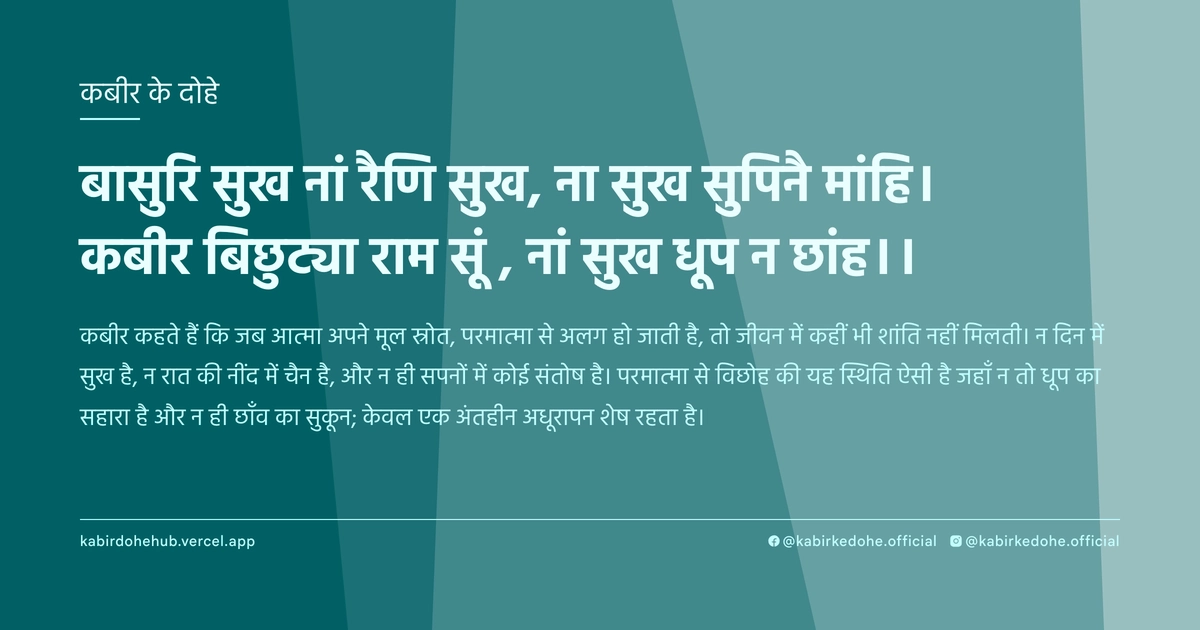
बासुरि सुख नां रैणि सुख, ना सुख सुपिनै मांहि।
कबीर बिछुट्या राम सूं , नां सुख धूप न छांह।।
Basuri sukh na raini sukh, na sukh supinai maahi. Kabir bichutya ram soon, na sukh dhoop na chhaanh.
इस पृष्ठ पर इस कबीर दोहे का अर्थ (meaning), हिंदी व्याख्या और अंग्रेज़ी अनुवाद, दार्शनिक विश्लेषण और व्यावहारिक जीवन सीख दी गई है। यह दोहा भक्ति (Bhakti) विषय से जुड़ा है — Kabir doha meaning and explanation in Hindi and English.
अर्थ (Meaning):
कबीर कहते हैं कि जब आत्मा अपने मूल स्रोत, परमात्मा से अलग हो जाती है, तो जीवन में कहीं भी शांति नहीं मिलती। न दिन में सुख है, न रात की नींद में चैन है, और न ही सपनों में कोई संतोष है। परमात्मा से विछोह की यह स्थिति ऐसी है जहाँ न तो धूप का सहारा है और न ही छाँव का सुकून; केवल एक अंतहीन अधूरापन शेष रहता है।
Kabir proclaims that when the soul is severed from its divine source, peace vanishes from every dimension of existence. There is no joy in the waking hours, no tranquility in the depths of the night, and no solace even within the realm of dreams. This separation from the Eternal creates a void where neither the warmth of the sun nor the coolness of the shade can provide relief; only an endless, aching incompleteness remains.
व्याख्या (Interpretation):
इस दोहे का शाब्दिक अर्थ विरह की पीड़ा है, लेकिन इसका गहरा आध्यात्मिक अर्थ 'अद्वैत' की विस्मृति है। यहाँ 'राम' किसी व्यक्ति विशेष नहीं, बल्कि उस निर्गुण ब्रह्म या सार्वभौमिक चेतना का प्रतीक हैं जो हर कण में व्याप्त है। जब मनुष्य माया के प्रभाव में आकर स्वयं को शरीर और अहंकार मान लेता है, तो वह अपनी वास्तविक प्रकृति से 'बिछुट' जाता है। यह विछोह बाहरी नहीं, बल्कि आंतरिक है—एक भ्रम है जो हमें यह विश्वास दिलाता है कि हम अलग हैं। यह विरोधाभास है कि हम जिसे खोज रहे हैं, वह हमारे भीतर ही है, फिर भी हम बाहरी दुनिया में सुख ढूँढते हैं। यह स्थिति उस प्यास की तरह है जो समुद्र के बीच रहकर भी नहीं बुझती क्योंकि हम नमक पी रहे होते हैं। अंततः, यह दोहा हमें यह समझाता है कि संसार के सभी भौतिक सुख क्षणभंगुर हैं और वास्तविक शांति केवल आत्म-साक्षात्कार के माध्यम से ही संभव है।
While the literal meaning speaks of the agony of separation, the deeper spiritual essence lies in the forgetfulness of 'Advaita' or non-duality. Here, 'Ram' does not refer to a mythological deity, but to the Nirgun Brahman—the formless, universal consciousness permeating every atom. When a human, clouded by Maya (illusion), identifies solely with the ego and the physical body, they become 'severed' from their true nature. This separation is not spatial but perceptual; it is the delusion of duality. The central paradox is that the seeker is the sought, yet the illusion of 'I' creates a perceived distance. This state is akin to a thirst that persists even while floating in an ocean because the soul is consuming the salt of worldly desires. Ultimately, the verse illustrates that all material pleasures are ephemeral, and true tranquility is attainable only through the realization of the Atman-Brahman unity.
दार्शनिक विश्लेषण (Philosophical Analysis):
कबीर का यह दोहा उस कालखंड की उपज है जब समाज कर्मकांडों और बाहरी आडंबरों में फँसा था। कबीर ने स्पष्ट किया कि मोक्ष किसी तीर्थ या मंदिर में नहीं, बल्कि आंतरिक मिलन में है। यह विचार सूफी मत के 'इश्क-ए-हकीकी' (ईश्वरीय प्रेम) से मेल खाता है, जहाँ प्रेमी अपनी आत्मा को परमात्मा में विलीन होते देखना चाहता है। यहाँ विरह की तड़प वास्तव में एक आध्यात्मिक उपकरण है जो अहंकार को गलाने का काम करती है।
अद्वैत वेदांत के परिप्रेक्ष्य में, यह 'बिछुट्या' होना केवल एक अविद्या (अज्ञान) है। जब तक जीव स्वयं को कर्ता और भोक्ता मानता है, वह दुख का अनुभव करता है। कबीर इस मानसिक द्वंद्व को उजागर करते हैं कि कैसे मनुष्य बाहरी सुखों (धूप और छाँव) में शांति खोजता है, जबकि समस्या उसकी अपनी चेतना के विखंडन में है।
कबीर का विरोध उन पाखंडियों से था जो दावा करते थे कि केवल विशिष्ट अनुष्ठानों से ईश्वर प्राप्त किया जा सकता है। उनके लिए, ईश्वर का अनुभव एक व्यक्तिगत और गहन आंतरिक यात्रा है। वे बताते हैं कि जब तक 'मैं' (अहंकार) जीवित है, तब तक 'राम' (परमात्मा) का अनुभव असंभव है।
मनोवैज्ञानिक स्तर पर, यह दोहा आधुनिक मनुष्य के 'अस्तित्वगत शून्य' (Existential Void) को दर्शाता है। हम भौतिक उपलब्धियों के शिखर पर होते हुए भी भीतर से खाली महसूस करते हैं क्योंकि हमारी आत्मा अपनी मूल प्रकृति की ओर लौटने के लिए छटपटा रही होती है।
अंततः, यह विश्लेषण हमें यह सिखाता है कि दुख का कारण बाहरी परिस्थितियाँ नहीं, बल्कि हमारी अपनी विस्मृति है। जब हम यह जान लेते हैं कि हम कभी अलग थे ही नहीं, तो विरह का यह दुख मुक्ति के आनंद में बदल जाता है।
This verse emerges from an era dominated by rigid ritualism and outward piety. Kabir asserts that liberation is not found in pilgrimages or temples, but in the internal union of the self with the Divine. This resonates deeply with the Sufi concept of 'Ishq-e-Haqiqi' (Divine Love), where the soul yearns to dissolve its separate identity into the Beloved. The agony of separation described here is not a lament, but a spiritual catalyst designed to erode the ego.
From the lens of Advaita Vedanta, being 'severed' is merely 'Avidya' or primordial ignorance. As long as the individual perceives themselves as the separate doer and enjoyer, they remain trapped in suffering. Kabir highlights the futility of seeking peace in external polarities—the 'sun' and 'shade' of worldly pleasure and pain—while the core issue is the fragmentation of consciousness.
Kabir’s philosophy was a direct challenge to the priestly class who claimed that God was accessible only through specific rites. For him, the experience of the Divine is a raw, personal, and internal journey. He posits that as long as the 'I' (the ego) persists, the experience of 'Ram' (the Universal Truth) remains obscured.
Psychologically, this verse mirrors the 'Existential Void' of the modern human. We often find ourselves at the peak of material success yet feeling profoundly empty, as the soul instinctively longs to return to its primordial source of wholeness.
Ultimately, this analysis reveals that suffering is not caused by external circumstances, but by our own forgetfulness. Once the realization dawns that the separation was an illusion and that we were never truly apart, the pain of longing transforms into the ecstasy of liberation.
मूल संदेश (Core Message):
- बाहरी सुख केवल भ्रम हैं, वास्तविक शांति आंतरिक मिलन में है।
- अहंकार ही वह पर्दा है जो हमें हमारी दिव्यता से अलग करता है।
- विरह की पीड़ा वास्तव में जागृति का पहला कदम है।
- जब 'मैं' मिटता है, तब 'राम' का अनुभव स्वतः घटित होता है।
- संसार की धूप-छाँव केवल मन की अवस्थाएँ हैं, सत्य इनसे परे है।
- External pleasures are mere illusions; true peace resides in internal union.
- The ego is the only veil separating us from our own divinity.
- The pain of separation is actually the first step toward spiritual awakening.
- When the 'I' dissolves, the experience of the Universal Truth occurs spontaneously.
- The polarities of the world are mere states of mind; Truth transcends them all.
व्यावहारिक उदाहरण (Practical Example):
वाराणसी के एक पुराने घाट पर रहने वाली एक वृद्ध विधवा, जानकी, का जीवन इस दोहे का जीवंत उदाहरण था। जानकी ने अपने जीवन के चालीस साल केवल पूजा-पाठ और कठोर नियमों के पालन में बिता दिए थे। वह मानती थी कि जितना अधिक वह बाहरी नियमों का पालन करेगी, उतनी ही जल्दी उसे शांति मिलेगी।
वह हर दिन घंटों मंत्र जाप करती, लेकिन उसके मन में अपने मृत पुत्र के प्रति एक गहरा दुख और समाज के प्रति कड़वाहट थी। उसकी रातें अनिद्रा में बीतती थीं और सपनों में भी उसे केवल पुराने विवाद और दुख ही दिखाई देते थे।
वह अक्सर मंदिर के पुजारियों से पूछती कि वह इतनी भक्ति क्यों कर रही है फिर भी उसके मन में शांति क्यों नहीं है। पुजारी उसे और अधिक कठिन व्रत रखने की सलाह देते, जिससे उसकी शारीरिक और मानसिक थकान और बढ़ जाती।
एक दिन, घाट के किनारे एक फकीर बैठा था जो केवल मौन रहकर मुस्कुरा रहा था। जानकी ने उससे पूछा, "बाबा, मैं जीवन भर राम का नाम जपती रही, फिर भी मुझे वह सुख क्यों नहीं मिला जिसकी बात शास्त्रों में है?"
फकीर ने शांति से जवाब दिया, "माँ, तुम राम को बाहर खोज रही हो, जबकि तुम खुद राम की ही एक लहर हो। तुम जिस विरह को महसूस कर रही हो, वह इसलिए है क्योंकि तुमने खुद को इस शरीर और अपनी दुखद यादों में कैद कर लिया है। तुम राम से अलग नहीं हो, बस तुमने खुद को अलग मान लिया है।"
यह बात जानकी के हृदय पर प्रहार की तरह लगी। उसने महसूस किया कि उसकी सारी पूजा केवल एक 'मुखौटा' थी ताकि वह अपने भीतर के खालीपन से बच सके। उसने बाहरी कर्मकांडों को छोड़कर केवल अपने भीतर की सांसों और उस मौन को देखना शुरू किया।
धीरे-धीरे, उसने पाया कि जब वह अपनी पहचान एक 'दुखी विधवा' से हटाकर केवल एक 'साक्षी' (observer) के रूप में देखती है, तो वह विरह समाप्त होने लगता है। उसने पाया कि शांति किसी मंत्र में नहीं, बल्कि इस स्वीकारोक्ति में थी कि वह और परमात्मा एक ही हैं।
उसकी नींद वापस आई, उसके सपनों से कड़वाहट चली गई, और वह घाट पर आने वाले हर व्यक्ति में उसी 'राम' को देखने लगी। अब उसे न धूप की तपिश डराती थी और न छाँव की मोह माया; वह स्वयं में पूर्ण हो गई थी।
जानकी का रूपांतरण यह दिखाता है कि जब हम बाहरी पहचानों को त्यागकर आंतरिक सत्य को अपनाते हैं, तब जीवन का वास्तविक सुख प्राप्त होता है।
Janaki, an elderly widow living on the ancient ghats of Varanasi, embodied the struggle described in this verse. For forty years, Janaki had devoted her life to rigorous rituals and the strict adherence to religious codes. She believed that the more she followed external rules, the sooner she would find peace.
She spent hours chanting mantras daily, yet her heart remained heavy with the grief of a lost son and a lingering bitterness toward society. Her nights were sleepless, and even her dreams were haunted by old conflicts and sorrows.
She frequently asked the temple priests why, despite her unwavering devotion, she felt no inner peace. The priests advised her to undertake even more strenuous fasts, which only increased her physical exhaustion and mental fragility.
One day, she encountered a wandering fakir sitting by the river, radiating a profound, silent joy. Janaki asked him, "Baba, I have spent my life chanting the name of Ram, yet why is the peace promised in the scriptures elusive for me?"
The fakir replied calmly, "Mother, you are searching for Ram outside, forgetting that you are a wave of the same ocean. The separation you feel is not real; it is a mental construct. You have imprisoned yourself in the identity of a grieving widow and a discarded woman. You are not separate from the Divine; you have only imagined a distance."
These words struck Janaki like a bolt of lightning. She realized that her rituals were merely a mask, a way to avoid facing the void within. She stopped clinging to the external forms and began to observe the silence between her breaths.
Gradually, she discovered that when she shifted her identity from a 'suffering widow' to a 'silent witness,' the agony of separation began to dissolve. She found that peace lay not in the mantra, but in the realization that she and the Divine were one.
Her sleep returned, the bitterness vanished from her dreams, and she began to see that same 'Ram' in every stranger who walked the ghats. Neither the scorching sun nor the deceptive shade could now disturb her; she had become complete within herself.
Janaki's transformation illustrates that when we shed our social and emotional masks to embrace the internal truth, the illusory separation vanishes, and true joy emerges.
अभ्यास मार्गदर्शन (Practice Guidance):
- प्रतिदिन 20 मिनट 'साक्षी भाव' का अभ्यास करें: अपने विचारों को बिना किसी निर्णय के देखें, जैसे आप किसी और के विचार देख रहे हों।
- आत्म-पूछताछ जर्नल: हर रात लिखें कि आज किस क्षण में आपने स्वयं को परमात्मा या प्रकृति से अलग महसूस किया और वह भावना किस 'अहंकार' या 'पहचान' से उपजी थी।
- मौन का व्रत: सप्ताह में एक बार कम से कम 3 घंटे पूर्ण मौन रहें, जिसमें बाहरी बातचीत के साथ-साथ आंतरिक मानसिक संवाद को भी शांत करने का प्रयास करें।
- डायग्नोस्टिक चेकलिस्ट: यदि आप छोटी बातों पर विचलित होते हैं, नींद में बेचैनी रहती है, या दूसरों की सफलता से ईर्ष्या महसूस करते हैं, तो यह संकेत है कि आप अभी भी 'विछोह' (separation) की स्थिति में जी रहे हैं।
- Practice 'Witness Consciousness' for 20 minutes daily: Observe your thoughts without judgment, as if you are watching someone else's mental movie.
- Self-Inquiry Journaling: Every night, record the specific moments you felt separate from the Divine or Nature, and identify which 'ego-identity' triggered that feeling of isolation.
- Vow of Silence: Once a week, maintain absolute silence for at least 3 hours, attempting to quiet not only external speech but also the internal mental chatter.
- Diagnostic Checklist: If you find yourself easily agitated by trivialities, suffer from restless sleep, or feel envy toward others, recognize these as symptoms of living in a state of 'separation' (Vichutya).
चिंतन प्रश्न (Reflection Questions):
- मेरी कौन सी सामाजिक पहचान (जैसे पद, धर्म, या रिश्ता) मुझे यह विश्वास दिलाती है कि मैं दूसरों से अलग और श्रेष्ठ या निम्न हूँ?
- क्या मेरी बेचैनी वास्तव में बाहरी अभावों के कारण है, या यह मेरे भीतर के एक गहरे शून्य की पुकार है जिसे मैं भौतिकता से भरने की कोशिश कर रहा हूँ?
- यदि मैं आज अपनी सभी उपलब्धियों और यादों को त्याग दूँ, तो मेरे भीतर क्या शेष बचेगा?
- मैं अपनी 'डिजिटल पहचान' (सोशल मीडिया इमेज) को बनाए रखने के लिए अपनी वास्तविक शांति का कितना बलिदान कर रहा हूँ?
- क्या मैं वास्तव में शांति चाहता हूँ, या मैं केवल अपने दुखों के अभाव को शांति समझ बैठा हूँ?
- Which social identity (status, religion, or relationship) convinces me that I am separate, superior, or inferior to others?
- Is my restlessness truly caused by external lack, or is it a call from a deep inner void that I am trying to fill with materialism?
- If I were to strip away all my achievements and memories today, what would remain at my core?
- How much of my authentic peace am I sacrificing to maintain my 'digital identity' and curated social image?
- Do I truly desire peace, or have I mistaken the mere absence of immediate pain for spiritual tranquility?