
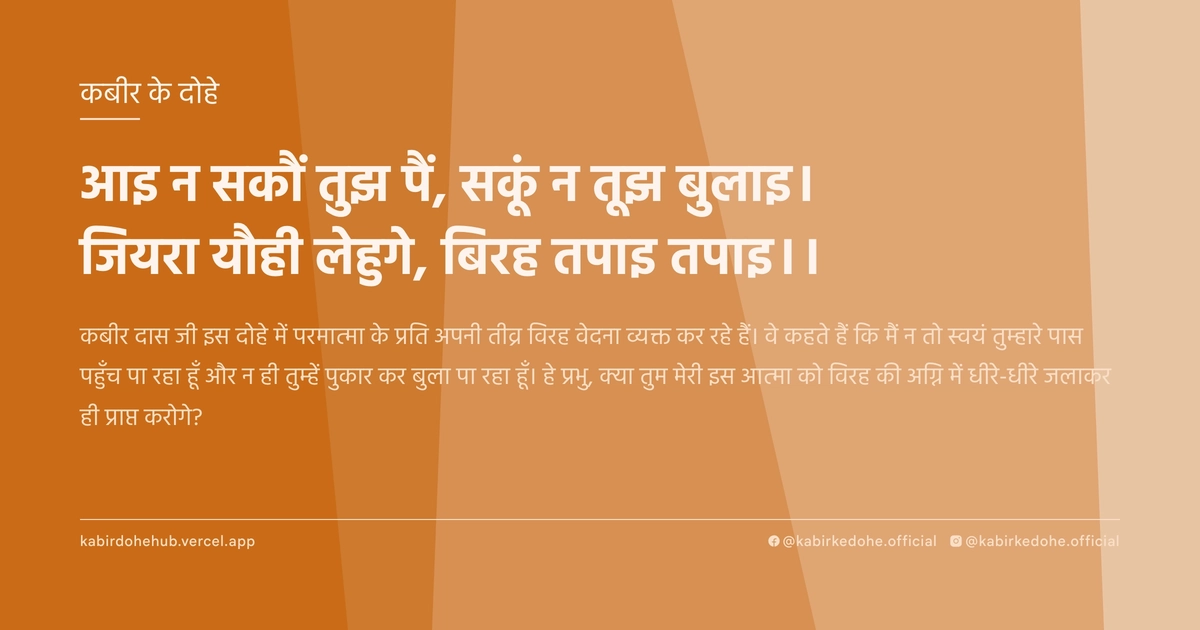
आइ न सकौं तुझ पैं, सकूं न तूझ बुलाइ।
जियरा यौही लेहुगे, बिरह तपाइ तपाइ।।
Aai na sakoun tujh pain, sakoun na tujh bulai. Jiyara yauhi lehuge, birah tapai tapai.
इस पृष्ठ पर इस कबीर दोहे का अर्थ (meaning), हिंदी व्याख्या और अंग्रेज़ी अनुवाद, दार्शनिक विश्लेषण और व्यावहारिक जीवन सीख दी गई है। यह दोहा भक्ति (Bhakti) विषय से जुड़ा है — Kabir doha meaning and explanation in Hindi and English.
अर्थ (Meaning):
कबीर दास जी इस दोहे में परमात्मा के प्रति अपनी तीव्र विरह वेदना व्यक्त कर रहे हैं। वे कहते हैं कि मैं न तो स्वयं तुम्हारे पास पहुँच पा रहा हूँ और न ही तुम्हें पुकार कर बुला पा रहा हूँ। हे प्रभु, क्या तुम मेरी इस आत्मा को विरह की अग्नि में धीरे-धीरे जलाकर ही प्राप्त करोगे?
Kabir expresses an intense longing for the Divine, describing a state of spiritual helplessness. He laments that he can neither reach the Beloved nor summon the Beloved to him. He asks if the Divine intends to claim his soul only after it has been completely purified and consumed by the searing fire of separation.
व्याख्या (Interpretation):
यह दोहा आत्मा और परमात्मा के बीच के द्वैत और मिलन की तड़प को दर्शाता है। 'आइ न सकौं' भौतिक सीमाओं और अहंकार के पर्दे को इंगित करता है, जबकि 'सकुं न तूझ बुलाइ' यह दर्शाता है कि साधक अभी उस स्तर पर नहीं पहुँचा है जहाँ उसकी पुकार ईश्वर तक पहुँचे। यहाँ 'बिरह' (विरह) केवल दुख नहीं, बल्कि एक आध्यात्मिक प्रक्रिया है। निरगुण भक्ति में, विरह वह अग्नि है जो माया के आवरण को जला देती है। जब तक 'मैं' (अहंकार) जीवित है, मिलन असंभव है; अतः परमात्मा विरह के माध्यम से साधक के अहंकार को गलाते हैं। यह अद्वैत वेदांत के उस सत्य की ओर इशारा है जहाँ आत्मा यह अनुभव करती है कि वह अलग है, और यही अनुभव उसे पूर्णता की ओर ले जाता है। अंततः, यह विरह ही वह सेतु है जो जीव को ब्रह्म में विलीन करता है।
This couplet captures the agonizing duality between the soul (Atman) and the Divine (Brahman). The phrase "cannot reach" signifies the barriers of ego and the illusion of Maya, while the inability to "call" suggests a lack of spiritual attunement. In the context of Nirgun Bhakti, 'Birha' (separation) is not mere sorrow but a transformative alchemical fire. It is the process of 'Tapas' where the impurities of the conditioned mind are incinerated. The paradox is that the feeling of separation is the first step toward realizing non-duality; only by feeling the void can one seek the fullness. This spiritual longing acts as a catalyst, stripping away the false identity of the 'I' until nothing remains but the Divine. The soul is not being punished, but purified through the intensity of longing.
दार्शनिक विश्लेषण (Philosophical Analysis):
कबीर का यह दोहा मध्यकालीन भारत के उस सामाजिक-धार्मिक परिवेश से उपजा है जहाँ कर्मकांड और बाहरी आडंबरों का बोलबाला था। कबीर ने मंदिर, मस्जिद और तीर्थयात्राओं के माध्यम से ईश्वर को पाने के दावों को खारिज कर दिया। उनके लिए ईश्वर किसी भौगोलिक स्थान पर नहीं, बल्कि हृदय की गहराई में है। यह दृष्टिकोण सूफी मत के 'इश्क-ए-हकीकी' (दिव्य प्रेम) से गहराई से प्रभावित है, जहाँ प्रेमी (साधक) अपने प्रिय (ईश्वर) के लिए तड़पता है।
दार्शनिक स्तर पर, यह अद्वैत वेदांत के उस सिद्धांत को पुष्ट करता है कि अज्ञानता (Avidya) के कारण हम स्वयं को ब्रह्म से अलग मानते हैं। यह 'अलग होने का अहसास' ही विरह का कारण है। कबीर यह समझाते हैं कि जब तक साधक यह महसूस नहीं करता कि वह अधूरा है, तब तक वह पूर्णता की खोज नहीं करेगा। यह मनोवैज्ञानिक रूपांतरण की एक प्रक्रिया है जहाँ दुख को एक उपकरण के रूप में उपयोग किया जाता है।
यहाँ 'तपाइ तपाइ' शब्द का प्रयोग अत्यंत महत्वपूर्ण है। यह केवल शारीरिक या मानसिक पीड़ा नहीं है, बल्कि यह 'तपस' है। जिस प्रकार सोने को शुद्ध करने के लिए उसे आग में तपाया जाता है, उसी प्रकार आत्मा को शुद्ध करने के लिए विरह की अग्नि आवश्यक है। यह ritualism के विरुद्ध एक सशक्त प्रहार है, क्योंकि कोई भी बाहरी अनुष्ठान उस आंतरिक तड़प की जगह नहीं ले सकता जो अहंकार को नष्ट करती है।
कबीर की यह विरह-अवस्था 'शून्य' की ओर ले जाती है। जब साधक पूरी तरह से टूट जाता है और उसके पास कोई सहारा नहीं बचता, तब वह पाता है कि जिसे वह बाहर खोज रहा था, वह उसके भीतर ही था। यह 'अहं' का विसर्जन है। सूफीवाद में इसे 'फना' कहा गया है—अपने अस्तित्व को ईश्वर में मिटा देना।
अंततः, यह दोहा हमें सिखाता है कि आध्यात्मिक मार्ग पर आने वाली बाधाएं और अकेलापन वास्तव में ईश्वर की कृपा हैं। वे हमें बाहरी दुनिया से मोड़कर आंतरिक जगत की ओर ले जाते हैं। यह विरह ही वह ईंधन है जो साधक को निरंतर चलते रहने की प्रेरणा देता है, जब तक कि वह द्वैत के पार न निकल जाए।
Kabir's poetry emerged during a period of rigid religious orthodoxy in medieval India. By articulating a personal, longing-filled relationship with the Divine, he bypassed the need for priestly intermediaries, temples, and mosques. His philosophy rejects the notion that God is a distant entity reachable through rituals; instead, he posits that the Divine is an immanent presence felt through the intensity of the heart. This aligns closely with the Sufi concept of 'Ishq-e-Haqiqi' (Divine Love), where the seeker's longing is the primary vehicle for spiritual ascent.
From a Vedantic perspective, the 'separation' Kabir describes is the result of 'Avidya' or spiritual ignorance. The soul mistakenly perceives itself as a separate entity from the Universal Consciousness (Brahman). This perceived duality creates the pain of longing. Kabir suggests that this pain is not a hindrance but a necessity. It is the psychological tension required to propel the soul from the periphery of existence toward the center.
The repetition of 'tapai tapai' (burning again and again) evokes the concept of 'Tapas'—spiritual austerity. Just as gold is purified in a crucible, the human ego is incinerated in the fire of longing. This is a direct critique of ritualism; while a ritual is a mechanical act, 'Birha' is an organic, emotional alchemy that transforms the very nature of the practitioner's being.
This state of longing leads to 'Fana' in Sufism or 'Laya' in Yoga—the annihilation of the individual self into the Absolute. The paradox is that the more the seeker feels the absence of God, the more they are actually being drawn into the Divine presence. The feeling of void is actually the presence of the Divine calling the soul home.
Ultimately, Kabir transforms suffering into a spiritual discipline. He teaches that the feeling of being 'lost' or 'unable to reach' is the most honest state of a seeker. It is in this absolute surrender and vulnerability that the ego finally collapses, allowing the non-dual reality of Atman and Brahman to reveal itself without the interference of the conceptual mind.
मूल संदेश (Core Message):
- बाहरी खोज व्यर्थ है; आंतरिक तड़प ही वास्तविक मार्ग है।
- अहंकार का विसर्जन केवल विरह की अग्नि में ही संभव है।
- दुख को बाधा नहीं, बल्कि शुद्धि के साधन के रूप में देखें।
- परमात्मा को बुलाना नहीं, बल्कि स्वयं को मिटाना ही मिलन है।
- द्वैत का अनुभव ही अद्वैत की प्राप्ति का पहला सोपान है।
- External searches are futile; internal longing is the only true path.
- The dissolution of ego is possible only in the fire of separation.
- View suffering not as a hurdle, but as a tool for purification.
- Union is not about calling the Divine, but about erasing the self.
- The experience of duality is the first step toward realizing non-duality.
व्यावहारिक उदाहरण (Practical Example):
वाराणसी के घाटों पर रहने वाले एक वृद्ध बुनकर, माधव, का जीवन अत्यंत सरल था। वह पीढ़ी दर पीढ़ी सूती कपड़े बुन रहा था, लेकिन उसके मन में एक गहरी बेचैनी थी। उसने जीवन भर कई पंडितों से संपर्क किया, कठिन व्रत रखे और गंगा में अनगिनत डुबकियाँ लगाईं, लेकिन उसे वह शांति नहीं मिली जिसकी वह तलाश कर रहा था। उसे लगता था कि ईश्वर उससे बहुत दूर है, किसी ऊँचे स्वर्ग में या किसी गहरे रहस्य में।
एक दिन, माधव ने कबीर के इस दोहे को सुना। उसे महसूस हुआ कि उसकी अब तक की सारी कोशिशें 'पहुँचने' की कोशिशें थीं—जैसे कोई किसी शहर की यात्रा करता है। उसने महसूस किया कि वह ईश्वर को एक 'वस्तु' या 'स्थान' मानकर खोज रहा था, इसलिए वह कभी नहीं मिल पाया।
उसने अपनी खोज का तरीका बदल दिया। अब उसने यह प्रार्थना करना बंद कर दिया कि "मुझे शांति दें" या "मुझे दर्शन दें"। इसके बजाय, उसने अपनी उस तड़प और अकेलेपन को स्वीकार करना शुरू किया जो उसे रातों को जगाए रखती थी। उसने उस दर्द को दबाने के बजाय उसे अपना साथी बना लिया।
वह घंटों अपने करघे पर काम करता, लेकिन अब उसका ध्यान इस बात पर था कि वह कितना अधूरा है। उसने महसूस किया कि उसकी यह 'अधूरापन' ही वास्तव में ईश्वर की उपस्थिति है। जब वह रोता, तो उसे लगता कि उसके आँसू उसे शुद्ध कर रहे हैं।
धीरे-धीरे, माधव के व्यवहार में बदलाव आया। उसने दूसरों के प्रति अपनी शिकायतें छोड़ दीं। उसने देखा कि हर इंसान उसी विरह की अग्नि में जल रहा है। वह अब केवल अपने लिए नहीं, बल्कि सबके दुख के प्रति संवेदनशील हो गया।
एक शाम, जब वह घाट पर बैठा था, उसे अचानक महसूस हुआ कि जिसे वह 'बुलाने' की कोशिश कर रहा था, वह तो उसके भीतर की धड़कन में ही समाया हुआ है। वह 'पहुँचने' की इच्छा से मुक्त हो गया क्योंकि वह जान गया कि वह कभी अलग था ही नहीं।
उसकी तड़प अब दुख नहीं, बल्कि एक आनंद बन गई थी। उसने पाया कि जब उसने 'पाने' की जिद छोड़ दी और केवल 'तड़पने' को स्वीकार किया, तब वह परमात्मा के सबसे करीब पहुँच गया।
माधव का जीवन अब एक उत्सव बन गया था। वह अब भी कपड़े बुनता था, लेकिन अब वह धागों में केवल सूत नहीं, बल्कि प्रेम और समर्पण बुन रहा था। उसकी आँखों की चमक अब किसी मंदिर की मूर्ति में नहीं, बल्कि हर जीवित प्राणी में झलकती थी।
इस प्रकार, कबीर के शब्दों ने माधव को कर्मकांडों के बोझ से मुक्त कर विरह की उस पवित्र अग्नि में झोंक दिया, जिसने उसके अहंकार को जलाकर राख कर दिया और उसे वास्तविक शांति प्रदान की।
Madhav, an elderly weaver living on the ghats of Varanasi, led a simple life. For generations, his family had woven cotton fabrics, but Madhav harbored a deep, unspoken restlessness. He had consulted numerous priests, observed rigorous fasts, and bathed in the Ganges countless times, yet the peace he sought remained elusive. He felt that God was distant, residing in a high heaven or hidden behind an impenetrable mystery.
One day, Madhav encountered this specific Doha of Kabir. He realized that all his previous efforts were attempts to 'reach'—as if the Divine were a destination in a distant city. He understood that he had been treating God as an object to be acquired or a place to be visited, which is why he had failed.
He decided to change his approach. He stopped praying for 'peace' or 'visions.' Instead, he began to embrace the very longing and loneliness that kept him awake at night. Rather than suppressing the pain of separation, he made it his constant companion.
He would spend hours at his loom, but now his focus shifted to his own sense of incompleteness. He realized that this feeling of being 'incomplete' was, in itself, the presence of the Divine. When he wept, he felt his tears were not signs of weakness, but a process of purification.
Gradually, Madhav's behavior transformed. He stopped complaining about his hardships and the flaws of others. He began to see that every human being he encountered was burning in a similar fire of longing. He became profoundly empathetic toward the suffering of all living beings.
One evening, while sitting on the ghats, a sudden realization dawned upon him: the One he had been trying to 'call' was the very rhythm of his own heartbeat. He was liberated from the desire to 'reach' because he understood that he had never truly been separate.
His longing ceased to be a source of agony and became a source of ecstasy. He discovered that when he stopped insisting on 'attaining' and simply accepted the 'yearning,' he became closest to the Divine.
Madhav's life became a celebration. He continued to weave, but now he wove love and surrender into every thread. The light in his eyes was no longer directed toward an idol in a temple, but reflected in every living soul he met.
Thus, Kabir's words liberated Madhav from the burden of ritualism and cast him into the sacred fire of separation, which incinerated his ego and granted him the ultimate peace of non-duality.
अभ्यास मार्गदर्शन (Practice Guidance):
- प्रतिदिन 20 मिनट मौन रहकर अपने भीतर की 'तड़प' या 'अधूरेपन' को महसूस करें। इसे दबाएं नहीं, बल्कि इसे एक पवित्र ऊर्जा के रूप में स्वीकार करें।
- एक डायरी लिखें जिसमें आप अपनी उन इच्छाओं और दुखों को दर्ज करें जो आपको ईश्वर या सत्य की ओर धकेलते हैं। पूछें: 'यह दर्द मुझे क्या सिखा रहा है?'
- व्यवहार में बदलाव: जब भी आप किसी व्यक्ति से अलग महसूस करें या अकेलापन महसूस करें, तो उसे 'विरह' मानकर उस शून्य में परमात्मा की उपस्थिति को खोजने का प्रयास करें।
- निदान चेकलिस्ट: क्या आप अभी भी ईश्वर को किसी बाहरी स्थान या कर्मकांड में खोज रहे हैं? क्या आपका दुख आपको क्रोधित करता है या यह आपको और अधिक विनम्र और करुणामयी बना रहा है? यदि दुख विनम्रता ला रहा है, तो आप सही मार्ग पर हैं।
- Spend 20 minutes daily in silence, consciously feeling the 'longing' or 'incompleteness' within. Do not suppress it; instead, welcome it as a sacred energy.
- Maintain a spiritual journal to record the desires and sorrows that push you toward the Truth. Ask yourself: 'What is this pain attempting to purify in me?'
- Behavioral Shift: Whenever you feel lonely or disconnected from others, perceive this as 'Birha' (sacred separation) and try to find the Divine presence within that very void.
- Diagnostic Checklist: Are you still seeking the Divine in external locations or rituals? Does your suffering lead to anger, or does it make you more humble and compassionate? If pain leads to humility, you are aligning with the path of the soul.
चिंतन प्रश्न (Reflection Questions):
- क्या मेरी आध्यात्मिक खोज वास्तव में सत्य की प्यास है, या यह केवल मेरे अहंकार को संतुष्ट करने का एक नया तरीका है?
- मैं अपने जीवन के किन 'खालीपन' या 'अधूरेपन' से डरता हूँ, और यदि मैं उन्हें स्वीकार कर लूँ तो वे मुझे कहाँ ले जा सकते हैं?
- क्या मैं ईश्वर को अपनी शर्तों पर 'बुलाने' की कोशिश कर रहा हूँ, या मैं स्वयं को उसकी इच्छा में समर्पित करने के लिए तैयार हूँ?
- मेरे जीवन में विरह की अग्नि किन रिश्तों या स्थितियों के माध्यम से प्रकट हो रही है, और मैं उनसे क्या सीख रहा हूँ?
- यदि मेरी पहचान, मेरा नाम और मेरा पद छीन लिया जाए, तो जो बचेगा, क्या वह परमात्मा के प्रति तड़प महसूस करेगा?
- Is my spiritual quest a genuine thirst for Truth, or is it just a sophisticated way to feed my ego?
- Which 'voids' or 'incompleteness' in my life do I fear, and where would they lead me if I fully embraced them?
- Am I trying to 'summon' the Divine on my own terms, or am I ready to surrender myself to the Divine will?
- Through which relationships or situations is the fire of separation manifesting in my life, and what is it teaching me?
- If my identity, name, and status were stripped away, would the remaining essence still feel the longing for the Absolute?