
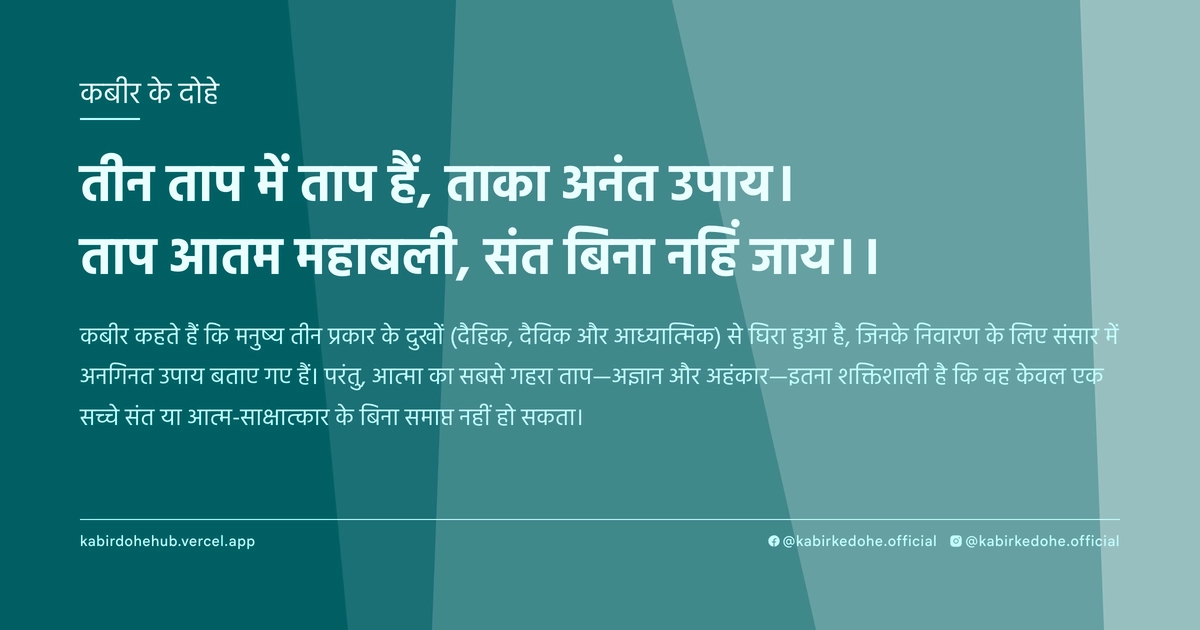
तीन ताप में ताप हैं, ताका अनंत उपाय।
ताप आतम महाबली, संत बिना नहिं जाय।।
Teen taap me taap hain, taaka anant upay. Taap aatam mahabali, sant bina nahin jaaye.
इस पृष्ठ पर इस कबीर दोहे का अर्थ (meaning), हिंदी व्याख्या और अंग्रेज़ी अनुवाद, दार्शनिक विश्लेषण और व्यावहारिक जीवन सीख दी गई है। यह दोहा गुरु महत्व (The Guru's Importance) विषय से जुड़ा है — Kabir doha meaning and explanation in Hindi and English.
अर्थ (Meaning):
कबीर कहते हैं कि मनुष्य तीन प्रकार के दुखों (दैहिक, दैविक और आध्यात्मिक) से घिरा हुआ है, जिनके निवारण के लिए संसार में अनगिनत उपाय बताए गए हैं। परंतु, आत्मा का सबसे गहरा ताप—अज्ञान और अहंकार—इतना शक्तिशाली है कि वह केवल एक सच्चे संत या आत्म-साक्षात्कार के बिना समाप्त नहीं हो सकता।
Kabir asserts that humanity is besieged by three types of suffering—physical, celestial, and spiritual—for which countless worldly remedies are sought. However, the most potent heat is the internal fire of the soul's ignorance and ego, which cannot be extinguished through material means, but only through the guidance of a true enlightened master.
व्याख्या (Interpretation):
शाब्दिक रूप से, यह दोहा जीवन के कष्टों की चर्चा करता है। आध्यात्मिक स्तर पर, 'तीन ताप' दैहिक (रोग), दैविक (प्राकृतिक आपदाएं) और आध्यात्मिक (मानसिक क्लेश) दुखों को दर्शाते हैं। कबीर यहाँ एक विरोधाभास प्रस्तुत करते हैं: जबकि बाहरी दुखों के लिए दवाएं और प्रार्थनाएं उपलब्ध हैं, 'आतम ताप' या अहंकार का ताप सबसे विनाशकारी है। यह ताप माया के प्रभाव से उत्पन्न होता है जो आत्मा को परमात्मा से अलग महसूस कराता है। निर्गुण भक्ति के अनुसार, जब तक साधक अपनी पृथक पहचान (अहंकार) को नहीं मिटाता, वह इस आंतरिक अग्नि में जलता रहता है। यह ताप केवल तब शांत होता है जब अद्वैत की स्थिति प्राप्त हो, जहाँ ज्ञाता और ज्ञेय का भेद समाप्त हो जाए।
Literally, the couplet addresses the sufferings of life. Spiritually, the 'three heats' refer to Adhyatmika (physical/mental), Adhibhautika (environmental/external), and Adhidaivika (supernatural/destined) afflictions. Kabir presents a paradox: while worldly remedies exist for external pains, the 'heat of the soul'—the fire of ego and ignorance—is the most formidable. This heat is fueled by Maya, the cosmic illusion that convinces the Atman it is separate from Brahman. In the context of Nirgun Bhakti, this internal combustion persists as long as the illusion of 'I' remains. The fire is only extinguished when the seeker realizes non-duality, dissolving the boundary between the individual self and the Universal Consciousness.
दार्शनिक विश्लेषण (Philosophical Analysis):
कबीर का यह दर्शन उस युग की प्रतिक्रिया है जहाँ धर्म केवल कर्मकांडों और बाहरी दिखावे तक सीमित था। उन्होंने स्पष्ट किया कि मंदिर, मस्जिद या तीर्थयात्राएं बाहरी ताप को कम करने का भ्रम दे सकती हैं, लेकिन आंतरिक रूपांतरण के बिना वे व्यर्थ हैं। यह विचार अद्वैत वेदांत के करीब है, जहाँ अज्ञान (Avidya) को ही समस्त दुखों का मूल कारण माना गया है।
सूफीवाद के 'फना' (अहंकार का विनाश) के सिद्धांत की तरह, कबीर भी आत्मा के ताप को मिटाने के लिए 'मैं' के विसर्जन की बात करते हैं। उनके लिए 'संत' कोई व्यक्ति नहीं, बल्कि वह चेतना है जिसने सत्य का अनुभव किया है। यह विश्लेषण दर्शाता है कि मनोवैज्ञानिक रूप से, मनुष्य अपनी इच्छाओं और आसक्तियों के कारण मानसिक तनाव में रहता है, जिसे कबीर 'ताप' कहते हैं।
कबीर जाति और संप्रदाय के भेदभाव को नकारते हुए यह तर्क देते हैं कि आध्यात्मिक पीड़ा सार्वभौमिक है। चाहे कोई ब्राह्मण हो या जुलाहा, अहंकार का ताप सबको समान रूप से जलाता है। यह दृष्टिकोण सामाजिक समानता का एक सशक्त आधार प्रदान करता है।
यहाँ 'अनंत उपाय' शब्द उन तमाम शॉर्टकट्स की ओर इशारा करता है जिन्हें लोग मोक्ष के लिए अपनाते हैं—जैसे कठिन व्रत या दिखावटी तपस्या। कबीर इन सबको नकारते हुए आंतरिक शुद्धि पर जोर देते हैं। वे बताते हैं कि जब तक जड़ मूल (अहंकार) नहीं कटेगा, शाखाएं (दुख) वापस आती रहेंगी।
अंततः, यह दोहा इस सत्य को स्थापित करता है कि आत्म-साक्षात्कार एक कठिन प्रक्रिया है। यह केवल बौद्धिक ज्ञान से नहीं, बल्कि एक जीवित अनुभव (Sadhana) से संभव है। संत की भूमिका यहाँ एक उत्प्रेरक (Catalyst) की है जो साधक के भीतर सोई हुई चेतना को जगाकर उसे इस अनंत ताप से मुक्ति दिलाता है।
Kabir’s philosophy emerges as a visceral reaction to an era where religion was reduced to sterile rituals and outward displays. He posits that temples, mosques, or pilgrimages may offer a fleeting illusion of relief from external suffering, but they are futile without an internal alchemy. This aligns closely with Advaita Vedanta, which identifies Avidya (ignorance) as the root cause of all human misery.
Mirroring the Sufi concept of 'Fana' (the annihilation of the self), Kabir argues that the 'heat of the soul' can only be extinguished by the dissolution of the ego. For him, the 'Sant' is not merely a person but a state of realized consciousness. Psychologically, this 'heat' represents the cognitive dissonance and emotional turbulence born from attachment and desire, which creates a persistent state of unrest.
By rejecting caste and sectarian divides, Kabir asserts that spiritual agony is universal. Whether one is a high-born priest or a humble weaver, the fire of ego burns with equal intensity. This perspective provides a powerful foundation for social egalitarianism, suggesting that the only true hierarchy is the level of one's spiritual awakening.
The phrase 'infinite remedies' mocks the shortcuts people take toward liberation—such as performative asceticism or rigid fasting. Kabir dismisses these as superficial. He argues that unless the root (the ego) is severed, the branches (suffering) will inevitably regrow, regardless of how many rituals are performed.
Ultimately, this couplet establishes that self-realization is an arduous process. It cannot be achieved through intellectual accumulation but only through lived experience (Sadhana). The Sant acts as a catalyst, awakening the dormant consciousness within the seeker to liberate them from this eternal internal combustion.
मूल संदेश (Core Message):
- बाहरी उपचार केवल लक्षणों को मिटाते हैं, मूल कारण को नहीं।
- अहंकार वह अग्नि है जो आत्मा की शांति को भस्म कर देती है।
- सच्चा गुरु वह है जो आपको आपकी अपनी सीमाओं का दर्पण दिखाए।
- मोक्ष कर्मकांडों में नहीं, बल्कि 'मैं' के विसर्जन में है।
- आंतरिक शांति केवल अद्वैत के अनुभव से संभव है।
- External remedies treat the symptoms, never the root cause.
- The ego is the fire that consumes the soul's inherent peace.
- A true master is a mirror reflecting your own limitations.
- Liberation lies not in rituals, but in the dissolution of the 'I'.
- Inner stillness is only possible through the realization of non-duality.
व्यावहारिक उदाहरण (Practical Example):
वाराणसी के घाटों पर रहने वाली एक वृद्ध विधवा, जानकी, का जीवन केवल दूसरों की सेवा और कठोर नियमों के पालन में बीत रहा था। वह मानती थी कि उसका कठोर अनुशासन और दूसरों के प्रति उसकी दया उसे मोक्ष दिलाएगी। वह स्वयं को बहुत पवित्र मानती थी और अनजाने में उन लोगों के प्रति उपेक्षा का भाव रखती थी जो उसके जितने 'धार्मिक' नहीं थे।
जानकी के भीतर एक अनकहा ताप था—एक सूक्ष्म अहंकार कि वह 'शुद्ध' है। यह ताप उसे मानसिक अशांति और अकेलेपन की गहरी खाई में धकेलता था, जिसे वह अपनी प्रार्थनाओं के पीछे छिपाती थी। वह अक्सर सोचती थी कि ईश्वर उसे वह शांति क्यों नहीं दे रहा जो उसने इतनी तपस्या के बाद अर्जित की है।
एक दिन, घाट पर एक फकीर आया जो बिना किसी बाहरी आडंबर के केवल मौन और मुस्कुराहट के साथ बैठा था। जानकी ने उससे पूछा कि वह इतना शांत कैसे है जबकि उसके पास न तो कोई शास्त्र है और न ही कोई विशेष अनुष्ठान।
फकीर ने बस इतना कहा, 'माँ, तुम अपनी पवित्रता का बोझ ढो रही हो। जिस दिन तुम यह भूल जाओगी कि तुम पवित्र हो, उस दिन तुम वास्तव में शुद्ध हो जाओगी।'
यह शब्द जानकी के लिए एक बिजली के झटके की तरह थे। उसे एहसास हुआ कि उसकी 'पवित्रता' ही वास्तव में उसका सबसे बड़ा बंधन था। वह जिसे अपनी उपलब्धि मान रही थी, वह वास्तव में उसका अहंकार था जो उसे दूसरों से अलग कर रहा था।
उस रात, जानकी ने अपनी सारी धार्मिक श्रेष्ठता को त्याग दिया। उसने महसूस किया कि वह जिसे 'सेवा' कह रही थी, वह वास्तव में अपनी छवि को बेहतर बनाने का एक तरीका था।
उसने अपनी आंतरिक अग्नि को पहचाना—वह ताप जो उसे यह विश्वास दिलाता था कि वह दूसरों से श्रेष्ठ है। जैसे ही उसने इस 'मैं' को विसर्जित किया, उसके हृदय में एक असीम शीतलता का अनुभव हुआ।
अब जानकी दूसरों की सेवा इसलिए नहीं करती थी कि वह 'पुण्य' कमाना चाहती थी, बल्कि इसलिए क्योंकि वह उनमें स्वयं को देखती थी। उसका जीवन अब नियमों का बोझ नहीं, बल्कि प्रेम का प्रवाह बन गया था।
उसने सीखा कि बाहरी तपस्या केवल शरीर को सुखाती है, लेकिन अहंकार का त्याग आत्मा को तृप्त करता है। वह अब वास्तव में मुक्त थी, क्योंकि उसने उस 'महाबली ताप' को पहचान लिया था और उसे मिटा दिया था।
उसकी मुस्कान अब उसकी प्रार्थनाओं से अधिक शक्तिशाली थी, क्योंकि वह अब किसी मंदिर में नहीं, बल्कि स्वयं के भीतर बसे उस निराकार सत्य में निवास करती थी।
Janaki, an elderly widow living on the ghats of Varanasi, spent her life in rigorous adherence to religious codes and serving others. She believed her strict discipline and perceived piety would guarantee her liberation. Unbeknownst to her, she harbored a subtle disdain for those who were not as 'devout' as she was.
Within Janaki burned an unspoken heat—a refined ego of her own purity. This internal fire manifested as a deep, hidden restlessness and a sense of isolation, which she masked with endless prayers. She often wondered why the Divine had not granted her the peace she felt she had earned through such austerity.
One day, a wandering dervish arrived at the ghats. He sat in absolute silence, radiating a profound peace without any outward signs of ritual or scholarship. Intrigued, Janaki asked him the secret of his tranquility, noting his lack of scriptures or formal practice.
The dervish replied simply, 'Mother, you are carrying the heavy burden of your own purity. The day you forget that you are holy, you will truly become pure.'
These words struck Janaki like a bolt of lightning. She realized that her 'purity' was actually her strongest chain. What she had mistaken for spiritual achievement was, in reality, an ego that separated her from the rest of humanity.
That night, Janaki surrendered her sense of religious superiority. She acknowledged that her 'service' to others had been a subconscious attempt to polish her own image rather than an act of selfless love.
She finally recognized the 'mighty heat'—the arrogance of being 'right' and 'holy'—that had kept her soul in turmoil. As she let go of this 'I', a cooling wave of serenity washed over her heart.
Janaki continued to serve others, but the motivation shifted. She no longer sought 'punya' (merit); she served because she saw herself in every suffering soul. Her life ceased to be a checklist of rules and became a flow of compassion.
She learned that external asceticism only withers the body, but the dissolution of ego nourishes the soul. She was finally free because she had identified and extinguished the most powerful fire of all.
Her smile became more potent than her prayers, for she no longer sought the Divine in a temple, but resided in the formless truth within her own being.
अभ्यास मार्गदर्शन (Practice Guidance):
- प्रतिदिन 20 मिनट 'साक्षी भाव' का अभ्यास करें: अपने विचारों को बिना किसी निर्णय के देखें और पहचानें कि कौन सा विचार 'मैं' (अहंकार) को पुष्ट कर रहा है।
- आत्म-पूछताछ जर्नल: प्रतिदिन एक ऐसी घटना लिखें जहाँ आपने स्वयं को दूसरों से श्रेष्ठ या निम्न महसूस किया। विश्लेषण करें कि यह भावना किस 'ताप' से उपजी है।
- व्यवहार परिवर्तन: दिन में कम से कम एक बार किसी ऐसे व्यक्ति की मदद करें जिससे आपके वैचारिक मतभेद हों, और यह सुनिश्चित करें कि आपकी मदद में कोई 'उपकार' का भाव न हो।
- निदान चेकलिस्ट: यदि आप दूसरों की आलोचना करते समय संतुष्टि महसूस करते हैं या अपनी अच्छाई का बखान करते हैं, तो समझ लें कि 'आतम ताप' अभी सक्रिय है।
- Practice 'Witness Consciousness' for 20 minutes daily: Observe your thoughts without judgment and identify which thoughts are reinforcing the 'I' (ego).
- Self-Inquiry Journaling: Record one daily instance where you felt superior or inferior to another. Analyze which specific 'heat' or attachment triggered this feeling.
- Behavioral Shift: Perform one act of selfless service daily for someone with whom you have a fundamental disagreement, ensuring there is no sense of 'charity' or superiority involved.
- Diagnostic Checklist: If you feel a secret satisfaction while criticizing others or a need to be recognized for your virtues, recognize that the 'soul-heat' is still active.
चिंतन प्रश्न (Reflection Questions):
- मेरी वह कौन सी 'पवित्रता' या 'अच्छाई' है जिसका उपयोग मैं अनजाने में दूसरों को छोटा दिखाने के लिए करता हूँ?
- क्या मेरी आध्यात्मिक साधना वास्तव में मुझे विनम्र बना रही है, या यह मेरे अहंकार को एक नया 'आध्यात्मिक' रूप दे रही है?
- जब मैं अकेला होता हूँ, तो वह कौन सी बेचैनी है जो किसी भी बाहरी सुख के बावजूद बनी रहती है?
- क्या मैं सत्य को खोजने के लिए तैयार हूँ, या मैं केवल उस सत्य को चाहता हूँ जो मेरी वर्तमान मान्यताओं की पुष्टि करे?
- मेरे जीवन का वह कौन सा 'ताप' है जिसे मैं दवाओं, मनोरंजन या रिश्तों के जरिए दबाने की कोशिश कर रहा हूँ?
- What specific 'purity' or 'virtue' do I unconsciously use as a tool to feel superior to others?
- Is my spiritual practice making me genuinely humble, or is it merely giving my ego a new 'spiritual' identity?
- In moments of absolute solitude, what is the persistent restlessness that remains despite all external comforts?
- Am I truly seeking the Truth, or am I merely seeking a truth that validates my existing biases?
- Which internal 'heat' am I attempting to suppress through medication, entertainment, or superficial relationships?