
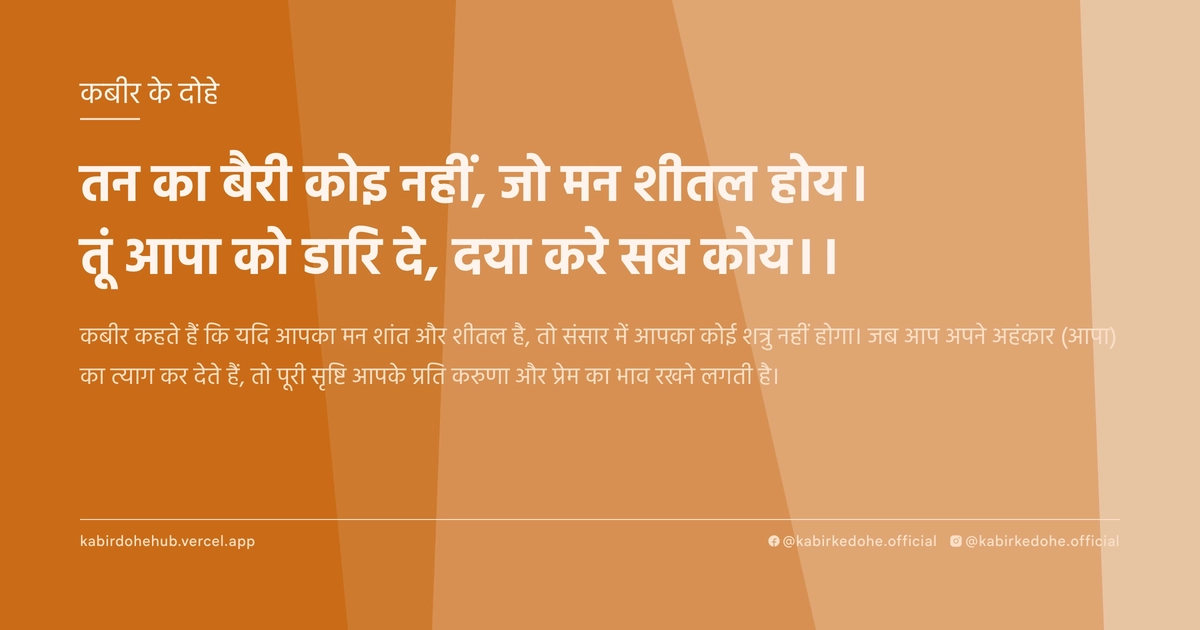
तन का बैरी कोइ नहीं, जो मन शीतल होय।
तूं आपा को डारि दे, दया करे सब कोय।।
Tan ka bairi koi nahi, jo man sheetal hoye. Tun aapa ko dari de, daya kare sab koy.
इस पृष्ठ पर इस कबीर दोहे का अर्थ (meaning), हिंदी व्याख्या और अंग्रेज़ी अनुवाद, दार्शनिक विश्लेषण और व्यावहारिक जीवन सीख दी गई है। यह दोहा विनम्रता (Humility) विषय से जुड़ा है — Kabir doha meaning and explanation in Hindi and English.
अर्थ (Meaning):
कबीर कहते हैं कि यदि आपका मन शांत और शीतल है, तो संसार में आपका कोई शत्रु नहीं होगा। जब आप अपने अहंकार (आपा) का त्याग कर देते हैं, तो पूरी सृष्टि आपके प्रति करुणा और प्रेम का भाव रखने लगती है।
Kabir teaches that if the mind remains cool and serene, no one in the world becomes an enemy. Once you cast aside the 'Aapa' or the egoic sense of self, the entire universe responds to you with compassion and grace.
व्याख्या (Interpretation):
इस दोहे का शाब्दिक अर्थ है कि आंतरिक शांति बाहरी संघर्षों को समाप्त कर देती है। रूपक के स्तर पर, 'शीतल मन' उस अवस्था को दर्शाता है जहाँ राग और द्वेष का अंत हो चुका है। यह निर्गुण भक्ति का सार है, जहाँ साधक यह अनुभव करता है कि वह और दूसरा अलग नहीं हैं। 'आपा' वह मायावी पर्दा है जो आत्मा को ब्रह्म से अलग दिखाता है। जब यह अहंकार गिरता है, तो द्वैत समाप्त हो जाता है और केवल अद्वैत शेष रहता है। इस प्रकार, शत्रुता वास्तव में हमारे अपने भीतर के अहंकार का प्रतिबिंब मात्र है। जब दर्पण साफ होता है, तो केवल प्रेम दिखाई देता है।
Literally, the verse suggests that inner peace dissolves external conflict. Metaphorically, the 'cool mind' represents a state where attachments and aversions have ceased, aligning with the essence of Nirgun Bhakti. The 'Aapa' is the illusory veil of Maya that creates a perceived separation between the Atman and Brahman. By shedding this ego, the practitioner transcends duality, realizing that the 'other' is merely a reflection of oneself. The paradox here is that by losing the individual identity (the ego), one gains the universal identity. Thus, enmity is not an external reality but a projection of the internal ego; once the ego vanishes, only universal compassion remains.
दार्शनिक विश्लेषण (Philosophical Analysis):
कबीर का यह विचार उनके युग के सामाजिक और धार्मिक तनावों के बीच एक क्रांतिकारी हस्तक्षेप था। उन्होंने कर्मकांडों और जातिगत श्रेष्ठता के बजाय आंतरिक शुद्धि पर बल दिया। यह दर्शन अद्वैत वेदांत के करीब है, जहाँ 'अहं ब्रह्मास्मि' का अर्थ केवल ज्ञान नहीं, बल्कि अहंकार का पूर्ण विलोपन है। कबीर यहाँ सूफी मत के 'फना' (स्वयं का विनाश) की अवधारणा को समाहित करते हैं, जहाँ प्रेमी अपने अस्तित्व को ईश्वर में विलीन कर देता है।
ritualism या बाहरी आडंबरों का विरोध करते हुए कबीर तर्क देते हैं कि तीर्थयात्रा या जप-तप तब तक व्यर्थ हैं जब तक मन का 'ताप' (क्रोध और अहंकार) शांत न हो। मनोवैज्ञानिक स्तर पर, यह 'प्रोजेक्शन' की प्रक्रिया को रोकने की बात है। जब हम किसी को शत्रु मानते हैं, तो हम वास्तव में अपने भीतर के असुरक्षा और क्रोध को बाहर प्रक्षेपित कर रहे होते हैं।
भक्ति आंदोलन के संदर्भ में, यह दोहा 'प्रेम मार्ग' की सर्वोच्चता को स्थापित करता है। यहाँ दया केवल एक मानवीय गुण नहीं, बल्कि ब्रह्मांडीय ऊर्जा है जो तब प्रवाहित होती है जब अवरोध (अहंकार) हट जाता है। कबीर स्पष्ट करते हैं कि शांति कोई बाहरी उपलब्धि नहीं, बल्कि हमारा स्वभाव है, जिसे केवल अहंकार की धूल ने ढका हुआ है।
ऐतिहासिक रूप से, कबीर ने एक ऐसे समाज को संबोधित किया जो धर्म के नाम पर विभाजित था। उनका संदेश था कि यदि व्यक्ति स्वयं को 'शून्य' कर ले, तो वह किसी भी विभाजन से ऊपर उठ सकता है। यह एक मनोवैज्ञानिक रूपांतरण है जहाँ 'मैं' से 'हम' और अंततः 'वह' (परमात्मा) की यात्रा पूरी होती है।
अंततः, यह विश्लेषण हमें बताता है कि शत्रुता एक मानसिक भ्रम है। जब साधक अपनी पहचान को शरीर और नाम से हटाकर शुद्ध चेतना में स्थापित करता है, तो उसे हर जीव में अपना ही रूप दिखाई देता है। यही वह बिंदु है जहाँ करुणा स्वाभाविक हो जाती है और संघर्ष का अंत होता है।
Kabir's insight serves as a revolutionary intervention amidst the socio-religious tensions of his era. He prioritized internal purification over ritualistic adherence and caste superiority. This philosophy closely aligns with Advaita Vedanta, where 'Aham Brahmasmi' is not merely a cognitive realization but the total annihilation of the ego. Kabir integrates the Sufi concept of 'Fana' (annihilation of the self), where the seeker dissolves their individual existence into the Divine.
Rejecting ritualism, Kabir argues that pilgrimages and repetitive chants are futile unless the 'heat' of the mind—anger and pride—is cooled. Psychologically, this addresses the mechanism of projection. When we perceive an enemy, we are often projecting our own internal insecurities and aggression onto another person. By cooling the mind, the projection ceases.
Within the Bhakti movement, this verse establishes the supremacy of the 'Path of Love.' Compassion is presented not just as a human virtue, but as a cosmic energy that flows once the obstruction of the ego is removed. Kabir posits that peace is not an external acquisition but our primordial nature, obscured by the dust of the ego.
Historically, Kabir spoke to a society fractured by religious dogma. His message was that by becoming 'Shunya' (zero/void), one transcends all divisions. This is a psychological transformation shifting from 'I' to 'We,' and ultimately to the Universal One.
Ultimately, this analysis reveals that enmity is a mental illusion. When the practitioner shifts their identity from the physical body and social label to pure consciousness, they recognize themselves in every being. At this juncture, compassion becomes spontaneous, and conflict becomes impossible.
मूल संदेश (Core Message):
- शत्रुता बाहरी नहीं, आंतरिक अहंकार का प्रतिबिंब है।
- मन की शीतलता ही वास्तविक मानसिक स्वतंत्रता है।
- अहंकार का विसर्जन ही करुणा का एकमात्र द्वार है।
- जब 'मैं' मिटता है, तब संपूर्ण ब्रह्मांड मित्र बन जाता है।
- शांति कोई लक्ष्य नहीं, बल्कि अहंकार-रहित होने की अवस्था है।
- Enmity is not external; it is a reflection of internal ego.
- The coolness of the mind is the only true mental freedom.
- The dissolution of ego is the sole gateway to universal compassion.
- When the 'I' vanishes, the entire universe becomes a friend.
- Peace is not a destination, but the state of being ego-less.
व्यावहारिक उदाहरण (Practical Example):
वाराणसी के घाटों पर रहने वाले एक वृद्ध बुनकर, माधव, का वर्णन करें। माधव अपनी कला में निपुण थे, लेकिन स्वभाव से अत्यंत क्रोधी और अहंकारी थे। वे मानते थे कि उनके द्वारा बुनी गई साड़ियाँ शहर में सबसे श्रेष्ठ हैं और जो भी उनकी आलोचना करता, वे उसे अपना जन्मजात शत्रु मान लेते थे। उनके और उनके पड़ोसी बुनकर, शिवदास, के बीच वर्षों से एक गहरी कड़वाहट थी, जो एक छोटी सी जमीन की सीमा को लेकर शुरू हुई थी।
माधव का जीवन तनावपूर्ण था; वे रात भर जागते और अपने शत्रुओं के खिलाफ योजनाएँ बनाते। उनके घर में शांति नहीं थी और उनके बच्चे उनसे डरते थे। उनका मन हमेशा 'तप्त' रहता था, जैसे भट्टी में जलता हुआ कोयला।
एक दिन, माधव एक पुराने संत के पास गए और अपनी मानसिक अशांति का कारण पूछा। संत ने उन्हें कोई मंत्र नहीं दिया, बल्कि केवल एक बात कही: 'माधव, तुम जिस शत्रु से लड़ रहे हो, वह शिवदास नहीं है, बल्कि वह छवि है जिसे तुमने अपने अहंकार ने गढ़ा है। जिस दिन तुम इस 'मैं' को छोड़ दोगे, तुम्हें वह शत्रु कहीं नहीं मिलेगा।'
माधव को पहले यह बात समझ नहीं आई, लेकिन उन्होंने प्रयोग करने का निर्णय लिया। उन्होंने तय किया कि वे अब अपनी श्रेष्ठता का दावा नहीं करेंगे। जब शिवदास ने एक बार फिर उनकी किसी गलती पर कटाक्ष किया, तो माधव ने पलटकर जवाब देने के बजाय अपनी आँखें बंद कीं और सोचा, 'यह क्रोध मेरा है, शिवदास का नहीं।'
धीरे-धीरे, माधव ने महसूस किया कि जैसे ही उन्होंने अपनी 'श्रेष्ठता' के बोझ को उतारा, उनका मन शीतल होने लगा। उन्होंने शिवदास की मदद करने के लिए हाथ बढ़ाया, बिना किसी उम्मीद के। उन्होंने देखा कि शिवदास का व्यवहार भी बदलने लगा था।
एक शाम, जब माधव ने अपनी सबसे सुंदर साड़ी शिवदास को उपहार में दी, तो शिवदास की आँखों में आँसू आ गए। उन्होंने स्वीकार किया कि वे भी उसी कड़वाहट के बोझ तले दबे थे।
माधव ने अनुभव किया कि शत्रुता वास्तव में एक मानसिक कारागार था जिसकी चाबी उनके अपने अहंकार के पास थी। जैसे ही उन्होंने 'आपा' (अहंकार) को त्यागा, पूरा मोहल्ला उनके प्रति दयालु और प्रेमपूर्ण हो गया।
अब माधव केवल कपड़े नहीं बुनते थे, बल्कि रिश्तों को बुनते थे। उनकी शांति उनके चेहरे पर एक दिव्य चमक बनकर उभरी, जिससे लोग उनकी ओर आकर्षित होने लगे।
यह 'कबीर ट्विस्ट' था—शत्रु को बदलने की कोशिश करने के बजाय, स्वयं के भीतर के शत्रु (अहंकार) को समाप्त करना। परिणाम यह हुआ कि बाहरी दुनिया स्वतः ही बदल गई।
माधव की कहानी यह सिखाती है कि शांति कोई बाहरी समझौता नहीं है, बल्कि आंतरिक समर्पण का परिणाम है।
Consider Madhav, an elderly weaver living on the ghats of Varanasi. Madhav was a master of his craft but possessed a temperament defined by anger and immense pride. He believed his sarees were the finest in the city, and anyone who critiqued his work was branded a lifelong enemy. For years, a bitter feud existed between him and his neighbor, Shivdas, sparked by a trivial dispute over a boundary line.
Madhav's life was fraught with tension; he spent sleepless nights ruminating on his grievances. There was no peace in his home, and his children feared his outbursts. His mind was perpetually 'heated,' like a glowing coal in a furnace.
One day, Madhav visited an old saint to ask why he felt such unrest. The saint gave him no mantra but a single observation: 'Madhav, the enemy you fight is not Shivdas, but an image constructed by your own ego. The day you drop this "I," you will find that the enemy has vanished.'
Initially confused, Madhav decided to experiment. He vowed to stop asserting his superiority. When Shivdas made a sarcastic remark about a flaw in his weaving, instead of retaliating, Madhav closed his eyes and whispered, 'This anger belongs to me, not to Shivdas.'
Gradually, Madhav realized that as he shed the burden of his perceived superiority, his mind began to cool. He reached out to help Shivdas with a difficult loom setting, expecting nothing in return.
One evening, when Madhav gifted his most exquisite saree to Shivdas, the latter broke down in tears. Shivdas confessed that he too had been crushed under the weight of the same bitterness.
Madhav realized that enmity was a mental prison, and the key was held by his own ego. Once he discarded the 'Aapa' (ego), the entire neighborhood became compassionate and loving toward him.
Now, Madhav did not just weave fabric; he wove relationships. His inner peace manifested as a divine glow, drawing people toward him in genuine affection.
This was the 'Kabir Twist'—instead of trying to change the enemy, he annihilated the enemy within (the ego). Consequently, the external world transformed automatically.
Madhav's story illustrates that peace is not an external negotiation but the result of internal surrender.
अभ्यास मार्गदर्शन (Practice Guidance):
- दैनिक ध्यान: प्रतिदिन 20 मिनट 'साक्षी भाव' का अभ्यास करें। जब भी क्रोध या द्वेष का विचार आए, उसे एक तीसरे व्यक्ति की तरह देखें और कहें, 'यह विचार आ रहा है, मैं यह विचार नहीं हूँ।'
- आत्म-पूछताछ जर्नल: प्रतिदिन रात को लिखें—'आज मैंने किस व्यक्ति को शत्रु माना और मेरे भीतर के किस अहंकार ने उस भावना को जन्म दिया?'
- व्यवहारिक परिवर्तन: दिन में कम से कम एक बार किसी ऐसे व्यक्ति की निस्वार्थ मदद करें जिससे आपके संबंध तनावपूर्ण रहे हों, बिना यह उम्मीद किए कि वे भी बदलेंगे।
- निदान चेकलिस्ट: यदि आप दूसरों की गलतियों पर तुरंत प्रतिक्रिया दे रहे हैं, नींद की कमी महसूस कर रहे हैं, या अपनी श्रेष्ठता सिद्ध करने की इच्छा रखते हैं, तो समझें कि आपका 'आपा' अभी सक्रिय है और मन 'तप्त' है।
- Daily Meditation: Practice 'Witness Consciousness' for 20 minutes daily. Whenever a thought of anger or hatred arises, observe it as a third party and tell yourself, 'This thought is occurring, but I am not this thought.'
- Self-Inquiry Journal: Every night, write—'Who did I perceive as an enemy today, and which part of my ego birthed that feeling?'
- Behavioral Shift: At least once a day, perform a selfless act of kindness for someone with whom you have a strained relationship, without expecting a change in their behavior.
- Diagnostic Checklist: If you find yourself reacting impulsively to others' mistakes, suffering from restlessness, or feeling a compulsive need to prove your superiority, recognize that your 'Aapa' (ego) is active and your mind is 'heated'.
चिंतन प्रश्न (Reflection Questions):
- मेरे जीवन में जिसे मैं अपना सबसे बड़ा शत्रु मानता हूँ, वह वास्तव में मेरे किस डर या असुरक्षा का दर्पण है?
- क्या मेरी 'नैतिक श्रेष्ठता' का भाव वास्तव में एक सूक्ष्म अहंकार है जो मुझे दूसरों से अलग करता है?
- यदि मैं अपनी सामाजिक पहचान (पद, नाम, जाति) को पूरी तरह हटा दूँ, तो क्या मेरे भीतर कोई शत्रु बचेगा?
- मैं अपनी डिजिटल पहचान (सोशल मीडिया) के माध्यम से किस तरह के 'आपा' या झूठे अहंकार को पोषित कर रहा हूँ?
- क्या मैं शांति चाहता हूँ, या मैं केवल अपनी शर्तों पर दूसरों का समर्पण चाहता हूँ?
- The person I consider my greatest enemy—which of my own fears or insecurities are they mirroring?
- Is my sense of 'moral superiority' actually a subtle form of ego that separates me from others?
- If I completely stripped away my social identity (title, name, caste), would any enemy remain within me?
- In what ways am I nourishing a false 'Aapa' or ego through my digital identity and social media presence?
- Do I truly desire peace, or do I merely desire the submission of others to my terms?