
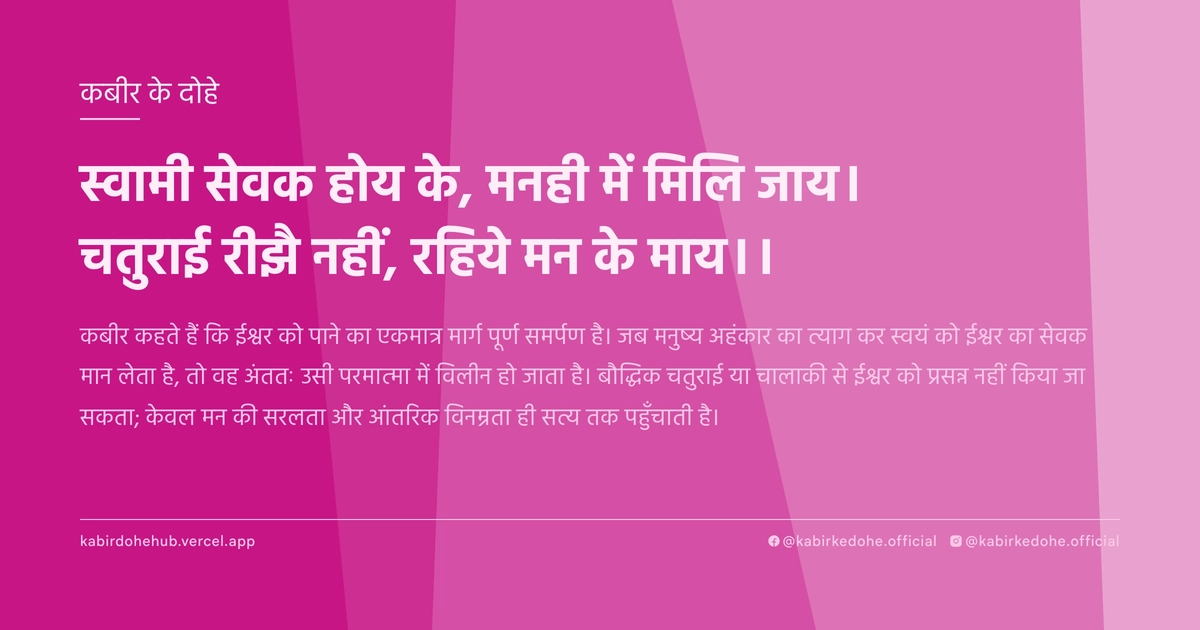
स्वामी सेवक होय के, मनही में मिलि जाय।
चतुराई रीझै नहीं, रहिये मन के माय।।
Swami sevak hoye ke, manhi mein mili jaaye. Chaturai reejhai nahi, rahiye man ke maay.
इस पृष्ठ पर इस कबीर दोहे का अर्थ (meaning), हिंदी व्याख्या और अंग्रेज़ी अनुवाद, दार्शनिक विश्लेषण और व्यावहारिक जीवन सीख दी गई है। यह दोहा विनम्रता (Humility) विषय से जुड़ा है — Kabir doha meaning and explanation in Hindi and English.
अर्थ (Meaning):
कबीर कहते हैं कि ईश्वर को पाने का एकमात्र मार्ग पूर्ण समर्पण है। जब मनुष्य अहंकार का त्याग कर स्वयं को ईश्वर का सेवक मान लेता है, तो वह अंततः उसी परमात्मा में विलीन हो जाता है। बौद्धिक चतुराई या चालाकी से ईश्वर को प्रसन्न नहीं किया जा सकता; केवल मन की सरलता और आंतरिक विनम्रता ही सत्य तक पहुँचाती है।
Kabir asserts that the only path to the Divine is absolute surrender. When a human relinquishes the ego and adopts the spirit of a humble servant, they eventually merge into the Supreme Consciousness. Intellectual cleverness or strategic piety cannot please the Divine; only the simplicity of heart and inner humility lead to the ultimate truth.
व्याख्या (Interpretation):
इस दोहे का शाब्दिक अर्थ है कि सेवक बनकर मन के भीतर समा जाओ। यहाँ 'सेवक' शब्द शारीरिक दासता नहीं, बल्कि 'अहंकार शून्य' अवस्था का प्रतीक है। कबीर निरगुण भक्ति की बात कर रहे हैं, जहाँ भक्त और भगवान के बीच का द्वैत समाप्त हो जाता है। 'चतुराई' यहाँ उस मानसिक अहंकार को दर्शाती है जो तर्क और शास्त्रार्थ के माध्यम से सत्य को जीतना चाहता है। माया का सबसे सूक्ष्म रूप यही बौद्धिक गर्व है। जब साधक अपनी चतुराई को त्याग कर 'मन के माय' यानी अंतर्मन की गहराई और सरलता में निवास करता है, तब वह अद्वैत की स्थिति प्राप्त करता है जहाँ आत्मा और परमात्मा एक हो जाते हैं।
Literally, the couplet urges one to become a servant and merge within the mind. Here, 'servant' does not imply physical servitude but symbolizes a state of 'zero ego.' Kabir speaks of Nirgun Bhakti, where the duality between the devotee and the Divine dissolves. 'Chaturayi' (cleverness) represents the mental arrogance that attempts to conquer truth through logic and scriptural debate. This intellectual pride is the subtlest form of Maya. When the seeker abandons this cleverness and resides in the 'simplicity of the heart,' they achieve the state of Advaita, where the Atman and Brahman are realized as one and the same.
दार्शनिक विश्लेषण (Philosophical Analysis):
कबीर का यह दोहा मध्यकालीन भारत के उस समय का है जब धर्म कर्मकांडों और बाहरी आडंबरों में जकड़ा हुआ था। कबीर ने स्पष्ट रूप से उन पंडितों और मुल्लाओं को चुनौती दी जो केवल शास्त्रों के ज्ञान (चतुराई) के बल पर मोक्ष का दावा करते थे। उनका दर्शन सूफीवाद के 'फना' (अहंकार का विनाश) और अद्वैत वेदांत के 'अहं ब्रह्मास्मि' का एक सुंदर संगम है।
यहाँ 'सेवक' होने का अर्थ है अपनी व्यक्तिगत पहचान को मिटा देना। जब तक 'मैं' मौजूद है, तब तक 'वह' (ईश्वर) दूर है। जैसे ही 'मैं' सेवक बन जाता है, वह दूरी समाप्त हो जाती है। यह मनोवैज्ञानिक रूपांतरण की प्रक्रिया है जहाँ व्यक्ति अपनी सामाजिक स्थिति, जाति और ज्ञान के बोझ को उतार फेंकता है।
कबीर का तर्क है कि ईश्वर किसी बाहरी अनुष्ठान या बौद्धिक व्यायाम से प्रभावित नहीं होते। वे केवल उस हृदय में निवास करते हैं जो पूरी तरह रिक्त और समर्पित है। यह रिक्तता ही वास्तव में पूर्णता है।
इस विश्लेषण में यह समझना आवश्यक है कि 'चतुराई' का विरोध केवल बुद्धि का विरोध नहीं है, बल्कि उस बुद्धि का विरोध है जो अलगाव पैदा करती है। जब बुद्धि समर्पण में बदल जाती है, तो वह ज्ञान बन जाती है।
अंततः, यह दोहा हमें सिखाता है कि सत्य कोई ऐसी वस्तु नहीं है जिसे खोजा या जीता जा सके, बल्कि यह वह है जो तब प्रकट होता है जब खोजने वाला (अहंकार) समाप्त हो जाता है। यह पूर्ण समर्पण ही मोक्ष का द्वार है।
This doha emerges from the medieval Indian era when religion was stifled by rigid rituals and outward displays of piety. Kabir explicitly challenged the scholars and clerics who claimed salvation based solely on scriptural knowledge (cleverness). His philosophy is a profound synthesis of the Sufi concept of 'Fana' (annihilation of the self) and the Advaita Vedanta realization of non-duality.
To be a 'servant' here means the total erasure of the individual identity. As long as the 'I' exists, the Divine remains distant. The moment the 'I' becomes a servant, the distance vanishes. This is a process of psychological transformation where the individual sheds the burdens of social status, caste, and intellectual pride.
Kabir argues that the Divine is not impressed by external rituals or intellectual gymnastics. The Divine resides only in a heart that is completely empty and surrendered. This emptiness is, in reality, the highest form of fullness.
It is crucial to understand that the opposition to 'cleverness' is not an opposition to intellect itself, but to the intellect that creates separation. When intellect transforms into surrender, it becomes true wisdom.
Ultimately, this doha teaches that Truth is not an object to be sought or conquered, but something that reveals itself once the seeker (the ego) ceases to exist. This absolute surrender is the only gateway to liberation.
मूल संदेश (Core Message):
- अहंकार की चतुराई सत्य के मार्ग में सबसे बड़ी बाधा है।
- पूर्ण समर्पण ही आत्मा और परमात्मा के मिलन का सेतु है।
- सादगी और विनम्रता बौद्धिक श्रेष्ठता से कहीं अधिक शक्तिशाली हैं।
- जब 'मैं' मिटता है, तभी 'अनंत' का अनुभव होता है।
- सेवा केवल कार्य नहीं, बल्कि अहंकार के विसर्जन की प्रक्रिया है।
- सत्य तर्क से नहीं, बल्कि हृदय की गहराई से प्राप्त होता है।
- The cleverness of ego is the greatest obstacle on the path to Truth.
- Absolute surrender is the only bridge between the Soul and the Divine.
- Simplicity and humility are far more powerful than intellectual superiority.
- Only when the 'I' vanishes does the experience of the 'Infinite' begin.
- Service is not just an act, but a process of dissolving the ego.
- Truth is attained not through logic, but through the depths of the heart.
व्यावहारिक उदाहरण (Practical Example):
वाराणसी के एक पुराने घाट पर माधव नाम का एक वृद्ध नाविक रहता था। माधव अपनी नाव चलाने की कला में बहुत निपुण था और उसे गर्व था कि वह शहर का सबसे चतुर नाविक है। वह अक्सर अन्य नाविकों को उनकी कमियों के बारे में बताता और खुद को श्रेष्ठ मानता था।
एक दिन, एक शांत और तेजस्वी संन्यासी उसकी नाव पर सवार हुए। संन्यासी ने देखा कि माधव अपनी चतुराई के कारण यात्रियों से अधिक पैसे लेने और उन्हें घुमाने के लिए झूठ बोलने में माहिर था। संन्यासी ने उसे कुछ नहीं कहा, बस उसकी आँखों में गहराई से देखा।
उस रात, माधव ने एक सपना देखा जिसमें वह एक विशाल समुद्र के बीच में था और उसकी नाव डूब रही थी। उसने अपनी सारी चतुराई लगाने की कोशिश की, लेकिन लहरें उसे निगल रही थीं। अंत में, उसने हार मान ली और चिल्लाया, 'मैं हार गया! मैं केवल आपका सेवक हूँ, जैसा आप चाहें वैसा करें!'
जैसे ही उसने यह समर्पण किया, लहरें शांत हो गईं और वह सुरक्षित किनारे पर पहुँच गया। जागने पर माधव को महसूस हुआ कि उसकी 'चतुराई' ही उसका सबसे बड़ा बोझ थी।
अगले दिन से, माधव का व्यवहार बदल गया। उसने अपनी नाव को केवल पैसे कमाने का साधन नहीं, बल्कि सेवा का माध्यम बना लिया।
वह अब यात्रियों की मदद बिना किसी स्वार्थ के करता था। उसने अपनी श्रेष्ठता का अहंकार त्याग दिया और खुद को गंगा मैया का एक छोटा सा सेवक मानने लगा।
उसकी इस सरलता ने लोगों को उसकी ओर आकर्षित किया। अब वह पहले से कहीं अधिक सम्मानित और खुश था।
उसने सीखा कि जब वह 'चतुर नाविक' बनने की कोशिश करता था, तो वह अकेला था, लेकिन जब वह 'सेवक' बना, तो पूरा ब्रह्मांड उसके साथ था।
उसकी चतुराई ने उसे अहंकार दिया था, लेकिन उसके समर्पण ने उसे शांति और प्रेम दिया।
माधव की कहानी यह सिद्ध करती है कि जब हम अपनी पहचान को सेवा में विलीन कर देते हैं, तो हम वास्तव में स्वयं को पा लेते हैं।
On an ancient ghat in Varanasi lived an elderly boatman named Madhav. Madhav was exceptionally skilled in navigating the river and took immense pride in being the cleverest boatman in the city. He often pointed out the flaws of other boatmen to assert his superiority.
One day, a serene and radiant monk boarded his boat. The monk noticed that Madhav used his cleverness to overcharge passengers and tell lies to lure them into longer trips. The monk said nothing, only looked deeply into Madhav's eyes.
That night, Madhav had a dream where he was in the middle of a vast ocean and his boat was sinking. He tried every clever trick he knew to save himself, but the waves continued to swallow him. Finally, he gave up and cried out, 'I am defeated! I am but your servant; do with me as you will!'
The moment he surrendered, the waves calmed, and he reached the shore safely. Upon waking, Madhav realized that his 'cleverness' had been his heaviest burden.
From the next day, Madhav's behavior transformed. He stopped viewing his boat as a mere tool for profit and turned it into a medium of service.
He began helping passengers without any selfish motive. He discarded his pride of superiority and began to see himself as a humble servant of Mother Ganga.
This simplicity attracted people to him more than his skill ever had. He became more respected and happier than he had ever been.
He learned that when he tried to be the 'clever boatman,' he was alone, but when he became a 'servant,' the entire universe was with him.
His cleverness had given him ego, but his surrender gave him peace and love.
Madhav's story proves that when we dissolve our identity into service, we truly find ourselves.
अभ्यास मार्गदर्शन (Practice Guidance):
- दैनिक अभ्यास: प्रतिदिन 15 मिनट मौन बैठें और विचार करें कि आपकी कौन सी 'चतुराई' (अहंकार) आपको दूसरों से अलग कर रही है।
- आत्म-पूछताछ: जब भी आप किसी बहस में जीतने की कोशिश करें, रुककर पूछें—'क्या मैं सत्य को खोज रहा हूँ या अपनी श्रेष्ठता को सिद्ध कर रहा हूँ?'
- व्यवहार परिवर्तन: दिन में कम से कम एक ऐसा कार्य करें जिसमें आप अपनी पहचान छुपाकर निस्वार्थ भाव से किसी की सेवा करें।
- निदान चेकलिस्ट: यदि आप दूसरों की गलती पर तुरंत प्रतिक्रिया देते हैं या अपनी उपलब्धियों का बखान करते हैं, तो समझें कि 'चतुराई' अभी हावी है। यदि आप आलोचना सुनकर भी शांत रहते हैं और सेवा में आनंद पाते हैं, तो आप सही मार्ग पर हैं।
- Daily Practice: Sit in silence for 15 minutes daily and contemplate which 'cleverness' (ego) is creating a barrier between you and others.
- Self-Inquiry: Whenever you feel the urge to win an argument, stop and ask—'Am I seeking the truth, or am I trying to prove my superiority?'
- Behavioral Change: Perform at least one act of selfless service daily where you keep your identity hidden and seek no recognition.
- Diagnostic Checklist: If you react instantly to others' mistakes or constantly narrate your achievements, the 'cleverness' is still dominant. If you remain calm during criticism and find joy in serving, you are aligned with the wisdom.
चिंतन प्रश्न (Reflection Questions):
- मेरी वह कौन सी 'बौद्धिक पहचान' है जिसे मैं खोने से सबसे ज्यादा डरता हूँ?
- क्या मेरा धर्म और आध्यात्मिकता का अभ्यास मुझे अधिक विनम्र बना रहा है या अधिक अहंकारी?
- जब मैं दूसरों की मदद करता हूँ, तो क्या मैं वास्तव में उनकी सेवा कर रहा हूँ या अपनी 'अच्छे इंसान' होने की छवि को पुष्ट कर रहा हूँ?
- मेरे जीवन का वह कौन सा क्षेत्र है जहाँ मैं अभी भी 'चतुराई' से परिणाम प्राप्त करने की कोशिश कर रहा हूँ?
- यदि मेरी सारी उपलब्धियाँ और पद छीन लिए जाएँ, तो मेरे भीतर क्या बचेगा?
- क्या मैं सत्य को स्वीकार करने के लिए तैयार हूँ, भले ही वह मेरी वर्तमान मान्यताओं को गलत साबित करे?
- What is that 'intellectual identity' I am most afraid of losing?
- Is my practice of religion and spirituality making me more humble or more arrogant?
- When I help others, am I truly serving them, or am I reinforcing my image as a 'good person'?
- In which area of my life am I still trying to achieve results through 'cleverness' and manipulation?
- If all my achievements and titles were stripped away, what would remain within me?
- Am I truly ready to accept the Truth, even if it proves my current beliefs wrong?