
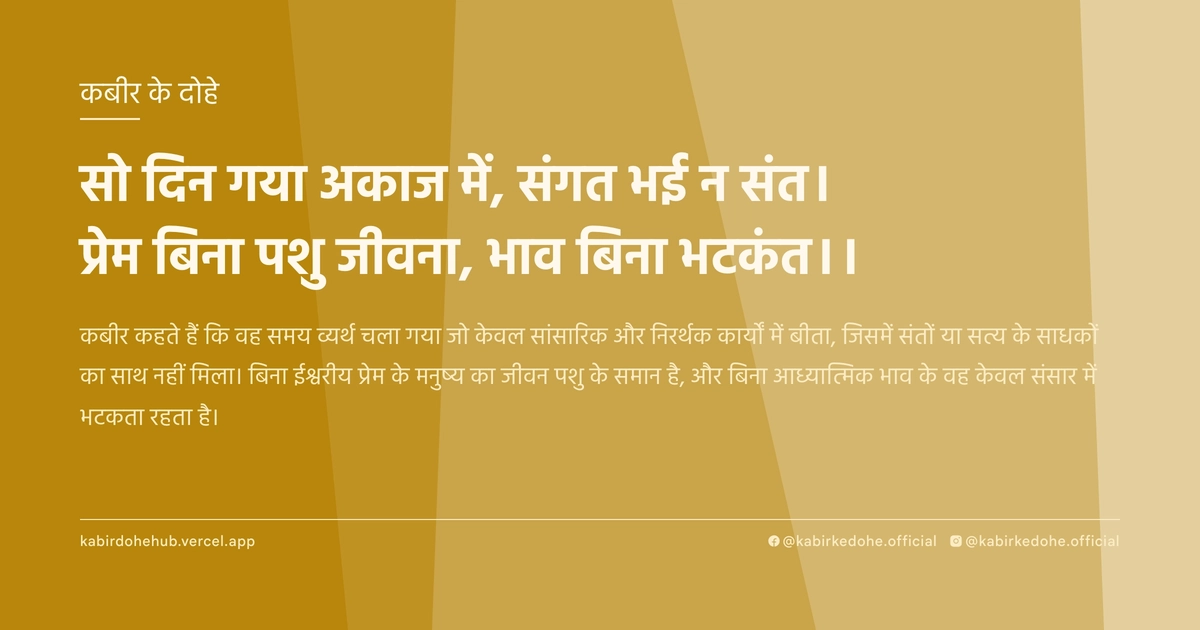
सो दिन गया अकाज में, संगत भई न संत।
प्रेम बिना पशु जीवना, भाव बिना भटकंत।।
So din gaya akaaj mein, sangat bhai na sant. Prem bina pashu jeevna, bhaav bina bhatkant.
इस पृष्ठ पर इस कबीर दोहे का अर्थ (meaning), हिंदी व्याख्या और अंग्रेज़ी अनुवाद, दार्शनिक विश्लेषण और व्यावहारिक जीवन सीख दी गई है। यह दोहा सत्संग (Satsang) विषय से जुड़ा है — Kabir doha meaning and explanation in Hindi and English.
अर्थ (Meaning):
कबीर कहते हैं कि वह समय व्यर्थ चला गया जो केवल सांसारिक और निरर्थक कार्यों में बीता, जिसमें संतों या सत्य के साधकों का साथ नहीं मिला। बिना ईश्वरीय प्रेम के मनुष्य का जीवन पशु के समान है, और बिना आध्यात्मिक भाव के वह केवल संसार में भटकता रहता है।
Kabir laments the time wasted in futile, worldly pursuits where the company of the enlightened was absent. He asserts that a life devoid of divine love is akin to the existence of an animal, and without a deep spiritual yearning, a human being remains a wanderer in the labyrinth of existence.
व्याख्या (Interpretation):
इस दोहे का शाब्दिक अर्थ समय की बर्बादी और सत्संग के अभाव पर शोक है। गहरे स्तर पर, 'अकाज' केवल बाहरी कार्य नहीं, बल्कि वह मानसिक शोर है जो हमें आत्मा से दूर रखता है। 'पशु जीवन' का अर्थ शारीरिक पशुता नहीं, बल्कि चेतना का वह स्तर है जहाँ केवल भूख, नींद और वासना प्रधान होती है। निर्गुण भक्ति के अनुसार, जब तक जीव माया के मोह में है, वह वास्तव में सो रहा है। 'भाव' वह सेतु है जो सीमित अहंकार को असीमित ब्रह्म से जोड़ता है। यहाँ विरोधाभास यह है कि मनुष्य स्वयं को श्रेष्ठ मानता है, किंतु प्रेम के अभाव में वह सबसे निम्न चेतना में गिर जाता है। यह अद्वैत वेदांत के उस सत्य को दर्शाता है जहाँ बिना आत्म-साक्षात्कार के, अस्तित्व केवल एक यांत्रिक पुनरावृत्ति है।
Literally, the verse mourns the loss of time and the absence of holy company. Metaphorically, 'akaaj' represents not just mundane tasks, but the mental noise that alienates the self from the Soul. 'Animal life' does not imply physical bestiality, but a state of consciousness dominated by instinct, hunger, and desire. In Nirgun Bhakti, as long as the soul is entangled in Maya, it remains in a state of spiritual slumber. 'Bhaav' (spiritual emotion) is the bridge connecting the limited ego to the infinite Brahman. The central paradox is that while humans claim superiority, without divine love, they descend to the lowest level of consciousness. This aligns with Advaita Vedanta, suggesting that without self-realization, existence is merely a mechanical repetition of biological urges.
दार्शनिक विश्लेषण (Philosophical Analysis):
कबीर का यह दोहा उनके युग के उस सामाजिक और धार्मिक ढांचे पर प्रहार करता है जहाँ लोग कर्मकांडों और बाहरी दिखावे को ही धर्म मानते थे। उनके लिए 'संगत' का अर्थ केवल किसी व्यक्ति के साथ बैठना नहीं, बल्कि उच्च चेतना का संचरण है। वे यहाँ स्पष्ट करते हैं कि बिना आंतरिक रूपांतरण के, बाहरी धार्मिक गतिविधियाँ 'अकाज' या व्यर्थ हैं।
दार्शनिक रूप से, यह सूफी मत के 'इश्क-ए-हकीकी' (दिव्य प्रेम) और वेदांत के 'भक्ति मार्ग' का संगम है। सूफीवाद में प्रेम ही वह एकमात्र साधन है जो प्रेमी को उसके प्रिय (परमात्मा) से मिलाता है। कबीर तर्क देते हैं कि बुद्धि और तर्क केवल मार्ग दिखा सकते हैं, लेकिन यात्रा केवल प्रेम के माध्यम से पूरी होती है।
अहंकार का विलोपन इस प्रक्रिया का केंद्र है। जब तक 'मैं' जीवित है, तब तक 'भाव' नहीं जागता। पशु और मनुष्य में अंतर केवल बौद्धिक क्षमता का नहीं, बल्कि उस क्षमता का है जिससे वे अपने अस्तित्व के स्रोत को पहचान सकें। जो इस स्रोत को नहीं पहचानता, वह जैविक रूप से मनुष्य होते हुए भी आध्यात्मिक रूप से पशु है।
कबीर यहाँ जाति और वर्ण के भेदों को निरर्थक बताते हैं क्योंकि प्रेम और भाव किसी सामाजिक श्रेणी के मोहताज नहीं होते। एक अछूत यदि प्रेम में लीन है, तो वह उस पंडित से श्रेष्ठ है जो केवल शास्त्रों का रटंत ज्ञान रखता है लेकिन हृदय में शुष्कता है।
अंततः, यह विश्लेषण हमें यह समझने पर मजबूर करता है कि जीवन की सार्थकता उसकी लंबाई में नहीं, बल्कि उसकी गहराई में है। समय का व्यय भौतिक संपदा जुटाने में नहीं, बल्कि उस आंतरिक मौन को खोजने में होना चाहिए जहाँ आत्मा और परमात्मा का भेद मिट जाता है।
This couplet strikes at the social and religious structures of Kabir's era, where ritualism and outward displays of piety were mistaken for spirituality. For Kabir, 'Sangat' is not merely physical proximity to a saint, but the transmission of higher consciousness. He asserts that without internal transformation, external religious activities are 'akaaj'—futile noise.
Philosophically, this is a convergence of the Sufi concept of 'Ishq-e-Haqiqi' (Divine Love) and the Vedantic path of Bhakti. In Sufism, love is the only vehicle capable of uniting the lover with the Beloved. Kabir argues that while intellect and logic can point the way, the journey can only be completed through the heart's devotion.
The annihilation of the ego (Fana) is central to this process. As long as the 'I' persists, true 'Bhaav' cannot awaken. The distinction between a human and an animal is not intellectual capacity, but the capacity to recognize the source of one's existence. One who fails to recognize this source remains spiritually animalistic despite their biological form.
Kabir renders caste and class distinctions irrelevant here, as love and spiritual yearning transcend social hierarchies. An outcast immersed in divine love is superior to a scholar who possesses rote knowledge of scriptures but harbors a desiccated heart.
Ultimately, this analysis forces us to realize that the meaning of life lies not in its duration, but in its depth. The expenditure of time should not be in accumulating material wealth, but in discovering that inner silence where the duality between the Atman and Brahman dissolves.
मूल संदेश (Core Message):
- यांत्रिक जीवन व्यर्थ है; प्रेम ही एकमात्र सार्थकता है।
- बिना भाव के भक्ति केवल एक शारीरिक व्यायाम है।
- सत्संग का अर्थ सत्य के साथ एकाकार होना है।
- अहंकार का त्याग ही वास्तविक मानवीय चेतना का उदय है।
- बाहरी आडंबर आंतरिक रिक्तता को नहीं भर सकते।
- Mechanical living is futile; love is the only true meaning.
- Devotion without emotion is merely a physical exercise.
- Sangat means becoming one with the Truth, not just a person.
- The surrender of ego is the awakening of true human consciousness.
- External rituals cannot fill internal emptiness.
व्यावहारिक उदाहरण (Practical Example):
वाराणसी के घाटों पर रहने वाले एक वृद्ध विधवा, जानकी, का जीवन केवल पूजा-पाठ और कठोर नियमों के इर्द-गिर्द सिमटा था। वह प्रतिदिन घंटों मंत्र जाप करती, लेकिन उसके मन में अन्य महिलाओं के प्रति निर्णय और कठोरता भरी रहती थी। वह मानती थी कि केवल नियमों का पालन ही मोक्ष का मार्ग है।
एक दिन उसकी मुलाकात एक घुमक्कड़ फकीर से हुई जो घाट की सीढ़ियों पर बैठकर बस मुस्कुरा रहा था। फकीर ने उससे पूछा, 'माई, तुम पत्थर की मूर्ति को तो बहुत प्यार करती हो, पर क्या उस पत्थर जैसी कठोरता को अपने भीतर से निकाला?'
जानकी को पहले तो यह बात चुभी, लेकिन फिर उसने महसूस किया कि उसका पूरा जीवन 'अकाज' में गया—सिर्फ रस्मों को निभाने में, प्रेम को महसूस करने में नहीं। उसने देखा कि वह मंदिर तो जाती थी, पर उसके हृदय में करुणा का अभाव था।
उसने धीरे-धीरे अपने जीवन में बदलाव किया। उसने मंत्रों के जाप से ज्यादा ध्यान उन लोगों की मदद करने में लगाया जो वास्तव में दुखी थे। उसने अपनी कठोरता को त्यागकर दूसरों के दर्द को अपनाना शुरू किया।
एक दिन उसने एक बीमार अजनबी की सेवा की, जिसे समाज ने त्याग दिया था। उस सेवा के दौरान उसे जो शांति मिली, वह उसे वर्षों के अनुष्ठानों में नहीं मिली थी।
उसे समझ आया कि वह अब तक केवल एक 'धार्मिक मशीन' की तरह जी रही थी, जो कि एक प्रकार का पशु जीवन ही था क्योंकि उसमें चेतना और प्रेम का अभाव था।
उसने महसूस किया कि 'भाव' का अर्थ केवल ईश्वर की मूर्ति के सामने रोना नहीं, बल्कि हर जीव में उसी ईश्वर को देखना और उससे प्रेम करना है।
जानकी का रूपांतरण तब पूरा हुआ जब उसने पाया कि अब उसे मोक्ष की चिंता नहीं है, क्योंकि प्रेम ही उसका मोक्ष बन गया है।
उसकी आँखों में अब निर्णय नहीं, बल्कि एक असीम करुणा थी। वह अब भटक नहीं रही थी, क्योंकि उसे अपना केंद्र मिल गया था।
यह 'कबीर ट्विस्ट' था—जहाँ कर्मकांड का अंत हुआ और वास्तविक प्रेम का जन्म हुआ, जिससे उसका जीवन पशुवत यांत्रिकता से मुक्त होकर दैवीय हो गया।
Janaki, an elderly widow living on the ghats of Varanasi, had a life confined to rigid rituals and strict adherence to religious laws. She spent hours chanting mantras, yet her heart was filled with judgment and harshness toward other women. She believed that following rules was the only path to liberation.
One day, she encountered a wandering fakir sitting on the steps of the ghat, simply smiling. The fakir asked her, 'Mother, you love the stone idol so much, but have you removed the stone-like hardness from within yourself?'
Initially, Janaki felt offended, but then she realized that her entire life had been spent in 'akaaj'—merely performing rituals without ever experiencing love. She saw that while she visited the temple, her heart lacked genuine compassion.
She slowly began to change. Instead of focusing solely on the repetition of mantras, she dedicated her time to helping those who were truly suffering. She traded her rigidity for the embrace of others' pain.
One day, she cared for a sick stranger whom society had discarded. In that act of service, she found a peace that years of formal rituals had never provided.
She realized she had been living as a 'religious machine,' which was essentially an animal-like existence because it lacked conscious love and spiritual awareness.
She understood that 'Bhaav' is not just weeping before an idol, but seeing the Divine in every living being and loving them unconditionally.
Janaki's transformation was complete when she found she no longer worried about salvation, for love itself had become her liberation.
Her eyes no longer held judgment, but an infinite compassion. She was no longer wandering, for she had found her center.
This was the 'Kabir Twist'—where ritualism ended and real love began, freeing her life from animalistic mechanicality and making it divine.
अभ्यास मार्गदर्शन (Practice Guidance):
- दैनिक आत्म-निरीक्षण: प्रतिदिन 15 मिनट मौन बैठें और विचार करें कि आज के कार्यों में से कितने वास्तव में प्रेम से प्रेरित थे और कितने केवल सामाजिक दबाव या आदत (अकाज) थे।
- करुणा का अभ्यास: दिन में कम से कम एक ऐसा कार्य करें जिसमें कोई व्यक्तिगत लाभ न हो, केवल दूसरे के प्रति निस्वार्थ भाव हो।
- जर्नलिंग प्रॉम्प्ट: 'यदि मैं अपनी सभी धार्मिक और सामाजिक पहचान हटा दूँ, तो मेरे भीतर क्या बचता है? क्या वह प्रेम है या शून्य?'
- डायग्नोस्टिक चेकलिस्ट: क्या मैं दूसरों की गलतियों पर तुरंत निर्णय लेता हूँ? क्या मेरा ध्यान परिणाम पर अधिक और प्रक्रिया के प्रेम पर कम है? यदि हाँ, तो मैं अभी भी 'पशु जीवन' की यांत्रिकता में हूँ।
- Daily Self-Inquiry: Sit in silence for 15 minutes daily and analyze how many of your actions were driven by genuine love and how many were merely social pressure or habit (akaaj).
- Practice of Compassion: Perform at least one act daily that offers no personal gain, driven solely by selfless empathy for another.
- Journaling Prompt: 'If I strip away all my religious and social identities, what remains within me? Is it love, or is it a void?'
- Diagnostic Checklist: Do I judge others' mistakes instantly? Is my focus more on the result than on the love of the process? If yes, I am still trapped in the mechanicality of an 'animal life'.
चिंतन प्रश्न (Reflection Questions):
- मेरे जीवन के वे कौन से 'अकाज' (व्यर्थ कार्य) हैं जिन्हें मैं अपनी व्यस्तता का नाम देकर सही ठहराता हूँ?
- क्या मेरा धर्म प्रेम पर आधारित है या केवल भय और परंपराओं के पालन पर?
- जब मैं किसी की मदद करता हूँ, तो क्या मैं वास्तव में उस व्यक्ति को देख रहा हूँ, या अपनी 'मदद करने वाली' छवि को?
- मेरे भीतर का वह 'पशु' कौन सा है जो अभी भी केवल अपनी इच्छाओं की तृप्ति में लगा है?
- यदि आज मेरा सारा सामाजिक सम्मान छीन लिया जाए, तो क्या मेरे पास प्रेम करने की क्षमता बचेगी?
- What are the 'akaaj' (futile tasks) in my life that I justify under the guise of being 'busy'?
- Is my spirituality based on love, or merely on fear and the adherence to tradition?
- When I help someone, am I truly seeing that person, or am I seeing my own image as a 'helper'?
- Which 'animal' within me is still solely occupied with the gratification of its own desires?
- If all my social status were stripped away today, would I still possess the capacity to love?