
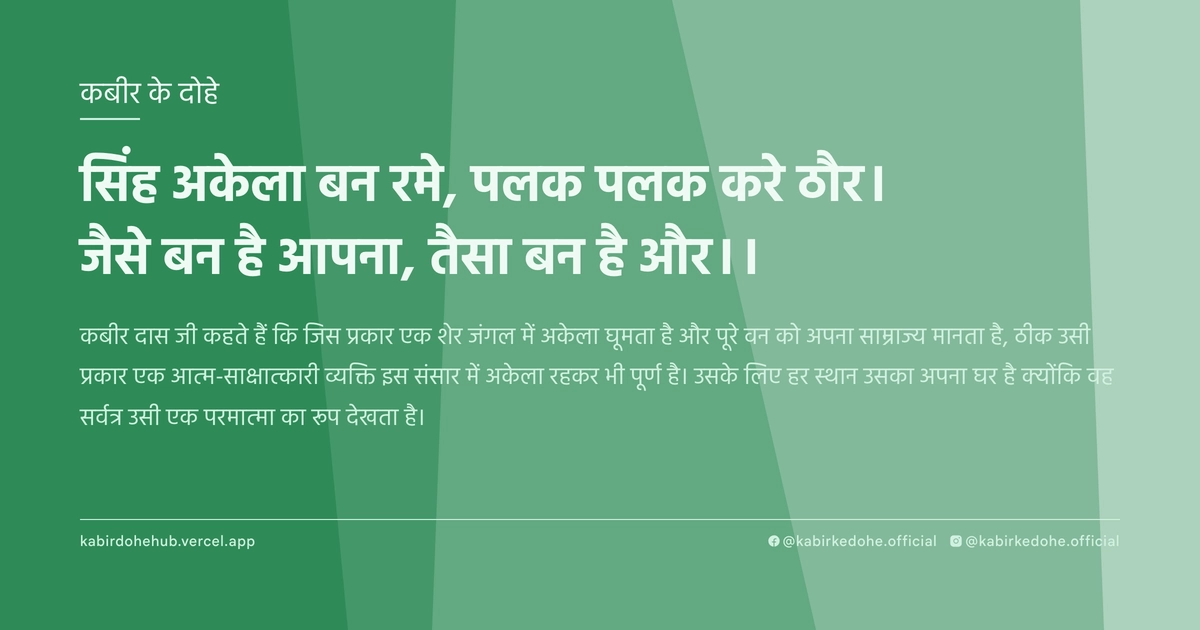
सिंह अकेला बन रमे, पलक पलक करे ठौर।
जैसे बन है आपना, तैसा बन है और।।
Singh akela ban rame, palak palak kare thaur. Jaise ban hai aapna, taisa ban hai aur.
इस पृष्ठ पर इस कबीर दोहे का अर्थ (meaning), हिंदी व्याख्या और अंग्रेज़ी अनुवाद, दार्शनिक विश्लेषण और व्यावहारिक जीवन सीख दी गई है। यह दोहा सहज योग (Sahaja Yoga) विषय से जुड़ा है — Kabir doha meaning and explanation in Hindi and English.
अर्थ (Meaning):
कबीर दास जी कहते हैं कि जिस प्रकार एक शेर जंगल में अकेला घूमता है और पूरे वन को अपना साम्राज्य मानता है, ठीक उसी प्रकार एक आत्म-साक्षात्कारी व्यक्ति इस संसार में अकेला रहकर भी पूर्ण है। उसके लिए हर स्थान उसका अपना घर है क्योंकि वह सर्वत्र उसी एक परमात्मा का रूप देखता है।
Kabir suggests that just as a lion roams the forest alone, claiming the entire wilderness as its own domain, a self-realized soul exists in this world in solitary spiritual independence. To such a person, every place becomes their own home because they perceive the single Divine presence pervading all existence.
व्याख्या (Interpretation):
इस दोहे का शाब्दिक अर्थ एक शेर की निर्भयता से शुरू होता है, लेकिन इसका गहरा आध्यात्मिक संकेत 'अद्वैत' की स्थिति है। यहाँ 'सिंह' उस जागृत आत्मा का प्रतीक है जिसने अहंकार का त्याग कर दिया है। 'अकेला' होने का अर्थ यहाँ अकेलापन नहीं, बल्कि 'एकत्व' (Oneness) है। जब साधक माया के भ्रम को तोड़ देता है, तो उसे यह अहसास होता है कि वह और यह ब्रह्मांड अलग नहीं हैं। यह निर्गुण भक्ति का शिखर है जहाँ भक्त और भगवान का भेद मिट जाता है। यह स्थिति उस मोक्ष की है जहाँ व्यक्ति बाहरी दुनिया के बंधनों से मुक्त होकर आंतरिक स्वतंत्रता का अनुभव करता है।
The literal meaning begins with the fearlessness of a lion, but the deeper spiritual signifier is the state of 'Advaita' or non-duality. Here, the 'lion' symbolizes the awakened soul that has shed the ego. Being 'alone' does not signify loneliness, but rather 'Oneness.' When the seeker shatters the illusion of Maya, they realize that they and the universe are not distinct. This is the pinnacle of Nirgun Bhakti, where the distinction between the devotee and the Divine vanishes. It describes a state of liberation where the individual is free from external bondages, experiencing absolute internal sovereignty.
दार्शनिक विश्लेषण (Philosophical Analysis):
कबीर का यह विचार उनके समय के सामाजिक और धार्मिक संकीर्णता पर एक प्रहार है। उन्होंने देखा कि लोग धर्म, जाति और संप्रदाय की दीवारों में कैद थे। इस दोहे के माध्यम से वे 'अद्वैत वेदांत' के उस सिद्धांत को पुष्ट करते हैं जहाँ आत्मा और ब्रह्म एक ही हैं। जब व्यक्ति यह जान लेता है कि वह स्वयं उस अनंत चेतना का हिस्सा है, तो वह किसी मंदिर, मस्जिद या विशिष्ट तीर्थ की खोज नहीं करता, क्योंकि पूरा अस्तित्व ही उसका मंदिर बन जाता है।
सूफीवाद के 'फना' (अहंकार का विनाश) के सिद्धांत से इसकी गहरी समानता है। जब तक 'मैं' मौजूद है, तब तक अलगाव है। जैसे ही 'मैं' मिटता है, केवल 'वह' (परमात्मा) बचता है। कबीर यहाँ कर्मकांडों के विरुद्ध तर्क देते हैं कि ईश्वर को बाहर खोजने की आवश्यकता नहीं है; वह तो भीतर की गहराई में स्थित है।
मनोवैज्ञानिक स्तर पर, यह दोहे आत्म-निर्भरता और मानसिक स्थिरता की बात करता है। समाज अक्सर हमें दूसरों की स्वीकृति पर निर्भर करता है, लेकिन 'सिंह' की तरह जीना वह साहस है जहाँ व्यक्ति अपनी आंतरिक सच्चाई के साथ संतुष्ट रहता है। यह बाहरी दुनिया के शोर के बीच एक आंतरिक मौन की स्थापना है।
ऐतिहासिक रूप से, कबीर ने बुनकर समुदाय से होते हुए भी उस आध्यात्मिक ऊंचाई को छुआ जहाँ उन्होंने राजा और रंक, पंडित और मुल्ला के बीच के कृत्रिम अंतर को मिटा दिया। उनके लिए सत्य वह है जो सार्वभौमिक है, न कि वह जो किसी किताब या परंपरा में सीमित है।
अंततः, यह विश्लेषण हमें बताता है कि वास्तविक स्वतंत्रता किसी स्थान को बदलने में नहीं, बल्कि अपनी दृष्टि को बदलने में है। जब दृष्टि बदलती है, तो रेगिस्तान भी उपवन बन जाता है और पराया घर भी अपना लगने लगता है।
Kabir's thought is a direct strike against the social and religious narrow-mindedness of his era. He observed people imprisoned within the walls of religion, caste, and sect. Through this couplet, he reinforces the 'Advaita Vedanta' principle where the Atman and Brahman are one. Once a person realizes they are part of that infinite consciousness, they cease searching for a specific temple, mosque, or pilgrimage site, for the entire existence becomes their sanctuary.
There is a profound similarity here with the Sufi concept of 'Fana' (the annihilation of the ego). As long as the 'I' exists, there is separation. The moment the 'I' vanishes, only 'He' (the Divine) remains. Kabir argues against ritualism, asserting that there is no need to seek God externally; the Divine resides in the depths of the inner self.
On a psychological level, this verse speaks of self-reliance and mental stability. Society often makes us dependent on external validation, but living like the 'lion' is the courage to remain satisfied with one's internal truth. It is the establishment of an inner silence amidst the noise of the external world.
Historically, despite belonging to the weaver community, Kabir reached a spiritual height where he erased the artificial distinctions between kings and paupers, pundits and mullahs. For him, truth is that which is universal, not that which is confined to a book or a tradition.
Ultimately, this analysis teaches us that true liberation lies not in changing one's location, but in changing one's perception. When the vision shifts, a desert becomes a garden, and a foreign land feels like home.
मूल संदेश (Core Message):
- अकेलापन एक भ्रम है, केवल एकत्व सत्य है।
- अहंकार का त्याग ही वास्तविक स्वतंत्रता की कुंजी है।
- बाहरी दुनिया की खोज आंतरिक शांति का विकल्प नहीं है।
- जब आप स्वयं को जान लेते हैं, तो पूरा संसार आपका अपना हो जाता है।
- निर्गुण भक्ति का अर्थ है हर कण में परमात्मा का अनुभव करना।
- Loneliness is an illusion; only Oneness is the truth.
- The surrender of ego is the key to true liberation.
- External searching is no substitute for internal peace.
- Once you know yourself, the entire universe becomes your own.
- Nirgun Bhakti means experiencing the Divine in every atom.
व्यावहारिक उदाहरण (Practical Example):
वाराणसी के घाटों पर रहने वाली एक वृद्ध विधवा, जिन्हें समाज ने हाशिए पर धकेल दिया था, की कहानी है। उनका अपना कोई घर नहीं था और वे अक्सर दूसरों की दया पर निर्भर रहती थीं।
वे हर दिन गंगा किनारे बैठतीं और लोगों को उनके अहंकार और दिखावे में डूबे हुए देखतीं। शुरू में वे अपनी स्थिति के लिए दुखी रहती थीं और समाज से सम्मान की उम्मीद करती थीं।
एक दिन उन्होंने कबीर के इस दोहे को सुना और गहराई से विचार किया। उन्होंने महसूस किया कि उनकी 'अकेलापन' वास्तव में उनकी सबसे बड़ी शक्ति है।
उन्होंने यह समझना शुरू किया कि जिस तरह शेर को जंगल के किसी एक कोने की जरूरत नहीं होती, वैसे ही उन्हें किसी के सहारे या किसी खास घर की जरूरत नहीं है।
उन्होंने अपनी छोटी सी कुटिया को ही अपना ब्रह्मांड मान लिया और हर आने-जाने वाले व्यक्ति में उसी एक ईश्वर की छवि देखना शुरू कर दिया।
अब वे किसी से कुछ नहीं मांगती थीं। उनके चेहरे पर एक ऐसी शांति थी जिसने शहर के बड़े-बड़े विद्वानों को भी अचंभित कर दिया।
एक बार एक धनी व्यक्ति ने उनसे पूछा कि वे बिना किसी सहारे के इतनी खुश कैसे हैं। उन्होंने मुस्कुराकर कहा, "जब पूरा संसार मेरा घर है, तो मैं किसी एक दीवार की मोहताज क्यों रहूँ?"
इस 'कबीर ट्विस्ट' ने उनके जीवन को अभाव से पूर्णता की ओर मोड़ दिया। अब वे केवल एक विधवा नहीं थीं, बल्कि एक मुक्त आत्मा थीं।
उनकी यह आंतरिक स्वतंत्रता देखकर लोग उनके पास शांति की तलाश में आने लगे। उन्होंने सिखाया कि घर ईंट-पत्थरों से नहीं, बल्कि चेतना से बनता है।
अंततः, उन्होंने यह सिद्ध किया कि जब आप स्वयं को ब्रह्मांड के साथ एक कर लेते हैं, तो आप कभी अकेले या बेघर नहीं होते।
This is the story of an elderly widow living on the ghats of Varanasi, pushed to the margins of society. She had no home of her own and often depended on the charity of others.
Every day she sat by the Ganges, watching people immersed in their ego and superficial displays of piety. Initially, she felt sorrow for her condition and longed for social respect.
One day, she heard this specific Doha of Kabir and contemplated it deeply. She realized that her 'solitude' was actually her greatest strength.
She began to understand that just as a lion does not need a specific corner of the forest, she did not need anyone's support or a specific house to feel complete.
She transformed her tiny hut into her own universe and started seeing the image of the one Divine in every person who passed by.
She no longer asked for anything from anyone. A serenity dawned on her face that astonished even the greatest scholars of the city.
Once, a wealthy man asked her how she could be so happy without any support. She smiled and replied, "When the entire universe is my home, why should I be dependent on a single wall?"
This 'Kabir Twist' shifted her life from a state of deprivation to a state of wholeness. She was no longer just a widow; she was a liberated soul.
Seeing her internal freedom, people began coming to her in search of peace. She taught them that a home is not built of bricks and stones, but of consciousness.
Ultimately, she proved that when you unify yourself with the universe, you are never alone or homeless.
अभ्यास मार्गदर्शन (Practice Guidance):
- प्रतिदिन 20 मिनट मौन अभ्यास करें, जहाँ आप स्वयं को एक व्यक्ति के रूप में नहीं, बल्कि एक अनंत चेतना के रूप में देखें।
- एक डायरी लिखें जिसमें आप उन क्षणों को दर्ज करें जब आपने 'अकेलेपन' को 'एकत्व' (Solitude to Oneness) में बदला।
- व्यवहार परिवर्तन: किसी भी स्थान पर जाते समय यह भाव रखें कि 'मैं यहाँ अतिथि नहीं, बल्कि इस घर का स्वामी हूँ' क्योंकि सब कुछ ईश्वर का है।
- डायग्नोस्टिक चेकलिस्ट: क्या मैं दूसरों की स्वीकृति के बिना शांत रह सकता हूँ? क्या मैं अजनबियों में भी अपनापन महसूस करता हूँ? क्या मेरा सुख बाहरी परिस्थितियों पर निर्भर है?
- Practice 20 minutes of daily silence, viewing yourself not as an individual, but as an infinite consciousness.
- Maintain a journal recording moments where you transformed 'loneliness' into 'Oneness' (Solitude to Oneness).
- Behavioral Change: Whenever entering a new place, hold the intention: "I am not a guest here, but the owner of this space," because everything belongs to the Divine.
- Diagnostic Checklist: Can I remain peaceful without external validation? Do I feel a sense of kinship even with strangers? Is my happiness dependent on external circumstances?
चिंतन प्रश्न (Reflection Questions):
- मेरी वह कौन सी पहचान है जिसे मैं दुनिया के सामने बनाए रखने के लिए संघर्ष करता हूँ, और यदि वह मिट जाए तो क्या बचेगा?
- क्या मेरा 'अकेलापन' वास्तव में मेरी आत्मा की पुकार है या केवल सामाजिक अलगाव का डर?
- मैं किन मानसिक दीवारों ने अपने चारों ओर खड़ी की हैं जो मुझे दूसरों में स्वयं को देखने से रोकती हैं?
- यदि मैं आज अपनी सभी भौतिक उपलब्धियों को खो दूँ, तो क्या मेरे भीतर वह 'सिंह' बचेगा जो बिना किसी सहारे के खुश रह सके?
- मेरे जीवन का कौन सा हिस्सा अभी भी 'पराया' महसूस होता है, और मैं उसे 'अपना' कैसे बना सकता हूँ?
- Which identity do I struggle to maintain before the world, and what would remain if that identity vanished?
- Is my 'loneliness' truly a call from my soul, or is it merely the fear of social isolation?
- What mental walls have I built around myself that prevent me from seeing myself in others?
- If I lost all my material achievements today, would the 'lion' within me remain, capable of being happy without support?
- Which part of my life still feels 'foreign' or 'alien,' and how can I make it my own?