
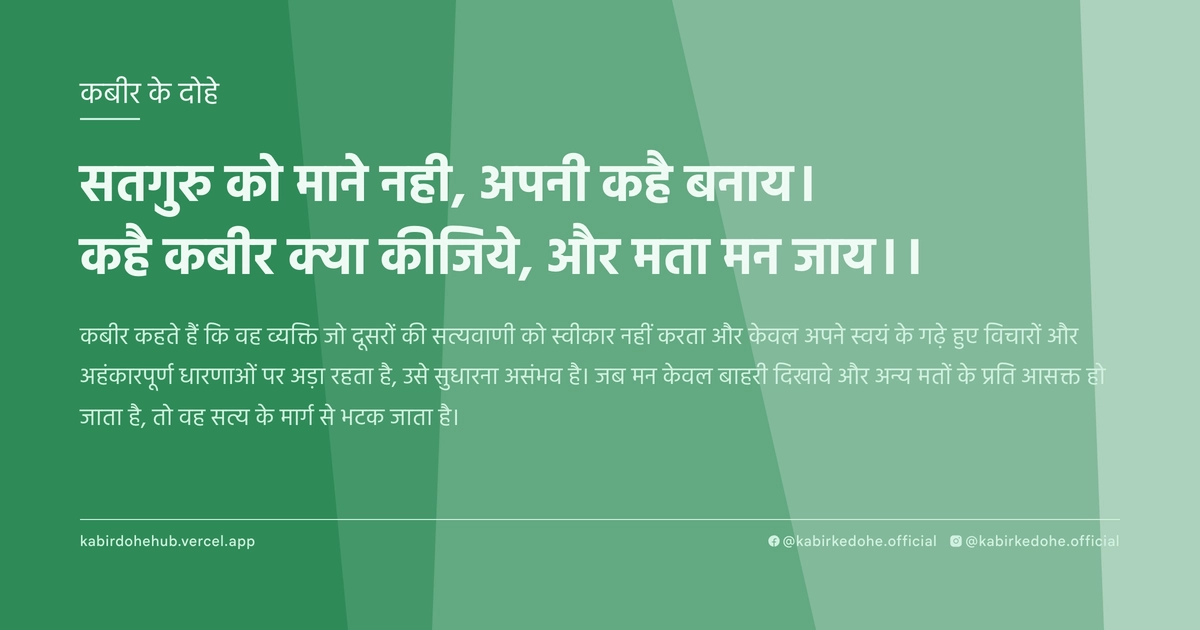
सतगुरु को माने नही, अपनी कहै बनाय।
कहै कबीर क्या कीजिये, और मता मन जाय।।
Satguru ko maane nahi, apni kahai banay. Kahai Kabir kyaC kariye, aur mata man jaaye.
इस पृष्ठ पर इस कबीर दोहे का अर्थ (meaning), हिंदी व्याख्या और अंग्रेज़ी अनुवाद, दार्शनिक विश्लेषण और व्यावहारिक जीवन सीख दी गई है। यह दोहा अहंकार (The Ego) विषय से जुड़ा है — Kabir doha meaning and explanation in Hindi and English.
अर्थ (Meaning):
कबीर कहते हैं कि वह व्यक्ति जो दूसरों की सत्यवाणी को स्वीकार नहीं करता और केवल अपने स्वयं के गढ़े हुए विचारों और अहंकारपूर्ण धारणाओं पर अड़ा रहता है, उसे सुधारना असंभव है। जब मन केवल बाहरी दिखावे और अन्य मतों के प्रति आसक्त हो जाता है, तो वह सत्य के मार्ग से भटक जाता है।
Kabir observes that a person who refuses to acknowledge the truth spoken by others and clings stubbornly to their own fabricated notions and ego-driven beliefs is beyond guidance. When the mind is captivated by external dogmas and foreign ideologies, it loses its way toward the ultimate truth.
व्याख्या (Interpretation):
शाब्दिक अर्थ यह है कि अज्ञानी व्यक्ति अपनी बात को ही अंतिम सत्य मानता है। रूपकात्मक रूप से, यह 'अहंकार' की उस दीवार को दर्शाता है जो आत्मा को परमात्मा से अलग करती है। यहाँ 'अपनी कहै बनाय' का अर्थ केवल शब्दों से नहीं, बल्कि उस मानसिक संरचना से है जिसे हम 'मैं' और 'मेरा' कहते हैं। यह स्थिति माया के प्रभाव को दर्शाती है, जहाँ व्यक्ति अपनी सीमित बुद्धि को ही सर्वोपरि मान लेता है। निर्गुण भक्ति के संदर्भ में, जब तक साधक अपनी पूर्व-धारणाओं का विसर्जन नहीं करता, वह निराकार ब्रह्म का अनुभव नहीं कर सकता। यह द्वैत का चरम है जहाँ व्यक्ति स्वयं को सत्य का एकमात्र स्वामी मान बैठता है, जबकि सत्य तो सबके भीतर समान रूप से प्रवाहित है। अंततः, यह दोहा उस मानसिक जड़ता की चेतावनी है जो आध्यात्मिक विकास को पूरी तरह अवरुद्ध कर देती है।
Literally, the verse describes a person who considers their own words as the final truth. Metaphorically, this represents the wall of 'Ahamkara' (ego) that separates the Atman from the Brahman. The phrase 'apni kahai banaay' refers not just to speech, but to the entire mental construct of 'I' and 'mine.' This state exemplifies the grip of Maya, where an individual mistakes their limited intellect for universal truth. In the context of Nirgun Bhakti, unless the seeker dissolves their preconceived notions, they cannot experience the Formless Divine. This is the peak of duality, where the individual claims ownership over truth, whereas truth flows equanimously through all. Ultimately, the couplet warns against the mental rigidity that completely obstructs spiritual evolution.
दार्शनिक विश्लेषण (Philosophical Analysis):
कबीर का यह दोहा उनके युग के धार्मिक कट्टरपंथ और बौद्धिक अहंकार पर एक तीखा प्रहार है। 15वीं शताब्दी में, जब समाज जाति, धर्म और कर्मकांडों के नाम पर विभाजित था, कबीर ने यह रेखांकित किया कि सत्य किसी विशेष ग्रंथ या व्यक्ति की बपौती नहीं है। उन्होंने ritualism (कर्मकांड) का विरोध किया क्योंकि वह बाहरी दिखावे पर आधारित था, जबकि सत्य आंतरिक अनुभव का विषय है।
अद्वैत वेदांत के दृष्टिकोण से, यह दोहा 'अविद्या' (अज्ञान) की व्याख्या करता है। जब जीव स्वयं को शरीर और मन समझता है, तो वह एक कृत्रिम पहचान बना लेता है। यह 'बनाय' (निर्मित) पहचान ही उसे सत्य को सुनने से रोकती है। कबीर यहाँ यह समझा रहे हैं कि जब तक 'मैं' जीवित है, तब तक 'वह' (परमात्मा) प्रकट नहीं हो सकता।
सूफी मत के 'फना' (अहंकार का विनाश) के सिद्धांत से इसकी गहरी समानता है। सूफीवाद में भी माना जाता है कि जब तक साधक अपनी व्यक्तिगत इच्छाओं और धारणाओं को मिटाता नहीं, वह ईश्वर के नूर में विलीन नहीं हो सकता। कबीर का 'और मता मन जाय' इसी भटकाव की ओर संकेत करता है जहाँ मन बाहरी मतों के जाल में फंसकर अपनी मूल प्रकृति को भूल जाता है।
मनोवैज्ञानिक स्तर पर, यह 'कन्फर्मेशन बायस' (पुष्टि पूर्वाग्रह) की बात करता है। मनुष्य केवल वही सुनना चाहता है जो उसके मौजूदा विश्वासों की पुष्टि करे। कबीर इस मानसिक अवरोध को तोड़ने की चुनौती देते हैं। वे कहते हैं कि सत्य को स्वीकार करने के लिए पहले अपने भीतर के 'ज्ञानी' होने के भ्रम को नष्ट करना होगा।
निष्कर्षतः, कबीर यह स्पष्ट करते हैं कि आध्यात्मिक प्रगति के लिए विनम्रता अनिवार्य है। बिना आत्म-समर्पण और पुराने विश्वासों के विसर्जन के, कोई भी व्यक्ति सत्य के करीब नहीं पहुँच सकता। यह दोहा हमें सिखाता है कि सत्य को 'पाया' नहीं जाता, बल्कि उसे 'स्वीकार' किया जाता है जब अहंकार का पर्दा हट जाता है।
This couplet is a sharp critique of the religious bigotry and intellectual arrogance prevalent during Kabir's era. In the 15th century, when society was fractured by caste, creed, and ritualism, Kabir emphasized that truth is not the monopoly of any specific scripture or person. He opposed ritualism because it relied on external performance, whereas truth is a matter of internal realization.
From the perspective of Advaita Vedanta, this verse explains 'Avidya' (ignorance). When the soul identifies itself with the body and mind, it creates an artificial identity. This 'fabricated' identity prevents the individual from hearing the truth. Kabir suggests that as long as the 'I' exists, the 'He' (the Divine) cannot manifest.
There is a profound similarity here with the Sufi concept of 'Fana' (annihilation of the ego). Sufism posits that until the seeker erases personal desires and preconceived notions, they cannot merge into the Divine Light. Kabir's mention of 'aur mata man jaay' points to this distraction, where the mind becomes trapped in external dogmas and forgets its original nature.
Psychologically, this addresses 'confirmation bias.' Humans tend to hear only that which confirms their existing beliefs. Kabir challenges this mental barrier, asserting that to accept the truth, one must first destroy the illusion of being an 'expert' or 'knower.'
In conclusion, Kabir clarifies that humility is an absolute prerequisite for spiritual progress. Without surrender and the dissolution of old beliefs, no one can approach the truth. The verse teaches us that truth is not 'attained' but 'accepted' once the veil of ego is lifted.
मूल संदेश (Core Message):
- अहंकार सत्य के मार्ग में सबसे बड़ी बाधा है।
- अपनी धारणाओं को सत्य मान लेना आध्यात्मिक अंधापन है।
- विनम्रता ही वह द्वार है जिससे ज्ञान प्रवेश करता है।
- बाहरी मतों का मोह आंतरिक सत्य को धुंधला कर देता है।
- सत्य को स्वीकार करने के लिए 'मैं' का विसर्जन आवश्यक है।
- Ego is the greatest obstacle on the path to Truth.
- Mistaking personal notions for absolute truth is spiritual blindness.
- Humility is the only gateway through which true knowledge enters.
- Attachment to external dogmas obscures the inner light of truth.
- The dissolution of the 'I' is essential to accept the Universal Truth.
व्यावहारिक उदाहरण (Practical Example):
वाराणसी के एक पुराने घाट पर रामदीन नाम का एक वृद्ध बुनकर रहता था। वह अपने काम में निपुण था, लेकिन स्वभाव से अत्यंत हठी। वह मानता था कि कपड़े बुनने का केवल उसका तरीका ही सही है और बाकी सब गलत।
एक दिन उसके पास एक युवा यात्री आया, जिसने उसे एक नई तकनीक बताई जिससे धागे कम खर्च होते और कपड़ा अधिक मजबूत बनता। रामदीन ने उसकी बात सुनने से पहले ही उसे झिड़क दिया और कहा, 'मैं चालीस साल से यह काम कर रहा हूँ, मुझे मत सिखाओ।'
युवा ने मुस्कुराते हुए कहा, 'काका, मैं आपको सिखा नहीं रहा, बस एक संभावना साझा कर रहा हूँ।' लेकिन रामदीन अपनी बात पर अड़ा रहा और उस तकनीक को अपनाने से इनकार कर दिया।
कुछ समय बाद, रामदीन ने देखा कि उसके पड़ोस के एक अन्य बुनकर ने उसी युवा की सलाह मानी थी। उस बुनकर के कपड़े अब शहर के सबसे महंगे बाज़ार में बिक रहे थे और उसकी आय दोगुनी हो गई थी।
रामदीन को अपनी गलती का अहसास हुआ, लेकिन उसका अहंकार अभी भी उसे रोक रहा था। वह सोचता था कि यदि वह अब उस युवा के पास गया, तो लोग उसका मज़ाक उड़ाएंगे कि वह अब झुक रहा है।
तभी उसने कबीर का यह दोहा सुना: 'को माने नही, अपनी कहै बनाय'। उसे अचानक लगा कि वह केवल अपनी बनाई हुई एक झूठी श्रेष्ठता की दुनिया में कैद है।
उसने महसूस किया कि उसका 'अनुभव' वास्तव में उसकी 'बेड़ी' बन गया था। उसने अपनी जिद छोड़ी और उस युवा यात्री के पास जाकर क्षमा मांगी और सीखने की इच्छा जताई।
जैसे ही उसने 'मैं जानता हूँ' के भाव को छोड़ा, उसके जीवन में न केवल आर्थिक समृद्धि आई, बल्कि उसे एक असीम मानसिक शांति मिली।
उसने सीखा कि सत्य किसी की उम्र या अनुभव का मोहताज नहीं होता; वह केवल एक खुले और विनम्र मन में ही प्रवेश कर सकता है।
रामदीन अब केवल एक कुशल बुनकर नहीं था, बल्कि एक ऐसा व्यक्ति बन गया था जो हर छोटी बात से सीखने को तैयार रहता था।
On an old ghat in Varanasi lived an elderly weaver named Ramdeen. He was masterly in his craft but incredibly stubborn by nature. He believed that his method of weaving was the only correct way and everyone else was wrong.
One day, a young traveler visited him and suggested a new technique that used fewer threads while making the fabric stronger. Before even listening, Ramdeen snapped at him, saying, 'I have been doing this for forty years; do not try to teach me.'
The youth smiled and replied, 'Uncle, I am not teaching you; I am merely sharing a possibility.' But Ramdeen clung to his own view and refused to adopt the technique.
After some time, Ramdeen noticed that another weaver in his neighborhood had followed the youth's advice. That weaver's fabrics were now selling in the most expensive markets of the city, and his income had doubled.
Ramdeen realized his mistake, but his ego still held him back. He feared that if he approached the youth now, people would mock him for finally bowing down.
Just then, he heard Kabir's couplet: 'Ko maane nahi, apni kahai banaay.' He suddenly felt that he was imprisoned in a fake world of superiority that he had constructed for himself.
He realized that his 'experience' had actually become his 'shackle.' He let go of his stubbornness, approached the young traveler, apologized, and expressed a genuine desire to learn.
The moment he relinquished the feeling of 'I already know,' he found not only financial prosperity but also an immense sense of mental peace.
He learned that truth is not dependent on age or experience; it can only enter a mind that is open and humble.
Ramdeen was no longer just a skilled weaver, but a man who was ready to learn from every small interaction in life.
अभ्यास मार्गदर्शन (Practice Guidance):
- प्रतिदिन 15 मिनट मौन रहकर यह विचार करें कि आपके कौन से विश्वास केवल आपकी 'बनाई हुई' धारणाएं हैं और सत्य नहीं।
- जब भी किसी से विवाद हो, तो अपनी बात साबित करने के बजाय, सामने वाले के तर्क में एक ऐसी सच्चाई खोजने का प्रयास करें जो आपने अनदेखी की हो।
- एक 'अहंकार डायरी' लिखें जिसमें उन क्षणों को दर्ज करें जब आपने किसी की सही सलाह को केवल इसलिए ठुकराया क्योंकि वह आपसे छोटा या अलग था।
- निदान चेकलिस्ट: क्या मैं दूसरों की बात सुनते समय केवल उत्तर देने की तैयारी कर रहा हूँ? क्या मैं अपनी राय को अपनी पहचान मान बैठा हूँ? यदि हाँ, तो आप 'अपनी कहै बनाय' के जाल में हैं।
- Spend 15 minutes in daily silence contemplating which of your beliefs are merely 'fabricated' notions rather than objective truths.
- During a disagreement, instead of trying to prove your point, consciously search for one grain of truth in the other person's argument that you might have overlooked.
- Maintain an 'Ego Diary' to record moments where you rejected sound advice simply because the person was younger, lower in status, or different from you.
- Diagnostic Checklist: Am I listening to others only to prepare my rebuttal? Have I mistaken my opinions for my identity? If yes, you are trapped in the web of 'apni kahai banaay'.
चिंतन प्रश्न (Reflection Questions):
- क्या मेरी वर्तमान पहचान मेरे अपने अनुभवों का निचोड़ है, या केवल समाज द्वारा दी गई धारणाओं का एक संग्रह?
- मैं उन लोगों के प्रति कैसा व्यवहार करता हूँ जिनके विचार मेरे मौलिक विश्वासों को चुनौती देते हैं?
- क्या मेरा 'ज्ञान' मुझे दूसरों से जोड़ रहा है या मुझे एक अलग, श्रेष्ठ द्वीप पर अकेला कर रहा है?
- यदि आज मेरी सारी मान्यताएं गलत साबित हो जाएं, तो मेरे पास 'मैं' के रूप में क्या बचेगा?
- क्या मैं सत्य की खोज कर रहा हूँ, या केवल अपनी बात को सही साबित करने के प्रमाण खोज रहा हूँ?
- Is my current identity a distillation of my own experiences, or merely a collection of societal assumptions?
- How do I react toward people whose ideas fundamentally challenge my core beliefs?
- Is my 'knowledge' connecting me to others, or is it isolating me on a separate, superior island?
- If all my beliefs were proven wrong today, what would remain of 'me'?
- Am I searching for the Truth, or am I merely searching for evidence to prove myself right?