
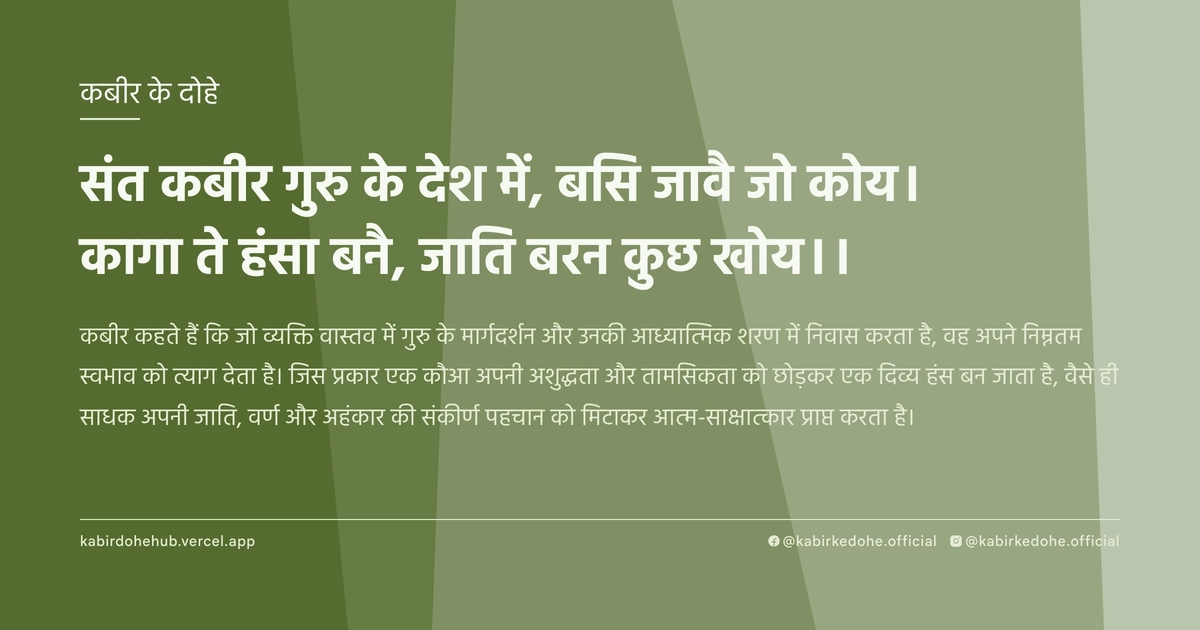
संत कबीर गुरु के देश में, बसि जावै जो कोय।
कागा ते हंसा बनै, जाति बरन कुछ खोय।।
Sant Kabir guru ke desh mein, basi jaave jo koy. Kaaga te hansa banai, jaati baran kuch khoy.
इस पृष्ठ पर इस कबीर दोहे का अर्थ (meaning), हिंदी व्याख्या और अंग्रेज़ी अनुवाद, दार्शनिक विश्लेषण और व्यावहारिक जीवन सीख दी गई है। यह दोहा गुरु महत्व (The Guru's Importance) विषय से जुड़ा है — Kabir doha meaning and explanation in Hindi and English.
अर्थ (Meaning):
कबीर कहते हैं कि जो व्यक्ति वास्तव में गुरु के मार्गदर्शन और उनकी आध्यात्मिक शरण में निवास करता है, वह अपने निम्नतम स्वभाव को त्याग देता है। जिस प्रकार एक कौआ अपनी अशुद्धता और तामसिकता को छोड़कर एक दिव्य हंस बन जाता है, वैसे ही साधक अपनी जाति, वर्ण और अहंकार की संकीर्ण पहचान को मिटाकर आत्म-साक्षात्कार प्राप्त करता है।
Kabir asserts that whoever truly dwells within the realm of the Guru's guidance and spiritual sanctuary transcends their lower nature. Just as a crow—symbolizing impurity and ignorance—is transformed into a divine swan, the seeker sheds the narrow identities of caste, creed, and ego to realize their true, universal essence.
व्याख्या (Interpretation):
इस दोहे का शाब्दिक अर्थ गुरु की शरण में आने से होने वाले परिवर्तन को दर्शाना है, लेकिन इसका गहरा आध्यात्मिक अर्थ 'अहंकार के विसर्जन' से जुड़ा है। यहाँ 'कागा' (कौआ) अज्ञान, लोभ और सांसारिक मोह का प्रतीक है, जबकि 'हंसा' (हंस) विवेक, पवित्रता और आत्मा की शुद्धता का प्रतिनिधित्व करता है। यह परिवर्तन केवल बाहरी नहीं, बल्कि आंतरिक रूपांतरण है जहाँ 'जाति बरन' का खोना सामाजिक पहचान का अंत नहीं, बल्कि उस 'माया' का अंत है जो हमें दूसरों से अलग करती है। निर्गुण भक्ति के परिप्रेक्ष्य में, यह उस स्थिति को दर्शाता है जहाँ साधक द्वैत (दो होने का भाव) को त्यागकर अद्वैत (एकता) में विलीन हो जाता है। यह एक आध्यात्मिक कीमिया (Alchemy) है जहाँ अशुद्ध चेतना शुद्ध ब्रह्म-चेतना में बदल जाती है। अंततः, यह दोहा इस विरोधाभास को उजागर करता है कि स्वयं को पूरी तरह खोकर ही वास्तव में स्वयं को पाया जा सकता है।
While the literal meaning focuses on the transformation through a Guru, the deeper metaphorical layer concerns the 'dissolution of the ego.' The 'crow' symbolizes ignorance, greed, and worldly attachment, whereas the 'swan' represents discernment, purity, and the awakened soul. This transformation is not merely external but an internal alchemy where 'losing caste and color' signifies the eradication of the 'Maya' (illusion) that creates separation. In the context of Nirgun Bhakti, this reflects the transition from duality to Advaita (non-duality), where the seeker merges with the formless Absolute. It highlights the central spiritual paradox: only by completely losing the false identity of the small 'i' can one realize the universal 'I'. The Guru's 'country' is not a physical place, but a state of consciousness where the ego is incinerated, leaving only the pure, luminous Atman.
दार्शनिक विश्लेषण (Philosophical Analysis):
कबीर का यह दोहा उनके युग के कट्टरपंथी सामाजिक और धार्मिक ढांचे पर एक सीधा प्रहार है। 15वीं शताब्दी के भारत में, जाति और वर्ण व्यवस्था व्यक्ति की आध्यात्मिक क्षमता को निर्धारित करती थी। कबीर ने इस धारणा को चुनौती देते हुए यह स्थापित किया कि आध्यात्मिक उत्थान जन्म से नहीं, बल्कि 'साधना' और 'गुरु' के मार्गदर्शन से होता है। यह विचार सूफीवाद के 'फना' (अहंकार का विनाश) और अद्वैत वेदांत के 'अहं ब्रह्मास्मि' के करीब है।
यहाँ 'गुरु' केवल एक व्यक्ति नहीं, बल्कि वह 'तत्व' या 'प्रकाश' है जो अज्ञान के अंधकार को मिटाता है। कबीर का दर्शन यह है कि जब तक मनुष्य अपनी सामाजिक पहचान (जाति, धर्म, पद) को ढोता रहता है, वह 'कौए' की तरह ही रहता है—जो केवल गंदगी और टुकड़ों की तलाश करता है। जैसे ही यह पहचान मिटती है, वह 'हंस' बन जाता है, जो दूध और पानी को अलग करने की क्षमता (विवेक) रखता है।
यह विश्लेषण स्पष्ट करता है कि कबीर कर्मकांडों के विरुद्ध थे। उनके लिए मंदिर या मस्जिद जाना पर्याप्त नहीं था; वास्तविक तीर्थ 'गुरु के देश' में बसना था, जिसका अर्थ है अपने भीतर के अहंकार को मिटाना। यह मनोवैज्ञानिक रूपांतरण की प्रक्रिया है जहाँ व्यक्ति अपनी सीमित पहचान को सार्वभौमिक पहचान में बदल देता है।
सूफी परंपरा में इसे 'इश्क-ए-हकीकी' (ईश्वरीय प्रेम) कहा गया है, जहाँ प्रेमी अपने अस्तित्व को मिटाकर प्रिय में समा जाता है। कबीर इसी बिंदु पर मिलते हैं जहाँ भक्ति, ज्ञान और प्रेम एक हो जाते हैं।
अतः, यह दोहा केवल गुरु-भक्ति का गीत नहीं है, बल्कि एक क्रांतिकारी घोषणा है कि आत्मा की कोई जाति नहीं होती। यह मनुष्य को उसकी आदिम, पशुवत प्रवृत्तियों से उठाकर उसे दिव्य चेतना के स्तर पर ले जाने का मार्ग है।
This Doha is a direct assault on the rigid social and religious hierarchies of Kabir's 15th-century India. During this era, caste and varna were believed to dictate one's spiritual potential. Kabir dismantled this notion, asserting that spiritual evolution is achieved not through birth, but through 'Sadhana' (disciplined practice) and the guidance of a true Guru. This aligns closely with the Sufi concept of 'Fana' (annihilation of the self) and the Advaita Vedanta realization of 'Aham Brahmasmi' (I am Brahman).
In this context, the 'Guru' is not merely a human teacher but the 'Tattva' or the illuminating light that dispels the darkness of ignorance. Kabir posits that as long as a human clings to their social identity—caste, religion, or status—they remain a 'crow,' scavenging for the scraps of worldly validation and driven by base instincts.
Once this false identity is shed, the seeker becomes a 'swan,' possessing the 'Viveka' (discernment) to separate the eternal from the ephemeral, much like the mythical swan separates milk from water. This is a psychological shift from the ego-centric 'I' to the cosmic 'Self.'
Kabir's rejection of ritualism is evident here; he suggests that the true pilgrimage is not to a physical shrine but to the 'country of the Guru,' which is a state of consciousness devoid of pride. This mirrors the Sufi path of 'Ishq-e-Haqiqi' (Divine Love), where the lover vanishes into the Beloved.
Ultimately, the philosophical core is that the soul is colorless and casteless. The transformation from crow to swan is the journey from the fragmented, conditioned mind to the unified, unconditioned spirit, proving that liberation is accessible to all, regardless of their social origin.
मूल संदेश (Core Message):
- अहंकार ही वह पर्दा है जो आत्मा को ढक कर रखता है।
- गुरु का अर्थ है वह प्रकाश जो हमारी झूठी पहचान को जला दे।
- सामाजिक पहचान एक बंधन है; आध्यात्मिक पहचान एक मुक्ति है।
- शुद्धता बाहरी स्नान से नहीं, बल्कि आंतरिक विवेक से आती है।
- स्वयं को मिटाना ही वास्तव में स्वयं को पाना है।
- विवेक ही वह शक्ति है जो हमें अज्ञान से ऊपर उठाती है।
- The ego is the veil that obscures the true radiance of the soul.
- The Guru is the light that incinerates our false identities.
- Social identity is a shackle; spiritual identity is liberation.
- Purity comes not from ritual bathing, but from internal discernment.
- To annihilate the small self is to discover the Universal Self.
- Viveka (discernment) is the power that lifts us above ignorance.
व्यावहारिक उदाहरण (Practical Example):
एक समय की बात है, वाराणसी के घाटों पर माधव नाम का एक वृद्ध नाविक रहता था। माधव का जीवन केवल नाव चलाने और दिन भर की कमाई से पेट भरने तक सीमित था। वह स्वभाव से अत्यंत क्रोधी और अहंकारी था। वह खुद को अन्य नाविकों से श्रेष्ठ मानता था क्योंकि उसकी नाव सबसे पुरानी और 'मशहूर' थी। वह अक्सर छोटे नाविकों का अपमान करता और अपनी श्रेष्ठता का प्रदर्शन करता।
एक दिन, उसकी नाव में एक शांत, तेजस्वी संन्यासी सवार हुए। संन्यासी ने माधव के क्रोध और अहंकार को देखा और उसे एक साधारण सी बात कही: 'माधव, तुम नाव तो चला रहे हो, लेकिन तुम्हारी आत्मा का बोझ तुम्हें डुबो रहा है। तुम खुद को इस लकड़ी के टुकड़े (नाव) से जोड़कर बैठे हो, जबकि तुम उससे कहीं बड़े हो।'
माधव को पहले तो यह बात अजीब लगी, लेकिन संन्यासी के शब्दों में एक ऐसी चुंबकीय शक्ति थी कि वह उनके साथ कुछ दिन रहने लगा। संन्यासी ने उसे कोई कठिन मंत्र नहीं दिया, बस उसे यह सिखाया कि वह अपनी पहचान को 'नाविक' या 'श्रेष्ठ नाविक' से हटाकर 'सेवा' में लगाए।
शुरुआत में माधव को बहुत कठिनाई हुई। उसका अहंकार उसे बार-बार याद दिलाता कि वह दूसरों से ऊपर है। लेकिन संन्यासी ने उसे एक अभ्यास दिया: 'जब भी तुम किसी की मदद करो, तो यह सोचना कि तुम अपनी ही मदद कर रहे हो, क्योंकि हम सब एक ही हैं।'
धीरे-धीरे माधव के भीतर का 'कौआ'—उसका क्रोध और अहंकार—मिटने लगा। उसने महसूस किया कि जिस श्रेष्ठता के लिए वह लड़ रहा था, वह केवल एक भ्रम था। उसने अपनी नाव का उपयोग उन गरीब यात्रियों के लिए मुफ्त में करना शुरू कर दिया जो किराया नहीं दे सकते थे।
एक दिन, एक अन्य नाविक ने माधव का अपमान किया, लेकिन माधव के चेहरे पर केवल एक मंद मुस्कान थी। उसके भीतर अब कोई द्वंद्व नहीं था। वह अब उस 'हंस' की तरह था जिसे अब बाहरी प्रशंसा या अपमान से कोई फर्क नहीं पड़ता था।
उसकी पहचान अब 'श्रेष्ठ नाविक' की नहीं, बल्कि एक 'करुणामयी आत्मा' की थी। उसने अपनी जाति और सामाजिक प्रतिष्ठा के अहंकार को पूरी तरह खो दिया था।
गाँव के लोग हैरान थे कि जो माधव कभी आग उगलने वाला कौआ था, वह अब शांति का प्रतीक हंस बन गया है। यह रूपांतरण किसी बाहरी चमत्कार से नहीं, बल्कि गुरु के शब्दों के प्रभाव से उसकी आंतरिक पहचान के बदलने से आया था।
Once, on the ghats of Varanasi, lived an elderly boatman named Madhav. Madhav's life was confined to rowing his boat and earning just enough to survive. He was naturally volatile, prone to anger, and deeply arrogant. He considered himself superior to other boatmen because he owned the oldest and most 'renowned' boat in the stretch. He frequently belittled younger boatmen, clinging to his perceived status.
One day, a serene and luminous sanyasi (monk) boarded his boat. The sanyasi observed Madhav's anger and pride and remarked simply: 'Madhav, you are rowing the boat, but the weight of your own ego is drowning you. You have identified yourself with this piece of wood, while you are far greater than it.'
Initially, Madhav found this absurd, but there was a magnetic pull in the sanyasi's words that led him to spend time in the monk's company. The sanyasi didn't give him complex mantras; instead, he taught him to shift his identity from being a 'superior boatman' to becoming an instrument of 'service.'
At first, Madhav struggled. His ego constantly reminded him of his superiority. The sanyasi gave him a practice: 'Whenever you help someone, believe that you are helping yourself, for we are all one.'
Slowly, the 'crow' within Madhav—his anger and pride—began to dissolve. He realized that the superiority he had fought to maintain was merely a mirage. He started using his boat to ferry poor pilgrims for free, those who could not afford the fare.
One day, another boatman insulted Madhav publicly, but Madhav responded only with a gentle smile. There was no longer any conflict within him. He had become like the 'swan,' untouched by external praise or condemnation.
His identity was no longer that of a 'successful boatman' but that of a 'compassionate soul.' He had completely shed the baggage of his social status and ego.
The villagers were astonished that Madhav, who was once a fire-breathing crow, had transformed into a swan of peace. This transformation didn't come from a miracle, but from the shift in his internal identity triggered by the Guru's wisdom.
अभ्यास मार्गदर्शन (Practice Guidance):
- दैनिक आत्म-निरीक्षण: प्रतिदिन 15 मिनट मौन बैठें और विचार करें कि आज आपने कितनी बार अपनी 'पहचान' (पद, जाति, ज्ञान) का उपयोग दूसरों को छोटा दिखाने के लिए किया।
- अहंकार का विसर्जन अभ्यास: दिन में एक ऐसा कार्य करें जिसमें आपको कोई श्रेय न मिले और आपकी पहचान गुप्त रहे। यह 'कौए' से 'हंस' बनने की पहली सीढ़ी है।
- जर्नलिंग प्रॉम्प्ट: 'यदि मेरी सामाजिक पहचान, मेरा नाम और मेरा पेशा मुझसे छीन लिया जाए, तो वास्तव में मैं कौन हूँ?' इस प्रश्न पर गहराई से लिखें।
- डायग्नोस्टिक चेकलिस्ट: क्या आप अभी भी दूसरों की गलतियों पर क्रोधित होते हैं? क्या आप अपनी उपलब्धियों का बखान करते हैं? यदि हाँ, तो आप अभी भी 'कागा' अवस्था में हैं। यदि आप दूसरों में स्वयं को देखते हैं, तो आप 'हंस' की ओर बढ़ रहे हैं।
- Daily Self-Observation: Sit in silence for 15 minutes daily and observe how many times you used your 'identity' (status, caste, knowledge) to feel superior to others.
- Ego-Dissolution Practice: Perform one act of service daily where you receive no credit and your identity remains anonymous. This is the first step from 'crow' to 'swan.'
- Journaling Prompt: 'If my social identity, my name, and my profession were stripped away, who would I actually be?' Explore this deeply in writing.
- Diagnostic Checklist: Do you still react with anger to others' mistakes? Do you feel a need to broadcast your achievements? If yes, you are still in the 'crow' state. If you see yourself in others, you are transitioning toward the 'swan' state.
चिंतन प्रश्न (Reflection Questions):
- आपकी वह कौन सी 'पहचान' है जिसे खोने के विचार मात्र से आपको डर लगता है?
- क्या आपका धर्म या जाति वास्तव में आपकी आत्मा का गुण है, या यह केवल एक सामाजिक लेबल है जिसे आपने ओढ़ रखा है?
- जब आप सोशल मीडिया पर अपनी छवि बनाते हैं, तो आप 'हंस' बन रहे होते हैं या अपने 'कौए' जैसे अहंकार को और पोषण दे रहे होते हैं?
- क्या आप किसी ऐसे व्यक्ति को क्षमा कर सकते हैं जिसने आपकी प्रतिष्ठा को ठेस पहुँचाई हो, बिना यह सोचे कि आपकी 'इज्जत' का क्या होगा?
- यदि आप पूरी तरह से 'शून्य' हो जाएं, तो क्या आप अभी भी वही व्यक्ति रहेंगे जो आप आज हैं?
- Which part of your 'identity' are you most terrified of losing?
- Is your religion or caste truly a quality of your soul, or just a social label you have worn?
- When you curate your image on social media, are you evolving into a 'swan' or feeding the 'crow' of your ego?
- Can you truly forgive someone who damaged your reputation without worrying about your 'honor'?
- If you were to become completely 'zero' (void), would you still be the same person you are today?