
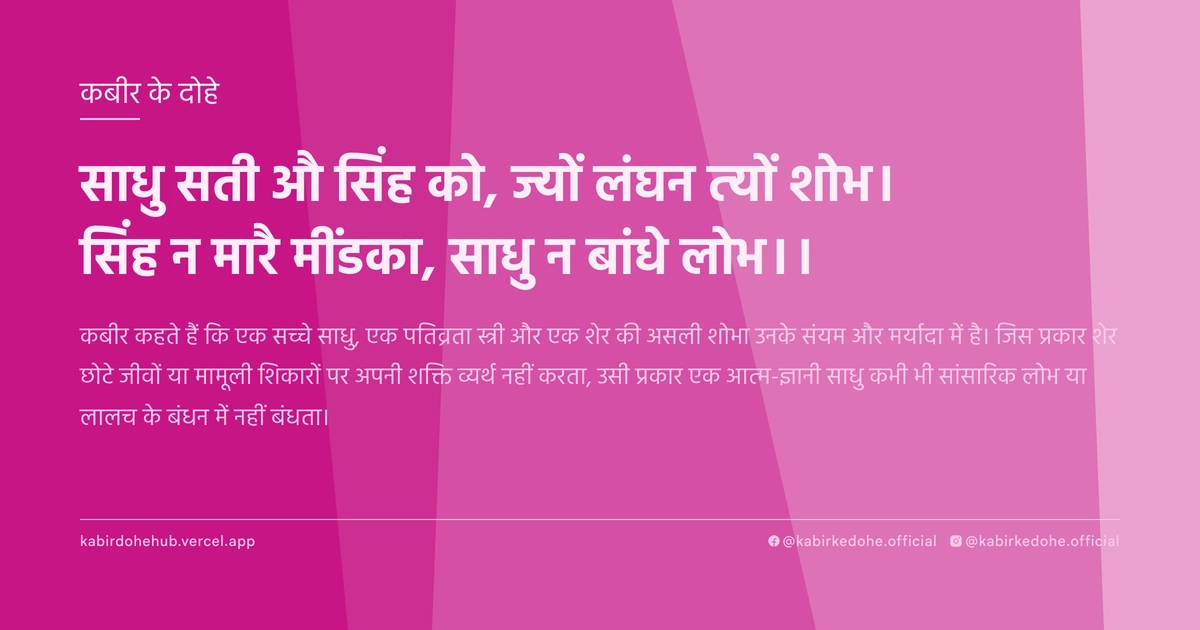
साधु सती औ सिंह को, ज्यों लंघन त्यों शोभ।
सिंह न मारै मींडका, साधु न बांधे लोभ।।
Sadhu sati au singh ko, jyon langhan tyon shobh. Singh na maarai meendka, sadhu na bandhe lobh.
इस पृष्ठ पर इस कबीर दोहे का अर्थ (meaning), हिंदी व्याख्या और अंग्रेज़ी अनुवाद, दार्शनिक विश्लेषण और व्यावहारिक जीवन सीख दी गई है। यह दोहा संयम (Self-discipline) विषय से जुड़ा है — Kabir doha meaning and explanation in Hindi and English.
अर्थ (Meaning):
कबीर कहते हैं कि एक सच्चे साधु, एक पतिव्रता स्त्री और एक शेर की असली शोभा उनके संयम और मर्यादा में है। जिस प्रकार शेर छोटे जीवों या मामूली शिकारों पर अपनी शक्ति व्यर्थ नहीं करता, उसी प्रकार एक आत्म-ज्ञानी साधु कभी भी सांसारिक लोभ या लालच के बंधन में नहीं बंधता।
Kabir asserts that the true grace of a saint, a virtuous soul, and a lion lies in their inherent restraint and dignity. Just as a lion does not waste its majesty by hunting insignificant prey, a realized saint remains untouched and unbound by the petty lures of worldly greed and material desire.
व्याख्या (Interpretation):
इस दोहे में कबीर 'शोभ' या गरिमा की बात करते हैं, जो बाहरी दिखावे से नहीं बल्कि आंतरिक अनुशासन से आती है। शेर का उदाहरण यहाँ शक्ति के विवेकपूर्ण उपयोग का प्रतीक है; वह अपनी भूख मिटाने के लिए शिकार करता है, न कि अपनी शक्ति प्रदर्शित करने के लिए छोटे जीवों को सताता है। इसी प्रकार, साधु के लिए 'लोभ' एक छोटे जीव के समान है जो उसकी आध्यात्मिक ऊंचाई को गिरा सकता है। यह निरगुण भक्ति का सार है, जहाँ साधक अपनी पहचान बाहरी उपाधियों में नहीं, बल्कि अपनी आंतरिक स्थिरता और वैराग्य में पाता है। माया का जाल सूक्ष्म होता है, और साधु की महानता इसी में है कि वह उस सूक्ष्म आकर्षण को पहचान कर उससे ऊपर उठ जाता है। यहाँ आत्मा और परमात्मा की एकता का संकेत है, क्योंकि जो ब्रह्म स्वरूप हो गया, उसे तुच्छ सांसारिक वस्तुओं की आवश्यकता नहीं रहती।
In this couplet, Kabir discusses 'shob' or dignity, which emanates not from outward appearance but from internal discipline. The lion serves as a metaphor for the judicious use of power; it hunts for sustenance, not to assert dominance over insignificant creatures. Similarly, for a saint, 'greed' is akin to a trivial prey that could diminish their spiritual stature. This is the essence of Nirgun Bhakti, where the seeker finds identity not in external titles, but in inner stability and detachment. The web of Maya is subtle, and the greatness of a saint lies in recognizing this subtle attraction and transcending it. There is a profound hint at the non-duality of Atman and Brahman; one who has realized the Universal Self finds no need for the trivialities of the material world.
दार्शनिक विश्लेषण (Philosophical Analysis):
कबीर का यह दर्शन उस समय के सामाजिक और धार्मिक पाखंड पर एक प्रहार है जहाँ 'साधु' होने का अर्थ केवल गेरुआ वस्त्र पहनना या माला जपना था। कबीर स्पष्ट करते हैं कि वास्तविक साधु वह है जिसका मन लोभ से मुक्त है। यह विचार अद्वैत वेदांत के 'तत त्वम असि' से मेल खाता है, जहाँ व्यक्ति जब स्वयं को ब्रह्मांडीय चेतना के रूप में देखता है, तो व्यक्तिगत इच्छाएं और लोभ स्वतः समाप्त हो जाते हैं।
सूफी मत के 'फना' (अहंकार का विनाश) की अवधारणा यहाँ स्पष्ट दिखती है। जब तक 'मैं' और 'मेरा' का भाव रहता है, तब तक लोभ जीवित रहता है। शेर का उदाहरण यह दर्शाता है कि वास्तविक शक्ति नियंत्रण में है, न कि उपभोग में। कबीर यहाँ यह समझा रहे हैं कि आध्यात्मिक प्रगति का पैमाना यह नहीं है कि आपने कितना ज्ञान अर्जित किया, बल्कि यह है कि आपने अपनी वासनाओं पर कितना नियंत्रण पाया है।
कर्मकांडों के विरोध में, कबीर आंतरिक शुद्धि पर जोर देते हैं। उनके अनुसार, मंदिर या मस्जिद जाने से अधिक महत्वपूर्ण यह है कि हृदय में लोभ का अभाव हो। लोभ केवल धन का नहीं होता, बल्कि प्रशंसा, सम्मान और सत्ता का लोभ भी उतना ही घातक है।
मनोवैज्ञानिक स्तर पर, यह दोहा मानवीय इच्छाओं के पदानुक्रम को संबोधित करता है। एक विकसित चेतना छोटे प्रलोभनों से विचलित नहीं होती क्योंकि वह एक उच्चतर आनंद (Satchidananda) का अनुभव कर चुकी होती है।
अंततः, कबीर यह संदेश देते हैं कि गरिमा और पवित्रता केवल उन लोगों के पास होती है जो अपनी इंद्रियों के स्वामी हैं, न कि उनके दास। यह एक क्रांतिकारी विचार था जिसने जाति और वर्ण के बजाय चरित्र और आचरण को प्राथमिकता दी।
Kabir's philosophy here is a direct critique of the social and religious hypocrisy of his era, where being a 'saint' was often reduced to wearing saffron robes or chanting beads. Kabir clarifies that a true saint is one whose mind is liberated from greed. This aligns with the Advaita Vedanta concept of 'Tat Tvam Asi'; when an individual perceives themselves as the cosmic consciousness, personal desires and greed naturally dissolve.
The Sufi concept of 'Fana' (the annihilation of the ego) is evident here. As long as the sense of 'I' and 'mine' persists, greed remains alive. The metaphor of the lion illustrates that true power lies in restraint, not in consumption. Kabir suggests that the metric of spiritual progress is not the amount of knowledge acquired, but the degree of mastery over one's cravings.
In opposition to ritualism, Kabir emphasizes internal purification. According to him, the absence of greed in the heart is far more significant than visiting temples or mosques. Greed is not limited to wealth; the craving for praise, honor, and power is equally detrimental.
On a psychological level, this couplet addresses the hierarchy of human desires. An evolved consciousness is not distracted by petty lures because it has already experienced a higher state of bliss (Satchidananda).
Ultimately, Kabir conveys that dignity and purity belong only to those who are masters of their senses, not slaves to them. This was a revolutionary idea that prioritized character and conduct over caste and creed.
मूल संदेश (Core Message):
- लोभ आत्मा की गरिमा को नष्ट करने वाला सबसे सूक्ष्म विष है।
- वास्तविक शक्ति उपभोग में नहीं, बल्कि आत्म-नियंत्रण में निहित है।
- बाहरी दिखावा नहीं, बल्कि आंतरिक संयम ही सच्ची शोभा है।
- जब हम तुच्छ इच्छाओं से ऊपर उठते हैं, तब हम अपनी वास्तविक प्रकृति को पहचानते हैं।
- अद्वैत की स्थिति में, व्यक्ति संपूर्ण होता है, इसलिए उसे किसी बाहरी वस्तु का लोभ नहीं रहता।
- Greed is the most subtle poison that erodes the dignity of the soul.
- True power resides not in consumption, but in self-mastery.
- Genuine grace is found in internal restraint, not in external display.
- By transcending trivial desires, we rediscover our authentic nature.
- In the state of non-duality, one is complete and thus free from the lure of external objects.
व्यावहारिक उदाहरण (Practical Example):
वाराणसी के घाटों पर रहने वाला एक वृद्ध बुनकर था, जिसका नाम माधव था। माधव अपनी कला में निपुण था और बहुत कम संसाधनों में संतोषी जीवन जीता था।
एक दिन शहर का एक अमीर व्यापारी उसके पास आया। उसने देखा कि माधव एक अत्यंत सुंदर रेशमी वस्त्र बुन रहा है, जिसमें अद्भुत बारीकी थी।
व्यापारी ने माधव को एक बड़ा प्रस्ताव दिया: "तुम मेरे लिए ऐसे दस वस्त्र बनाओ, और मैं तुम्हें इतना धन दूंगा कि तुम जीवन भर आराम से रह सकोगे और एक बड़ा घर खरीद सकोगे।"
माधव ने विनम्रता से मना कर दिया। व्यापारी हैरान था। उसने प्रस्ताव को और लुभाया, सोने के सिक्कों की पोटली दिखाई और माधव के परिवार की गरीबी का हवाला दिया।
माधव ने मुस्कुराते हुए कहा, "साहब, मेरा करघा मेरी साधना है। यदि मैं धन के लोभ में आकर केवल आपके लिए काम करूँगा, तो मेरी कला की पवित्रता नष्ट हो जाएगी और मैं अपनी आत्मा का सौदा कर लूंगा।"
व्यापारी को लगा कि माधव मूर्ख है। उसने माधव को नीचा दिखाने की कोशिश की और कहा कि वह उसकी गरीबी का मजाक उड़ा रहा है।
तभी माधव ने एक छोटा सा टुकड़ा बुनकर व्यापारी को दिया और कहा, "यह उपहार है। जब आप इसे पहनेंगे, तो आपको उस शांति का अनुभव होगा जो मैंने इसे बुनते समय महसूस की है, न कि उस तनाव का जो आपके धन के साथ आता है।"
व्यापारी ने जब उस वस्त्र को छुआ, तो उसे एक अजीब सी शांति महसूस हुई। उसने महसूस किया कि माधव के पास वह 'शोभ' (गरिमा) है जो उसके पास अरबों रुपयों के बावजूद नहीं थी।
व्यापारी को समझ आया कि माधव उस शेर की तरह है जो छोटे प्रलोभनों के आगे नहीं झुकता। उसने अपनी जिद छोड़ दी और माधव के संतोष से प्रेरणा ली।
माधव का जीवन बदल गया क्योंकि उसने अपनी कला को व्यापार नहीं, बल्कि ईश्वर की प्रार्थना बना लिया था, जिससे वह मानसिक रूप से समृद्ध हो गया।
In the ghats of Varanasi lived an elderly weaver named Madhav. Madhav was a master of his craft and lived a contented life with very few resources.
One day, a wealthy merchant from the city visited him. He noticed that Madhav was weaving an exquisitely beautiful silk garment with incredible precision.
The merchant offered him a grand proposal: "Weave ten such garments for me, and I will give you enough wealth to live in luxury for the rest of your life and buy a grand house."
Madhav politely declined. The merchant was astonished. He intensified the offer, showing bags of gold coins and citing the poverty of Madhav's family.
Madhav smiled and replied, "Sir, my loom is my spiritual practice. If I work only for you out of greed for money, the purity of my art will be destroyed, and I will be trading my soul."
The merchant thought Madhav was a fool. He tried to belittle him, suggesting that he was mocking the merchant's generosity.
Then, Madhav wove a small piece of cloth and gave it to the merchant as a gift, saying, "This is a present. When you wear this, you will feel the peace I felt while weaving it, not the stress that accompanies your wealth."
As the merchant touched the fabric, he felt a strange sense of tranquility. He realized that Madhav possessed a 'shob' (dignity) that he lacked despite his billions.
The merchant understood that Madhav was like the lion who does not bow to petty lures. He abandoned his arrogance and drew inspiration from Madhav's contentment.
Madhav's life was transformed because he treated his art not as a business, but as a prayer to the Divine, making him mentally and spiritually affluent.
अभ्यास मार्गदर्शन (Practice Guidance):
- दैनिक अभ्यास: दिन में कम से कम एक बार ऐसी स्थिति का चुनाव करें जहाँ आप किसी छोटे लाभ या प्रशंसा को त्याग कर अपनी गरिमा बनाए रखें।
- आत्म-पूछताछ जर्नल: लिखें कि दिन भर में किन क्षणों में 'लोभ' ने आपके निर्णय को प्रभावित किया और यदि आप उस समय 'शेर' की तरह संयमित होते तो क्या होता।
- व्यवहार परिवर्तन: जब भी कोई प्रलोभन आए, तो रुकें और स्वयं से पूछें—'क्या यह वस्तु मेरी आंतरिक शांति से अधिक मूल्यवान है?'
- निदान चेकलिस्ट: यदि आप दूसरों की प्रशंसा के लिए अपनी मान्यताओं से समझौता कर रहे हैं, या छोटी जीत के लिए अपनी ईमानदारी खो रहे हैं, तो आप लोभ के बंधन में हैं।
- Daily Practice: At least once a day, consciously choose to forego a small gain or a piece of praise to maintain your inner dignity.
- Self-Inquiry Journal: Document moments where 'greed' influenced your decisions and reflect on how you would have acted if you had the restraint of a 'lion'.
- Behavioral Shift: Whenever a temptation arises, pause and ask yourself—'Is this object more valuable than my internal peace?'
- Diagnostic Checklist: You are bound by greed if you find yourself compromising your values for external validation or sacrificing integrity for short-term gains.
चिंतन प्रश्न (Reflection Questions):
- क्या मेरी 'सफलता' की परिभाषा दूसरों की नजरों में ऊँचा उठने की इच्छा है, जो वास्तव में एक सूक्ष्म लोभ है?
- मैं किन छोटी-छोटी बातों के लिए अपनी मानसिक शांति का सौदा करता हूँ?
- यदि समाज में मेरी पहचान और प्रतिष्ठा पूरी तरह समाप्त हो जाए, तो मेरे भीतर क्या बचेगा?
- क्या मैं अपनी शक्ति का उपयोग दूसरों को नियंत्रित करने के लिए करता हूँ, या स्वयं को अनुशासित करने के लिए?
- मेरे जीवन का वह कौन सा 'छोटा शिकार' (लोभ) है जो मुझे मेरी आध्यात्मिक ऊंचाई तक पहुँचने से रोक रहा है?
- Is my definition of 'success' actually a subtle greed to be perceived as superior by others?
- For what trivial things do I routinely trade my mental peace?
- If my social identity and reputation were completely erased, what would remain within me?
- Do I use my power to control others, or to discipline myself?
- What is the 'small prey' (petty greed) in my life that prevents me from reaching my spiritual peak?