
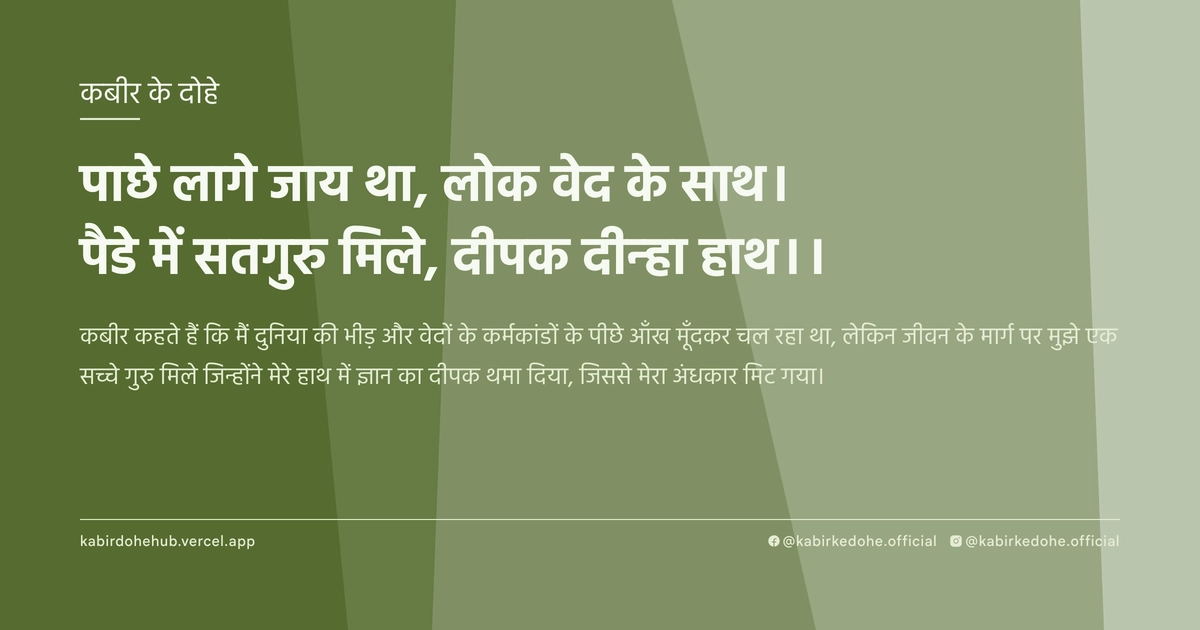
पाछे लागे जाय था, लोक वेद के साथ।
पैडे में सतगुरु मिले, दीपक दीन्हा हाथ।।
Paache laage jaay tha, lok ved ke saath. Paide mein satguru mile, deepak dinha haath.
इस पृष्ठ पर इस कबीर दोहे का अर्थ (meaning), हिंदी व्याख्या और अंग्रेज़ी अनुवाद, दार्शनिक विश्लेषण और व्यावहारिक जीवन सीख दी गई है। यह दोहा गुरु महत्व (The Guru's Importance) विषय से जुड़ा है — Kabir doha meaning and explanation in Hindi and English.
अर्थ (Meaning):
कबीर कहते हैं कि मैं दुनिया की भीड़ और वेदों के कर्मकांडों के पीछे आँख मूँदकर चल रहा था, लेकिन जीवन के मार्ग पर मुझे एक सच्चे गुरु मिले जिन्होंने मेरे हाथ में ज्ञान का दीपक थमा दिया, जिससे मेरा अंधकार मिट गया।
Kabir reflects that he was blindly following the crowd and the rigid rituals of the scriptures, drifting without true direction. However, he encountered a True Teacher (Satguru) who handed him the lamp of spiritual awakening, illuminating the path to truth and dissolving his ignorance.
व्याख्या (Interpretation):
इस दोहे का शाब्दिक अर्थ है कि साधक सामाजिक परंपराओं और शास्त्रोक्त नियमों का अनुसरण कर रहा था। रूपकात्मक रूप से, 'लोक वेद' उस सामूहिक अज्ञानता और मानसिक कंडीशनिंग का प्रतीक है जो हमें बाहरी आडंबरों में उलझाए रखती है। 'दीपक' यहाँ आत्म-ज्ञान (Self-Realization) का प्रतीक है। यह निर्गुण भक्ति का सार है, जहाँ ईश्वर किसी पुस्तक या मंदिर में नहीं, बल्कि भीतर की चेतना में है। जब तक गुरु का प्रकाश नहीं मिलता, मनुष्य माया के जाल में फँसा रहता है, यह मानते हुए कि बाहरी अनुष्ठान ही मोक्ष का मार्ग हैं। यह द्वैत से अद्वैत की ओर संक्रमण है, जहाँ 'मैं' और 'परमात्मा' का भेद मिट जाता है।
Literally, the seeker describes following social conventions and scriptural mandates. Metaphorically, 'Lok Ved' represents the collective ignorance and psychological conditioning that binds the soul to external rituals. The 'Lamp' symbolizes the awakening of the Atman (Self). This aligns with Nirgun Bhakti, asserting that the Divine is not found in texts or temples but within the consciousness. Until the Satguru provides this light, the individual remains trapped in Maya, mistakenly believing that ritualistic adherence leads to liberation. It depicts the transition from duality to non-duality (Advaita), where the perceived separation between the seeker and the Infinite vanishes.
दार्शनिक विश्लेषण (Philosophical Analysis):
कबीर का यह दोहा उनके युग के धार्मिक पाखंड और जातिगत श्रेष्ठता पर एक गहरा प्रहार है। उस समय, वेदों और शास्त्रों का ज्ञान केवल उच्च जातियों तक सीमित था, और आम जन केवल अंधानुकरण कर रहे थे। कबीर यहाँ 'लोक वेद' कहकर यह संकेत देते हैं कि शास्त्र तब तक व्यर्थ हैं जब तक वे जीवंत अनुभव में न बदलें। यह दृष्टिकोण सूफी मत के 'इरफ़ान' (divine knowledge) और अद्वैत वेदांत के 'ज्ञान मार्ग' से मेल खाता है, जहाँ व्यक्तिगत अनुभव को शास्त्रगत ज्ञान से ऊपर रखा गया है।
दार्शनिक स्तर पर, यह दोहा 'अविद्या' (ignorance) और 'विद्या' (knowledge) के बीच के संघर्ष को दर्शाता है। कबीर का तर्क है कि सामाजिक मान्यताएँ अक्सर सत्य को ढक लेती हैं। जब हम भीड़ के पीछे चलते हैं, तो हम अपनी मौलिकता खो देते हैं। गुरु यहाँ कोई व्यक्ति नहीं, बल्कि वह चेतना है जो हमें हमारी अपनी आंतरिक शक्ति से परिचित कराती है।
यह विश्लेषण यह स्पष्ट करता है कि मोक्ष किसी बाहरी प्रक्रिया से नहीं, बल्कि आंतरिक रूपांतरण से आता है। कबीर ritualism (कर्मकांड) को एक मानसिक बेड़ी मानते हैं। उनके लिए, सत्य वह है जिसे जिया जाए, न कि वह जिसे पढ़ा जाए। यह अहंकार के विसर्जन की प्रक्रिया है, क्योंकि जब तक 'मैं' (अहंकार) शास्त्रों का रक्षक बना रहता है, वह सत्य को नहीं देख पाता।
सूफीवाद के संदर्भ में, यह 'मुर्शिद' (गुरु) की आवश्यकता पर जोर देता है, जिसके बिना आध्यात्मिक यात्रा में भटकने का डर रहता है। जैसे एक अंधेरे कमरे में मोमबत्ती की जरूरत होती है, वैसे ही संसार के भ्रम में गुरु के मार्गदर्शन की आवश्यकता होती है।
अंततः, यह दोहा यह संदेश देता है कि सत्य सार्वभौमिक है और किसी विशेष धर्म या पुस्तक की जागीर नहीं है। यह मनुष्य को एक 'अनुयायी' से बदलकर एक 'साक्षी' बनाने की प्रक्रिया है, जहाँ व्यक्ति स्वयं अपने जीवन का प्रकाश बन जाता है।
This couplet is a profound critique of the religious hypocrisy and caste-based intellectual hegemony of Kabir's era. During his time, scriptural knowledge was the monopoly of the elite, leaving the masses to follow blindly. By mentioning 'Lok Ved,' Kabir suggests that scriptures are sterile unless they are transformed into lived, experiential truth. This mirrors the Sufi concept of 'Irfan' (gnostic knowledge) and the Advaita Vedanta path of 'Jnana,' where direct experience supersedes textual authority.
Philosophically, the verse highlights the tension between 'Avidya' (ignorance) and 'Vidya' (true knowledge). Kabir argues that social consensus often obscures the ultimate truth. When one follows the crowd, they sacrifice their ontological authenticity. The Guru here is not merely a human figure but the catalyst of consciousness that awakens the dormant divinity within the seeker.
This analysis reveals that liberation is not a result of external processes but of internal transmutation. Kabir views ritualism as a psychological shackle. For him, truth is something to be lived, not read. This is a process of ego-annihilation; as long as the 'I' identifies as a protector or scholar of scriptures, it remains blind to the actual Truth.
In the context of Sufism, this emphasizes the necessity of the 'Murshid' (guide), without whom the spiritual journey is fraught with disorientation. Just as a candle is essential in a dark room, the Guru's guidance is vital in the labyrinth of worldly illusion (Maya).
Ultimately, the verse asserts that Truth is universal and not the property of any specific religion or book. It is a transition from being a 'follower' to becoming a 'witness,' where the individual eventually becomes their own source of light.
मूल संदेश (Core Message):
- भीड़ का अनुसरण करना आध्यात्मिक अंधापन है।
- सच्चा ज्ञान शास्त्रों में नहीं, अनुभव में है।
- गुरु वह है जो आपको स्वयं से मिलाए।
- बाहरी आडंबर केवल आत्मा की बेड़ियाँ हैं।
- आंतरिक प्रकाश ही एकमात्र वास्तविक मार्गदर्शक है।
- Following the crowd is a form of spiritual blindness.
- True wisdom resides in experience, not in texts.
- The real Guru is the one who introduces you to yourself.
- External rituals are merely shackles for the soul.
- The inner light is the only authentic guide.
व्यावहारिक उदाहरण (Practical Example):
वाराणसी के घाटों पर रहने वाली एक वृद्ध विधवा, जानकी, का जीवन केवल परंपराओं और कठोर नियमों के इर्द-गिर्द घूमता था। वह मानती थी कि मोक्ष केवल कठिन उपवास, निरंतर माला जाप और समाज द्वारा निर्धारित शोक के नियमों का पालन करने से मिलेगा। उसने अपना पूरा जीवन दूसरों की नजरों में 'पवित्र' दिखने की कोशिश में बिता दिया, लेकिन उसके भीतर एक गहरा खालीपन और डर था।
एक दिन, वह एक साधारण से बुनकर के पास बैठी, जो कबीर की वाणी गा रहा था। उस बुनकर ने उससे कहा, 'माँ, तुम पत्थर की मूर्तियों और कागजों के नियमों में जिसे खोज रही हो, वह तुम्हारे भीतर की सांसों में छिपा है। बाहर की दुनिया तुम्हें डराती है क्योंकि तुम भीड़ के पीछे चल रही हो।'
जानकी को पहले यह बात अपमानजनक लगी। उसने सोचा कि एक मामूली बुनकर उसे धर्म सिखाएगा? लेकिन उस बुनकर की आँखों में एक ऐसी शांति थी जो उसने किसी बड़े पंडित में नहीं देखी थी। उसने जानकी से कहा, 'एक बार अपनी आँखें बंद करो और केवल उस शांति को देखो जो शब्दों के खत्म होने के बाद आती है।'
जानकी ने वैसा ही किया। पहली बार उसने महसूस किया कि उसकी सारी तपस्या केवल एक सामाजिक मुखौटा थी। वह डर के कारण नियमों का पालन कर रही थी, प्रेम के कारण नहीं। उसे एहसास हुआ कि वह अब तक 'लोक वेद' यानी समाज की मान्यताओं के पीछे चल रही थी।
उस बुनकर के शब्दों ने उसके भीतर एक 'दीपक' जला दिया। उसने महसूस किया कि ईश्वर किसी नियम की किताब में नहीं, बल्कि करुणा और आत्म-जागरूकता में है। उसने कठोर उपवास छोड़े और अपना समय बीमारों की सेवा में लगाना शुरू किया।
उसका व्यवहार बदल गया। अब वह दूसरों को यह नहीं बताती थी कि उन्हें क्या करना चाहिए, बल्कि वह स्वयं प्रेम का उदाहरण बन गई। उसकी आंतरिक शांति देखकर लोग उसकी ओर आकर्षित होने लगे।
उसने पाया कि जब उसने बाहरी दिखावे का त्याग किया, तो उसे वह शांति मिली जिसकी तलाश में वह दशकों से भटक रही थी। वह अब किसी की अनुयायी नहीं थी, बल्कि अपनी आत्मा की स्वामिनी थी।
यह 'कबीर ट्विस्ट' था—जहाँ एक बाहरी नियम का पालन करने वाली महिला, आंतरिक सत्य की खोजकर्ता बन गई। उसकी मुक्ति किसी तीर्थ यात्रा से नहीं, बल्कि एक साधारण मनुष्य द्वारा दिए गए ज्ञान के दीपक से हुई।
Janaki, an elderly widow living on the ghats of Varanasi, spent her life orbiting rigid traditions and social mandates. She believed liberation was achieved solely through grueling fasts, incessant chanting, and adhering to the mourning rituals prescribed by society. She spent decades striving to appear 'pure' in the eyes of others, yet inside, she harbored a profound emptiness and fear.
One day, she sat beside a simple weaver who was singing the verses of Kabir. The weaver looked at her and said, 'Mother, the one you seek in stone idols and paper rules is hidden within your own breath. The outside world frightens you because you are merely following the crowd.'
Initially, Janaki found this offensive. How could a mere weaver teach her about Dharma? However, there was a serenity in the weaver's eyes that she had never witnessed in any high priest. He told her, 'Close your eyes for a moment and observe the silence that remains after the words end.'
Janaki obeyed. For the first time, she realized that her entire spiritual practice had been a social mask. She had been following rules out of fear, not love. She recognized that she had been drifting behind the 'Lok Ved'—the collective expectations of society.
The weaver's words lit a 'lamp' within her. She understood that the Divine does not reside in a rulebook but in compassion and self-awareness. She abandoned her harsh fasts and began spending her time caring for the sick.
Her behavior transformed. She no longer told others how to live; she became a living example of love. People were drawn to her not by her piety, but by her inner peace.
She discovered that by shedding the external facade, she found the tranquility she had chased for decades. She was no longer a follower; she became the sovereign of her own soul.
This was the 'Kabir Twist'—where a woman defined by external restrictions became a seeker of internal truth. Her liberation came not from a pilgrimage, but from the lamp of wisdom handed to her by an ordinary man.
अभ्यास मार्गदर्शन (Practice Guidance):
- प्रतिदिन 20 मिनट मौन अभ्यास करें, जहाँ आप अपने विचारों को केवल एक दर्शक की तरह देखें, बिना किसी निर्णय के।
- एक डायरी लिखें जिसमें आप उन सामाजिक मान्यताओं की सूची बनाएँ जिन्हें आप केवल इसलिए मानते हैं क्योंकि 'सब ऐसा करते हैं'।
- व्यवहार परिवर्तन: किसी ऐसे व्यक्ति की मदद करें जिससे आपका वैचारिक मतभेद हो, ताकि आप अपनी पहचान के अहंकार को तोड़ सकें।
- निदान चेकलिस्ट: क्या मैं किसी कार्य को इसलिए कर रहा हूँ क्योंकि यह सही है, या इसलिए क्योंकि इससे समाज में मेरी छवि अच्छी होगी? यदि उत्तर 'छवि' है, तो आप अभी भी 'लोक वेद' के पीछे हैं।
- Practice 20 minutes of daily silence, observing your thoughts as a detached witness without judgment.
- Maintain a journal listing the social beliefs you hold simply because 'everyone else does'—question the origin of these beliefs.
- Behavioral Shift: Perform an act of selfless service for someone with whom you have a fundamental ideological conflict to dissolve the ego of identity.
- Diagnostic Checklist: Ask, 'Am I performing this action because it is inherently right, or because it enhances my social image?' If the answer is 'image,' you are still following the 'Lok Ved'.
चिंतन प्रश्न (Reflection Questions):
- मेरे जीवन के कितने निर्णय वास्तव में मेरे अपने हैं और कितने केवल सामाजिक दबाव का परिणाम हैं?
- यदि कल सारे धर्मग्रंथ नष्ट हो जाएँ, तो मेरे पास सत्य को पहचानने का क्या आधार बचेगा?
- मैं अपनी 'धार्मिक' या 'नैतिक' छवि का उपयोग दूसरों को छोटा महसूस कराने के लिए कैसे करता हूँ?
- मेरे भीतर का वह कौन सा डर है जो मुझे भीड़ से अलग होने से रोकता है?
- क्या मैं सत्य की खोज कर रहा हूँ, या केवल अपनी पूर्व-मान्यताओं की पुष्टि?
- How many of my life's decisions are truly my own, and how many are merely results of social pressure?
- If all scriptures were destroyed tomorrow, what basis would I have left to recognize the Truth?
- How do I use my 'religious' or 'moral' image to make others feel inferior?
- What is the specific fear within me that prevents me from stepping away from the crowd?
- Am I searching for the Truth, or merely seeking confirmation of my pre-existing beliefs?