
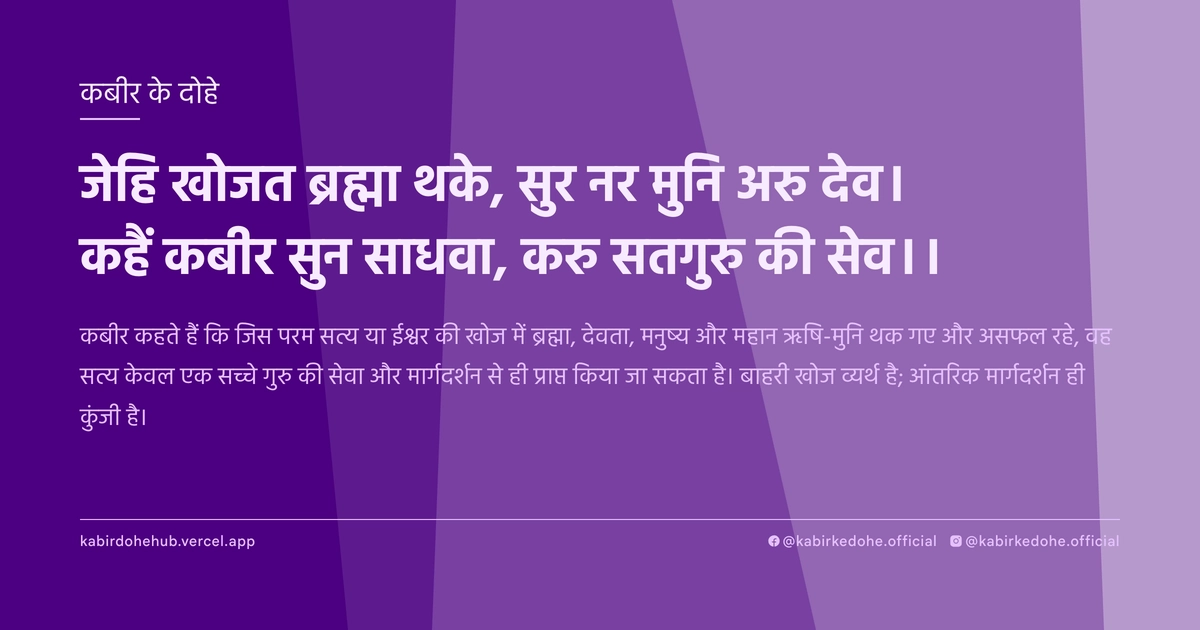
जेहि खोजत ब्रह्मा थके, सुर नर मुनि अरु देव।
कहैं कबीर सुन साधवा, करु सतगुरु की सेव।।
Jehi khojat brahma thake, sur nar muni aru dev. Kahain kabir sun sadhva, karu satguru ki sev.
इस पृष्ठ पर इस कबीर दोहे का अर्थ (meaning), हिंदी व्याख्या और अंग्रेज़ी अनुवाद, दार्शनिक विश्लेषण और व्यावहारिक जीवन सीख दी गई है। यह दोहा गुरु महत्व (The Guru's Importance) विषय से जुड़ा है — Kabir doha meaning and explanation in Hindi and English.
अर्थ (Meaning):
कबीर कहते हैं कि जिस परम सत्य या ईश्वर की खोज में ब्रह्मा, देवता, मनुष्य और महान ऋषि-मुनि थक गए और असफल रहे, वह सत्य केवल एक सच्चे गुरु की सेवा और मार्गदर्शन से ही प्राप्त किया जा सकता है। बाहरी खोज व्यर्थ है; आंतरिक मार्गदर्शन ही कुंजी है।
Kabir asserts that the ultimate truth or Divine, which Brahma, celestial beings, humans, and sages have exhausted themselves searching for in vain, can only be realized through the selfless service and guidance of a True Guru. External quests are futile; internal awakening via a master is the only key.
व्याख्या (Interpretation):
इस दोहे का शाब्दिक अर्थ है कि सृष्टि के रचयिता और समस्त दिव्य शक्तियाँ भी उस सत्य को नहीं पा सकीं जिसे वे खोज रहे थे। यहाँ 'खोजत' शब्द एक मानसिक और शारीरिक प्रयास को दर्शाता है जो अहंकार से प्रेरित होता है। कबीर संकेत करते हैं कि जब तक साधक स्वयं को 'खोजने वाला' मानता है, वह द्वैत में फँसा रहता है। निरगुण भक्ति के अनुसार, ईश्वर कोई वस्तु नहीं है जिसे खोजा जाए, बल्कि वह एक अनुभव है जिसे जागृत किया जाता है। माया का पर्दा इतना घना है कि बुद्धि और शास्त्र भी विफल हो जाते हैं। केवल सतगुरु, जो स्वयं उस शून्य या ब्रह्म में स्थित है, शिष्य के भीतर के अंधकार को मिटा सकता है। यह आत्मा और परमात्मा के अद्वैत मिलन की प्रक्रिया है जहाँ 'मैं' का विसर्जन अनिवार्य है।
Literally, the verse suggests that even the creator Brahma and all celestial entities failed in their quest for the Ultimate Truth. The word 'khojat' implies a mental and physical exertion driven by the ego's desire to 'possess' knowledge. Kabir suggests that as long as the seeker perceives themselves as a 'searcher,' they remain trapped in duality. In Nirgun Bhakti, the Divine is not an object to be found, but a state of being to be realized. The veil of Maya is so dense that intellect and scriptures prove insufficient. Only the Satguru, who is already merged in the Void or Brahman, can dissolve the disciple's ignorance. This is the process of Advaita (non-duality), where the 'I' must be annihilated for the Universal Truth to emerge.
दार्शनिक विश्लेषण (Philosophical Analysis):
कबीर का यह दोहा उस युग की प्रतिक्रिया है जहाँ धर्म केवल कर्मकांडों, कठिन तपस्या और शास्त्रार्थ तक सीमित था। उन्होंने देखा कि पंडित और मुल्ला दोनों ही बाहरी प्रतीकों में उलझे हुए थे, जबकि सत्य उनके भीतर था। कबीर का 'सतगुरु' कोई व्यक्ति नहीं, बल्कि वह चेतना है जो शिष्य को उसके अपने वास्तविक स्वरूप से परिचित कराती है। यह विचार अद्वैत वेदांत के करीब है, जहाँ जीव और ब्रह्म एक ही हैं, बस अज्ञानता के कारण अलग दिखते हैं।
सूफी मत के 'पीर' और भारतीय 'गुरु' की अवधारणा यहाँ मिलती है। सूफीवाद में 'फना' (अहंकार का विनाश) के बिना 'बका' (ईश्वर में अस्तित्व) संभव नहीं है। कबीर इसी विनाश की बात कर रहे हैं। वे कहते हैं कि ब्रह्मा जैसे शक्तिशाली देवता भी इसलिए थके क्योंकि वे 'खोज' रहे थे—अर्थात वे मान रहे थे कि सत्य उनसे अलग है। यह विच्छेद ही सबसे बड़ी बाधा है।
कबीर जाति और वर्ण व्यवस्था को पूरी तरह नकारते हैं। उनके लिए 'साधवा' वह है जो सत्य की प्यास रखता है, चाहे वह किसी भी कुल का हो। वे ritualism (कर्मकांड) का विरोध करते हैं क्योंकि मंदिर, मस्जिद या तीर्थयात्रा केवल शरीर की यात्रा है, आत्मा की नहीं। सत्य का मार्ग 'सेवा' से शुरू होता है, जो वास्तव में अहंकार के समर्पण की प्रक्रिया है।
मनोवैज्ञानिक स्तर पर, यह दोहा 'कर्ता' भाव के अंत की बात करता है। जब हम कहते हैं 'मैं खोज रहा हूँ', तो हम अपनी सीमित बुद्धि पर भरोसा करते हैं। गुरु की सेवा का अर्थ है अपनी बुद्धि को एक उच्चतर चेतना के प्रति समर्पित करना। यह समर्पण ही वह द्वार है जिससे माया का भ्रम टूटता है।
अंततः, कबीर यह स्पष्ट करते हैं कि सत्य कोई गंतव्य नहीं है जहाँ पहुँचा जाए, बल्कि यह एक दृष्टि है जिसे विकसित करना होता है। जब साधक गुरु के माध्यम से अपने भीतर के 'अहं' को मिटा देता है, तो उसे पता चलता है कि जिसे वह बाहर खोज रहा था, वह सदैव उसके भीतर ही था। यही वह 'परम सत्य' है जिसने देवताओं को भी भ्रमित रखा।
This couplet is a profound critique of an era where spirituality was reduced to rigid rituals, asceticism, and scholarly debates. Kabir observed that both the priest and the cleric were entangled in external symbols, ignoring the internal spark. His concept of the 'Satguru' is not merely a human teacher but a catalyst of consciousness that awakens the disciple to their own primordial nature. This aligns closely with Advaita Vedanta, which posits that the individual soul (Atman) and the universal soul (Brahman) are identical, separated only by the illusion of ignorance.
There is a strong resonance here with the Sufi concept of the 'Pir.' In Sufism, 'Fana' (the annihilation of the ego) is the prerequisite for 'Baqa' (eternal subsistence in the Divine). Kabir emphasizes this annihilation. He suggests that even Brahma, the creator, failed because he was 'searching'—implying a perceived separation between the seeker and the sought. This duality is the primary obstacle to liberation.
Kabir radically rejects the caste system and social hierarchies. To him, a 'Sadhwa' is anyone with an authentic longing for truth, regardless of birth. He opposes ritualism because pilgrimages and temple visits are merely physical journeys, not spiritual evolutions. The path to truth begins with 'Seva' (service), which is essentially the practice of surrendering the ego.
Psychologically, the verse addresses the fallacy of the 'doer.' When we claim 'I am searching,' we rely on the limited, conditioned intellect. Service to the Guru represents the surrender of this limited intellect to a higher state of awareness. This surrender is the only mechanism capable of piercing the veil of Maya.
Ultimately, Kabir clarifies that Truth is not a destination to be reached, but a perspective to be attained. Once the seeker dissolves the 'I' through the guidance of the Master, they realize that the object of their search was the searcher itself. This is the paradox of the Divine: it is hidden in plain sight, obscured only by the noise of the ego.
मूल संदेश (Core Message):
- बाहरी खोज अक्सर अहंकार का एक सूक्ष्म रूप होती है।
- सत्य खोजा नहीं जाता, बल्कि अज्ञान के हटने पर प्रकट होता है।
- गुरु वह सेतु है जो 'मैं' को 'तत्व' में बदल देता है।
- सेवा केवल शारीरिक कार्य नहीं, बल्कि अहंकार का विसर्जन है।
- अद्वैत का अर्थ है यह जानना कि खोजने वाला और खोजा जाने वाला एक ही है।
- External searching is often a subtle mask for the ego's desire.
- Truth is not found; it reveals itself when ignorance vanishes.
- The Guru is the bridge that transforms the 'I' into the 'Essence.'
- Service is not a physical chore, but the dissolution of the self.
- Non-duality is the realization that the seeker and the sought are one.
व्यावहारिक उदाहरण (Practical Example):
वाराणसी के घाटों पर रहने वाले एक वृद्ध विधवा, जानकी, का जीवन केवल पूजा-पाठ और परंपराओं के इर्द-गिर्द घूमता था। वह प्रतिदिन घंटों मंदिर जाती, कठिन व्रत रखती और शास्त्रों के अनुसार जीवन जीने का दावा करती। उसे विश्वास था कि उसकी यह 'खोज' और तपस्या उसे मोक्ष दिलाएगी। लेकिन उसके मन में शांति नहीं थी; वह हमेशा इस बात से परेशान रहती कि ईश्वर उसे अनदेखा क्यों कर रहे हैं।
एक दिन उसकी मुलाकात एक साधारण से बुनकर से हुई, जो कबीर के विचारों में लीन था। उस बुनकर ने जानकी से कहा, 'माँ, आप पत्थर की मूर्तियों में जिसे खोज रही हैं, वह आपके भीतर की करुणा में छिपा है। आप पूजा तो करती हैं, लेकिन क्या आप उस ईश्वर को अपने पास बैठे भूखे में देख पाती हैं?'
जानकी को पहले तो यह बात अपमानजनक लगी। उसने सोचा कि एक साधारण बुनकर उसे धर्म सिखा रहा है। लेकिन धीरे-धीरे उसने महसूस किया कि उसकी सारी पूजा केवल एक सामाजिक प्रदर्शन और मानसिक अहंकार था। वह 'मोक्ष' को एक पुरस्कार की तरह खोज रही थी, न कि एक अनुभव की तरह।
बुनकर ने उसे 'सेवा' का एक नया अर्थ समझाया। उसने कहा कि असली गुरु वह है जो आपको आपके अहंकार का दर्पण दिखाए। जानकी ने तय किया कि वह अब केवल मंदिर नहीं जाएगी, बल्कि घाट पर रहने वाले उन अनाथ बच्चों की मदद करेगी जिन्हें समाज ने ठुकरा दिया था।
शुरुआत में यह उसके लिए कठिन था। उसका मन कहता था कि यह समय की बर्बादी है और उसे अपनी साधना पर ध्यान देना चाहिए। लेकिन जैसे-जैसे उसने उन बच्चों की सेवा करना शुरू किया, उसके भीतर का 'मैं'—वह धार्मिक श्रेष्ठता का भाव—मिटने लगा।
एक दोपहर, जब वह एक बीमार बच्चे की सेवा कर रही थी, उसे अचानक एक ऐसी शांति का अनुभव हुआ जो उसे हज़ारों घंटों की पूजा में नहीं मिली थी। उसे महसूस हुआ कि वह बच्चा ही वह 'परम सत्य' है जिसे वह मंदिर की दीवारों में खोज रही थी।
उसने महसूस किया कि उसकी अब तक की सारी खोज 'अहंकार' से प्रेरित थी। वह खुद को 'पवित्र' साबित करना चाहती थी। लेकिन सेवा के माध्यम से, जब उसका अहंकार गिरा, तो सत्य स्वयं प्रकट हो गया।
जानकी अब मंदिर जाती थी, लेकिन अब वह वहां ईश्वर को मांगने नहीं, बल्कि उस कृतज्ञता को अर्पित करने जाती थी जो उसने सेवा के माध्यम से पाई थी। उसका जीवन अब बाहरी खोज से आंतरिक उपस्थिति में बदल गया था।
Janaki, an elderly widow living on the ghats of Varanasi, spent her entire existence revolving around rituals and traditions. She spent hours daily in temples, observed rigorous fasts, and claimed to live strictly by the scriptures. She believed her 'search' and austerity would eventually grant her Moksha. Yet, her mind was restless; she was perpetually troubled by why the Divine seemed to ignore her.
One day, she encountered a simple weaver immersed in the teachings of Kabir. The weaver told her, 'Mother, the one you seek in stone idols is hidden within your own compassion. You perform rituals, but can you see that same Divine in the hungry person sitting beside you?'
Initially, Janaki found this offensive. She felt a simple weaver was presuming to teach her religion. However, she gradually realized that her piety was merely a social performance and a mental ego-trip. She was treating 'liberation' as a reward to be earned, rather than a state to be experienced.
The weaver explained a different meaning of 'Seva' (service). He told her that a true Guru is one who holds up a mirror to your ego. Janaki decided that instead of only visiting the temple, she would help the orphaned children on the ghats who had been discarded by society.
At first, this was a struggle. Her mind whispered that this was a waste of time and that she should focus on her spiritual disciplines. But as she began serving those children, her sense of 'I'—the feeling of religious superiority—began to erode.
One afternoon, while tending to a sick child, she experienced a profound peace that had eluded her during thousands of hours of prayer. She realized that the child was the very 'Ultimate Truth' she had been searching for within the temple walls.
She understood that her previous search was driven by ego. She wanted to prove her own 'holiness.' But through selfless service, as her ego collapsed, the Truth revealed itself spontaneously.
Janaki continued to visit the temple, but no longer to beg for grace. She went to offer the gratitude she had discovered through service. Her life had shifted from an external quest to an internal presence.
अभ्यास मार्गदर्शन (Practice Guidance):
- प्रतिदिन 20 मिनट मौन बैठें और यह निरीक्षण करें कि आपका मन किस 'लक्ष्य' को पाने के लिए बेचैन है। यह पहचानें कि क्या वह खोज वास्तव में सत्य की है या केवल अहंकार की तृप्ति की।
- एक 'अहंकार डायरी' लिखें: दिन भर में जब भी आपको लगे कि आप दूसरों से अधिक आध्यात्मिक, ज्ञानी या नैतिक हैं, उसे लिखें और विश्लेषण करें कि यह भावना कहाँ से आ रही है।
- बिना किसी अपेक्षा के किसी ऐसे व्यक्ति की सेवा करें जिससे आपका कोई संबंध नहीं है। यह देखें कि क्या आप सेवा के दौरान 'कर्ता' होने का भाव महसूस कर रहे हैं या केवल एक माध्यम बन रहे हैं।
- निदान चेकलिस्ट: क्या मैं सत्य को एक 'चीज़' की तरह खोज रहा हूँ? क्या मेरी साधना मुझे दूसरों से अलग (श्रेष्ठ) महसूस करा रही है? क्या मैं गुरु के निर्देशों को अपनी बुद्धि से तौल रहा हूँ? यदि हाँ, तो आप अभी भी माया के प्रभाव में हैं।
- Sit in silence for 20 minutes daily and observe the 'goal' your mind is restless to achieve. Discern whether this search is truly for Truth or merely for the gratification of the ego.
- Maintain an 'Ego Journal': Whenever you feel more spiritual, knowledgeable, or moral than others during the day, record it and analyze the source of this feeling.
- Perform an act of service for someone with whom you have no connection, without any expectation of reward. Observe whether you feel like the 'doer' or merely a channel for grace.
- Diagnostic Checklist: Am I treating Truth as an 'object' to be acquired? Does my spiritual practice make me feel separate from or superior to others? Am I filtering the Guru's guidance through my own limited intellect? If yes, you are still under the influence of Maya.
चिंतन प्रश्न (Reflection Questions):
- क्या मेरी आध्यात्मिक यात्रा वास्तव में सत्य की खोज है, या मैं केवल अपनी पहचान को 'आध्यात्मिक' बनाकर समाज में सम्मान पाना चाहता हूँ?
- यदि मेरे जीवन से सभी धार्मिक प्रतीक और पहचान हटा दी जाएं, तो क्या मेरे भीतर कुछ शेष बचेगा जिसे मैं 'सत्य' कह सकूँ?
- मैं किन लोगों को 'अयोग्य' मानता हूँ, और क्या मेरा यह निर्णय मेरे अपने अहंकार का प्रतिबिंब है?
- क्या मैं गुरु की सेवा वास्तव में समर्पण के लिए करता हूँ, या इसलिए कि मैं एक 'आदर्श शिष्य' दिखना चाहता हूँ?
- मेरे भीतर का वह कौन सा हिस्सा है जो अभी भी यह मानता है कि ईश्वर मुझसे अलग है और उसे 'पाना' संभव है?
- Is my spiritual journey truly a quest for Truth, or am I merely seeking social validation by labeling myself as 'spiritual'?
- If all religious symbols and identities were stripped away from my life, would anything remain within me that I could call 'Truth'?
- Whom do I deem 'unworthy,' and is this judgment merely a reflection of my own internal ego?
- Do I serve a teacher out of genuine surrender, or because I wish to be perceived as an 'ideal disciple'?
- Which part of me still believes that the Divine is separate from me and that it is possible to 'attain' it?