
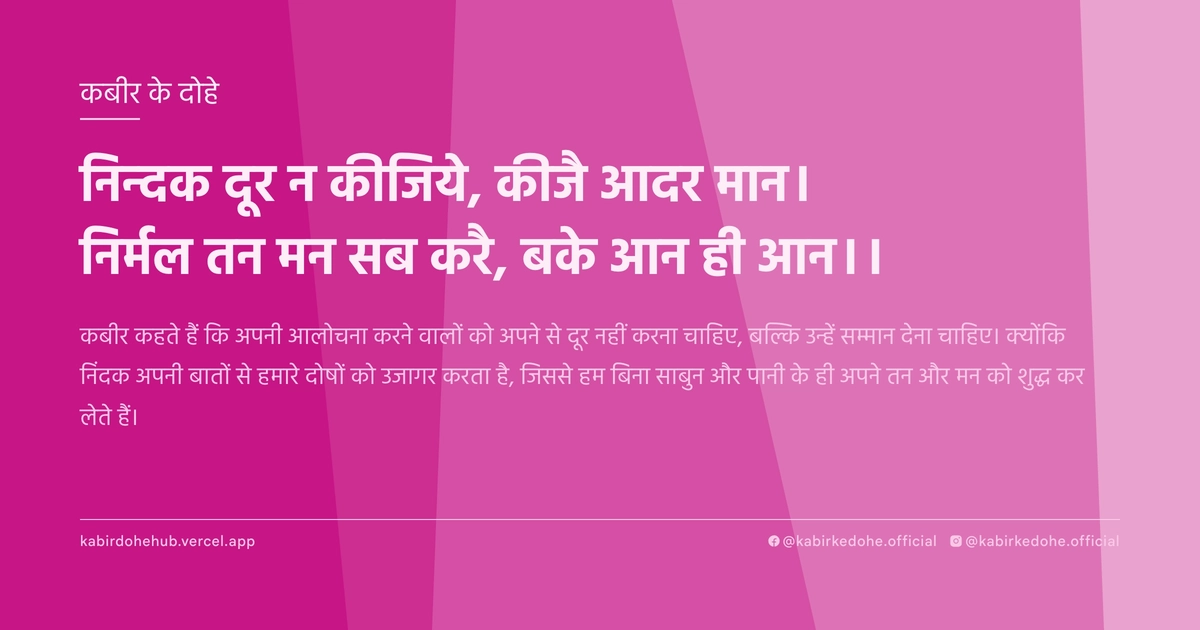
निन्दक दूर न कीजिये, कीजै आदर मान।
निर्मल तन मन सब करै, बके आन ही आन।।
Nindak door na kijiye, keejai aadar maan. Nirmal tan man sab karai, bake aan hi aan.
इस पृष्ठ पर इस कबीर दोहे का अर्थ (meaning), हिंदी व्याख्या और अंग्रेज़ी अनुवाद, दार्शनिक विश्लेषण और व्यावहारिक जीवन सीख दी गई है। यह दोहा विनम्रता (Humility) विषय से जुड़ा है — Kabir doha meaning and explanation in Hindi and English.
अर्थ (Meaning):
कबीर कहते हैं कि अपनी आलोचना करने वालों को अपने से दूर नहीं करना चाहिए, बल्कि उन्हें सम्मान देना चाहिए। क्योंकि निंदक अपनी बातों से हमारे दोषों को उजागर करता है, जिससे हम बिना साबुन और पानी के ही अपने तन और मन को शुद्ध कर लेते हैं।
Kabir advises us not to distance ourselves from those who criticize us, but rather to treat them with respect. He suggests that a critic serves as a spiritual cleanser, scrubbing away our flaws and ego through their words, thereby purifying our body and mind without the need for physical soap or water.
व्याख्या (Interpretation):
इस दोहे का शाब्दिक अर्थ है कि आलोचकों का स्वागत करें। गहरे स्तर पर, यह 'अहंकार' के विसर्जन की प्रक्रिया है। निंदक यहाँ एक दर्पण की तरह है जो हमें वह दिखाता है जिसे हम अपनी माया और अहंकार के कारण देख नहीं पाते। निर्गुण भक्ति में, स्वयं को शून्य करना ही ईश्वर तक पहुँचने का मार्ग है। जब हम आलोचना को स्वीकार करते हैं, तो हम अपने 'अहं' (Ego) को नष्ट करते हैं, जो अद्वैत वेदांत के अनुसार आत्मा और ब्रह्म के बीच की सबसे बड़ी बाधा है। यह विरोधाभास है कि जो हमें चोट पहुँचाता है, वही वास्तव में हमारी मुक्ति का मार्ग प्रशस्त करता है।
Literally, the verse urges the acceptance of critics. Metaphorically, it describes the process of dissolving the 'Ahamkara' or ego. The critic acts as a mirror, reflecting the shadows of our personality that are otherwise hidden by the veil of Maya (illusion). In Nirgun Bhakti, the path to the Divine is paved through the annihilation of the self. By welcoming criticism, we dismantle the ego, which Advaita Vedanta identifies as the primary barrier between the Atman (individual soul) and Brahman (universal consciousness). The central paradox is that the one who appears to be an enemy is actually a spiritual catalyst for purification.
दार्शनिक विश्लेषण (Philosophical Analysis):
कबीर का यह दृष्टिकोण उनके युग के सामाजिक और धार्मिक पाखंडों के विरुद्ध एक सशक्त प्रहार था। उस समय, लोग केवल बाहरी शुद्धता और कर्मकांडों (Ritualism) पर जोर देते थे, जबकि आंतरिक गंदगी को अनदेखा करते थे। कबीर ने सिखाया कि वास्तविक शुद्धि बाहरी स्नान से नहीं, बल्कि आंतरिक आत्म-निरीक्षण से आती है।
यह दर्शन सूफीवाद के 'नफ्स' (Nafs) या अहंकार के संघर्ष से मेल खाता है, जहाँ साधक को अपनी निम्न प्रवृत्तियों को मारकर उच्चतर सत्य को प्राप्त करना होता है। जब कोई हमारी निंदा करता है, तो वह हमारे भीतर के 'अहं' को उत्तेजित करता है; यदि हम उस उत्तेजना को प्रतिक्रिया के बजाय अवलोकन में बदल दें, तो हम मानसिक शांति प्राप्त कर लेते हैं।
अद्वैत वेदांत के अनुसार, द्वैत (दोहराव) ही दुख का कारण है। जब हम निंदक और स्वयं को अलग-अलग देखते हैं, तो संघर्ष होता है। लेकिन जब हम निंदक को अपने ही सुधार के एक उपकरण के रूप में देखते हैं, तो द्वैत समाप्त हो जाता है।
कबीर जाति और वर्ण व्यवस्था के कट्टर विरोधी थे। उन्होंने यह स्पष्ट किया कि आध्यात्मिक उन्नति किसी विशेष कुल या जाति के लिए आरक्षित नहीं है, बल्कि वह हर उस व्यक्ति के लिए उपलब्ध है जो अपने अहंकार को त्यागने का साहस रखता है।
मनोवैज्ञानिक स्तर पर, यह दोहा 'संज्ञानात्मक पुनर्गठन' (Cognitive Restructuring) की बात करता है। यह हमें सिखाता है कि बाहरी नकारात्मकता को आंतरिक विकास के ईंधन में कैसे बदला जाए, जिससे व्यक्ति भावनात्मक रूप से अभेद्य और आध्यात्मिक रूप से विनम्र बन जाता है।
Kabir's perspective was a potent strike against the social and religious hypocrisies of his era. During his time, there was an obsession with external purity and rigid ritualism, while internal corruption was ignored. Kabir asserted that true purification does not come from ritual baths but from rigorous internal introspection.
This philosophy aligns with the Sufi concept of battling the 'Nafs' (the lower self/ego), where the seeker must annihilate their base instincts to realize the Higher Truth. When a critic attacks us, they trigger our ego; if we transform that trigger from a reaction into an observation, we attain a state of equanimity.
According to Advaita Vedanta, duality is the root of all suffering. When we perceive the critic and ourselves as separate entities in conflict, we suffer. However, when we view the critic as a divine instrument for our own refinement, the duality dissolves into a singular process of growth.
Kabir was a fierce opponent of the caste system and social hierarchies. He emphasized that spiritual evolution is not the preserve of any particular caste or creed, but is accessible to anyone courageous enough to surrender their ego.
Psychologically, this Doha advocates for 'cognitive restructuring.' It teaches the practitioner how to transmute external negativity into fuel for internal evolution, rendering the individual emotionally resilient and spiritually humble.
मूल संदेश (Core Message):
- आलोचना को शत्रुता नहीं, बल्कि आध्यात्मिक औषधि मानें।
- अहंकार का विसर्जन ही वास्तविक आंतरिक शुद्धि का मार्ग है।
- सत्य कड़वा होता है, लेकिन वही हमें बंधनमुक्त करता है।
- बाहरी प्रशंसा माया है, आंतरिक सुधार ही वास्तविक उपलब्धि है।
- निंदक वह नि:शुल्क शिक्षक है जो हमारे दोषों को मिटाता है।
- विनम्रता वह ढाल है जो आलोचना को अवसर में बदल देती है।
- View criticism not as hostility, but as spiritual medicine.
- The dissolution of ego is the only path to true internal purity.
- Truth is often bitter, yet it is the only force that liberates.
- External praise is an illusion; internal refinement is the only achievement.
- The critic is a free teacher who scrubs away our imperfections.
- Humility is the shield that transforms a critique into an opportunity.
व्यावहारिक उदाहरण (Practical Example):
वाराणसी के एक पुराने घाट पर रामदीन नाम का एक वृद्ध कुम्हार रहता था। वह मिट्टी के बहुत सुंदर बर्तन बनाता था, लेकिन उसे अपनी कला पर बहुत गर्व था। वह मानता था कि पूरे शहर में उसके जैसा कोई कलाकार नहीं है।
उसी घाट पर एक अन्य कुम्हार, शिवराम, रहता था जो अक्सर रामदीन के बर्तनों में कमियाँ निकालता था। शिवराम कहता, 'तुम्हारी कला में चमक तो है, लेकिन मजबूती नहीं। तुम्हारे बर्तनों की बनावट में अभी भी अधूरापन है।'
शुरुआत में रामदीन को शिवराम की बातें बहुत चुभती थीं। वह उससे बात करना बंद कर देता और मन ही मन उसे कोसता रहता। उसे लगता कि शिवराम उसकी सफलता से जलता है।
एक दिन रामदीन ने महसूस किया कि उसकी नाराजगी उसे मानसिक शांति नहीं दे रही है। उसने कबीर के शब्दों को याद किया और तय किया कि वह शिवराम की बातों को गुस्से के बजाय जिज्ञासा से सुनेगा।
अगली बार जब शिवराम ने उसके काम की आलोचना की, तो रामदीन ने क्रोधित होने के बजाय पूछा, 'भाई, आप सही कह रहे होंगे। कृपया मुझे विस्तार से बताएं कि मैं इसे और मजबूत कैसे बना सकता हूँ?'
शिवराम हैरान रह गया। उसने पहली बार रामदीन को विनम्र पाया और उसे अपनी कुछ गुप्त तकनीकें सिखानी शुरू कर दीं, जिन्हें वह अब तक छिपाकर रखता था।
धीरे-धीरे रामदीन ने अपनी गलतियों को सुधारना शुरू किया। उसने पाया कि शिवराम की कड़वी बातें वास्तव में उसके काम को निखारने की दवा थीं।
रामदीन का अहंकार धीरे-धीरे मिट गया। अब वह केवल एक कुशल कुम्हार ही नहीं, बल्कि एक शांत और दयालु इंसान बन गया था।
उसने महसूस किया कि यदि शिवराम उसकी तारीफ करता रहता, तो वह कभी अपनी कमियों को नहीं पहचान पाता और अपनी कला में कभी सुधार नहीं कर पाता।
अंत में, रामदीन ने शिवराम को अपना सबसे प्रिय मित्र बना लिया, क्योंकि उसने जाना कि सच्चा मित्र वही है जो आपको आपकी गलतियों से अवगत कराए, न कि वह जो केवल चापलूसी करे।
On an ancient ghat in Varanasi lived an elderly potter named Ramdeen. He crafted exquisite clay vessels and took immense pride in his art, believing no one in the city could match his skill.
On the same ghat lived another potter, Shivram, who frequently pointed out flaws in Ramdeen's work. Shivram would say, 'Your art has luster, but lacks strength. The structure of your pots is still incomplete.'
Initially, Ramdeen found Shivram's words piercing. He stopped speaking to him and harbored resentment, believing Shivram was merely jealous of his success.
One day, Ramdeen realized that his anger was robbing him of his peace. Recalling Kabir's wisdom, he decided to listen to Shivram's critiques with curiosity instead of rage.
The next time Shivram criticized his work, instead of reacting, Ramdeen asked, 'Brother, you are likely correct. Please explain in detail how I can make these stronger?'
Shivram was astonished. Finding Ramdeen humble for the first time, he began sharing secret techniques he had previously kept hidden.
Gradually, Ramdeen began correcting his mistakes. He realized that Shivram's bitter words were actually the medicine needed to refine his craft.
Ramdeen's ego slowly dissolved. He became not only a more skilled potter but also a peaceful and compassionate human being.
He understood that if Shivram had only praised him, he would have remained blind to his flaws and his art would have stagnated.
Ultimately, Ramdeen made Shivram his closest friend, realizing that a true friend is one who alerts you to your errors rather than one who merely flatters you.
अभ्यास मार्गदर्शन (Practice Guidance):
- दैनिक अभ्यास: जब भी कोई आपकी आलोचना करे, तुरंत प्रतिक्रिया देने के बजाय 10 सेकंड का मौन रखें और मन में कहें, 'यह मेरा दर्पण है'।
- आत्म-अन्वेषण जर्नल: प्रतिदिन एक ऐसी बात लिखें जिसके लिए आपको आलोचना मिली और विश्लेषण करें कि उस आलोचना के पीछे का सत्य क्या था और आपका अहंकार कहाँ आहत हुआ।
- व्यवहारिक परिवर्तन: सचेत रूप से उन लोगों के साथ समय बिताएं जो आपको चुनौती देते हैं, न कि केवल उन लोगों के साथ जो आपकी प्रशंसा करते हैं।
- निदान चेकलिस्ट: यदि आप आलोचना सुनकर क्रोधित होते हैं या सामने वाले को नीचा दिखाने की कोशिश करते हैं, तो समझें कि आपका अहंकार अभी भी प्रभावी है। यदि आप शांति से विश्लेषण कर पा रहे हैं, तो आप इस ज्ञान को जी रहे हैं।
- Daily Practice: Whenever you receive criticism, maintain a 10-second silence before responding and mentally whisper, 'This is my mirror.'
- Self-Inquiry Journal: Daily record one instance of criticism you received. Analyze the objective truth within that critique and identify exactly where your ego felt wounded.
- Behavioral Shift: Consciously spend more time with people who challenge your perspectives rather than those who only offer validation and flattery.
- Diagnostic Checklist: If criticism triggers immediate anger or a desire to belittle the other person, your ego is still dominant. If you can analyze the feedback with equanimity, you are embodying this wisdom.
चिंतन प्रश्न (Reflection Questions):
- क्या मैं वास्तव में सुधार चाहता हूँ, या मैं केवल अपनी छवि को दूसरों की नज़रों में सही बनाए रखना चाहता हूँ?
- मेरे जीवन में वह कौन सा 'निंदक' है जिसे मैंने अपने अहंकार के कारण दूर कर दिया, और उसने मुझे क्या सिखाया होता?
- जब मैं दूसरों की आलोचना करता हूँ, तो क्या मेरा उद्देश्य उनकी मदद करना होता है या अपनी श्रेष्ठता सिद्ध करना?
- मेरी डिजिटल पहचान (सोशल मीडिया) पर मिलने वाली प्रशंसा मुझे सत्य से दूर कर रही है या पास ला रही है?
- क्या मैं अपनी उन कमियों को स्वीकार करने का साहस रखता हूँ जिन्हें मैं दुनिया से छिपाता हूँ?
- यदि आज मेरी सारी प्रशंसा छीन ली जाए, तो मेरे व्यक्तित्व का क्या बचेगा?
- Do I truly desire improvement, or am I merely obsessed with maintaining a curated image in the eyes of others?
- Who is the 'critic' in my life whom I pushed away due to ego, and what lesson did I miss by doing so?
- When I criticize others, is my intention genuinely to help them or to subconsciously assert my own superiority?
- Is the validation I receive through my digital identity (social media) distancing me from my authentic truth?
- Do I possess the courage to acknowledge the flaws I meticulously hide from the world?
- If all external praise were stripped away today, what would remain of my core identity?