
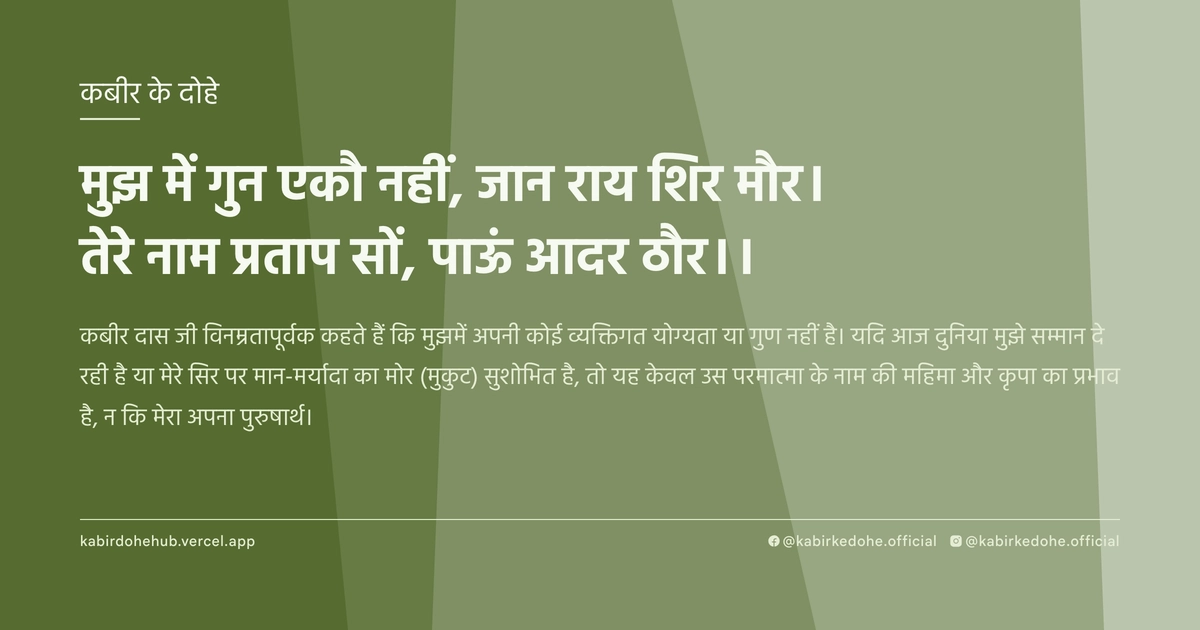
मुझ में गुन एकौ नहीं, जान राय शिर मौर।
तेरे नाम प्रताप सों, पाऊं आदर ठौर।।
Mujh me gun ekau nahin, jaan rai shir mour. Tere naam pratap son, paun aadar thour.
इस पृष्ठ पर इस कबीर दोहे का अर्थ (meaning), हिंदी व्याख्या और अंग्रेज़ी अनुवाद, दार्शनिक विश्लेषण और व्यावहारिक जीवन सीख दी गई है। यह दोहा विनम्रता (Humility) विषय से जुड़ा है — Kabir doha meaning and explanation in Hindi and English.
अर्थ (Meaning):
कबीर दास जी विनम्रतापूर्वक कहते हैं कि मुझमें अपनी कोई व्यक्तिगत योग्यता या गुण नहीं है। यदि आज दुनिया मुझे सम्मान दे रही है या मेरे सिर पर मान-मर्यादा का मोर (मुकुट) सुशोभित है, तो यह केवल उस परमात्मा के नाम की महिमा और कृपा का प्रभाव है, न कि मेरा अपना पुरुषार्थ।
Kabir humbly declares that he possesses no inherent virtues or merits of his own. He asserts that any honor, respect, or prestige he receives in the world—symbolized by the peacock plume upon his head—is not a result of his personal achievement, but is solely due to the divine grace and the transformative power of the Almighty's name.
व्याख्या (Interpretation):
यह दोहा पूर्ण आत्म-समर्पण और अहंकार के विसर्जन की पराकाष्ठा है। शाब्दिक रूप से, कबीर अपनी शून्य योग्यता को स्वीकार कर रहे हैं, लेकिन आध्यात्मिक स्तर पर यह 'अहं' (Ego) से 'सोऽहम्' (I am That) की यात्रा है। 'शिर मौर' यहाँ सामाजिक प्रतिष्ठा और आध्यात्मिक सिद्धि का प्रतीक है। कबीर समझाते हैं कि जब साधक स्वयं को पूरी तरह रिक्त कर देता है, तभी वह परमात्मा की अनंत ऊर्जा का पात्र बन पाता है। यह निर्गुण भक्ति का सार है, जहाँ भक्त अपनी व्यक्तिगत पहचान को मिटाकर ईश्वर के विराट स्वरूप में विलीन हो जाता है। यहाँ द्वैत का अंत होता है और यह बोध जागृत होता है कि कर्ता मनुष्य नहीं, बल्कि वह परमतत्व है जो सबके भीतर प्रवाहित है। माया हमें विश्वास दिलाती है कि हमारी सफलता हमारी अपनी है, जबकि सत्य यह है कि हम केवल माध्यम हैं।
This couplet represents the pinnacle of total surrender and the dissolution of the ego. Literally, Kabir acknowledges his own lack of merit, but on a spiritual plane, this is the journey from 'Aham' (the limited ego) to 'So-ham' (the realization of oneness with the Divine). The 'peacock plume' (shir maur) symbolizes both social prestige and spiritual attainment. Kabir explains that only when a seeker renders themselves completely empty can they become a vessel for the infinite energy of the Divine. This is the essence of Nirgun Bhakti, where the devotee erases their individual identity to merge into the formless Absolute. Here, duality ends, and the realization dawns that the human is not the 'doer' but merely a medium through which the Supreme Consciousness operates. Maya creates the illusion of personal achievement, while the truth remains that all grace flows from a single source.
दार्शनिक विश्लेषण (Philosophical Analysis):
कबीर का यह दृष्टिकोण उनके युग के उस सामाजिक और धार्मिक ढांचे पर एक गहरा प्रहार है जहाँ योग्यता को जाति, कुल या बाहरी कर्मकांडों से मापा जाता था। कबीर ने इस मिथक को तोड़ा कि आध्यात्मिक ज्ञान केवल उच्च वर्णों या विद्वानों की बपौती है। उनका दर्शन अद्वैत वेदांत के इस सिद्धांत से मेल खाता है कि जब तक 'मैं' (अहंकार) रहता है, तब तक 'वह' (परमात्मा) नहीं मिलता। यह सूफी मत के 'फना' (Fana) के सिद्धांत के समान है, जहाँ साधक अपनी हस्ती को ईश्वर की इच्छा में मिटा देता है।
यहाँ 'गुण' शब्द का प्रयोग बहुत सूक्ष्म है। कबीर सांसारिक गुणों (जैसे धन, पद, या बौद्धिक चातुर्य) को आध्यात्मिक मार्ग में बाधा मानते हैं। उनके अनुसार, जब मनुष्य यह दावा करता है कि "मैंने यह किया", तो वह वास्तव में अपनी आध्यात्मिक प्रगति को रोक देता है। वास्तविक विनम्रता वह नहीं है जो दूसरों के सामने दिखाई जाए, बल्कि वह है जो भीतर से यह जान ले कि व्यक्तिगत अस्तित्व एक भ्रम है।
यह दोहा कर्मकांडीय धर्म की अस्वीकृति करता है। यदि सम्मान केवल बाहरी अनुष्ठानों से मिलता, तो कबीर की सादगी उन्हें उपेक्षित रखती। लेकिन उनका सम्मान उनकी 'शून्यता' से आया। यह इस सत्य को उजागर करता है कि परमात्मा की कृपा किसी योग्यता की मोहताज नहीं होती, बल्कि वह केवल एक शुद्ध और अहंकार-रहित हृदय में निवास करती है।
मनोवैज्ञानिक स्तर पर, यह 'इम्पोस्टर सिंड्रोम' का आध्यात्मिक रूपांतरण है। जहाँ आधुनिक मनोविज्ञान इसे असुरक्षा मानता है, कबीर इसे मुक्ति का मार्ग बताते हैं। जब हम अपनी सफलता का श्रेय स्वयं लेते हैं, तो हम दबाव और डर के बंधन में बंध जाते हैं। लेकिन जब हम इसे दैवीय कृपा मानते हैं, तो हम तनावमुक्त होकर केवल सेवा भाव में लीन हो जाते हैं।
अंततः, यह विश्लेषण हमें सिखाता है कि वास्तविक शक्ति 'अहंकार' में नहीं, बल्कि 'समर्पण' में है। कबीर का 'शिर मौर' वास्तव में वह मुकुट है जो केवल उसे मिलता है जिसने अपना मुकुट (अहंकार) परमात्मा के चरणों में त्याग दिया है। यह विरोधाभास ही कबीर के मार्ग की विशेषता है—जो खुद को शून्य करता है, वही पूर्ण हो जाता है।
Kabir's perspective is a profound critique of the social and religious structures of his era, where merit was measured by caste, lineage, or external rituals. He shattered the myth that spiritual enlightenment was the exclusive preserve of the upper castes or the scholarly elite. His philosophy aligns with the Advaita Vedanta principle that as long as the 'I' (ego) persists, the 'That' (Divine) remains elusive. This mirrors the Sufi concept of 'Fana' (annihilation), where the seeker dissolves their existence into the will of the Beloved.
The use of the word 'gun' (virtue/merit) is highly nuanced. Kabir views worldly virtues—such as wealth, status, or intellectual prowess—as potential obstacles on the spiritual path. According to him, the moment a human claims "I have achieved this," they effectively halt their spiritual progression. True humility is not a performance for others, but an internal realization that the individual identity is an illusion.
This couplet rejects ritualistic religion. If honor were derived from external rites, Kabir's simplicity would have left him ignored. Instead, his prestige emerged from his 'emptiness.' This highlights the truth that divine grace is not contingent upon merit but resides only in a heart that is pure and devoid of ego.
Psychologically, this is a spiritual transformation of what modern psychology might call 'imposter syndrome.' While the modern world views the lack of self-attribution as insecurity, Kabir presents it as the path to liberation. When we claim success as our own, we bind ourselves to the burdens of pressure and fear. By attributing it to divine grace, we are freed to exist in a state of selfless service.
Ultimately, this analysis teaches us that true power lies not in ego, but in surrender. Kabir's 'peacock plume' is the crown given only to those who have discarded their own crown of pride at the feet of the Divine. This paradox is the hallmark of Kabir's path: he who makes himself zero becomes the Infinite.
मूल संदेश (Core Message):
- अहंकार वह पर्दा है जो हमें हमारी वास्तविक दिव्यता देखने से रोकता है।
- सच्ची योग्यता स्वयं को शून्य करने की क्षमता में निहित है।
- जब 'मैं' मिटता है, तभी 'परमात्मा' का प्राकट्य होता है।
- बाहरी सम्मान केवल एक प्रतिबिंब है; असली प्रकाश भीतर के समर्पण से आता है।
- समर्पण कमजोरी नहीं, बल्कि सर्वोच्च आध्यात्मिक शक्ति का स्रोत है।
- The ego is the veil that prevents us from seeing our inherent divinity.
- True merit lies in the capacity to render oneself completely empty.
- Only when the 'I' vanishes does the 'Divine' manifest.
- External honor is but a reflection; the real light comes from inner surrender.
- Surrender is not weakness, but the source of the highest spiritual power.
व्यावहारिक उदाहरण (Practical Example):
एक समय की बात है, वाराणसी के घाटों पर रामदीन नाम का एक वृद्ध बुनकर रहता था। रामदीन अपनी सादगी और ईमानदारी के लिए जाना जाता था, लेकिन वह समाज में बहुत निम्न स्थान पर था। वह दिन भर सूत कातता और रात को ईश्वर के नाम का जाप करता। उसके पास न तो कोई बड़ी डिग्री थी और न ही कोई राजनीतिक रसूख।
एक दिन शहर के बड़े पंडितों और विद्वानों की एक सभा हुई, जहाँ धर्म और मोक्ष पर गहन चर्चा हो रही थी। वहाँ उपस्थित लोग एक-दूसरे को अपनी विद्वत्ता दिखाने में लगे थे और शास्त्रार्थ के माध्यम से एक-दूसरे को नीचा दिखा रहे थे। तभी रामदीन वहाँ से गुजरा। उसकी आँखों में एक ऐसी शांति और चेहरे पर ऐसा तेज था कि सभा के सभी विद्वान ठिठक गए।
एक अहंकारी पंडित ने उसका मज़ाक उड़ाते हुए पूछा, "ए बुनकर! तूने कौन से शास्त्र पढ़े हैं कि तेरे चेहरे पर ऐसा संतोष है? क्या तू हमें बता सकता है कि मोक्ष क्या है?"
रामदीन ने बड़ी विनम्रता से सिर झुकाया और कहा, "महाराज, मैं तो अनपढ़ हूँ। मुझमें कोई गुण नहीं है। मैं तो बस एक तुच्छ धागा हूँ जिसे परमात्मा अपनी मर्जी से बुन रहा है। जो कुछ भी मुझमें अच्छा है, वह उसी की कृपा है।"
पंडित को लगा कि वह डर गया है, लेकिन रामदीन की बातों में एक ऐसी सच्चाई थी जिसने पंडित के अहंकार को हिला दिया। पंडित ने महसूस किया कि वह सालों से किताबों में जिसे खोज रहा था, वह सहजता इस अनपढ़ बुनकर के भीतर थी।
रामदीन ने आगे कहा, "जब मैं यह भूल जाता हूँ कि मैं 'रामदीन' हूँ, तब केवल 'राम' रह जाता है। और जब मैं मिट जाता हूँ, तब वह मुझे अपना बना लेता है। मेरी इस शांति का श्रेय मेरी किसी योग्यता को नहीं, बल्कि उस नाम के प्रताप को है जिसने मुझे खुद से आजाद कर दिया।"
यह सुनकर सभा में सन्नाटा छा गया। पंडित ने अपना मस्तक झुका लिया। उसे समझ आया कि ज्ञान केवल शब्दों का संग्रह नहीं, बल्कि अहंकार का विसर्जन है।
उस दिन के बाद, रामदीन की ख्याति पूरे शहर में फैल गई। लोग उसे 'संत' मानने लगे और उसके पास सलाह लेने आने लगे। लेकिन रामदीन में कोई बदलाव नहीं आया। वह अब भी वही पुराना बुनकर था, जो हर आने वाले को यही कहता कि "मुझमें कुछ नहीं, सब उस मालिक की देन है।"
उसने अपनी प्रसिद्धि को कभी अपने सिर पर नहीं चढ़ने दिया। उसने उस 'शिर मौर' (सम्मान) को परमात्मा को समर्पित कर दिया, जिससे वह और भी अधिक विनम्र और शांत हो गया।
इस प्रकार, रामदीन ने यह सिद्ध किया कि जब मनुष्य अपनी योग्यता का दावा छोड़ देता है, तो वह वास्तव में उस सार्वभौमिक योग्यता का हिस्सा बन जाता है जो उसे साधारण से असाधारण बना देती है।
Once upon a time, on the ghats of Varanasi, lived an elderly weaver named Ramdeen. Ramdeen was known for his simplicity and honesty, yet he occupied a very low position in the social hierarchy. He spent his days spinning yarn and his nights chanting the name of the Divine.
One day, a grand assembly of the city's most learned pundits and scholars convened to discuss religion and salvation. The attendees were locked in a fierce battle of intellect, using scriptures to belittle one another and prove their superiority.
As Ramdeen happened to pass by, the scholars noticed a profound peace in his eyes and a radiance on his face that stopped them in their tracks. An arrogant pundit, mocking him, asked, "Hey weaver! Which scriptures have you studied to possess such contentment? Can you tell us the secret of Moksha?"
Ramdeen bowed his head with deep humility and replied, "Sir, I am unlettered. I possess no virtues. I am but a humble thread being woven by the Divine according to His will. Whatever goodness exists in me is solely the grace of the Almighty."
The pundit initially thought Ramdeen was speaking out of fear, but there was an authenticity in his voice that shook the pundit's ego. He realized that the serenity he had sought for years in heavy volumes of text was naturally present in this uneducated weaver.
Ramdeen continued, "When I forget that I am 'Ramdeen,' only 'Ram' remains. When I vanish, He makes me His own. This peace is not the result of my merit, but the power of that Name which has liberated me from myself."
A heavy silence descended upon the assembly. The pundit bowed his head, realizing that true knowledge is not the accumulation of words, but the dissolution of the ego.
Following this encounter, Ramdeen's fame spread throughout the city. People began to revere him as a saint and sought his guidance. However, Ramdeen remained unchanged. He was still the same simple weaver, telling everyone, "There is nothing in me; everything is a gift from the Master."
He never allowed the 'peacock plume' of fame to inflate his ego. He dedicated all the respect he received back to the Divine, which only made him more humble and serene.
Thus, Ramdeen demonstrated that when a person ceases to claim personal merit, they become a vessel for a universal grace that transforms the ordinary into the extraordinary.
अभ्यास मार्गदर्शन (Practice Guidance):
- प्रतिदिन 15 मिनट 'साक्षी भाव' का अभ्यास करें: अपने भीतर उठने वाले विचारों को देखें और यह महसूस करें कि आप कर्ता नहीं, केवल एक माध्यम हैं।
- आत्म-पूछताछ जर्नल: दिन के अंत में उन कार्यों को लिखें जिनमें आपको गर्व महसूस हुआ, और फिर विश्लेषण करें कि उनमें बाहरी कारकों और दैवीय कृपा का कितना योगदान था।
- सेवा का संकल्प: सप्ताह में एक बार ऐसा कार्य करें जिसके लिए आपको कोई श्रेय न मिले और यह सुनिश्चित करें कि किसी को पता न चले कि वह आपने किया है।
- निदान चेकलिस्ट: यदि आप दूसरों की आलोचना कर रहे हैं या अपनी उपलब्धियों पर अहंकार महसूस कर रहे हैं, तो समझें कि आप 'अहं' के बंधन में हैं। यदि आप प्रशंसा और निंदा दोनों को समान भाव से स्वीकार कर रहे हैं, तो आप इस ज्ञान को जी रहे हैं।
- Practice 'Witness Consciousness' for 15 minutes daily: Observe the thoughts arising within you and realize that you are not the doer, but merely a medium.
- Self-Inquiry Journaling: At the end of the day, list the achievements that made you feel proud, then analyze the role of external factors and divine grace in those successes.
- Vow of Anonymous Service: Once a week, perform an act of kindness where you receive no credit and ensure that no one knows you were the source.
- Diagnostic Checklist: If you find yourself criticizing others or feeling inflated by your achievements, recognize that you are bound by the ego. If you accept both praise and criticism with equanimity, you are living this wisdom.
चिंतन प्रश्न (Reflection Questions):
- मेरे जीवन की सबसे बड़ी उपलब्धि वास्तव में मेरी अपनी है, या मैं केवल सही समय और सही परिस्थितियों का परिणाम था?
- जब लोग मेरी प्रशंसा करते हैं, तो मेरा अहंकार उसे कैसे सोखता है, और क्या यह मुझे दूसरों से अलग करता है?
- क्या मैं अपनी 'अच्छाई' या 'परोपकार' का उपयोग अनजाने में दूसरों को नीचा दिखाने के लिए करता हूँ?
- यदि आज मुझसे मेरी सारी सामाजिक पहचान और पद छीन लिए जाएं, तो मेरे भीतर क्या बचेगा?
- मैं अपनी डिजिटल पहचान (सोशल मीडिया) के माध्यम से किस 'आदर्श छवि' को गढ़ने की कोशिश कर रहा हूँ, और वह मेरी वास्तविक आत्मा से कितनी दूर है?
- Is the greatest achievement of my life truly my own, or was I merely the result of the right timing and circumstances?
- When people praise me, how does my ego absorb it, and does it create a distance between me and others?
- Do I unconsciously use my 'goodness' or 'philanthropy' as a tool to feel superior to others?
- If all my social identities and titles were stripped away today, what would actually remain within me?
- What 'ideal image' am I trying to construct through my digital identity, and how far is that from my authentic soul?