
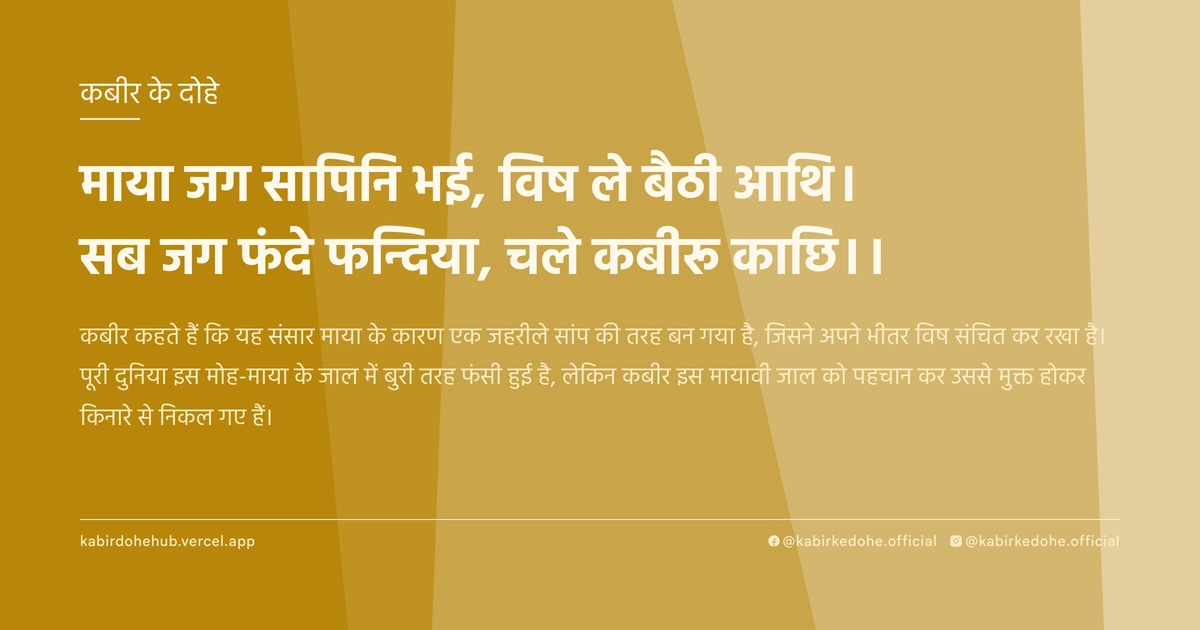
माया जग सापिनि भई, विष ले बैठी आथि।
सब जग फंदे फन्दिया, चले कबीरू काछि।।
Maya jag sapini bhayi, vish le baithi aathi. Sab jag fande fandiya, chale Kabiru kachhi.
इस पृष्ठ पर इस कबीर दोहे का अर्थ (meaning), हिंदी व्याख्या और अंग्रेज़ी अनुवाद, दार्शनिक विश्लेषण और व्यावहारिक जीवन सीख दी गई है। यह दोहा माया (Maya) विषय से जुड़ा है — Kabir doha meaning and explanation in Hindi and English.
अर्थ (Meaning):
कबीर कहते हैं कि यह संसार माया के कारण एक जहरीले सांप की तरह बन गया है, जिसने अपने भीतर विष संचित कर रखा है। पूरी दुनिया इस मोह-माया के जाल में बुरी तरह फंसी हुई है, लेकिन कबीर इस मायावी जाल को पहचान कर उससे मुक्त होकर किनारे से निकल गए हैं।
Kabir asserts that the world has become like a venomous serpent due to Maya, harboring a lethal poison of attachment. While the entire world remains hopelessly entangled in the intricate webs of illusion and desire, Kabir has recognized the trap and skillfully navigated his way to liberation, walking free along the edge.
व्याख्या (Interpretation):
इस दोहे का शाब्दिक अर्थ है कि संसार एक सांप है, लेकिन आध्यात्मिक स्तर पर यह 'माया' के प्रभाव को दर्शाता है। माया वह शक्ति है जो सत्य को ढक देती है और हमें असत्य को सत्य मानने पर मजबूर करती है। यहाँ सांप का विष 'अहंकार' और 'आसक्ति' का प्रतीक है, जो धीरे-धीरे आत्मा को सुला देता है। निर्गुण भक्ति के अनुसार, ईश्वर किसी मूर्ति में नहीं बल्कि स्वयं के भीतर है, परंतु माया हमें बाहरी आडंबरों में उलझाए रखती है। यह अद्वैत वेदांत के उस सिद्धांत को पुष्ट करता है जहाँ जीव स्वयं को ब्रह्म से अलग मानकर दुखी होता है। कबीर का 'काछि' चलना यह दर्शाता है कि उन्होंने द्वैत (दो होने का भाव) को समाप्त कर लिया है। अंततः, यह दोहा मनुष्य की उस त्रासदी को उजागर करता है जहाँ वह जिसे सुख समझता है, वही वास्तव में उसका बंधन है।
Literally, the verse describes the world as a serpent, but metaphorically, it addresses the pervasive influence of Maya. Maya is the cosmic illusion that veils the ultimate reality, compelling the soul to mistake the transient for the eternal. The 'venom' symbolizes ego and attachment, which act as a spiritual sedative, numbing the soul to its own divine nature. In the context of Nirgun Bhakti, the Divine is formless and immanent, yet Maya lures the seeker toward external rituals and sensory gratifications. This aligns with Advaita Vedanta's core tenet: the perceived separation between Atman (individual soul) and Brahman (universal consciousness) is the primary delusion. Kabir's act of walking 'along the edge' signifies his transcendence of duality. The central paradox presented is that the very world we strive to conquer and possess is the very cage that imprisons our spirit.
दार्शनिक विश्लेषण (Philosophical Analysis):
कबीर का यह दोहा उस युग की उपज है जब समाज कर्मकांडों और बाहरी दिखावे में डूबा था। उन्होंने देखा कि लोग तीर्थयात्राओं और कठिन व्रतों में समय व्यतीत कर रहे थे, जबकि उनके भीतर का क्रोध और लोभ कम नहीं हो रहा था। कबीर ने इस 'संस्थागत धर्म' का विरोध किया और सीधे अनुभव (Anubhava) पर जोर दिया। उनके लिए माया केवल धन या संपत्ति नहीं थी, बल्कि वह मानसिक स्थिति थी जो मनुष्य को उसके वास्तविक स्वरूप से दूर ले जाती है।
दार्शनिक रूप से, यह सूफी मत के 'नफ्स' (अहंकार) के विनाश और वेदांत के 'माया विनिर्मुक्त' होने की प्रक्रिया से मिलता-जुलता है। कबीर तर्क देते हैं कि जब तक मनुष्य 'मैं' और 'मेरा' के भाव में रहता है, वह उस सांप के विष के प्रभाव में है। यह विष उसे जन्म और मृत्यु के चक्र में बांधे रखता है। उन्होंने जाति और धर्म की दीवारों को तोड़कर यह बताया कि मुक्ति किसी विशेष वर्ग के लिए नहीं, बल्कि उसके लिए है जो जागृत है।
यहाँ 'सांप' का रूपक अत्यंत गहरा है। सांप शांत दिखता है लेकिन घातक होता है, ठीक वैसे ही जैसे सांसारिक सुख शुरुआत में लुभावने लगते हैं लेकिन अंत में दुख और विरह देते हैं। कबीर इस मनोवैज्ञानिक सत्य को उजागर करते हैं कि मनुष्य अपनी इच्छाओं का दास बन जाता है।
अद्वैत दर्शन के अनुसार, माया कोई बाहरी वस्तु नहीं बल्कि हमारी अपनी अज्ञानता (Avidya) है। जब ज्ञान का प्रकाश आता है, तो माया गायब नहीं होती, बल्कि उसका स्वरूप बदल जाता है—वह बंधन के बजाय साधन बन जाती है। कबीर इसी ज्ञानोदय की बात कर रहे हैं।
अंततः, कबीर का संदेश यह है कि मुक्ति के लिए संसार को छोड़ने की आवश्यकता नहीं है, बल्कि संसार के प्रति अपने दृष्टिकोण को बदलने की आवश्यकता है। जब आप यह जान लेते हैं कि यह सब एक खेल है, तो आप इस खेल में रहते हुए भी इससे अप्रभावित रहते हैं। यही वह 'काछि' चलना है, जहाँ साधक संसार में रहते हुए भी उससे ऊपर उठ जाता है।
Kabir's verse emerged from an era dominated by rigid ritualism and superficial piety. He observed a society obsessed with external markers of holiness—pilgrimages, fasting, and caste hierarchies—while the internal landscape remained cluttered with greed and hatred. Kabir rejected this 'institutionalized religion,' advocating instead for direct, personal experience (Anubhava) as the only valid path to truth.
Philosophically, this aligns with the Sufi concept of annihilating the 'Nafs' (the lower ego) and the Vedantic pursuit of becoming 'Maya-vimukta' (liberated from illusion). To Kabir, Maya was not merely material wealth, but a psychological state of identification with the transient. He argues that as long as one clings to the notions of 'I' and 'Mine,' they are under the influence of the serpent's venom, which binds the soul to the endless cycle of Samsara.
The metaphor of the serpent is particularly potent. A snake appears calm yet remains lethal; similarly, worldly pleasures seem alluring initially but eventually yield sorrow and spiritual stagnation. Kabir exposes the psychological trap where human desire transforms from a tool for survival into a master that enslaves the spirit.
According to Advaita Vedanta, Maya is not an external entity but a manifestation of our own ignorance (Avidya). When the light of true knowledge (Jnana) dawns, Maya does not vanish, but its nature is transformed—it ceases to be a shackle and becomes a medium for liberation. Kabir speaks of this awakening, where the seeker recognizes the illusory nature of the ego.
Ultimately, Kabir suggests that liberation does not require physical renunciation of the world, but a cognitive shift in how one perceives it. By realizing that the world is a play of shadows, one can exist within it without being consumed by it. This is the essence of 'walking along the edge'—living in the world, but not being of the world, maintaining a state of detached engagement.
मूल संदेश (Core Message):
- संसार का आकर्षण एक सुंदर लेकिन जहरीला भ्रम है।
- अहंकार और आसक्ति ही वह विष है जो आत्मा को अंधा करता है।
- सत्य की खोज बाहरी दुनिया में नहीं, आंतरिक मौन में है।
- मुक्ति का अर्थ संसार छोड़ना नहीं, बल्कि मोह छोड़ना है।
- जागरूकता ही वह एकमात्र शस्त्र है जो माया के जाल को काट सकता है।
- Worldly attraction is a beautiful yet lethal illusion.
- Ego and attachment are the venoms that blind the soul.
- Truth is found not in the external world, but in internal silence.
- Liberation is not about leaving the world, but leaving the attachment to it.
- Awareness is the only blade sharp enough to cut through the web of Maya.
व्यावहारिक उदाहरण (Practical Example):
एक समय की बात है, वाराणसी के घाटों पर रामदीन नाम का एक पुराना बुनकर रहता था। वह अपनी कला में निपुण था, लेकिन उसका मन हमेशा इस बात की चिंता में रहता था कि उसके बेटे शहर जाकर बड़ा आदमी बनें और उसे और अधिक धन दिलाएं। वह दिन-रात मेहनत करता, लेकिन उसकी खुशी उसके बेटों की सफलता और समाज में उनकी प्रतिष्ठा पर टिकी थी।
रामदीन के लिए उसका परिवार और उसकी संपत्ति ही उसकी दुनिया थी। वह जितना अधिक कमाता, उसकी इच्छाएं उतनी ही बढ़ती जातीं। वह अपने बेटों को महंगे कपड़े और विलासिता की चीजें देता, यह सोचकर कि यही जीवन की सार्थकता है। वह इस बात से अनजान था कि वह जिस 'सफलता' के पीछे भाग रहा है, वह वास्तव में एक अंतहीन प्यास है।
एक दिन, उसके सबसे बड़े बेटे ने उसे पूरी तरह भुला दिया और विदेश चला गया। जब रामदीन ने उसे याद किया, तो उसे केवल उपेक्षा और ठंडापन मिला। रामदीन टूट गया। उसे लगा कि उसकी पूरी जिंदगी की मेहनत बेकार गई। वह गहरे अवसाद में डूब गया और सोचने लगा कि उसने अपनी पूरी ऊर्जा जिस 'माया' को सींचने में लगाई, उसने उसे अंत में केवल अकेलापन दिया।
तभी उसकी मुलाकात एक फकीर से हुई, जिसने उसे कबीर का यह दोहा सुनाया। फकीर ने कहा, "रामदीन, तूने सांप को पाल लिया और सोचा कि वह तुझे सुरक्षा देगा। तूने अपनी खुशी दूसरों की पहचान में खोजी, जबकि खुशी तो तेरे अपने भीतर के शून्य में थी।"
रामदीन को अचानक एक झटका लगा। उसे समझ आया कि वह अब तक जिस 'प्रेम' को अपना मान रहा था, वह वास्तव में एक 'अधिकार' की भावना थी। वह अपने बेटों से नहीं, बल्कि उनके द्वारा दी जाने वाली सामाजिक प्रतिष्ठा से प्रेम करता था। यह अहसास उसके लिए उस विष के प्रभाव को कम करने जैसा था।
उसने धीरे-धीरे अपनी इच्छाओं का त्याग करना शुरू किया। उसने बुनना जारी रखा, लेकिन अब वह धन के लिए नहीं, बल्कि उस सृजन की खुशी के लिए बुनने लगा। उसने अपने छोटे बेटे को भी अपनी महत्वाकांक्षाओं के बोझ से मुक्त कर दिया और उसे अपनी सहज प्रकृति के अनुसार जीने की अनुमति दी।
अब रामदीन घाट पर बैठकर मुस्कुराता था। लोग उसे देखते और सोचते कि उसने सब कुछ खो दिया है, लेकिन रामदीन जानता था कि उसने वास्तव में सब कुछ पा लिया है। उसने उस जाल को पहचान लिया था जिसमें पूरी दुनिया फंसी थी।
उसका जीवन अब एक शांत नदी की तरह था। वह अब भी परिवार के साथ था, लेकिन अब वह उनके व्यवहार से विचलित नहीं होता था। उसने 'काछि' चलना सीख लिया था—संसार के बीच रहकर भी उससे मुक्त रहना।
रामदीन की यह कहानी हमें सिखाती है कि जब हम बाहरी उपलब्धियों को अपनी पहचान बना लेते हैं, तो हम माया के विष का शिकार हो जाते हैं। मुक्ति तब मिलती है जब हम यह जान लेते हैं कि असली घर हमारे भीतर है, बाहर नहीं।
अंत में, रामदीन ने अपनी सारी जमापूंजी एक छोटे से आश्रम में दान कर दी और केवल अपनी बुनियादी जरूरतों के साथ जीने लगा। उसकी आँखों में अब वह बेचैनी नहीं थी, बल्कि एक गहरी, अनंत शांति थी।
Once, in the bustling ghats of Varanasi, lived an old weaver named Ramdeen. He was a master of his craft, but his mind was perpetually consumed by the anxiety of his sons' futures. He dreamed of them becoming powerful men in the city, believing that their success and social status would be the ultimate validation of his own life's work.
For Ramdeen, his family and the accumulation of wealth were the center of his universe. The more he earned, the more his desires expanded. He showered his sons with luxuries, convinced that this material ascent was the only true meaning of existence. He remained oblivious to the fact that the 'success' he chased was an insatiable thirst.
Years later, his eldest son, having achieved great wealth abroad, completely forgot him. When Ramdeen reached out, he was met with cold indifference and neglect. Ramdeen was shattered. He felt that his entire life's labor had been a waste, falling into a deep depression as he realized that the 'Maya' he had nurtured had left him with nothing but loneliness.
During this dark phase, he encountered a wandering fakir who recited Kabir's verse to him. The fakir remarked, "Ramdeen, you raised a serpent in your home and expected it to protect you. You sought your happiness in the identity of others, forgetting that true peace resides in the stillness within yourself."
This was a moment of profound awakening for Ramdeen. He realized that what he had called 'love' for his children was actually a desire for 'ownership' and social prestige. He had been loving the image of his sons, not the sons themselves. This realization acted as an antidote to the venom of attachment.
Slowly, Ramdeen began to dismantle his expectations. He continued to weave, but no longer for the sake of profit or prestige; he wove for the sheer joy of creation. He released his younger son from the burden of his ambitions, allowing the boy to live according to his own nature.
Now, Ramdeen would sit by the Ganges and smile. To the onlookers, he seemed like a man who had lost everything, but Ramdeen knew he had finally gained everything. He had recognized the invisible net that held the rest of the world captive.
His life became like a calm river. He remained part of his family, but he was no longer disturbed by their fluctuations in behavior. He had learned to 'walk along the edge'—existing in the world without being consumed by its delusions.
Ramdeen's story illustrates that when we anchor our identity to external achievements, we succumb to the venom of Maya. Liberation occurs the moment we realize that the true home is within, not in the projections of the world.
Eventually, Ramdeen donated most of his savings to a local shelter and lived with only the barest necessities. The restlessness in his eyes was replaced by a deep, infinite serenity that no material loss could touch.
अभ्यास मार्गदर्शन (Practice Guidance):
- प्रतिदिन 20 मिनट 'साक्षी भाव' का अभ्यास करें: अपने विचारों को ऐसे देखें जैसे आप किसी अजनबी की फिल्म देख रहे हों, उनमें शामिल न हों।
- स्व-पूछताछ जर्नल: हर रात लिखें कि आज किस बात ने आपको सबसे अधिक विचलित किया और वह 'माया' (अहंकार या आसक्ति) का कौन सा रूप था।
- व्यवहार परिवर्तन: सप्ताह में एक बार ऐसी वस्तु या स्थिति का त्याग करें जिससे आप अत्यधिक जुड़े हुए हैं, ताकि आप अपनी निर्भरता को पहचान सकें।
- निदान चेकलिस्ट: यदि आप दूसरों की सफलता से ईर्ष्या महसूस कर रहे हैं या अपनी उपलब्धियों पर अत्यधिक गर्व कर रहे हैं, तो समझें कि आप 'सांप के विष' (माया) के प्रभाव में हैं।
- Practice 'Witness Consciousness' for 20 minutes daily: Observe your thoughts as if watching a stranger's movie, without becoming entangled in them.
- Self-Inquiry Journaling: Every night, record the specific event that disturbed you most and identify which form of 'Maya' (ego or attachment) was triggered.
- Behavioral Shift: Once a week, intentionally let go of a material object or a specific outcome you are clinging to, to recognize your dependency.
- Diagnostic Checklist: If you feel envy toward others' success or excessive pride in your own, recognize that you are currently under the influence of the 'serpent's venom' (Maya).
चिंतन प्रश्न (Reflection Questions):
- मेरे जीवन में वह कौन सी 'सफलता' है जिसे मैं अपनी पहचान मानता हूँ, और यदि वह कल छिन जाए, तो मेरा अस्तित्व क्या बचेगा?
- मैं किन रिश्तों में प्रेम नहीं, बल्कि नियंत्रण और अधिकार की भावना रखता हूँ?
- मेरा 'डिजिटल ईगो' (सोशल मीडिया इमेज) मुझे वास्तविक सत्य से कितना दूर ले जा रहा है?
- क्या मैं वास्तव में स्वतंत्र हूँ, या मैं केवल अपनी इच्छाओं के एक अधिक परिष्कृत पिंजरे में कैद हूँ?
- मेरे भीतर का वह कौन सा डर है जो मुझे पूर्ण समर्पण और शांति से रोकता है?
- Which 'success' in my life have I mistaken for my identity, and what would remain of me if it were stripped away tomorrow?
- In which of my relationships am I practicing control and ownership rather than genuine, selfless love?
- To what extent is my 'digital ego' (social media persona) distancing me from my authentic, internal truth?
- Am I truly free, or am I simply imprisoned in a more sophisticated cage of my own desires?
- What is the hidden fear within me that prevents total surrender to the present moment and inner peace?