
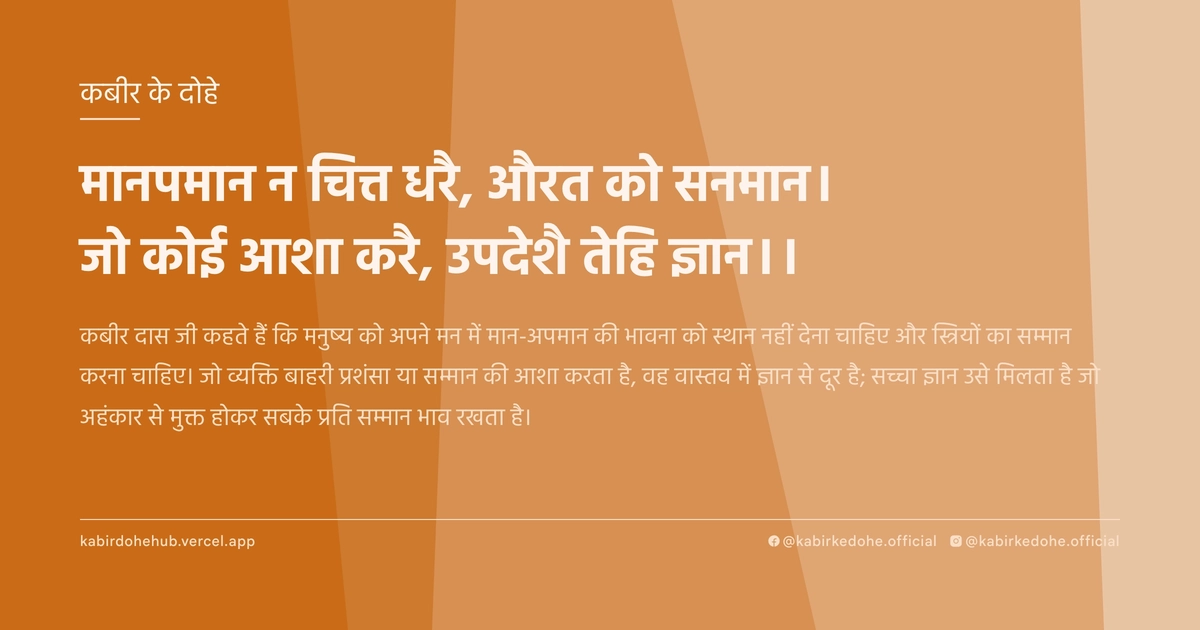
मानपमान न चित्त धरै, औरत को सनमान।
जो कोई आशा करै, उपदेशै तेहि ज्ञान।।
Manpaman na chitt dharai, aurat ko sanman. Jo koi aasha karai, updeshai tehi gyan.
इस पृष्ठ पर इस कबीर दोहे का अर्थ (meaning), हिंदी व्याख्या और अंग्रेज़ी अनुवाद, दार्शनिक विश्लेषण और व्यावहारिक जीवन सीख दी गई है। यह दोहा विनम्रता (Humility) विषय से जुड़ा है — Kabir doha meaning and explanation in Hindi and English.
अर्थ (Meaning):
कबीर दास जी कहते हैं कि मनुष्य को अपने मन में मान-अपमान की भावना को स्थान नहीं देना चाहिए और स्त्रियों का सम्मान करना चाहिए। जो व्यक्ति बाहरी प्रशंसा या सम्मान की आशा करता है, वह वास्तव में ज्ञान से दूर है; सच्चा ज्ञान उसे मिलता है जो अहंकार से मुक्त होकर सबके प्रति सम्मान भाव रखता है।
Kabir suggests that one should not harbor feelings of pride or resentment over honor and dishonor in the mind, and must uphold the dignity of women. Those who crave external validation or social status are blinded to the truth; true spiritual knowledge descends only upon those who abandon the ego's desire for recognition.
व्याख्या (Interpretation):
इस दोहे का शाब्दिक अर्थ सामाजिक सम्मान और स्त्री मर्यादा से जुड़ा है, परंतु इसका गहरा आध्यात्मिक अर्थ 'अहंकार' के विसर्जन में है। 'मान-अपमान' यहाँ द्वैत (duality) का प्रतीक है—जहाँ व्यक्ति स्वयं को दूसरों की दृष्टि से आंकता है। जब कबीर 'औरत के सम्मान' की बात करते हैं, तो वे समाज के सबसे उपेक्षित वर्ग के प्रति करुणा और समानता की बात कर रहे हैं, जो कि माया के प्रभाव को तोड़ने का पहला कदम है। निर्गुण भक्ति में, आत्मा का कोई लिंग या सामाजिक दर्जा नहीं होता; वह केवल शुद्ध चेतना है। जो व्यक्ति बाहरी सम्मान की 'आशा' करता है, वह वास्तव में अपनी पहचान को शरीर और सामाजिक स्थिति (Maya) से जोड़ रहा है। जब यह आशा समाप्त होती है, तब 'ज्ञान' का उदय होता है, जो कि आत्मा और ब्रह्म की एकता (Advaita) का अनुभव है।
Literally, the verse addresses social honor and the respect due to women, yet its deeper metaphysical layer concerns the dissolution of the 'I'. 'Honor and dishonor' represent the duality of the ego, where the self is defined by external perception. By emphasizing the respect for women, Kabir targets the systemic prejudices of his time, suggesting that true spirituality cannot coexist with the oppression of others. In Nirgun Bhakti, the soul is genderless and devoid of caste; it is pure consciousness. The 'hope' or 'craving' for respect is a shackle of Maya, binding the seeker to a false identity. Only when the desire for validation vanishes does 'Gyan' (divine knowledge) emerge, revealing the non-duality of Atman and Brahman, where the observer and the observed become one.
दार्शनिक विश्लेषण (Philosophical Analysis):
कबीर का यह दोहा उस युग की सामाजिक कठोरता पर प्रहार करता है जहाँ जाति और लिंग के आधार पर श्रेष्ठता तय होती थी। वे ritualism (कर्मकांड) का विरोध करते हैं क्योंकि बाहरी दिखावे और पूजा-पाठ से अहंकार और बढ़ता है, घटता नहीं। यहाँ कबीर का दृष्टिकोण सूफी मत और अद्वैत वेदांत का संगम है। सूफीवाद में 'इश्क-ए-हकीकी' (ईश्वरीय प्रेम) के लिए अहंकार का मरना (Fana) अनिवार्य है। इसी तरह, अद्वैत वेदांत सिखाता है कि 'अहंकार' ही वह पर्दा है जो हमें सत्य देखने से रोकता है।
मान-अपमान का द्वंद्व मनोवैज्ञानिक बंधन है। जब हम सम्मान चाहते हैं, तो हम अनजाने में अपमान के डर को भी पालते हैं। कबीर इस मनोवैज्ञानिक चक्र को तोड़ने का सुझाव देते हैं। वे कहते हैं कि यदि आप स्वयं को ब्रह्म का अंश मानते हैं, तो आपको किसी बाहरी प्रमाण की आवश्यकता नहीं है।
स्त्री के सम्मान की बात करना उस समय के पितृसत्तात्मक ढांचे में एक क्रांतिकारी कदम था। कबीर के लिए, ईश्वर हर उस हृदय में वास करता है जो प्रेम और करुणा से भरा हो। यदि कोई व्यक्ति मंदिर में माथा टेकता है लेकिन घर में स्त्रियों का अनादर करता है, तो उसकी भक्ति केवल एक पाखंड है।
यह ज्ञान की प्राप्ति की एक विशिष्ट विधि है: 'निषेध के माध्यम से प्राप्ति'। पहले आशा (desire) का त्याग, फिर मान-अपमान के द्वंद्व का अंत, और अंततः शुद्ध ज्ञान का उदय। यह प्रक्रिया अहंकार के पूर्ण विलोपन की है, जिसे 'शून्य' की अवस्था कहा जाता है।
अंततः, कबीर यह स्पष्ट करते हैं कि ज्ञान कोई ऐसी वस्तु नहीं है जिसे किताबों से पढ़ा जाए, बल्कि यह एक अनुभव है जो तब घटित होता है जब व्यक्ति अपनी पहचान को सामाजिक श्रेणियों से ऊपर उठा लेता है। सच्चा ज्ञान वह है जो हमें विनम्र बनाता है और समस्त सृष्टि में एक ही चेतना का दर्शन कराता है।
Kabir’s verse strikes at the heart of the social rigidity of his era, where superiority was dictated by caste and gender. He vehemently rejects ritualism, arguing that external ceremonies often inflate the ego rather than diminish it. His perspective is a synthesis of Sufi mysticism and Advaita Vedanta. In Sufism, the concept of 'Fana' (annihilation of the self) is essential to achieve 'Ishq-Haqiqi' (Divine Love). Similarly, Advaita Vedanta posits that the 'Ahamkara' (ego) is the primary veil obscuring the realization of the Absolute.
The duality of honor and dishonor is a psychological trap. By craving respect, one inadvertently cultivates a fear of disgrace. Kabir suggests breaking this cycle by realizing that if one is a fragment of the Divine, external validation becomes redundant. The ego is the only entity that feels insulted; the soul, being eternal and unchanging, remains untouched by social labels.
Advocating for the respect of women in a deeply patriarchal society was a radical act of spiritual liberation. For Kabir, the Divine resides in every heart characterized by compassion. A person who performs elaborate rituals but denies dignity to women is merely practicing a spiritual facade, disconnected from the essence of Truth.
This path to enlightenment is a method of 'attainment through negation'. First, the cessation of desire (Asha), then the collapse of the duality of honor and dishonor, and finally, the emergence of pure Knowledge. This process mirrors the journey toward 'Shunya' (the Void), where the individual identity dissolves into the universal consciousness.
Ultimately, Kabir clarifies that Knowledge is not an academic acquisition but an experiential realization. It occurs when a person transcends social categories and recognizes the singular, formless reality (Nirgun) animating all existence. True wisdom is that which fosters humility and reveals the unity of all beings.
मूल संदेश (Core Message):
- बाहरी सम्मान एक भ्रम है, आंतरिक शांति ही वास्तविक सत्य है।
- अहंकार का विसर्जन ही ज्ञान के द्वार खोलने की एकमात्र कुंजी है।
- स्त्री और उपेक्षितों का सम्मान आपकी अपनी आध्यात्मिक उन्नति का पैमाना है।
- जब 'मैं' समाप्त होता है, तब 'ब्रह्म' का अनुभव प्रारंभ होता है।
- प्रशंसा की भूख आत्मा की सबसे बड़ी बेड़ी है।
- External honor is a mirage; inner stillness is the only enduring truth.
- The dissolution of the ego is the sole key to unlocking divine knowledge.
- Respect for the marginalized is the true metric of your spiritual evolution.
- When the 'I' vanishes, the experience of the Universal Consciousness begins.
- The hunger for validation is the heaviest shackle on the soul.
व्यावहारिक उदाहरण (Practical Example):
एक समय की बात है, वाराणसी के घाटों पर माधव नाम का एक वृद्ध बुनकर रहता था। माधव अपने काम में निपुण था, लेकिन उसका स्वभाव अत्यंत अहंकारी था। वह मानता था कि उसके द्वारा बुने गए वस्त्र शहर के सबसे श्रेष्ठ हैं और वह चाहता था कि हर कोई उसकी प्रशंसा करे। जब भी कोई ग्राहक उसके काम की तारीफ नहीं करता, वह क्रोधित हो जाता और खुद को अपमानित महसूस करता।
उसी बस्ती में एक विधवा महिला रहती थी, जिसे समाज ने हाशिए पर धकेल दिया था। वह माधव के घर के पास छोटी सी जगह पर अनाज साफ करती थी। माधव अक्सर उसे तुच्छ समझता और उससे बात करते समय रूखा व्यवहार करता। वह सोचता था कि एक 'अछूत' और 'विधवा' महिला उसकी बराबरी कैसे कर सकती है।
एक दिन, माधव ने एक बहुत ही जटिल और सुंदर वस्त्र तैयार किया। उसने इसे शहर के सबसे बड़े सेठ को दिखाने का निर्णय लिया, इस उम्मीद में कि सेठ उसकी बहुत प्रशंसा करेगा और उसे भारी इनाम देगा। लेकिन जब सेठ ने वस्त्र देखा, तो उसने बड़ी सहजता से कहा, 'काम अच्छा है, लेकिन इसमें वह गहराई नहीं जो आत्मा को छुए।'
माधव यह सुनकर टूट गया। उसे लगा कि उसका अपमान हुआ है। वह गुस्से और निराशा में अपने घर लौटा। रास्ते में उसने देखा कि वही विधवा महिला एक घायल कुत्ते की सेवा कर रही थी और उसके चेहरे पर एक ऐसी शांति और संतोष था जिसे माधव ने कभी महसूस नहीं किया था।
माधव ने उससे पूछा, 'तुम्हें इस दुनिया से कोई सम्मान नहीं मिलता, फिर भी तुम इतनी शांत कैसे हो?' उस महिला ने मुस्कुराकर कहा, 'भैया, सम्मान तो वह वस्त्र है जो दुनिया पहनाती है, जो कभी भी उतारा जा सकता है। मैं तो उस मालिक की सेवा में हूँ जहाँ न कोई छोटा है न बड़ा।'
यह बात माधव के हृदय पर बिजली की तरह गिरी। उसे अहसास हुआ कि वह अब तक 'मान-अपमान' के जिस खेल में उलझा था, वह वास्तव में उसकी अपनी मानसिक गुलामी थी। उसने महसूस किया कि जिस महिला को वह तुच्छ समझता था, वह वास्तव में उससे कहीं अधिक 'ज्ञानी' और मुक्त थी क्योंकि उसमें प्रशंसा की कोई भूख नहीं थी।
अगले दिन से माधव का व्यवहार पूरी तरह बदल गया। उसने अपनी कला को प्रशंसा के लिए नहीं, बल्कि समर्पण के लिए इस्तेमाल करना शुरू किया। उसने उस महिला की मदद की और समाज के अन्य उपेक्षित लोगों के प्रति सम्मान दिखाना शुरू किया।
जैसे ही माधव ने सम्मान की 'आशा' छोड़ी, उसे एक अद्भुत मानसिक शांति मिली। अब उसे इस बात से फर्क नहीं पड़ता था कि सेठ उसकी तारीफ करता है या नहीं। उसकी कला में अब एक नई रूहानी चमक आ गई थी, क्योंकि वह अब अहंकार से नहीं, बल्कि प्रेम से बुन रहा था।
Once in the ghats of Varanasi, there lived an elderly weaver named Madhav. Madhav was exceptionally skilled in his craft, but he was consumed by a profound ego. He believed his textiles were the finest in the city and craved constant admiration. Whenever a customer failed to praise his work, he would succumb to anger, feeling deeply insulted.
In the same neighborhood lived a widow who had been marginalized by society. She spent her days cleaning grains in a small patch of land near Madhav's house. Madhav viewed her with contempt, treating her with coldness and indifference, believing a 'social outcast' could never be his equal.
One day, Madhav crafted an incredibly intricate and beautiful garment. He decided to present it to the city's wealthiest merchant, hoping for lavish praise and a grand reward. However, upon seeing the cloth, the merchant remarked casually, 'The work is fine, but it lacks the depth that touches the soul.'
Madhav was devastated. He perceived this as a grave insult. He returned home consumed by rage and despair. On his way, he noticed the widow tending to a wounded dog. Her face radiated a serenity and contentment that Madhav had never experienced in his life.
Curious, Madhav asked her, 'You receive no honor from this world, yet how are you so peaceful?' The woman smiled and replied, 'Brother, honor is but a garment the world lends us, which can be stripped away at any moment. I serve the Master where there is neither high nor low.'
These words struck Madhav like a bolt of lightning. He realized that the game of 'honor and dishonor' he had been playing was actually a form of mental slavery. He saw that the woman he had deemed insignificant was far more 'knowledgeable' and free because she harbored no hunger for validation.
From the next day, Madhav's behavior underwent a complete transformation. He stopped weaving for praise and began weaving as an act of surrender. He started helping the widow and showing genuine respect to all the marginalized people in his community.
As soon as Madhav relinquished the 'hope' for respect, he attained an extraordinary inner peace. He no longer cared whether the merchant praised him or not. A new spiritual luminosity entered his art, for he was no longer weaving with ego, but with love.
अभ्यास मार्गदर्शन (Practice Guidance):
- दैनिक अभ्यास: दिन में तीन बार रुकें और स्वयं से पूछें, 'क्या मैं इस समय किसी की प्रशंसा की उम्मीद कर रहा हूँ या अपमान से डर रहा हूँ?'
- आत्म-निरीक्षण जर्नल: उन स्थितियों को लिखें जहाँ आपको लगा कि आपका अपमान हुआ है। विश्लेषण करें कि आपके भीतर का कौन सा 'अहंकार' चोटिल हुआ है।
- व्यवहार परिवर्तन: जानबूझकर उन लोगों के प्रति विनम्रता और सम्मान दिखाएं जिन्हें समाज 'निम्न' मानता है, और देखें कि इससे आपके आंतरिक क्रोध में कितनी कमी आती है।
- डायग्नोस्टिक चेकलिस्ट: यदि आप किसी की आलोचना सुनकर बेचैन होते हैं या दूसरों की मदद केवल प्रशंसा के लिए करते हैं, तो समझें कि आप अभी भी 'माया' के प्रभाव में हैं।
- Daily Practice: Three times a day, pause and ask yourself, 'Am I currently craving validation or fearing a loss of status?'
- Self-Inquiry Journal: Document instances where you felt insulted. Analyze which specific part of your 'ego-identity' was wounded.
- Behavioral Shift: Consciously practice humility and profound respect toward those marginalized by society, observing how this diminishes your own internal volatility.
- Diagnostic Checklist: If a stranger's criticism disrupts your peace or if your kindness is contingent on being noticed, recognize that you are still operating within the illusion of Maya.
चिंतन प्रश्न (Reflection Questions):
- यदि कल आपकी सारी सामाजिक प्रतिष्ठा छीन ली जाए, तो आपके भीतर क्या बचेगा?
- आप दूसरों के प्रति जो सम्मान दिखाते हैं, क्या वह वास्तव में उनके लिए है या आपकी अपनी छवि को बेहतर बनाने के लिए?
- आपके जीवन में वह कौन सा व्यक्ति है जिसे आप 'अयोग्य' मानते हैं? क्या यह निर्णय आपकी आत्मा ने लिया है या आपके सामाजिक कंडीशनिंग ने?
- क्या आप अपनी डिजिटल पहचान (Social Media Ego) को ही अपना वास्तविक अस्तित्व मान बैठे हैं?
- अपमान की भावना वास्तव में क्या है—सत्य की खोज या अहंकार की चीख?
- If all your social status were stripped away tomorrow, what would remain of your identity?
- Is the respect you show others truly for them, or is it a tool to polish your own image?
- Who is the person you consider 'inferior' in your life? Was this judgment made by your soul or by your social conditioning?
- Have you mistaken your digital persona (Social Media Ego) for your actual existence?
- What is the feeling of insult, in reality—a quest for truth or the scream of a wounded ego?