
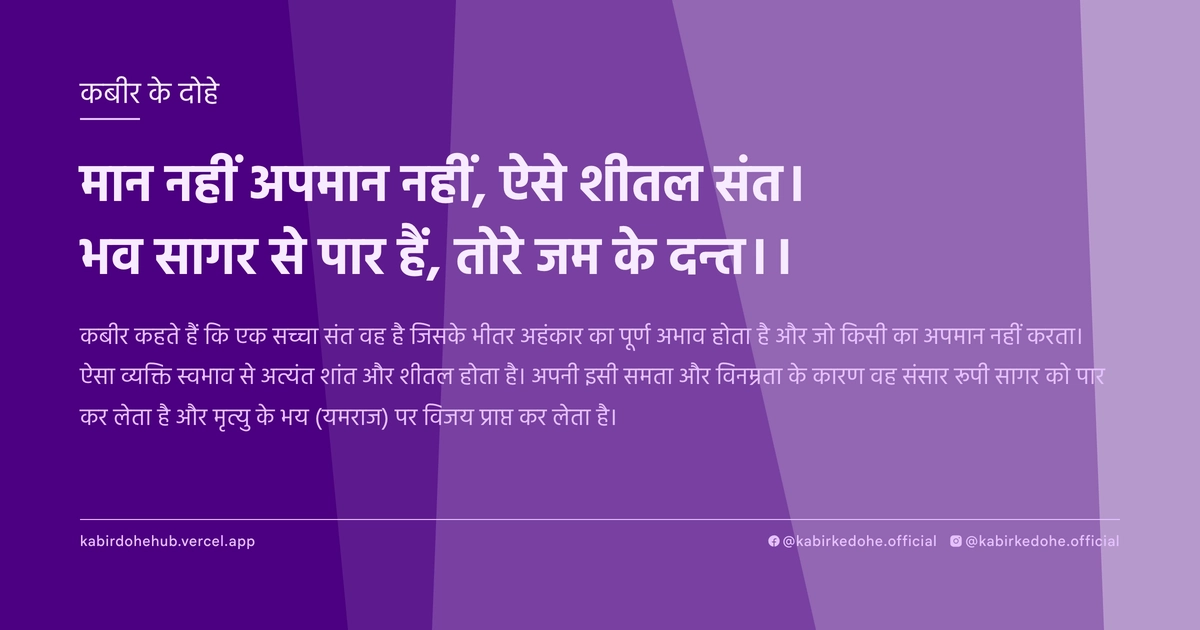
मान नहीं अपमान नहीं, ऐसे शीतल संत।
भव सागर से पार हैं, तोरे जम के दन्त।।
Maan nahi apmaan nahi, aise sheetal sant. Bhav sagar se paar hain, tore jam ke dant.
इस पृष्ठ पर इस कबीर दोहे का अर्थ (meaning), हिंदी व्याख्या और अंग्रेज़ी अनुवाद, दार्शनिक विश्लेषण और व्यावहारिक जीवन सीख दी गई है। यह दोहा सत्संग (Satsang) विषय से जुड़ा है — Kabir doha meaning and explanation in Hindi and English.
अर्थ (Meaning):
कबीर कहते हैं कि एक सच्चा संत वह है जिसके भीतर अहंकार का पूर्ण अभाव होता है और जो किसी का अपमान नहीं करता। ऐसा व्यक्ति स्वभाव से अत्यंत शांत और शीतल होता है। अपनी इसी समता और विनम्रता के कारण वह संसार रूपी सागर को पार कर लेता है और मृत्यु के भय (यमराज) पर विजय प्राप्त कर लेता है।
Kabir asserts that a true saint is one who is entirely devoid of ego and never insults others. Such a person possesses a naturally cool and serene temperament. Through this equanimity and humility, they successfully cross the ocean of worldly existence and shatter the teeth of Yama, the god of death, overcoming the ultimate fear of mortality.
व्याख्या (Interpretation):
शाब्दिक अर्थ में, यह दोहा एक ऐसे संत का वर्णन करता है जो अपमान से मुक्त है। रूपकात्मक स्तर पर, 'अपमान' केवल दूसरों को नीचा दिखाना नहीं है, बल्कि स्वयं को दूसरों से श्रेष्ठ मानना है। 'शीतल' होना उस अवस्था को दर्शाता है जहाँ क्रोध और द्वेष की अग्नि शांत हो चुकी है। यह निर्गुण भक्ति का सार है, जहाँ भक्त ईश्वर को किसी मूर्ति में नहीं, बल्कि जीव मात्र की सेवा और विनम्रता में पाता है। जब व्यक्ति 'मैं' और 'मेरा' के भ्रम (माया) को त्याग देता है, तो वह अद्वैत की स्थिति में पहुँच जाता है। यहाँ 'जम के दन्त' तोड़ना मृत्यु पर विजय नहीं, बल्कि मृत्यु के भय और पुनर्जन्म के चक्र से मुक्ति है। यह आत्मा और ब्रह्म की एकता का बोध है, जहाँ द्वैत समाप्त हो जाता है।
Literally, the couplet describes a saint free from the act of insulting. Metaphorically, 'insult' refers not just to belittling others, but to the subtle ego that perceives oneself as superior. Being 'cool' or 'sheetal' signifies a state where the fires of anger and hatred have been extinguished. This is the essence of Nirgun Bhakti, where the devotee finds the Divine not in idols, but in the service and humility toward all living beings. When one discards the illusion (Maya) of 'I' and 'mine,' they enter the state of Advaita (non-duality). Breaking the 'teeth of Yama' does not imply physical immortality, but the conquest over the fear of death and the cycle of rebirth. It is the realization of the oneness of Atman and Brahman, where all duality ceases to exist.
दार्शनिक विश्लेषण (Philosophical Analysis):
कबीर का यह दोहा उस सामाजिक और धार्मिक परिवेश में लिखा गया था जहाँ जातिगत श्रेष्ठता और धार्मिक कट्टरता चरम पर थी। कबीर ने ritualism (कर्मकांड) का विरोध किया और यह स्थापित किया कि मोक्ष किसी विशेष मंदिर, मस्जिद या जाति से नहीं, बल्कि आंतरिक शुद्धि और व्यवहार से मिलता है।
दार्शनिक रूप से, यह अद्वैत वेदांत के करीब है, जहाँ यह माना जाता है कि अहंकार ही वह पर्दा है जो हमें सत्य से अलग करता है। जब अहंकार मिटता है, तो व्यक्ति 'शीतल' हो जाता है क्योंकि घर्षण केवल अहंकार के कारण होता है।
सूफीवाद के 'फना' (अहंकार का विनाश) के सिद्धांत से भी यह मेल खाता है। जब एक सूफी अपनी हस्ती को ईश्वर में विलीन कर देता है, तो वह दुनिया के प्रति करुणा से भर जाता है।
मनोवैज्ञानिक स्तर पर, अपमान करना एक रक्षा तंत्र (defense mechanism) है जो हमारी असुरक्षा को छुपाता है। कबीर सुझाव देते हैं कि वास्तविक शक्ति विनम्रता में है, न कि प्रभुत्व में।
अंततः, यह दोहा यह स्पष्ट करता है कि आध्यात्मिक उपलब्धि का पैमाना कठिन तपस्या नहीं, बल्कि यह है कि आप दूसरों के साथ कैसा व्यवहार करते हैं। करुणा ही एकमात्र सेतु है जो भवसागर को पार कराती है।
This doha was composed in a socio-religious climate marked by rigid caste hierarchies and religious dogmatism. Kabir challenged ritualism, establishing that liberation is attained not through specific temples, mosques, or caste lineages, but through internal purification and ethical conduct.
Philosophically, this aligns with Advaita Vedanta, which posits that the ego is the only veil separating the individual from the Ultimate Truth. When the ego dissolves, the individual becomes 'cool' or serene, as conflict arises only from the friction of competing egos.
It also resonates with the Sufi concept of 'Fana' (annihilation of the self). When a Sufi merges their identity into the Divine, they are filled with universal compassion, viewing all of creation as a reflection of the Beloved.
Psychologically, the act of insulting others is a defense mechanism used to mask inner insecurity. Kabir suggests that true power resides in humility rather than dominance.
Ultimately, the doha clarifies that the metric of spiritual attainment is not rigorous asceticism, but the quality of one's interaction with others. Compassion is the only bridge capable of crossing the ocean of worldly suffering.
मूल संदेश (Core Message):
- अहंकार ही वह अग्नि है जो आत्मा को जलाती है।
- विनम्रता केवल व्यवहार नहीं, बल्कि एक आध्यात्मिक उपलब्धि है।
- अपमान का अभाव ही वास्तविक आंतरिक शक्ति का प्रमाण है।
- जब 'मैं' मिटता है, तब परमात्मा का अनुभव होता है।
- शांति वह शस्त्र है जो मृत्यु के भय को भी समाप्त कर देता है।
- Ego is the fire that consumes the essence of the soul.
- Humility is not merely a behavior, but a profound spiritual achievement.
- The absence of the urge to insult is the proof of true inner strength.
- When the 'I' dissolves, the experience of the Divine begins.
- Serenity is the weapon that conquers even the fear of death.
व्यावहारिक उदाहरण (Practical Example):
एक पुराने समय के वाराणसी के घाटों पर माधव नाम का एक वृद्ध बुनकर रहता था। वह अपनी कला में निपुण था, लेकिन उसका स्वभाव अत्यंत विनम्र था।
उसी घाट पर एक अहंकारी जमींदार रहता था जो अक्सर गरीबों का उपहास करता था और उन्हें नीचा दिखाता था।
एक दिन जमींदार ने माधव के साधारण कपड़ों का मजाक उड़ाया और उसे सबके सामने अपमानित किया।
माधव ने न तो क्रोध किया, न ही पलटकर जवाब दिया; उसने केवल एक मंद मुस्कान के साथ जमींदार को प्रणाम किया।
जमींदार को यह शांति बहुत खली; उसे लगा कि उसकी शक्ति माधव की चुप्पी के सामने हार गई है।
कुछ दिनों बाद, जमींदार एक गंभीर पारिवारिक संकट में फँस गया और समाज में उसका सम्मान गिर गया।
जब सबने उसका साथ छोड़ दिया, तब माधव ही था जिसने बिना किसी शिकायत के उसकी मदद की और उसे सहारा दिया।
जमींदार ने महसूस किया कि उसकी सत्ता और अहंकार उसे सुरक्षा नहीं दे सके, लेकिन माधव की 'शीतलता' ने उसे बचा लिया।
उसने माधव के चरणों में गिरकर क्षमा मांगी और समझा कि असली जीत दूसरों को झुकाने में नहीं, बल्कि स्वयं को मिटाने में है।
यह 'कबीर ट्विस्ट' था—जहाँ अपमान का अभाव ही सबसे शक्तिशाली हथियार बन गया और जमींदार का अहंकार टूट गया।
In the ancient lanes of Varanasi, there lived an elderly weaver named Madhav. He was a master of his craft, but his defining trait was his profound humility.
On the same ghat lived an arrogant landlord who frequently mocked the poor and took pleasure in belittling them.
One day, the landlord ridiculed Madhav's simple attire and insulted him publicly in front of a crowd.
Madhav neither reacted with anger nor offered a retort; he simply bowed with a serene smile and greeted the landlord.
The landlord felt unsettled by this peace; he realized that his perceived power had been defeated by Madhav's silence.
Months later, the landlord faced a severe family crisis and a loss of social standing, leaving him isolated and broken.
While everyone else turned away, it was Madhav who stepped forward to help him without a single word of reproach.
The landlord realized that his wealth and ego provided no sanctuary, but Madhav's 'coolness' provided a healing refuge.
He fell at Madhav's feet, realizing that true victory lies not in dominating others, but in the annihilation of the self.
This was the 'Kabir Twist'—where the absence of insult became the most powerful force, shattering the landlord's ego completely.
अभ्यास मार्गदर्शन (Practice Guidance):
- दैनिक अभ्यास: दिन में कम से कम एक बार किसी ऐसे व्यक्ति के प्रति दया दिखाएं जिसने आपके साथ बुरा व्यवहार किया हो।
- आत्म-निरीक्षण जर्नल: लिखें कि दिन भर में किन क्षणों में आपको दूसरों को छोटा दिखाने की इच्छा हुई और वह इच्छा कहाँ से आई।
- व्यवहारिक परिवर्तन: बातचीत के दौरान 'मैं' और 'मेरा' शब्दों के प्रयोग को कम करें और दूसरों के योगदान को प्राथमिकता दें।
- डायग्नोस्टिक चेकलिस्ट: क्या मैं किसी की गलती पर तुरंत प्रतिक्रिया करता हूँ? क्या मुझे दूसरों की सफलता से जलन होती है? क्या मैं अपनी विनम्रता का प्रदर्शन कर रहा हूँ या वास्तव में विनम्र हूँ?
- Daily Practice: Once a day, consciously show kindness to someone who has behaved poorly toward you.
- Self-Inquiry Journal: Record moments when you felt the urge to belittle someone and analyze the root of that insecurity.
- Behavioral Shift: Reduce the use of 'I' and 'Mine' in conversations, consciously shifting focus to the contributions of others.
- Diagnostic Checklist: Do I react instantly to others' mistakes? Do I feel envy toward others' success? Am I performing humility for an audience, or is it an internal state?
चिंतन प्रश्न (Reflection Questions):
- क्या मेरी विनम्रता वास्तव में आंतरिक है, या यह केवल एक सामाजिक मुखौटा है जिसे मैं सम्मान पाने के लिए पहनता हूँ?
- जब कोई मेरा अपमान करता है, तो मुझे क्रोध क्यों आता है? वह कौन सा 'अहंकार' है जिसे चोट पहुँची है?
- क्या मैं उन लोगों को भी सम्मान दे सकता हूँ जिन्हें समाज 'तुच्छ' मानता है, बिना किसी दयाभाव के, केवल समानता के भाव से?
- मेरे जीवन का वह कौन सा क्षेत्र है जहाँ मैं अभी भी अपनी श्रेष्ठता सिद्ध करने की कोशिश कर रहा हूँ?
- यदि मेरी सारी उपलब्धियाँ और पद छीन लिए जाएं, तो क्या मेरी शांति बनी रहेगी?
- Is my humility truly internal, or is it a social mask I wear to gain respect from others?
- When I am insulted, why do I feel anger? Which specific part of my 'ego' is being wounded?
- Can I respect those whom society deems 'insignificant'—not out of pity, but out of a genuine sense of equality?
- In which area of my life am I still desperately trying to prove my superiority?
- If all my achievements and titles were stripped away, would my inner peace remain intact?