
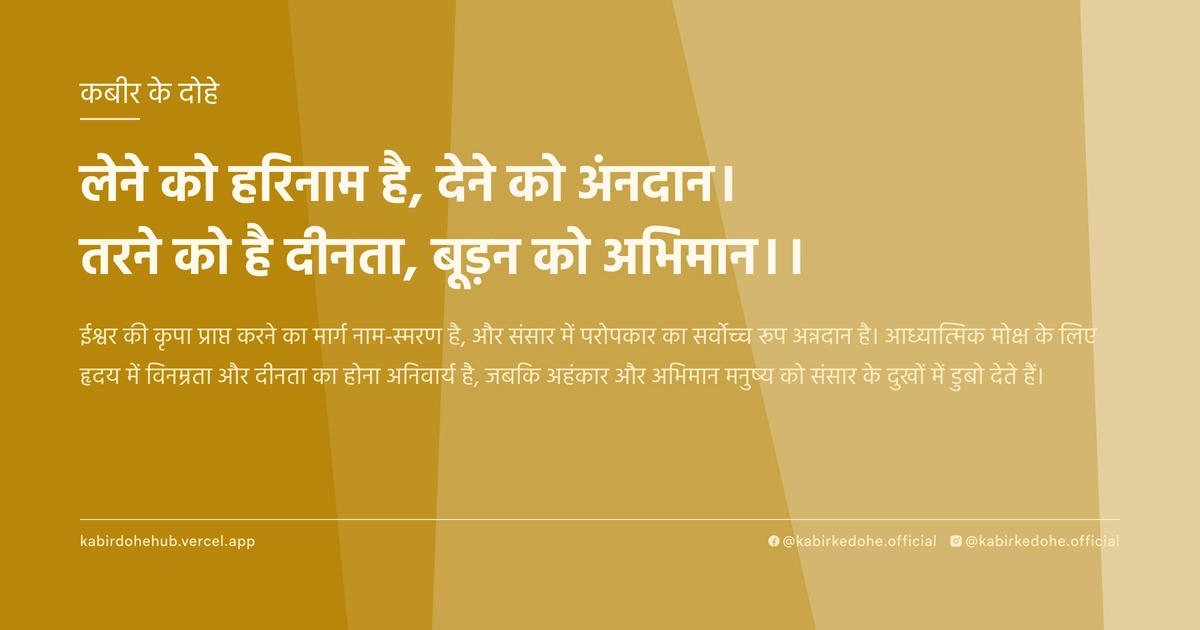
लेने को हरिनाम है, देने को अंनदान।
तरने को है दीनता, बूड़न को अभिमान।।
Lene ko harinaam hai, dene ko ann-daan. Tarne ko hai deenta, boodan ko abhimaan.
इस पृष्ठ पर इस कबीर दोहे का अर्थ (meaning), हिंदी व्याख्या और अंग्रेज़ी अनुवाद, दार्शनिक विश्लेषण और व्यावहारिक जीवन सीख दी गई है। यह दोहा विनम्रता (Humility) विषय से जुड़ा है — Kabir doha meaning and explanation in Hindi and English.
अर्थ (Meaning):
ईश्वर की कृपा प्राप्त करने का मार्ग नाम-स्मरण है, और संसार में परोपकार का सर्वोच्च रूप अन्नदान है। आध्यात्मिक मोक्ष के लिए हृदय में विनम्रता और दीनता का होना अनिवार्य है, जबकि अहंकार और अभिमान मनुष्य को संसार के दुखों में डुबो देते हैं।
To receive divine grace, one must practice the remembrance of the Divine Name, and to give back to the world, the highest act is the sharing of food. Humility and a sense of surrender are the only vessels that can carry a soul across the ocean of existence, whereas pride and ego are the weights that inevitably sink the seeker.
व्याख्या (Interpretation):
यह दोहा आध्यात्मिक आदान-प्रदान के संतुलन को दर्शाता है। 'हरिनाम' केवल शब्दों का जाप नहीं, बल्कि उस निराकार ब्रह्म के साथ एकाकार होने की प्रक्रिया है। 'अन्नदान' भौतिक दान नहीं, बल्कि अहंकार का विसर्जन है क्योंकि भोजन जीवन का आधार है। यहाँ 'दीनता' का अर्थ कमजोरी नहीं, बल्कि 'अद्वैत' की वह स्थिति है जहाँ व्यक्ति यह जान लेता है कि वह स्वयं कुछ नहीं है, बल्कि सब कुछ उस परमात्मा का ही विस्तार है। इसके विपरीत, 'अभिमान' वह मायावी पर्दा है जो आत्मा को परमात्मा से अलग करता है। जब तक 'मैं' जीवित है, तब तक 'वह' अदृश्य रहता है। यह विरोधाभास है कि जो स्वयं को शून्य कर लेता है, वही पूर्णता को प्राप्त करता है।
This couplet illustrates the sacred equilibrium of spiritual exchange. 'Harinam' is not merely the repetition of a name, but the process of merging with the Formless Brahman. 'Annadan' transcends material charity; it is the dissolution of the ego, as food is the most fundamental sustenance of life. Here, 'deenta' (humility) does not signify weakness, but the state of Non-duality (Advaita) where the individual realizes they are not a separate entity, but an extension of the Universal Consciousness. Conversely, 'abhiman' (pride) is the veil of Maya that separates the Atman from Brahman. The central paradox is that only by becoming 'nothing' can one become 'everything.' The ego is the anchor that sinks the soul, while surrender is the sail that leads to liberation.
दार्शनिक विश्लेषण (Philosophical Analysis):
कबीर का यह दर्शन निर्गुण भक्ति की पराकाष्ठा है, जहाँ वे किसी बाहरी कर्मकांड के बजाय आंतरिक शुद्धि पर बल देते हैं। उनके समय में धर्म केवल बाहरी दिखावे और जातिगत श्रेष्ठता तक सीमित था। कबीर ने 'अन्नदान' के माध्यम से सामाजिक समरसता और करुणा का संदेश दिया, जो सूफीवाद के 'खिदमत' (सेवा) के सिद्धांत से मेल खाता है।
अद्वैत वेदांत के परिप्रेक्ष्य में, अभिमान वह 'अविद्या' है जो हमें यह विश्वास दिलाती है कि हम शरीर या मन हैं। जब यह भ्रम टूटता है, तब केवल शुद्ध चेतना शेष रहती है। कबीर तर्क देते हैं कि मोक्ष किसी कठिन तपस्या से नहीं, बल्कि अहंकार के विसर्जन से मिलता है।
यहाँ 'हरिनाम' का अर्थ है उस सार्वभौमिक सत्य का स्मरण करना जो हर जीव में व्याप्त है। यह किसी विशिष्ट देवता की पूजा नहीं, बल्कि उस एक तत्व की खोज है। यह दृष्टिकोण ब्राह्मणवादी कर्मकांडों और कट्टरपंथी धार्मिकता दोनों को चुनौती देता है।
मनोवैज्ञानिक स्तर पर, अभिमान एक रक्षा तंत्र है जो व्यक्ति को अपनी आंतरिक रिक्तता से बचाता है। जब व्यक्ति 'दीनता' या पूर्ण समर्पण को अपनाता है, तो वह इस रक्षा तंत्र को तोड़कर वास्तविक शांति का अनुभव करता है।
अंततः, कबीर यह स्पष्ट करते हैं कि आध्यात्मिक यात्रा 'पाने' की नहीं, बल्कि 'खोने' की यात्रा है—अपनी पहचान, अपने अहंकार और अपने भ्रम को खोने की यात्रा, ताकि वह सत्य प्रकट हो सके जो सदैव उपस्थित था।
Kabir’s philosophy here represents the pinnacle of Nirgun Bhakti, emphasizing internal purification over external ritualism. In his era, religion had devolved into superficial displays and caste-based superiority. Through 'Annadan,' Kabir advocates for social harmony and compassion, echoing the Sufi principle of 'Khidmat' (selfless service).
From the perspective of Advaita Vedanta, pride is the 'Avidya' (ignorance) that convinces us we are the body or the mind. When this illusion shatters, only pure consciousness remains. Kabir argues that liberation is not achieved through rigorous asceticism, but through the annihilation of the ego.
'Harinam' in this context is the remembrance of the Universal Truth permeating every living being. It is not the worship of a specific deity, but the search for the One Element. This stance challenges both Brahmanical ritualism and dogmatic religious orthodoxy.
Psychologically, pride is a defense mechanism that protects the individual from their own internal void. When a seeker embraces 'deenta' or total surrender, they dismantle this defense and experience authentic peace.
Ultimately, Kabir clarifies that the spiritual journey is not one of 'acquisition' but of 'loss'—the loss of identity, ego, and illusion, allowing the Truth that was always present to finally reveal itself.
मूल संदेश (Core Message):
- अहंकार वह पत्थर है जो आत्मा को डुबो देता है।
- विनम्रता वह नाव है जो मोक्ष तक ले जाती है।
- नाम-स्मरण अंतर्मन की शुद्धि का सरलतम मार्ग है।
- परोपकार तभी सार्थक है जब उसमें 'मैं' का अभाव हो।
- शून्यता में ही पूर्णता का वास होता है।
- Pride is the stone that sinks the soul.
- Humility is the vessel that carries one to liberation.
- Remembrance of the Divine is the simplest path to inner purity.
- Altruism is meaningful only when the 'I' is absent.
- In absolute emptiness, the fullness of Truth resides.
व्यावहारिक उदाहरण (Practical Example):
वाराणसी के घाटों पर रहने वाली एक वृद्ध विधवा, जानकी, का जीवन अत्यंत कठिन था। वह दूसरों के घरों में छोटे-मोटे काम करती और जो कुछ मिलता, उससे अपना गुजारा करती। जानकी के मन में ईश्वर के प्रति अटूट श्रद्धा थी, लेकिन वह किसी मंदिर के पुजारी के सामने झुकने के बजाय चुपचाप अपना काम करती रही।
उसी शहर में एक धनी व्यापारी था, जो प्रतिदिन सोने के सिक्के दान करता और बड़े गर्व से अपनी दानवीरता की चर्चा करता। वह मानता था कि उसकी संपत्ति उसे मोक्ष दिलाएगी। वह जानकी को तुच्छ समझता था क्योंकि वह फटे कपड़ों में रहती थी।
एक बार शहर में भीषण अकाल पड़ा। व्यापारी का अहंकार और उसकी संपत्ति उसे लोगों की भूख से नहीं बचा सकी; लोग उसकी प्रशंसा तो करते थे, लेकिन उसकी आत्मा भीतर से सूखी थी। वह जितना अधिक दान करता, उसका 'दाता' होने का अहंकार उतना ही बढ़ता जाता।
दूसरी ओर, जानकी के पास बहुत कम था, लेकिन वह अपनी आधी रोटी भी किसी भूखे राहगीर को दे देती। वह यह नहीं सोचती थी कि वह दान कर रही है, बल्कि उसे लगता था कि वह केवल उस भूखे व्यक्ति के माध्यम से ईश्वर की सेवा कर रही है।
एक दिन व्यापारी ने जानकी को देखा कि वह अपनी अंतिम रोटी एक बीमार कुत्ते को खिला रही थी और उसकी आँखों में एक असीम शांति थी। व्यापारी ने पूछा, 'तुम्हारे पास कुछ नहीं है, फिर भी तुम इतनी प्रसन्न कैसे हो?'
जानकी ने सरलता से उत्तर दिया, 'साहब, मैंने अपनी 'मैं' को भूख के साथ बाँट दिया है। जब तक मैं खुद को बड़ा समझती रही, मैं बोझिल थी। जब मैंने खुद को छोटा और ईश्वर का सेवक माना, तो मेरा बोझ उतर गया।'
यह शब्द व्यापारी के हृदय पर प्रहार की तरह लगे। उसे अहसास हुआ कि उसका 'अभिमान' उसे डुबो रहा था, जबकि जानकी की 'दीनता' उसे पार ले जा रही थी।
व्यापारी ने उसी क्षण अपने अहंकार का त्याग किया। उसने केवल धन देना बंद नहीं किया, बल्कि धन देने के पीछे की 'अहंकार की भावना' को त्याग दिया। उसने जानकी के चरणों में सिर झुकाया और सीखा कि वास्तविक दान वह है जहाँ देने वाला खुद को मिटा दे।
धीरे-धीरे व्यापारी का जीवन बदल गया। वह अब प्रशंसा के लिए नहीं, बल्कि प्रेम के लिए कार्य करने लगा। उसने जाना कि अन्नदान तभी सार्थक है जब वह विनम्रता के साथ किया जाए।
अंततः, वह व्यापारी जो कभी खुद को सबसे ऊपर समझता था, अब सबसे छोटा बनकर जीवन की सच्ची तृप्ति का अनुभव करने लगा।
Janki, an elderly widow living on the ghats of Varanasi, led a life of extreme hardship. She performed odd jobs in various households, barely earning enough to survive. Janki possessed an unwavering faith in the Divine, yet she never sought validation from priests, preferring a quiet, invisible devotion.
In the same city lived a wealthy merchant who donated gold coins daily, loudly proclaiming his generosity. He believed his wealth was his ticket to salvation and looked down upon Janki for her tattered clothes and poverty.
Once, a severe famine struck the city. The merchant's pride and wealth could not shield him from the collective misery; people praised his charity, but his soul remained arid. The more he gave, the more his identity as a 'Great Giver' inflated.
Meanwhile, Janki had almost nothing, yet she would share half of her meager roti with any hungry passerby. She didn't view it as an act of charity, but as serving the Divine residing within the hungry person.
One day, the merchant saw Janki feeding her last piece of bread to a sick dog, her eyes reflecting a profound, immeasurable peace. He asked her, 'You have nothing, yet how are you so content?'
Janki replied simply, 'Sir, I have shared my "I" with the hunger. As long as I considered myself great, I was burdened. When I accepted myself as small and a servant of the Divine, my burden vanished.'
These words struck the merchant like a thunderbolt. He realized that his 'abhiman' (pride) was the very weight sinking him, while Janki's 'deenta' (humility) was the vessel carrying her across.
The merchant immediately renounced his ego. He didn't stop giving, but he stopped the 'feeling of superiority' that accompanied the giving. He bowed before Janki, learning that true charity occurs only when the giver erases themselves from the act.
Slowly, the merchant's life transformed. He ceased working for applause and began working for love. He understood that Annadan is only meaningful when coupled with absolute humility.
Ultimately, the man who once considered himself the highest began to experience the true saturation of life by becoming the lowest.
अभ्यास मार्गदर्शन (Practice Guidance):
- प्रतिदिन 15 मिनट मौन रहकर इस विचार का चिंतन करें कि 'मैं' केवल एक माध्यम हूँ, कर्ता नहीं।
- सप्ताह में एक बार किसी ऐसे व्यक्ति की निस्वार्थ सेवा करें जिससे आपको कोई सामाजिक लाभ न मिले, और इस क्रिया को गुप्त रखें।
- जब भी मन में श्रेष्ठता का भाव आए, तुरंत किसी ऐसे व्यक्ति का स्मरण करें जिसने आपको जीवन में कुछ सिखाया हो, ताकि अहंकार शांत हो सके।
- डायरी में लिखें: 'आज मैंने किस क्षण में अपने अहंकार को महसूस किया और उसे कैसे विसर्जित किया?'
- निदान चेकलिस्ट: क्या मैं दान देने के बाद प्रशंसा की अपेक्षा करता हूँ? क्या मैं दूसरों की गलतियों पर तुरंत निर्णय लेता हूँ? यदि हाँ, तो अभिमान अभी जीवित है।
- Spend 15 minutes in silence daily contemplating the thought: 'I am merely a medium, not the doer.'
- Once a week, perform a selfless act of service for someone from whom you gain no social or material advantage, and keep the act strictly secret.
- Whenever a feeling of superiority arises, immediately recall someone who taught you a vital lesson in life to neutralize the ego.
- Journaling prompt: 'At what moment today did I feel my ego surfacing, and how did I consciously dissolve it?'
- Diagnostic Checklist: Do I expect praise after giving? Do I judge others' mistakes instantly? If yes, the 'abhiman' is still active.
चिंतन प्रश्न (Reflection Questions):
- मेरे जीवन में 'दान' वास्तव में करुणा है या मेरी श्रेष्ठता सिद्ध करने का एक साधन?
- क्या मैं अपनी धार्मिक या आध्यात्मिक पहचान को दूसरों से ऊपर मानता हूँ?
- वह कौन सा डर है जो मुझे पूरी तरह से विनम्र होने से रोकता है?
- यदि मेरी सारी उपलब्धियाँ और पद छीन लिए जाएँ, तो क्या मेरी पहचान अभी भी शेष रहेगी?
- मैं अपनी डिजिटल पहचान (सोशल मीडिया) के माध्यम से किस प्रकार के सूक्ष्म अहंकार को पोषित कर रहा हूँ?
- Is my 'charity' truly an act of compassion, or a tool to validate my own superiority?
- Do I perceive my religious or spiritual identity as being 'higher' than others?
- What is the underlying fear that prevents me from being completely humble?
- If all my achievements and titles were stripped away, would any identity of mine remain?
- In what ways am I nurturing a subtle ego through my digital persona and social media presence?