
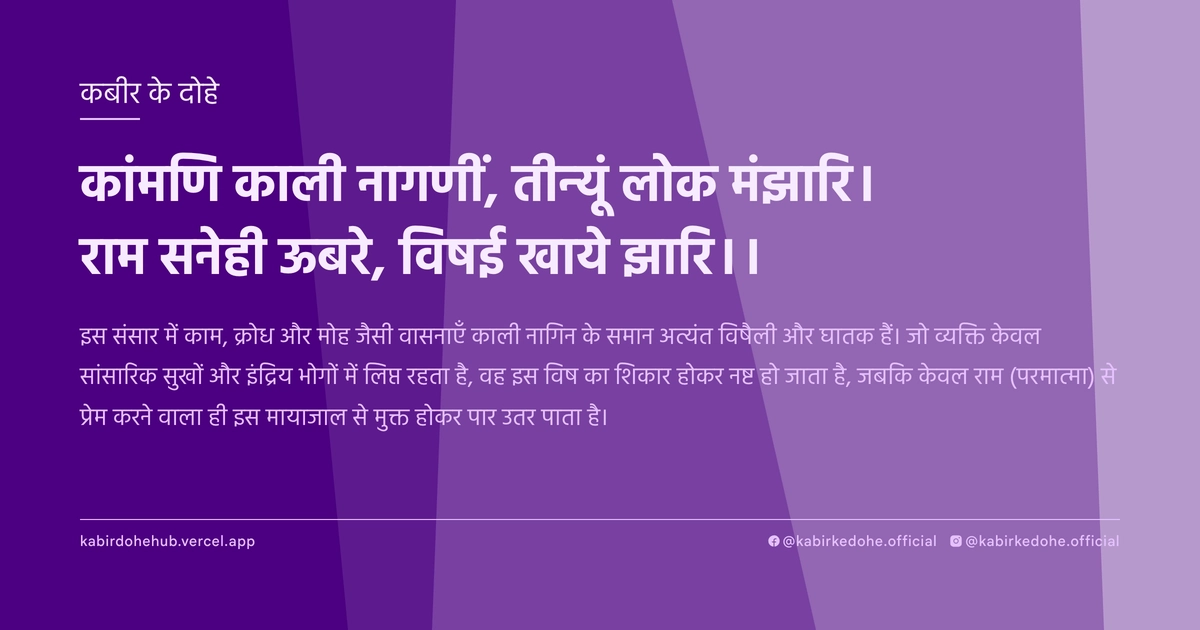
कांमणि काली नागणीं, तीन्यूं लोक मंझारि।
राम सनेही ऊबरे, विषई खाये झारि।।
Kanmani kali nagnin, tinyun lok manjhari. Ram sanehi oobare, vishai khaye jhari.
इस पृष्ठ पर इस कबीर दोहे का अर्थ (meaning), हिंदी व्याख्या और अंग्रेज़ी अनुवाद, दार्शनिक विश्लेषण और व्यावहारिक जीवन सीख दी गई है। यह दोहा माया (Maya) विषय से जुड़ा है — Kabir doha meaning and explanation in Hindi and English.
अर्थ (Meaning):
इस संसार में काम, क्रोध और मोह जैसी वासनाएँ काली नागिन के समान अत्यंत विषैली और घातक हैं। जो व्यक्ति केवल सांसारिक सुखों और इंद्रिय भोगों में लिप्त रहता है, वह इस विष का शिकार होकर नष्ट हो जाता है, जबकि केवल राम (परमात्मा) से प्रेम करने वाला ही इस मायाजाल से मुक्त होकर पार उतर पाता है।
The world is permeated by desires, anger, and attachments that act like venomous black cobras, striking unseen. Those who surrender to the intoxications of sensory pleasures are consumed by this spiritual poison, whereas only the one who anchors their soul in the love of the Divine (Ram) can transcend this perilous existence and attain liberation.
व्याख्या (Interpretation):
कबीर यहाँ 'काली नागणी' के रूप में काम, क्रोध और लोभ का रूपक प्रस्तुत करते हैं। जिस प्रकार नागिन का विष शरीर को धीरे-धीरे समाप्त करता है, उसी प्रकार सांसारिक आसक्तियाँ आत्मा की चेतना को कुंद कर देती हैं। यह दोहा निरगुण भक्ति की ओर संकेत करता है, जहाँ 'राम' किसी व्यक्ति विशेष नहीं बल्कि वह सर्वव्यापी चेतना है जो माया के पर्दे के पीछे छिपी है। जब साधक अपनी पहचान अहंकार (माया) से हटाकर उस निराकार ब्रह्म से जोड़ता है, तब वह द्वैत से अद्वैत की ओर बढ़ता है। यहाँ विष का अर्थ है वह अज्ञान जो हमें यह विश्वास दिलाता है कि हम शरीर हैं, जबकि हम वास्तव में शुद्ध आत्मा हैं। इस विरोधाभास को समझना ही मोक्ष का मार्ग है।
Kabir employs the metaphor of the 'black cobra' to represent the lethal nature of lust, anger, and greed. Just as venom paralyzes the physical body, worldly attachments paralyze the spiritual consciousness, trapping the soul in the cycle of Samsara. The mention of 'Ram' here refers not to a mythological deity, but to the Nirgun (formless) Absolute—the primordial vibration of existence. This reflects the Advaita Vedanta principle where the illusion of separation (Maya) is the poison, and the realization of non-duality (Atman-Brahman) is the antidote. The paradox lies in the fact that the very world we strive to possess is the source of our bondage. Liberation occurs only when the seeker shifts their longing from the transient object to the eternal Subject.
दार्शनिक विश्लेषण (Philosophical Analysis):
कबीर का यह दोहा उनके युग के सामाजिक और धार्मिक पाखंडों पर एक गहरा प्रहार है। उस समय धर्म केवल कर्मकांडों और बाहरी दिखावे तक सीमित था, जबकि कबीर ने आंतरिक शुद्धता पर बल दिया। उन्होंने बताया कि मंदिर या मस्जिद जाने से अधिक महत्वपूर्ण है अपने भीतर के 'विष' यानी अहंकार को समाप्त करना। यह विचार सूफी मत के 'फना' (अहंकार का विनाश) और वेदांत के 'अहं ब्रह्मास्मि' के करीब है।
यहाँ 'विषई' शब्द उन लोगों के लिए है जो इंद्रिय सुखों को ही अंतिम सत्य मानते हैं। कबीर तर्क देते हैं कि भौतिक सुख क्षणभंगुर हैं और अंततः दुख का कारण बनते हैं। यह मनोवैज्ञानिक परिवर्तन की मांग करता है जहाँ व्यक्ति बाहरी दुनिया से अपनी खुशी खोजना बंद कर आंतरिक शांति की ओर मुड़े।
कबीर की दृष्टि में जाति और धर्म के भेद कृत्रिम हैं क्योंकि विष सबको समान रूप से प्रभावित करता है और राम का प्रेम सबके लिए खुला है। वे ritualism (कर्मकांड) को एक ऐसी चादर बताते हैं जो सत्य को ढक देती है।
दार्शनिक स्तर पर, यह दोहा 'त्रिगुण' (सत्व, रजस, तमस) के प्रभाव को दर्शाता है। काम और क्रोध रजस और तमस का मिश्रण हैं, जबकि राम-प्रेम सत्व की पराकाष्ठा है।
अंततः, कबीर यह संदेश देते हैं कि मुक्ति किसी बाहरी सहायता से नहीं, बल्कि अपनी चेतना के रूपांतरण से संभव है। जब प्रेम की अग्नि जलती है, तो वासनाओं का विष स्वतः ही जलकर राख हो जाता है।
Kabir’s verse is a surgical strike against the ritualistic stagnation of his era. During a time when spirituality was reduced to the performance of rites and the adherence to caste hierarchies, Kabir pivoted the discourse toward internal alchemy. He asserts that the true battlefield is not external but within the psyche, where the 'poison' of the ego resides. This aligns closely with the Sufi concept of 'Fana'—the annihilation of the lower self to merge with the Divine.
From the perspective of Advaita Vedanta, the 'black cobras' are the projections of Maya. Maya creates a false sense of identity, leading the individual to seek fulfillment in the transient (the sensory world). This pursuit is the 'poison' because it reinforces the illusion of separation. Kabir suggests that the only antidote is the realization of the formless Brahman, referred to here as 'Ram'.
Psychologically, the poem addresses the cycle of craving and aversion. The 'vishai' (sensualists) are trapped in a loop of desire, where every satisfaction leads to a greater hunger, effectively poisoning their peace of mind. Kabir advocates for a radical shift in consciousness—from the 'I' (ego) to the 'Thou' (Universal Soul).
Historically, Kabir’s rejection of organized religion was a call for a democratic spirituality. By claiming that love for the Divine is the only rescue, he dismantled the monopoly of the priestly class over salvation. He posits that a simple weaver or a laborer can achieve higher liberation than a scholar if they possess genuine love.
In conclusion, the philosophical core of this Doha is the transcendence of duality. The poison is the belief in 'mine' and 'thine'; the cure is the experience of oneness. The transformation is not additive but subtractive—removing the layers of desire to reveal the inherent purity of the soul.
मूल संदेश (Core Message):
- सांसारिक इच्छाएं आत्मा के लिए धीमा जहर हैं।
- बाहरी पूजा तब तक व्यर्थ है जब तक आंतरिक विष न मिटे।
- मोह और प्रेम के बीच का अंतर ही मुक्ति का द्वार है।
- अहंकार का विसर्जन ही वास्तविक 'राम' का मिलन है।
- शांति वस्तुओं में नहीं, बल्कि वस्तुओं के प्रति अनासक्ति में है।
- Worldly cravings are a slow-acting poison to the soul.
- External rituals are hollow without internal purification.
- The bridge to liberation is the shift from attachment to love.
- The annihilation of the ego is the only true union with the Divine.
- Peace resides not in possession, but in the art of letting go.
व्यावहारिक उदाहरण (Practical Example):
वाराणसी के घाटों पर रहने वाले एक वृद्ध विधवा, जानकी, का जीवन केवल पूजा-पाठ और दूसरों की सेवा में बीता था। लेकिन उनके मन में एक गहरा क्षोभ था—अपने बेटे के प्रति, जिसने उन्हें वर्षों पहले छोड़ दिया था। यह क्रोध एक काली नागिन की तरह उनके हृदय में लिपटा हुआ था, जो उनकी हर प्रार्थना को कड़वाहट से भर देता था।
वे घंटों शिव की आरती करतीं, लेकिन जैसे ही आरती समाप्त होती, उनका मन फिर उसी पुराने दुख और गुस्से में डूब जाता। उन्हें लगता था कि वे बहुत धार्मिक हैं, पर उनकी शांति केवल बाहरी थी।
एक दिन उनकी मुलाकात एक घुमंतू साधु से हुई, जिन्होंने उनकी आँखों में छिपे उस विष को पहचान लिया। साधु ने उनसे कहा, "माई, तुम मंदिर की सफाई तो कर रही हो, पर मन के भीतर के उस नाग को नहीं निकाल पा रही हो जो तुम्हारी शांति को डस रहा है।"
जानकी ने पहले तो इसे अपनी आस्था का अपमान समझा, लेकिन फिर उन्होंने महसूस किया कि उनका 'राम' केवल पत्थर की मूर्ति में है, उनके जीवन के कड़वे सच में नहीं।
उन्होंने विचार किया कि क्या वास्तव में उनका बेटा गलत था, या उनकी अपनी उम्मीदें कि बेटा उनके अनुसार चले, वह विष था? उन्होंने महसूस किया कि उनका मोह ही उनके क्रोध का कारण था।
अगले कुछ हफ्तों तक, उन्होंने हर बार जब क्रोध आया, तो उसे 'काली नागणी' के रूप में देखा। उन्होंने उस भावना से लड़ने के बजाय, उसे राम के प्रेम में विसर्जित करना शुरू किया।
उन्होंने यह स्वीकार किया कि उनका बेटा एक स्वतंत्र आत्मा है और उनका उससे जुड़ाव केवल एक सांसारिक बंधन था। जैसे ही उन्होंने 'पकड़ने' की इच्छा छोड़ी, वह विष धीरे-धीरे उतरने लगा।
एक सुबह, जब वे गंगा स्नान कर रही थीं, उन्हें पहली बार महसूस हुआ कि उनके भीतर का बोझ हल्का हो गया है। उन्होंने अपने बेटे को माफ नहीं किया, बल्कि उस 'मोह' को माफ कर दिया जिसने उन्हें कैद किया था।
अब उनकी प्रार्थनाओं में केवल शब्द नहीं थे, बल्कि एक वास्तविक शांति थी। उन्होंने जान लिया कि बाहरी अनुष्ठान केवल शरीर को शांत करते हैं, लेकिन आत्मा का विष केवल प्रेम और समर्पण से ही मिटता है।
जानकी अब केवल एक विधवा नहीं थीं, बल्कि एक मुक्त आत्मा बन चुकी थीं, जिन्होंने अपने भीतर की नागिन को राम-प्रेम की अग्नि में भस्म कर दिया था।
In the narrow lanes of Varanasi lived Janaki, an elderly widow who spent her days in rigorous prayer and service. To the world, she was a paragon of piety, but within her heart lurked a deep, festering resentment toward her son, who had abandoned her decades ago. This anger was like a black cobra, coiled tightly around her soul, poisoning every mantra she chanted.
She would spend hours in the temple, yet the moment she stepped out, the venom of bitterness would resurface, clouding her vision and hardening her heart. She believed her rituals were her salvation, unaware that her internal state remained toxic.
One afternoon, she encountered a wandering ascetic who looked into her eyes and saw the hidden turmoil. He told her, "Mother, you are scrubbing the temple floors, but you have left the venomous snake in your heart untouched. No amount of incense can mask the smell of a rotting ego."
Initially, Janaki felt insulted, believing her devotion was beyond question. However, the words haunted her. She began to realize that her 'Ram' existed only in the stone idols, not in the living reality of her pain.
She started questioning the nature of her grief. Was it truly the son's absence that hurt, or was it her own attachment—the desire for him to be exactly who she wanted him to be? She realized that this attachment was the very poison Kabir spoke of.
For the next few months, whenever the surge of anger rose, she visualized it as the 'black cobra'. Instead of suppressing it or feeding it with memories, she offered that emotion to the formless Divine, asking for the strength to let go.
She stopped trying to 'fix' the past and instead focused on the present moment of awareness. She understood that her love for her son had become a chain of possession rather than a flow of grace.
One morning, while bathing in the Ganges, a profound silence descended upon her. She felt the grip of the cobra loosen. She didn't necessarily 'forgive' her son in a conventional sense; rather, she forgave the illusion that she was entitled to his obedience.
Her prayers ceased to be a transaction for peace and became a celebration of it. The external rituals remained, but they were now empty shells filled with the living breath of liberation.
Janaki transformed from a woman burdened by a legacy of pain into a beacon of stillness, proving that the only way to kill the serpent of desire is to dissolve the 'I' in the ocean of Divine Love.
अभ्यास मार्गदर्शन (Practice Guidance):
- दैनिक अवलोकन: दिन भर में जब भी क्रोध, ईर्ष्या या अत्यधिक मोह महसूस हो, तो उसे 'काली नागणी' के रूप में पहचानें और तुरंत एक गहरी सांस लेकर उसे साक्षी भाव से देखें।
- आत्म-पूछताछ जर्नल: प्रतिदिन लिखें—"आज मैंने किस चीज को पकड़ने की कोशिश की? क्या वह पकड़ने की इच्छा मुझे शांति दे रही है या तनाव?"
- मौन साधना: प्रतिदिन 20 मिनट पूर्ण मौन में बैठें और अपने भीतर के शोर को सुनें। यह पहचानें कि कौन सी इच्छाएं आपको विचलित कर रही हैं और उन्हें निराकार राम को समर्पित करें।
- डायग्नोस्टिक चेकलिस्ट: यदि आप छोटी बातों पर उत्तेजित हो रहे हैं, दूसरों के सुख से जल रहे हैं, या केवल बाहरी प्रशंसा के लिए कार्य कर रहे हैं, तो समझ लें कि 'विष' सक्रिय है। यदि आप विपरीत परिस्थितियों में भी तटस्थ रह पा रहे हैं, तो आप 'ऊबरे' (मुक्त) हो रहे हैं।
- Daily Observation: Whenever anger, jealousy, or intense attachment arises, label it as the 'Black Cobra'. Observe the sensation without judgment to detach the ego from the emotion.
- Self-Inquiry Journaling: Each night, ask yourself: "What did I try to possess or control today? Did this desire bring me peace or a sense of lack?"
- Silence Practice: Spend 20 minutes in absolute silence. Listen to the internal noise and consciously offer your cravings to the formless Absolute, shifting focus from the 'want' to the 'being'.
- Diagnostic Checklist: You are under the influence of 'poison' if you experience reactive anger, a need for external validation, or chronic dissatisfaction. You are 'transcending' if you maintain equanimity amidst chaos and feel a detached love for all.
चिंतन प्रश्न (Reflection Questions):
- मेरे जीवन में वह कौन सी 'काली नागणी' (इच्छा/क्रोध) है जिसे मैं प्यार से पाल रहा हूँ?
- क्या मेरी धार्मिकता केवल एक मुखौटा है ताकि मैं अपने आंतरिक अंधेरे को छिपा सकूँ?
- यदि आज मेरी सारी सामाजिक पहचान (पद, प्रतिष्ठा) छीन ली जाए, तो मेरे भीतर क्या बचेगा?
- मैं जिसे 'प्रेम' कहता हूँ, क्या वह वास्तव में दूसरे के प्रति समर्पण है या केवल अपनी इच्छाओं की पूर्ति?
- मेरे डिजिटल जीवन (सोशल मीडिया) का अहंकार मेरे वास्तविक आध्यात्मिक विकास को कैसे बाधित कर रहा है?
- Which 'black cobra' of desire or resentment am I currently nurturing in the shadows of my heart?
- Is my outward spirituality merely a mask to hide an unexamined internal darkness?
- If all my social labels and achievements were stripped away today, what essence of 'I' would remain?
- Is the love I claim to feel for others actually a form of subtle possession and control?
- How does my digital ego and the pursuit of online validation feed the poison of separation in my life?