
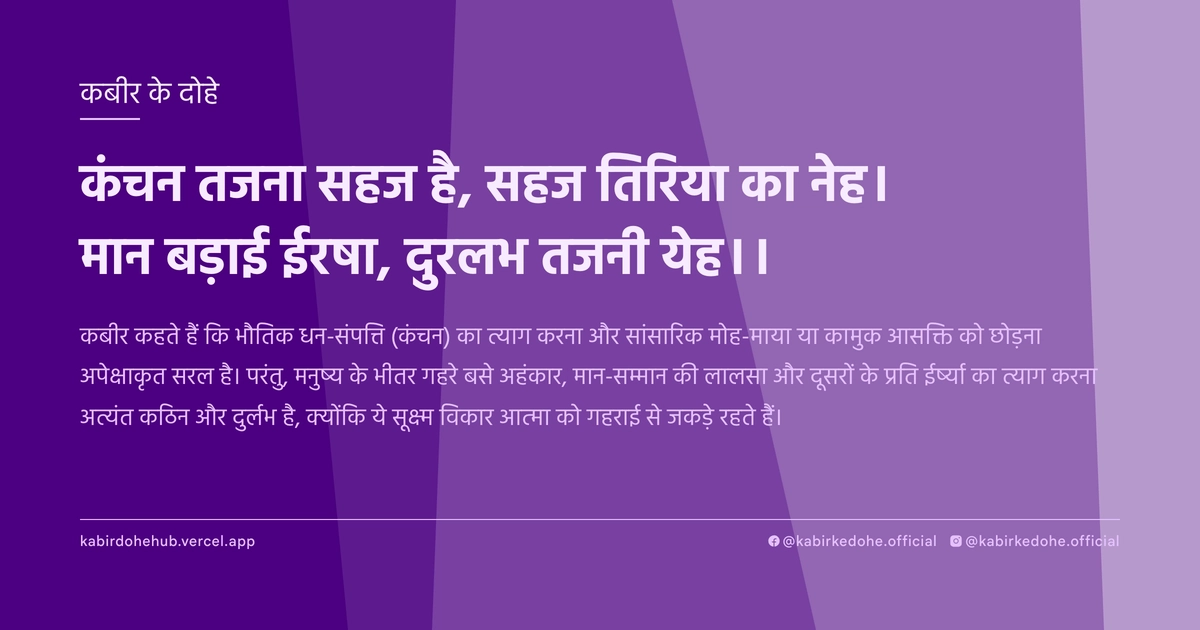
कंचन तजना सहज है, सहज तिरिया का नेह।
मान बड़ाई ईरषा, दुरलभ तजनी येह।।
Kanchan tajna sahaj hai, sahaj tiriya ka neh. Maan badai irsha, durlabh tajni yeh.
इस पृष्ठ पर इस कबीर दोहे का अर्थ (meaning), हिंदी व्याख्या और अंग्रेज़ी अनुवाद, दार्शनिक विश्लेषण और व्यावहारिक जीवन सीख दी गई है। यह दोहा अहंकार (The Ego) विषय से जुड़ा है — Kabir doha meaning and explanation in Hindi and English.
अर्थ (Meaning):
कबीर कहते हैं कि भौतिक धन-संपत्ति (कंचन) का त्याग करना और सांसारिक मोह-माया या कामुक आसक्ति को छोड़ना अपेक्षाकृत सरल है। परंतु, मनुष्य के भीतर गहरे बसे अहंकार, मान-सम्मान की लालसा और दूसरों के प्रति ईर्ष्या का त्याग करना अत्यंत कठिन और दुर्लभ है, क्योंकि ये सूक्ष्म विकार आत्मा को गहराई से जकड़े रहते हैं।
Kabir asserts that renouncing material wealth (gold) and letting go of worldly attachments or romantic longing is relatively simple. However, the act of relinquishing the ego, the craving for social status and prestige, and the poison of jealousy is profoundly difficult and rare, as these subtle internal vices are deeply ingrained in the human psyche.
व्याख्या (Interpretation):
इस दोहे में कबीर भौतिक और मानसिक आसक्तियों के बीच एक स्पष्ट अंतर करते हैं। 'कंचन' और 'नेह' बाहरी और भावनात्मक आकर्षण हैं, जिन्हें संकल्प शक्ति से छोड़ा जा सकता है। लेकिन 'मान', 'बड़ाई' और 'ईरषा' अहंकार के सूक्ष्म रूप हैं जो व्यक्ति की पहचान (Identity) से जुड़े होते हैं। यह निर्गुण भक्ति का मार्ग है जहाँ साधक को केवल बाहरी दुनिया से नहीं, बल्कि अपने भीतर के 'मैं' (अहंकार) से लड़ना होता है। माया यहाँ केवल धन नहीं, बल्कि वह सामाजिक छवि है जिसे हम सत्य मान बैठते हैं। जब तक यह सूक्ष्म अहंकार नहीं मिटता, आत्मा और ब्रह्म का अद्वैत मिलन संभव नहीं है। यह विरोधाभास है कि हम जिसे अपना 'सम्मान' कहते हैं, वही वास्तव में हमारी मुक्ति के मार्ग में सबसे बड़ी बाधा है।
In this couplet, Kabir draws a sharp distinction between material and psychological attachments. 'Kanchan' (gold) and 'Neh' (affection/lust) represent external and emotional lures that can be abandoned through sheer willpower. However, 'Maan' (pride), 'Badai' (prestige), and 'Irsha' (jealousy) are subtle manifestations of the ego, inextricably linked to one's perceived identity. This aligns with the path of Nirgun Bhakti, where the seeker must battle not just the external world, but the internal 'I'. Maya here is not merely wealth, but the social persona we mistake for reality. Until this subtle ego is annihilated, the non-duality of Atman and Brahman remains elusive. The central paradox is that what we cherish as 'honor' is actually the primary shackle preventing spiritual liberation.
दार्शनिक विश्लेषण (Philosophical Analysis):
कबीर का यह विचार उनके युग के सामाजिक और धार्मिक पाखंड पर एक गहरा प्रहार है। उस समय धर्म के नाम पर बाहरी कर्मकांडों और जातिगत श्रेष्ठता का बोलबाला था। कबीर ने स्पष्ट किया कि केवल गेरुआ वस्त्र पहनना या घर छोड़ना (भौतिक त्याग) पर्याप्त नहीं है। वास्तविक वैराग्य आंतरिक है। यह दृष्टिकोण अद्वैत वेदांत के करीब है, जहाँ अज्ञान (Avidya) ही बंधन का कारण है। जब व्यक्ति स्वयं को शरीर या सामाजिक पद से जोड़ता है, तो वह द्वैत में जीता है।
सूफी मत के 'फना' (अहंकार का विनाश) के सिद्धांत की तरह, कबीर भी मानते हैं कि जब तक 'मैं' जीवित है, तब तक 'वह' (ईश्वर) प्रकट नहीं हो सकता। ईर्ष्या और मान वास्तव में इस भ्रम का परिणाम हैं कि हम दूसरों से अलग और श्रेष्ठ हैं। यह मनोवैज्ञानिक विश्लेषण दर्शाता है कि बाहरी त्याग एक क्रिया है, जबकि आंतरिक त्याग एक रूपांतरण है।
कबीर ने जाति और वर्ण व्यवस्था को इसलिए नकारा क्योंकि वह 'मान-बड़ाई' की चरम सीमा थी। एक व्यक्ति अपनी जाति के कारण स्वयं को श्रेष्ठ मानता है, जो कि एक मानसिक रोग है। इस रोग का उपचार केवल आत्म-साक्षात्कार और विनम्रता के माध्यम से संभव है।
दार्शनिक स्तर पर, यह दोहा हमें सिखाता है कि वासना (Lust) और लोभ (Greed) की तुलना में अहंकार (Pride) अधिक घातक है। लोभ को संतोष से जीता जा सकता है, लेकिन अहंकार को केवल पूर्ण समर्पण और शून्य होने की अवस्था से ही जीता जा सकता है।
अंततः, कबीर का संदेश यह है कि आध्यात्मिक यात्रा का अंतिम पड़ाव बाहरी दुनिया का त्याग नहीं, बल्कि उस सूक्ष्म 'अहंकार' का विसर्जन है जो हमें ब्रह्मांडीय चेतना से अलग करता है। यह 'अहं' का 'वहम्' में बदलना ही वास्तविक मोक्ष है।
Kabir's insight is a profound critique of the social and religious hypocrisy of his era, where external rituals and caste-based superiority prevailed. He clarifies that merely donning saffron robes or abandoning one's home (material renunciation) is insufficient. True detachment is internal. This perspective closely aligns with Advaita Vedanta, where ignorance (Avidya) is the root cause of bondage. When an individual identifies with the body or a social rank, they exist in a state of duality.
Mirroring the Sufi concept of 'Fana' (the annihilation of the self), Kabir believes that as long as the 'I' persists, the 'Divine' cannot manifest. Jealousy and pride are the fruits of the delusion that we are separate from and superior to others. This psychological analysis reveals that external renunciation is a mere action, whereas internal renunciation is a total transformation.
Kabir rejected the caste system because it represented the zenith of 'Maan-Badai' (pride and prestige). The belief that one is superior by birth is a psychological ailment. The cure for this ailment lies solely in self-realization and radical humility.
On a philosophical level, this doha teaches that pride is far more lethal than lust or greed. Greed can be countered with contentment, but pride can only be conquered through total surrender and the state of becoming 'zero'.
Ultimately, Kabir's message is that the final stage of the spiritual journey is not the abandonment of the world, but the dissolution of the subtle ego that separates the individual from the universal consciousness. The transition from 'Aham' (I) to 'Vaham' (the illusion of I) is the essence of true liberation.
मूल संदेश (Core Message):
- बाहरी त्याग केवल शुरुआत है, आंतरिक त्याग ही गंतव्य है।
- अहंकार वह सूक्ष्म पर्दा है जो आत्मा को परमात्मा से अलग करता है।
- सच्ची प्रतिष्ठा वह है जहाँ 'मैं' का अस्तित्व पूरी तरह समाप्त हो जाए।
- ईर्ष्या वास्तव में अपनी ही लघुता का प्रमाण है।
- शून्य होने का साहस ही पूर्णता की ओर ले जाता है।
- External renunciation is merely the start; internal renunciation is the destination.
- The ego is the subtle veil that separates the soul from the Divine.
- True prestige is found where the existence of 'I' is completely erased.
- Jealousy is, in reality, a testament to one's own perceived incompleteness.
- The courage to become 'zero' is the only path to becoming 'whole'.
व्यावहारिक उदाहरण (Practical Example):
वाराणसी के एक पुराने मोहल्ले में रामदीन नाम का एक अत्यंत कुशल बुनकर रहता था। वह अपनी महीन मलमल के लिए पूरे शहर में प्रसिद्ध था। उसकी कला की प्रशंसा राजाओं से लेकर आम जनता तक करती थी। धीरे-धीरे, इस 'बड़ाई' ने रामदीन के भीतर एक सूक्ष्म अहंकार पैदा कर दिया। वह अब अन्य बुनकरों को तुच्छ समझने लगा और खुद को 'कला का सम्राट' मानने लगा।
एक दिन, उसके मोहल्ले में एक साधारण सा फकीर आया। फकीर ने रामदीन के काम की प्रशंसा नहीं की, बल्कि उसकी आँखों में झाँककर कहा, 'कपड़ा तो सुंदर है, पर बुनने वाला अहंकार के बोझ से दबा हुआ है।'
रामदीन को यह बात चुभी। उसने सोचा कि यह फकीर उसकी महानता को नहीं पहचान पा रहा है। उसने फकीर को नीचा दिखाने की कोशिश की, लेकिन फकीर शांत रहा।
कुछ दिनों बाद, रामदीन के शहर में एक बड़ा उत्सव हुआ जहाँ उसे सर्वश्रेष्ठ बुनकर का सम्मान मिलना था। वह अपनी जीत के नशे में चूर था। तभी उसे खबर मिली कि उसके सबसे पुराने प्रतिद्वंद्वी, जिसे वह तुच्छ समझता था, ने एक ऐसी कृति बनाई है जो उसकी कला से कहीं अधिक सूक्ष्म और दिव्य है।
रामदीन के भीतर ईर्ष्या की अग्नि भड़क उठी। वह रात भर सो नहीं सका। उसे महसूस हुआ कि वह सोने-चाँदी के मोह में नहीं था, लेकिन 'सबसे श्रेष्ठ' होने के मोह ने उसकी शांति छीन ली थी।
उसने फिर से उस फकीर की शरण ली। फकीर ने उसे एक साधारण सूती कपड़ा दिया और कहा, 'इसकी सिलाई करो, लेकिन इस बार यह अपनी प्रशंसा के लिए नहीं, बल्कि किसी जरूरतमंद की सेवा के लिए करो।'
रामदीन ने पहली बार बिना किसी 'मान' की इच्छा के काम किया। उसने एक गरीब अनाथ बच्चे के लिए छोटे से वस्त्र सिले। जब उसने उस बच्चे की मुस्कान देखी, तो उसे वह सुख मिला जो उसे राजसी सम्मानों से कभी नहीं मिला था।
उसे समझ आया कि सोने का त्याग करना आसान है, लेकिन 'मैं सबसे बड़ा हूँ' इस विचार को त्यागना कितना कठिन था।
उस दिन रामदीन का अहंकार टूटा। उसने अपनी कला को अपनी पहचान नहीं, बल्कि ईश्वर की सेवा का माध्यम बना लिया।
अब वह शहर का सबसे प्रसिद्ध बुनकर तो था, लेकिन उसके भीतर अब कोई 'बुनकर' नहीं बचा था, केवल एक विनम्र सेवक था।
In an ancient neighborhood of Varanasi lived Ramdin, an exceptionally skilled weaver. He was renowned throughout the city for his fine muslin. His art was praised by everyone, from kings to commoners. Gradually, this 'Badai' (prestige) planted a subtle seed of ego within Ramdin. He began to view other weavers as inferior and started seeing himself as the 'Emperor of Art'.
One day, a simple wandering dervish arrived in his lane. The dervish did not praise Ramdin's work; instead, looking into his eyes, he said, 'The fabric is beautiful, but the weaver is crushed under the weight of his own ego.'
Ramdin felt stung. He thought the dervish failed to recognize his greatness. He tried to belittle the dervish, but the dervish remained undisturbed and silent.
A few days later, a grand festival was held in the city where Ramdin was to be honored as the best weaver. He was intoxicated by the prospect of victory. Suddenly, he learned that his oldest rival, whom he considered mediocre, had created a piece of work far more subtle and divine than his own.
A fire of jealousy ignited within Ramdin. He could not sleep all night. He realized that while he wasn't obsessed with gold or silver, the obsession with being 'the best' had robbed him of his peace.
He sought the dervish again. The dervish handed him a piece of plain cotton cloth and said, 'Stitch this, but this time, not for your own praise, but for the service of someone in need.'
For the first time, Ramdin worked without any desire for 'Maan' (honor). He stitched small garments for a poor orphan child. When he saw the child's smile, he experienced a joy that royal honors had never provided.
He understood that renouncing gold is easy, but renouncing the thought 'I am the greatest' was the hardest battle of all.
That day, Ramdin's ego shattered. He stopped treating his art as his identity and instead turned it into a medium of divine service.
He remained the city's most famous weaver, but inside, the 'weaver' had vanished, leaving behind only a humble servant.
अभ्यास मार्गदर्शन (Practice Guidance):
- प्रतिदिन 15 मिनट 'साक्षी भाव' का अभ्यास करें: जब भी मन में किसी की प्रशंसा पाने की इच्छा या किसी के प्रति ईर्ष्या जागे, तो उसे एक तीसरे व्यक्ति की तरह देखें और कहें, 'यह मेरा अहंकार बोल रहा है, मैं नहीं'।
- अनाम सेवा (Anonymous Service): सप्ताह में एक बार ऐसा कार्य करें जिससे किसी की मदद हो, लेकिन यह सुनिश्चित करें कि किसी को पता न चले कि वह कार्य आपने किया है। यह 'मान-बड़ाई' के मोह को तोड़ने का सबसे प्रभावी तरीका है।
- आत्म-पूछताछ जर्नल: हर रात सोने से पहले लिखें—'आज मैंने कहाँ अपनी श्रेष्ठता सिद्ध करने की कोशिश की?' और 'किस व्यक्ति की सफलता ने मुझे असहज किया?' इस ईमानदारी से अहंकार की जड़ें कमजोर होती हैं।
- निदान चेकलिस्ट (Diagnostic Checklist): यदि आप निम्नलिखित लक्षणों को महसूस करते हैं, तो आप अभी भी अहंकार के प्रभाव में हैं: 1. प्रशंसा न मिलने पर क्रोध या उदासी। 2. दूसरों की गलती पर तुरंत श्रेष्ठता का अनुभव। 3. अपनी उपलब्धियों का बार-बार जिक्र करना। 4. किसी की प्रगति देखकर आंतरिक बेचैनी।
- Practice 'Witness Consciousness' for 15 minutes daily: Whenever a desire for praise or a spark of jealousy arises, observe it as a third party and tell yourself, 'This is the ego speaking, not the true I'.
- Anonymous Service: Once a week, perform an act of kindness ensuring that no one knows you were the benefactor. This is the most effective way to break the addiction to 'Maan-Badai' (prestige).
- Self-Inquiry Journaling: Every night before sleep, write—'Where did I try to prove my superiority today?' and 'Whose success made me feel uncomfortable?' This honesty weakens the roots of the ego.
- Diagnostic Checklist: You are still under the influence of the ego if you experience: 1. Anger or sadness when not praised. 2. An immediate sense of superiority when others make a mistake. 3. Frequent mentioning of your own achievements. 4. Internal restlessness at another's progress.
चिंतन प्रश्न (Reflection Questions):
- यदि समाज से आपकी सारी उपाधियाँ, पद और प्रशंसा छीन ली जाएँ, तो आपके पास 'स्वयं' के रूप में क्या बचेगा?
- आपकी वह कौन सी 'छवि' है जिसे आप दुनिया के सामने बनाए रखने के लिए सबसे अधिक मानसिक ऊर्जा खर्च करते हैं?
- क्या आप वास्तव में दूसरों की सफलता से खुश होते हैं, या आप केवल अपनी तुलना में उनकी स्थिति का आकलन करते हैं?
- वह कौन सा सूक्ष्म अहंकार है जो आपको अपने प्रियजनों के साथ भी पूरी तरह विनम्र होने से रोकता है?
- क्या आपकी आध्यात्मिक साधना वास्तव में अहंकार को मिटा रही है, या यह आपको 'एक आध्यात्मिक व्यक्ति' होने का नया अहंकार दे रही है?
- If all your titles, positions, and praises were stripped away by society, what would remain of 'you'?
- Which specific 'image' of yourself do you spend the most mental energy maintaining for the world?
- Are you truly happy for others' success, or do you merely calculate their position relative to your own?
- What is that subtle pride that prevents you from being completely humble even with those you love most?
- Is your spiritual practice actually dissolving the ego, or is it giving you a new ego of being 'a spiritual person'?