
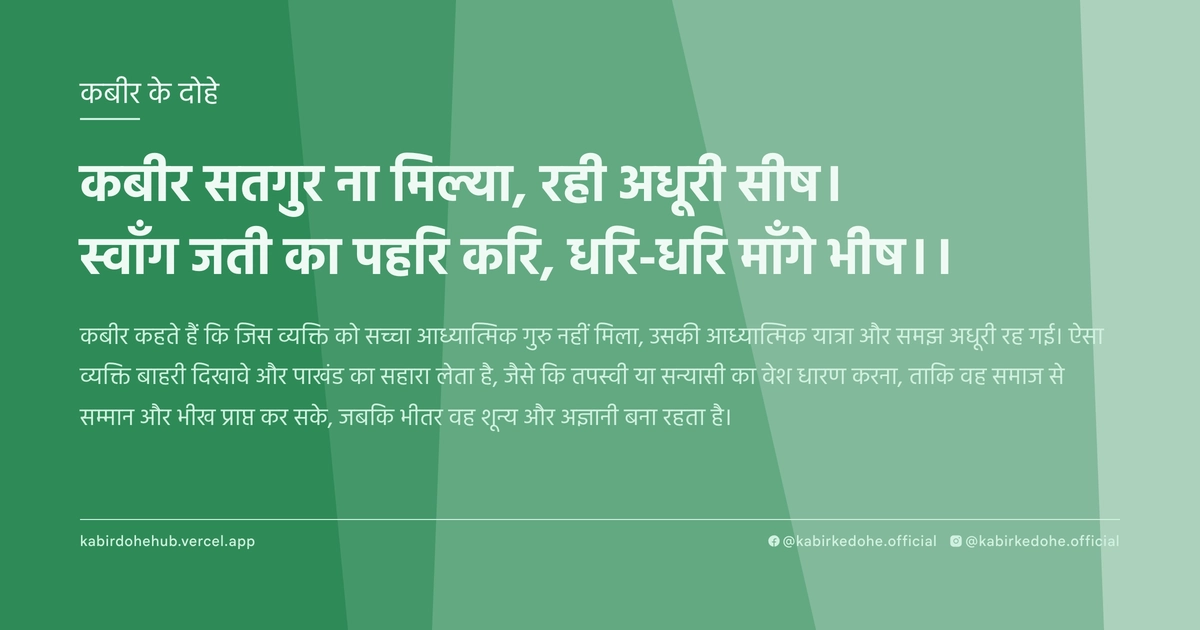
कबीर सतगुर ना मिल्या, रही अधूरी सीष।
स्वाँग जती का पहरि करि, धरि-धरि माँगे भीष।।
Kabir satgur na milya, rahi adhoori sish. Swaang jati ka pahri kari, dhari-dhari maange bhish.
इस पृष्ठ पर इस कबीर दोहे का अर्थ (meaning), हिंदी व्याख्या और अंग्रेज़ी अनुवाद, दार्शनिक विश्लेषण और व्यावहारिक जीवन सीख दी गई है। यह दोहा गुरु महत्व (The Guru's Importance) विषय से जुड़ा है — Kabir doha meaning and explanation in Hindi and English.
अर्थ (Meaning):
कबीर कहते हैं कि जिस व्यक्ति को सच्चा आध्यात्मिक गुरु नहीं मिला, उसकी आध्यात्मिक यात्रा और समझ अधूरी रह गई। ऐसा व्यक्ति बाहरी दिखावे और पाखंड का सहारा लेता है, जैसे कि तपस्वी या सन्यासी का वेश धारण करना, ताकि वह समाज से सम्मान और भीख प्राप्त कर सके, जबकि भीतर वह शून्य और अज्ञानी बना रहता है।
Kabir asserts that without the guidance of a true spiritual master, one's awakening remains incomplete. Such an individual resorts to the facade of asceticism, donning the outward costume of a renunciant to solicit alms and social prestige, while remaining internally void of actual realization and spiritual depth.
व्याख्या (Interpretation):
यह दोहा बाहरी आडंबर और आंतरिक शून्यता के बीच के विरोधाभास को दर्शाता है। 'अधूरी सीष' का अर्थ केवल ज्ञान की कमी नहीं, बल्कि आत्म-साक्षात्कार की विफलता है। यहाँ 'स्वाँग' शब्द माया के उस जाल को इंगित करता है जहाँ व्यक्ति अपनी ईगो (अहंकार) को संतुष्ट करने के लिए धर्म का मुखौटा पहनता है। निर्गुण भक्ति के संदर्भ में, यह चेतावनी है कि बिना सही दिशा-निर्देश के, साधना केवल एक मानसिक खेल या सामाजिक प्रदर्शन बन जाती है। यह आत्मा और परमात्मा के मिलन के बजाय, केवल 'साधु' कहलाने की लालसा है, जो अद्वैत वेदांत के मार्ग में सबसे बड़ी बाधा है।
This couplet highlights the stark paradox between external ostentation and internal emptiness. 'Adhuri sees' refers not merely to a lack of knowledge, but to the failure of self-realization. The term 'Swang' (masquerade) signifies the trap of Maya, where the individual uses religion as a mask to feed the ego. In the context of Nirgun Bhakti, it warns that without authentic guidance, spiritual practice devolves into a psychological game or social performance. Instead of the union of Atman and Brahman, the seeker chases the label of a 'saint,' which is the primary obstacle in the path of non-duality.
दार्शनिक विश्लेषण (Philosophical Analysis):
कबीर का यह प्रहार उस समय के सामाजिक-धार्मिक परिवेश पर है जहाँ धर्म केवल वस्त्रों, मालाओं और तिलक तक सीमित हो गया था। वे ritualism (कर्मकांड) का पुरजोर विरोध करते हैं क्योंकि उनका मानना था कि ईश्वर किसी विशेष पोशाक या बाहरी क्रिया में नहीं, बल्कि हृदय की शुद्धता में बसता है।
दार्शनिक स्तर पर, यह दोहा अद्वैत वेदांत के उस सिद्धांत से जुड़ता है जहाँ 'अविद्या' (अज्ञान) ही बंधन का कारण है। जब तक साधक को एक 'सतगुरु' (सच्चा गुरु) नहीं मिलता जो उसे उसके वास्तविक स्वरूप का बोध कराए, वह माया के भ्रम में फंसा रहता है। यहाँ गुरु केवल एक व्यक्ति नहीं, बल्कि वह चेतना है जो अहंकार के पर्दे को हटाती है।
सूफी मत के 'पीर' या 'मुर्शिद' की अवधारणा के समान, कबीर यहाँ आंतरिक मार्गदर्शन की आवश्यकता पर बल देते हैं। वे बताते हैं कि बिना आंतरिक रूपांतरण के, बाहरी त्याग केवल एक 'नाटक' है। यह अहंकार का एक सूक्ष्म रूप है जहाँ व्यक्ति खुद को दूसरों से श्रेष्ठ दिखाने के लिए 'त्याग' का ढोंग करता है।
कबीर जाति और वर्ग के भेदभाव को नकारते हुए यह स्पष्ट करते हैं कि आध्यात्मिक योग्यता किसी विशेष कुल या वेशभूषा से नहीं आती। वे उस पाखंडी संस्कृति पर प्रहार करते हैं जो धर्म को एक व्यवसाय या सामाजिक स्थिति प्राप्त करने के साधन के रूप में उपयोग करती है।
अंततः, यह विश्लेषण हमें मनोवैज्ञानिक रूपांतरण की ओर ले जाता है। सच्चा रूपांतरण तब होता है जब व्यक्ति अपनी 'छवि' (image) को नष्ट कर देता है और सत्य के सामने नग्न (निर्मोही) हो जाता है। जब तक 'मैं एक साधु हूँ' का भाव रहता है, तब तक सत्य की प्राप्ति असंभव है क्योंकि वह 'मैं' ही सबसे बड़ी बाधा है।
Kabir’s critique targets the socio-religious climate of his era, where spirituality had been reduced to garments, beads, and tilaks. He vehemently opposes ritualism, asserting that the Divine resides not in specific attire or external rites, but in the purity of the heart.
Philosophically, this couplet aligns with the Advaita Vedanta principle that 'Avidya' (ignorance) is the root of all bondage. Until the seeker finds a 'Satguru' (True Teacher) capable of unveiling their true nature, they remain trapped in the illusions of Maya. Here, the Guru is not merely a person, but a catalyst of consciousness that strips away the veil of ego.
Similar to the Sufi concept of the 'Pir' or 'Murshid,' Kabir emphasizes the necessity of internal guidance. He argues that without an inner metamorphosis, external renunciation is nothing more than a 'performance.' This is a subtle form of ego, where the individual simulates detachment to appear superior to others.
Rejecting caste and class hierarchies, Kabir clarifies that spiritual merit does not derive from lineage or clothing. He attacks the hypocritical culture that utilizes religion as a business or a tool for social mobility.
Ultimately, this analysis leads us toward psychological transformation. True awakening occurs only when the individual destroys their 'image' and stands naked—devoid of pretension—before the Truth. As long as the notion of 'I am a saint' persists, realization remains impossible, for that 'I' is the ultimate barrier.
मूल संदेश (Core Message):
- बाहरी दिखावा आंतरिक शून्यता को कभी नहीं भर सकता।
- सच्चा गुरु वह है जो आपको आपके अहंकार से मुक्त करे।
- धर्म कोई पोशाक नहीं, बल्कि चेतना का रूपांतरण है।
- जब तक 'मैं' का मुखौटा है, तब तक 'सत्य' का अनुभव असंभव है।
- सादगी ही वह द्वार है जिससे वास्तविक ज्ञान प्रवेश करता है।
- External facades can never fill an internal void.
- A true Guru is one who liberates you from your own ego.
- Religion is not a costume, but a transformation of consciousness.
- As long as the mask of 'I' exists, the experience of Truth is impossible.
- Simplicity is the only gateway through which real knowledge enters.
व्यावहारिक उदाहरण (Practical Example):
वाराणसी के एक पुराने मोहल्ले में माधव नाम का एक व्यक्ति रहता था। माधव ने अपनी पूरी जवानी व्यापार में बिताई, लेकिन बुढ़ापे में उसे अचानक 'मोक्ष' की चिंता सताने लगी। उसने देखा कि शहर के लोग उन साधुओं का बहुत सम्मान करते हैं जो भगवा वस्त्र पहनते हैं और लंबी दाढ़ी रखते हैं।
माधव ने रातों-रात अपने सारे कपड़े बदल दिए, माथे पर बड़ा सा तिलक लगाया और एक लकड़ी की माला पहन ली। उसने घर छोड़ दिया और गंगा के घाटों पर बैठ गया। लोग उसे 'महात्मा माधव' कहकर पुकारने लगे और उसे श्रद्धावश दान और भोजन देने लगे।
बाहर से वह एक महान तपस्वी लग रहा था, लेकिन भीतर वह अभी भी उन्हीं पुरानी लालसाओं और क्रोध से भरा था। वह मन ही मन उन लोगों को तुच्छ समझता था जो काम कर रहे थे, जबकि वह 'मुक्त' था। वह अपनी इस नई छवि के अहंकार में डूब गया था।
एक दिन उसकी मुलाकात एक साधारण से कुम्हार से हुई, जो मिट्टी के बर्तन बना रहा था। कुम्हार ने माधव की आँखों में देखा और मुस्कुराते हुए कहा, 'महाराज, आपके वस्त्र तो बहुत सुंदर हैं, लेकिन क्या आपकी आत्मा ने भी कपड़े बदले हैं?'
माधव को यह बात चुभी। उसने क्रोध में कहा, 'मैं वर्षों से तपस्या कर रहा हूँ, तुम एक साधारण कुम्हार मुझे क्या सिखाओगे?' कुम्हार ने शांति से उत्तर दिया, 'तपस्या वस्त्रों से नहीं, सत्य को स्वीकार करने से होती है। आप यहाँ भीख माँग रहे हैं—सिर्फ अन्न की नहीं, बल्कि प्रशंसा की भीख।'
यह बात माधव के हृदय पर बिजली की तरह गिरी। उसे एहसास हुआ कि उसने धर्म को केवल एक मुखौटा बनाया था ताकि वह अपनी आंतरिक रिक्तता और डर को छिपा सके। वह जिसे 'त्याग' समझ रहा था, वह वास्तव में उसकी ईगो का एक नया विस्तार था।
उस रात माधव ने घंटों तक उस कुम्हार के शब्दों पर विचार किया। उसने महसूस किया कि वह अब तक केवल एक 'स्वाँग' कर रहा था। उसने अपनी बाहरी पहचान को पकड़ने की कोशिश छोड़ी और पहली बार ईमानदारी से अपनी कमियों को स्वीकार किया।
अगले दिन, माधव ने वह दिखावटी वेशभूषा त्याग दी। उसने फिर से साधारण कपड़े पहने और चुपचाप लोगों की सेवा में लग गया। अब वह 'महात्मा' नहीं था, लेकिन वह पहली बार वास्तव में एक 'साधक' बन गया था क्योंकि उसने अपनी छवि का मोह छोड़ दिया था।
In an old neighborhood of Varanasi lived a man named Madhav. Madhav spent his youth in trade, but in old age, he was suddenly gripped by an anxiety for 'Moksha.' He noticed that the townspeople deeply revered monks who wore saffron robes and grew long beards.
Overnight, Madhav changed his entire wardrobe, applied a large tilak on his forehead, and wore a wooden bead necklace. He left his home and settled on the banks of the Ganges. People began calling him 'Mahatma Madhav,' offering him alms and food out of reverence.
Externally, he appeared to be a great ascetic, but internally, he was still consumed by the same old cravings and anger. He secretly looked down upon those who worked, believing himself to be 'liberated.' He became intoxicated by the ego of his new image.
One day, he met a simple potter shaping clay pots. The potter looked into Madhav's eyes, smiled, and asked, 'Maharaj, your clothes are indeed beautiful, but has your soul also changed its clothes?'
Madhav felt stung. He replied angrily, 'I have been practicing penance for years; what can a simple potter like you teach me?' The potter replied calmly, 'Penance does not come from clothes, but from accepting the Truth. You are still begging here—not just for food, but for the alms of admiration.'
These words struck Madhav like a bolt of lightning. He realized he had used religion merely as a mask to hide his internal void and fear. What he perceived as 'renunciation' was actually just a new expansion of his ego.
That night, Madhav contemplated the potter's words for hours. He recognized that he had been performing a 'Swang' (masquerade). He stopped trying to cling to his external identity and, for the first time, honestly acknowledged his flaws.
The next day, Madhav discarded the ostentatious attire. He returned to simple clothes and quietly dedicated himself to serving others. He was no longer a 'Mahatma' in the eyes of the world, but for the first time, he became a true 'Seeker' because he had relinquished the attachment to his image.
अभ्यास मार्गदर्शन (Practice Guidance):
- प्रतिदिन 20 मिनट मौन अभ्यास करें, जहाँ आप अपनी सामाजिक पहचान (नाम, पद, प्रतिष्ठा) को पूरी तरह भुलाकर केवल एक 'साक्षी' बनकर रहें।
- एक 'ईगो जर्नल' बनाएँ: दिन भर में कितनी बार आपने अपनी श्रेष्ठता सिद्ध करने के लिए किसी विशेष व्यवहार या शब्द का प्रयोग किया, उसे लिखें और विश्लेषण करें।
- व्यवहार परिवर्तन: किसी ऐसे व्यक्ति की सेवा करें जिससे आप आमतौर पर बात नहीं करते या जिसे आप अपने से निम्न समझते हैं, बिना किसी को बताए कि आप ऐसा कर रहे हैं।
- डायग्नोस्टिक चेकलिस्ट: यदि आपको किसी की प्रशंसा से अत्यधिक खुशी मिलती है या आलोचना से तीव्र क्रोध आता है, तो समझ लें कि आप अभी भी 'छवि' (Image) के जाल में हैं, सत्य के मार्ग पर नहीं।
- Practice 20 minutes of daily silence where you completely strip away your social identity (name, rank, prestige) and exist solely as a 'Witness.'
- Maintain an 'Ego Journal': Record every instance during the day where you used a specific behavior or word to prove your superiority, then analyze the motive.
- Behavioral Shift: Serve someone you typically ignore or perceive as 'lower' than you, ensuring the act remains completely anonymous and devoid of pride.
- Diagnostic Checklist: If you feel an intense rush of pleasure from praise or a sharp sting of anger from criticism, recognize that you are still trapped in the 'Image,' not the Truth.
चिंतन प्रश्न (Reflection Questions):
- मेरे जीवन का वह कौन सा 'मुखौटा' है जिसे मैं समाज के सामने सबसे अधिक गर्व से पहनता हूँ?
- यदि मुझसे मेरी सारी उपाधियाँ, पद और धार्मिक पहचान छीन ली जाएँ, तो वास्तव में मेरा अस्तित्व क्या बचेगा?
- क्या मेरी आध्यात्मिक साधना मुझे विनम्र बना रही है, या यह मुझे दूसरों से श्रेष्ठ महसूस कराने का एक नया तरीका बन गई है?
- मैं अपनी डिजिटल पहचान (सोशल मीडिया) पर जो छवि प्रस्तुत करता हूँ, वह मेरे वास्तविक आंतरिक संघर्षों से कितनी अलग है?
- क्या मैं सत्य की खोज कर रहा हूँ, या मैं केवल 'सत्य खोजने वाले' की छवि का आनंद ले रहा हूँ?
- What is the specific 'mask' in my life that I wear with the most pride before society?
- If all my titles, positions, and religious identities were stripped away, what would actually remain of my existence?
- Is my spiritual practice making me humble, or has it become a new way to feel superior to others?
- How far removed is the image I project on my digital identity (social media) from my actual internal struggles?
- Am I truly seeking the Truth, or am I merely enjoying the image of being a 'seeker of Truth'?