
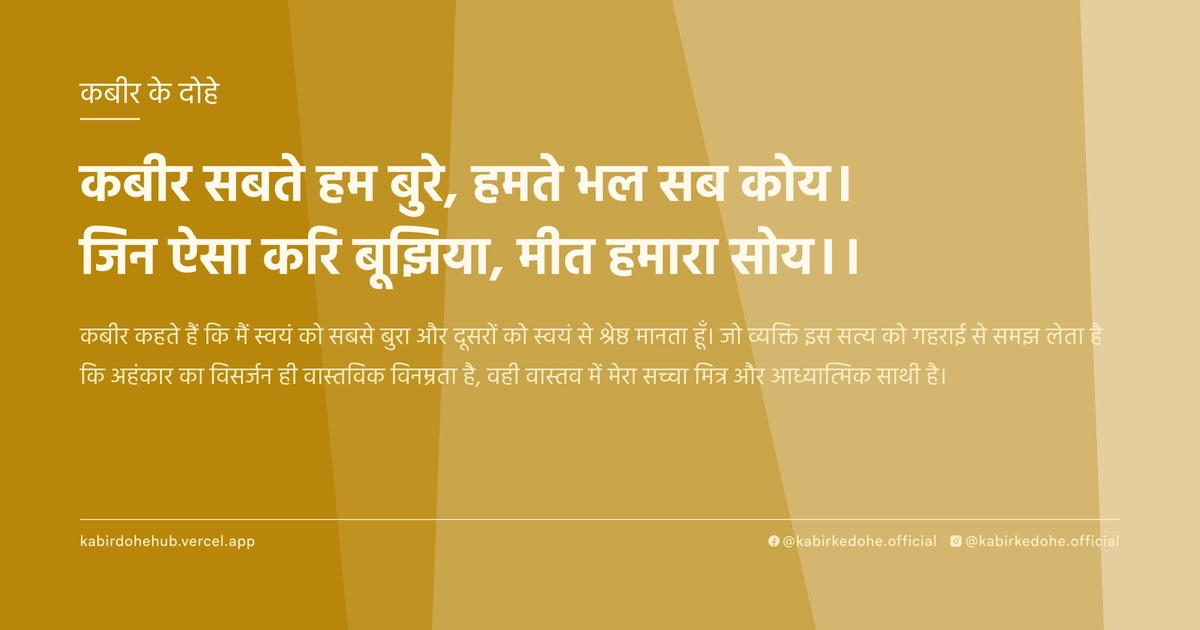
कबीर सबते हम बुरे, हमते भल सब कोय।
जिन ऐसा करि बूझिया, मीत हमारा सोय।।
Kabir sabte hum bure, hamte bhal sab koy. Jin aisa kari boojhiya, meet hamara soy.
इस पृष्ठ पर इस कबीर दोहे का अर्थ (meaning), हिंदी व्याख्या और अंग्रेज़ी अनुवाद, दार्शनिक विश्लेषण और व्यावहारिक जीवन सीख दी गई है। यह दोहा विनम्रता (Humility) विषय से जुड़ा है — Kabir doha meaning and explanation in Hindi and English.
अर्थ (Meaning):
कबीर कहते हैं कि मैं स्वयं को सबसे बुरा और दूसरों को स्वयं से श्रेष्ठ मानता हूँ। जो व्यक्ति इस सत्य को गहराई से समझ लेता है कि अहंकार का विसर्जन ही वास्तविक विनम्रता है, वही वास्तव में मेरा सच्चा मित्र और आध्यात्मिक साथी है।
Kabir declares that he perceives himself as the lowest among all and views everyone else as superior. He asserts that whoever possesses the spiritual insight to realize this state of absolute humility and the dissolution of the ego is truly his companion and friend.
व्याख्या (Interpretation):
शाब्दिक रूप से यह दोहा आत्म-निंदा प्रतीत होता है, परंतु वास्तव में यह 'अहंकार' के पूर्ण विनाश की घोषणा है। यहाँ 'बुरा' होने का अर्थ नैतिक पतन नहीं, बल्कि उस 'मैं' (अहंकार) का अंत है जो स्वयं को दूसरों से अलग या श्रेष्ठ समझता है। यह निर्गुण भक्ति का सार है जहाँ साधक शून्य हो जाता है। जब व्यक्ति स्वयं को शून्य मानता है, तब वह ब्रह्मांडीय चेतना (ब्रह्म) के लिए रिक्त स्थान बनाता है। यह अद्वैत वेदांत के उस सिद्धांत की ओर संकेत है जहाँ द्वैत (मैं और तुम) समाप्त हो जाता है। इस विरोधाभास के माध्यम से कबीर यह समझा रहे हैं कि वास्तविक श्रेष्ठता स्वयं को निम्नतम मानने की क्षमता में निहित है।
Literally, this couplet appears to be an act of self-deprecation, but it is actually a proclamation of the total annihilation of the 'Ahamkara' (ego). Being 'bad' or 'lowest' here does not refer to moral failure, but to the erasure of the 'I' that perceives separation or superiority over others. This is the essence of Nirgun Bhakti, where the seeker becomes a void. By perceiving oneself as nothing, one creates the necessary space for the Universal Consciousness (Brahman) to reside. It points toward the Advaita Vedanta principle where duality—the distinction between self and other—dissolves. Through this paradox, Kabir teaches that true spiritual supremacy lies in the capacity to perceive oneself as the least.
दार्शनिक विश्लेषण (Philosophical Analysis):
कबीर का यह दृष्टिकोण उनके युग के सामाजिक और धार्मिक पाखंडों पर एक गहरा प्रहार है। उस समय जाति और धार्मिक श्रेष्ठता का अहंकार चरम पर था; कबीर ने 'सबसे बुरा' बनकर उस पूरी व्यवस्था को चुनौती दी। यह सूफी मत के 'फना' (अस्तित्व का विलीनीकरण) के सिद्धांत से मेल खाता है, जहाँ प्रेमी अपने अस्तित्व को ईश्वर की इच्छा में विलीन कर देता है।
दार्शनिक स्तर पर, यह दोहा अद्वैत वेदांत के उस सत्य को उजागर करता है कि जब तक 'मैं' जीवित है, तब तक 'सत्य' प्रकट नहीं हो सकता। कबीर यहाँ मनोवैज्ञानिक रूपांतरण की बात कर रहे हैं। वे बताते हैं कि जब हम दूसरों को श्रेष्ठ मानते हैं, तो हम वास्तव में अपने भीतर के उस न्यायाधीश को मार रहे होते हैं जो निरंतर तुलना करता है।
यह विचार कर्मकांडीय धर्म के विपरीत है, जो बाहरी शुद्धता और पद पर जोर देता है। कबीर आंतरिक शुद्धता को 'अहंकार शून्य' होने में देखते हैं। उनके लिए, भक्ति कोई बाहरी क्रिया नहीं, बल्कि आंतरिक शून्यता की स्थिति है।
अक्सर लोग इसे केवल विनम्रता समझ लेते हैं, जबकि यह 'अहंकार का विलोपन' है। विनम्रता एक गुण है जिसे अहंकार प्रदर्शित कर सकता है, लेकिन 'स्वयं को सबसे बुरा मानना' एक आध्यात्मिक सर्जरी है जो अहंकार की जड़ को ही काट देती है।
अंततः, यह दोहा मनुष्य को उस स्थिति में ले जाता है जहाँ वह किसी से प्रतिस्पर्धा नहीं करता। जब कोई शत्रु नहीं रहता और कोई श्रेष्ठ नहीं रहता, तब केवल प्रेम शेष बचता है। यही वह बिंदु है जहाँ साधक और परमात्मा एक हो जाते हैं।
Kabir's perspective is a profound strike against the social and religious hypocrisies of his era. At a time when caste and religious superiority were rampant, Kabir challenged the entire system by claiming to be the 'worst.' This aligns with the Sufi concept of 'Fana' (annihilation), where the lover dissolves their existence into the will of the Divine.
On a philosophical level, this doha illuminates the Advaita Vedanta truth that as long as the 'I' exists, the 'Truth' cannot manifest. Kabir is discussing a psychological transformation. He suggests that by viewing others as superior, we are actually killing the internal judge that constantly engages in comparison.
This ideology stands in stark contrast to ritualistic religion, which emphasizes external purity and hierarchy. Kabir views internal purity as the state of being 'ego-less.' For him, devotion is not an external act but a state of internal emptiness.
Common literalists often mistake this for mere humility. However, while humility can be a trait displayed by the ego, claiming to be the 'worst' is a spiritual surgery that severs the very root of the ego.
Ultimately, this teaching brings the human being to a state where competition ceases. When there is no enemy and no superior, only love remains. This is the precise point where the seeker and the Divine merge into one.
मूल संदेश (Core Message):
- अहंकार ही सत्य और साधक के बीच की सबसे बड़ी दीवार है।
- स्वयं को निम्नतम मानना ही वास्तविक आध्यात्मिक उत्थान की पहली सीढ़ी है।
- तुलना का अंत ही मानसिक शांति का प्रारंभ है।
- जब 'मैं' मिटता है, तभी 'वह' (परमात्मा) प्रकट होता है।
- प्रेम केवल वहीं प्रवेश करता है जहाँ अहंकार का अभाव होता है।
- The ego is the greatest wall between the seeker and the Truth.
- Perceiving oneself as the lowest is the first step toward true spiritual ascent.
- The end of comparison is the beginning of mental peace.
- Only when the 'I' is erased does the 'Divine' manifest.
- Love only enters where the ego is absent.
व्यावहारिक उदाहरण (Practical Example):
वाराणसी के एक पुराने घाट पर रामदीन नाम का एक वृद्ध नाविक रहता था। वह अपनी नाव चलाने की कला में निपुण था, लेकिन उसका स्वभाव अत्यंत उग्र था। वह मानता था कि वह शहर का सबसे अनुभवी नाविक है और अन्य सभी नाविक अनाड़ी हैं। वह अक्सर नए लड़कों का अपमान करता और उन्हें नीचा दिखाता था।
एक दिन, एक शांत संन्यासी उसकी नाव पर सवार हुए। रामदीन ने गर्व से अपनी कुशलता का बखान करना शुरू किया और अन्य नाविकों की कमियां गिनाने लगा। संन्यासी ने मुस्कुराते हुए कबीर का यह दोहा सुनाया और कहा, 'रामदीन, जब तक तुम खुद को सबसे श्रेष्ठ मानोगे, तुम केवल अपनी छोटी सी नाव के मालिक रहोगे, लेकिन जिस दिन तुम खुद को सबसे छोटा मानोगे, पूरा गंगा तट तुम्हारा हो जाएगा।'
रामदीन को पहले तो यह बात समझ नहीं आई, लेकिन उसने प्रयोग करने का निर्णय लिया। अगले एक महीने तक, उसने जानबूझकर यह अभ्यास किया कि वह हर नाविक की एक ऐसी खूबी ढूंढे जो उसमें नहीं थी। उसने देखा कि एक युवा नाविक लहरों को उससे बेहतर पढ़ता था, और एक अन्य नाविक यात्रियों के साथ अधिक विनम्र था।
धीरे-धीरे, रामदीन का वह 'श्रेष्ठता का बोझ' उतरने लगा। उसने महसूस किया कि जब वह खुद को 'सबसे बुरा' या 'सीखने वाला' मानने लगा, तो उसका क्रोध गायब हो गया। अब वह दूसरों की आलोचना करने के बजाय उनकी प्रशंसा करने लगा।
शहर के अन्य नाविक, जो पहले उससे नफरत करते थे, अब उसकी ओर खिंचे चले आने लगे। वे उसे अपना मार्गदर्शक मानने लगे क्योंकि अब उसके शब्दों में अहंकार नहीं, बल्कि करुणा थी।
एक शाम, रामदीन ने महसूस किया कि वह अब नाव नहीं चला रहा था, बल्कि प्रेम चला रहा था। उसकी आंतरिक शांति इतनी गहरी हो गई थी कि वह अब किसी भी अपमान से विचलित नहीं होता था।
उसने पाया कि जब उसने अपनी श्रेष्ठता का दावा छोड़ा, तो उसे एक ऐसी खुशी मिली जो उसने पिछले चालीस वर्षों में कभी महसूस नहीं की थी। वह अब वास्तव में स्वतंत्र था।
यह 'कबीर ट्विस्ट' था—श्रेष्ठता की खोज में वह अकेला था, लेकिन निम्नता को स्वीकार करते ही वह सबके प्रिय बन गया। उसने जान लिया कि शून्य होना ही पूर्ण होना है।
On an ancient ghat in Varanasi lived an elderly boatman named Ramdeen. He was masterful in his craft, but his temperament was volatile. He believed himself to be the most experienced boatman in the city and viewed all others as amateurs, often insulting young boatmen and belittling their skills.
One day, a serene monk boarded his boat. Ramdeen began boasting of his prowess and listing the flaws of his competitors. The monk smiled and recited this doha of Kabir, saying, 'Ramdeen, as long as you consider yourself the greatest, you will only be the master of a tiny boat; but the day you consider yourself the least, the entire banks of the Ganges will belong to you.'
Ramdeen didn't understand at first, but he decided to experiment. For the next month, he consciously practiced finding one quality in every other boatman that he himself lacked. He noticed a young boy who read the currents better than he did, and another who was far more compassionate toward passengers.
Gradually, Ramdeen's 'burden of superiority' began to lift. He realized that by viewing himself as the 'worst' or a perpetual 'learner,' his anger vanished. Instead of criticizing others, he began to appreciate them.
Other boatmen, who previously detested him, began to be drawn to him. They started seeing him as a mentor because his words no longer carried the sting of ego, but the warmth of compassion.
One evening, Ramdeen realized he was no longer just steering a boat, but steering love. His inner peace became so profound that no insult could disturb him anymore.
He discovered that by relinquishing his claim to superiority, he attained a joy he hadn't felt in forty years. He was finally truly free.
This was the 'Kabir Twist'—in the pursuit of being the best, he was alone; but in accepting the lowest place, he became beloved by all. He learned that to be zero is to be infinite.
अभ्यास मार्गदर्शन (Practice Guidance):
- प्रतिदिन 15 मिनट मौन बैठें और अपने भीतर के उस 'मैं' को पहचानें जो दूसरों से तुलना करता है। जब भी श्रेष्ठता का भाव आए, मन ही मन कहें 'मैं शून्य हूँ'।
- एक 'विनम्रता डायरी' लिखें। प्रतिदिन कम से कम तीन ऐसे लोगों के नाम लिखें जिनसे आपने कुछ सीखा, चाहे वे आपसे पद या उम्र में छोटे ही क्यों न हों।
- व्यवहार परिवर्तन: किसी विवाद के समय, अपनी बात सही साबित करने के बजाय, सामने वाले के दृष्टिकोण में छिपी किसी एक सच्चाई को स्वीकार करें।
- निदान चेकलिस्ट: क्या आप दूसरों की सफलता से ईर्ष्या करते हैं? क्या आप अनचाही सलाह देते हैं? क्या आप अपनी उपलब्धियों का बार-बार जिक्र करते हैं? यदि हाँ, तो आपका अहंकार अभी सक्रिय है।
- Sit in silence for 15 minutes daily and observe the 'I' within that constantly compares itself to others. Whenever a feeling of superiority arises, mentally whisper, 'I am zero.'
- Maintain a 'Humility Journal.' Every day, list at least three people from whom you learned something, regardless of their status or age relative to yours.
- Behavioral Shift: During a conflict, instead of striving to prove your point, consciously acknowledge one truth in the other person's perspective.
- Diagnostic Checklist: Do you feel envy at others' success? Do you offer unsolicited advice? Do you frequently mention your own achievements? If yes, your ego is still active.
चिंतन प्रश्न (Reflection Questions):
- आपकी वह कौन सी उपलब्धि है जिसे आप अपनी पहचान का आधार मानते हैं, और यदि वह छिन जाए तो आपका अस्तित्व क्या बचेगा?
- क्या आप वास्तव में दूसरों की मदद करना चाहते हैं, या मदद करके अपनी श्रेष्ठता सिद्ध करना चाहते हैं?
- आपके जीवन में वह कौन सा व्यक्ति है जिसे आप 'बुरा' मानते हैं? क्या वह बुराई आपके अपने भीतर के किसी प्रतिबिंब का हिस्सा है?
- डिजिटल युग में, आपकी सोशल मीडिया प्रोफाइल आपके वास्तविक स्वरूप को दिखाती है या एक निर्मित 'श्रेष्ठ' छवि को?
- क्या आप बिना किसी प्रशंसा की इच्छा के किसी के प्रति समर्पित हो सकते हैं?
- Which achievement do you use as the foundation of your identity, and what would remain of your existence if it were taken away?
- Do you truly wish to help others, or do you use helping as a means to validate your own superiority?
- Who is the person in your life you consider 'bad'? Is that perceived evil a reflection of something within yourself?
- In the digital age, does your social media profile reflect your true self or a curated 'superior' image?
- Can you be devoted to someone without any desire for recognition or praise?