
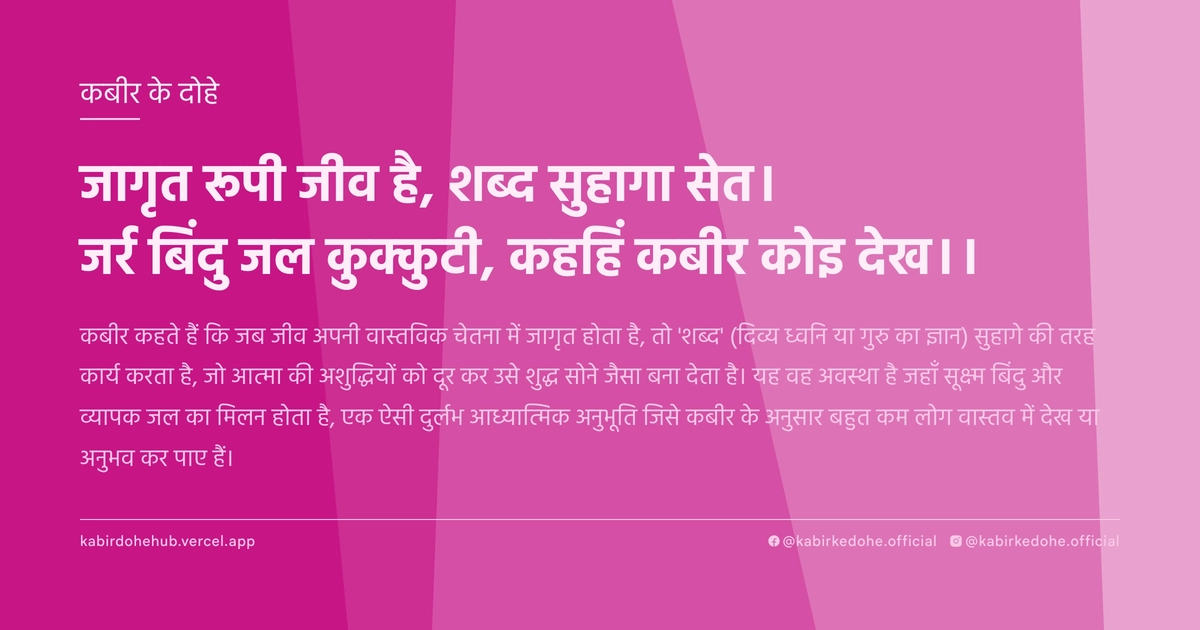
जागृत रूपी जीव है, शब्द सुहागा सेत।
जर्र बिंदु जल कुक्कुटी, कहहिं कबीर कोइ देख।।
Jagrit rupi jeev hai, shabd suhaga set. Jarr bindu jal kukkuti, kahahin kabir koi dekh.
इस पृष्ठ पर इस कबीर दोहे का अर्थ (meaning), हिंदी व्याख्या और अंग्रेज़ी अनुवाद, दार्शनिक विश्लेषण और व्यावहारिक जीवन सीख दी गई है। यह दोहा अंतर ज्योति (The Inner Light) विषय से जुड़ा है — Kabir doha meaning and explanation in Hindi and English.
अर्थ (Meaning):
कबीर कहते हैं कि जब जीव अपनी वास्तविक चेतना में जागृत होता है, तो 'शब्द' (दिव्य ध्वनि या गुरु का ज्ञान) सुहागे की तरह कार्य करता है, जो आत्मा की अशुद्धियों को दूर कर उसे शुद्ध सोने जैसा बना देता है। यह वह अवस्था है जहाँ सूक्ष्म बिंदु और व्यापक जल का मिलन होता है, एक ऐसी दुर्लभ आध्यात्मिक अनुभूति जिसे कबीर के अनुसार बहुत कम लोग वास्तव में देख या अनुभव कर पाए हैं।
Kabir asserts that when the soul awakens to its true nature, the 'Shabd' (divine sound or the Guru's word) acts as borax (suhaga), purifying the soul of its impurities to reveal its golden essence. He describes a mystical state where the infinitesimal point (bindu) merges with the cosmic waters, a rare spiritual realization that Kabir challenges the seeker to actually witness within themselves.
व्याख्या (Interpretation):
इस दोहे का शाब्दिक अर्थ है कि जागृत आत्मा के लिए शब्द एक उत्प्रेरक है। रूपक के तौर पर, 'सुहागा' वह तत्व है जो सोने को शुद्ध करता है; इसी तरह, 'शब्द' या नाद-योग अहंकार की परतों को जला देता है। यहाँ 'जर्र बिंदु' सूक्ष्म चेतना का प्रतीक है और 'जल' ब्रह्मांडीय ऊर्जा का। यह निर्गुण भक्ति का सार है जहाँ साधक किसी बाहरी मूर्ति की नहीं, बल्कि अपने भीतर की ध्वनि की खोज करता है। यह अद्वैत वेदांत के उस सिद्धांत को दर्शाता है जहाँ व्यक्ति (Atman) और परमात्मा (Brahman) के बीच का अंतर मिट जाता है। कबीर यहाँ एक विरोधाभास प्रस्तुत करते हैं: सत्य सबके भीतर है, फिर भी यह 'अदृश्य' है क्योंकि मनुष्य माया के मोह में सोया हुआ है।
Literally, the verse suggests that for an awakened soul, the Word is a catalyst. Metaphorically, 'Suhaga' (borax) is used to purify gold; similarly, the 'Shabd' or divine vibration incinerates the layers of ego. The 'Jarr Bindu' symbolizes the infinitesimal seed of consciousness, while 'Jal' represents the cosmic fluid of existence. This is the essence of Nirgun Bhakti, where the seeker pursues the formless sound rather than external idols. It aligns with Advaita Vedanta's non-duality, where the distinction between Atman and Brahman dissolves. Kabir presents a paradox: the truth is omnipresent yet 'invisible' because humanity remains slumbering in the illusion of Maya.
दार्शनिक विश्लेषण (Philosophical Analysis):
कबीर का यह दोहा उस कालखंड का है जब भारतीय समाज कर्मकांडों और बाहरी आडंबरों में जकड़ा हुआ था। कबीर ने स्पष्ट रूप से मंदिर, मस्जिद और जातिगत श्रेष्ठता को नकारते हुए 'आंतरिक शुद्धि' पर जोर दिया। उनका दर्शन सूफीवाद के 'फना' (अहंकार का विनाश) और वेदांत के 'अहं ब्रह्मास्मि' का एक अनूठा संगम है।
यहाँ 'शब्द' का अर्थ केवल बोला गया शब्द नहीं, बल्कि वह आदि-ध्वनि (Anahad Naad) है जो सृष्टि के मूल में है। कबीर का तर्क है कि बिना इस आंतरिक ध्वनि के अनुभव के, सभी धार्मिक चर्चाएँ व्यर्थ हैं। यह एक मनोवैज्ञानिक रूपांतरण की प्रक्रिया है जहाँ साधक अपनी पहचान को शरीर और नाम से हटाकर शुद्ध चेतना में स्थानांतरित करता है।
वेदांत के परिप्रेक्ष्य में, यह 'माया' के पर्दे को हटाने की प्रक्रिया है। जब जीव 'जागृत' होता है, तो वह समझता है कि वह अलग नहीं, बल्कि उसी अनंत जल का हिस्सा है। यह द्वैत (duality) का अंत है।
सूफी मत की तरह, कबीर यहाँ प्रेम और समर्पण के माध्यम से ईश्वर के साथ एकाकार होने की बात करते हैं। सुहागा जैसे सोने को चमकाता है, वैसे ही गुरु का ज्ञान शिष्य के भीतर के अंधकार को मिटाता है।
अंततः, कबीर यह चेतावनी देते हैं कि आध्यात्मिक मार्ग केवल बौद्धिक विमर्श का विषय नहीं है। 'कोइ देख' कहकर वे चुनौती देते हैं कि क्या आपने वास्तव में उस सत्य का अनुभव किया है या आप केवल शास्त्रों को रट रहे हैं। यह अनुभवजन्य सत्य (Empirical Truth) की मांग है, न कि विश्वास की।
This Doha emerges from an era where Indian society was stifled by rigid rituals and outward displays of piety. Kabir explicitly rejected temples, mosques, and caste hierarchies, emphasizing 'internal purification' over external performance. His philosophy is a unique synthesis of the Sufi concept of 'Fana' (annihilation of the ego) and the Vedantic realization of 'Aham Brahmasmi'.
In this context, 'Shabd' does not refer to spoken language but to the primordial vibration (Anahad Naad) at the core of creation. Kabir argues that without experiencing this internal sound, all religious discourse is futile. It is a process of psychological transformation where the seeker shifts their identity from the physical body and social labels to pure consciousness.
From an Advaita perspective, this is the process of piercing the veil of 'Maya'. When the soul 'awakens', it realizes it is not a separate entity but a drop in the cosmic ocean. This marks the end of duality.
Similar to Sufism, Kabir speaks of merging with the Divine through love and surrender. Just as borax refines gold, the Guru's wisdom strips away the dross of the disciple's ignorance.
Ultimately, Kabir warns that the spiritual path is not a matter of intellectual debate. By asking 'koi dekh' (who has seen it?), he challenges the seeker to move beyond scriptural rote learning toward direct, experiential realization. He demands empirical truth over blind faith.
मूल संदेश (Core Message):
- बाहरी शोर को शांत करें ताकि आंतरिक सत्य सुनाई दे।
- अहंकार वह अशुद्धि है जिसे केवल आत्म-ज्ञान का सुहागा मिटा सकता है।
- परमात्मा कोई व्यक्ति नहीं, बल्कि एक सार्वभौमिक चेतना की ध्वनि है।
- जागृति का अर्थ है—स्वयं को शरीर से अलग शुद्ध आत्मा मानना।
- अनुभव ही एकमात्र प्रमाण है, शास्त्रों का रटना केवल भ्रम है।
- Silence the external noise to hear the internal truth.
- Ego is the impurity that only the borax of self-knowledge can erase.
- The Divine is not a person, but the vibration of universal consciousness.
- Awakening means recognizing oneself as pure soul, distinct from the body.
- Experience is the only proof; rote learning of scriptures is merely an illusion.
व्यावहारिक उदाहरण (Practical Example):
एक समय की बात है, वाराणसी के घाटों पर रहने वाला एक वृद्ध बुनकर था, जिसका नाम माधव था। माधव दिन भर सूत कातता और कपड़े बुनता, लेकिन उसका मन हमेशा इस बेचैनी से भरा रहता कि वह जीवन में क्या हासिल कर पाया। वह अक्सर पंडितों और मौलवियों के पास जाता, उनसे मोक्ष के कठिन मंत्र पूछता, लेकिन उसे कभी शांति नहीं मिली।
एक दिन उसकी मुलाकात एक घुमक्कड़ फकीर से हुई, जिसने माधव से कहा, 'तू बाहर जिसे खोज रहा है, वह तेरे भीतर की खामोशी में छिपा है। बस अपने भीतर की उस ध्वनि को सुन जो सांसों के साथ आती और जाती है।'
माधव ने शुरू में इसे मजाक समझा। वह सोचता था कि शांति किसी तीर्थ यात्रा या कठिन उपवास से मिलेगी। लेकिन फकीर के शब्दों ने उसके भीतर एक जिज्ञासा जगा दी। उसने तय किया कि वह हर दिन एक घंटा चुपचाप बैठकर केवल अपनी सांसों और हृदय की धड़कन पर ध्यान देगा।
शुरुआत में, उसका मन उसके पुराने दुखों, परिवार के झगड़ों और गरीबी की यादों से भरा रहा। उसे लगा कि यह समय की बर्बादी है। लेकिन जैसे-जैसे दिन बीते, उसने महसूस किया कि उसके भीतर एक सूक्ष्म गूँज है, जो बाहरी शोर से अलग है।
एक दोपहर, जब वह करघे पर काम कर रहा था, अचानक उसे महसूस हुआ कि वह और उसका करघा अलग नहीं हैं। वह धागा, वह कपड़ा और वह बुनने वाला—सब एक ही लय में नाच रहे थे। उसे ऐसा लगा जैसे उसके भीतर का 'मैं' पिघल गया है और वह एक विशाल समुद्र में विलीन हो गया है।
यह वह 'सुहागा' क्षण था। माधव की सारी शिकायतें, उसका अहंकार कि वह एक 'दुखी बुनकर' है, सब जलकर राख हो गए। उसने पाया कि जिस शांति को वह काशी के घाटों पर ढूंढ रहा था, वह उसके अपने हृदय के केंद्र में थी।
अब माधव का व्यवहार बदल गया। वह अब भी कपड़े बुनता था, लेकिन अब वह काम बोझ नहीं, बल्कि प्रार्थना बन गया था। वह अब दूसरों की मदद बिना किसी उम्मीद के करने लगा।
जब लोग उससे उसकी शांति का राज पूछते, तो वह बस मुस्कुराता और कहता, 'मैंने वह देख लिया है जिसे देखने के लिए आँखें नहीं, जागृत हृदय चाहिए।' माधव अब एक साधारण बुनकर नहीं, बल्कि एक जीवित अनुभव बन चुका था।
Once, on the ghats of Varanasi, lived an elderly weaver named Madhav. Madhav spent his days spinning yarn and weaving cloth, yet his mind was plagued by a persistent restlessness about what he had truly achieved in life. He frequently visited pundits and maulvis, seeking complex mantras for salvation, but peace remained elusive.
One day, he encountered a wandering fakir who told him, 'What you seek outside is hidden in the silence within. Just listen to that sound inside you that arrives and departs with every breath.'
Initially, Madhav dismissed this as a joke. He believed peace could only be attained through pilgrimages or rigorous fasting. However, the fakir's words planted a seed of curiosity. He decided to spend one hour every day sitting in absolute silence, focusing only on his breath and heartbeat.
At first, his mind was a storm of old grievances, family disputes, and memories of poverty. He felt he was wasting his time. But as days passed, he noticed a subtle resonance within, distinct from the external noise of the city.
One afternoon, while working at his loom, he suddenly felt that he and the loom were not separate. The thread, the fabric, and the weaver—all were dancing in a single, unified rhythm. It felt as if the 'I' within him had melted, merging into a vast, cosmic ocean.
This was the 'Suhaga' moment. All of Madhav's complaints and his ego—the identity of being a 'suffering weaver'—were incinerated. He discovered that the peace he had sought on the ghats of Kashi was residing in the center of his own heart.
Madhav's behavior transformed. He continued to weave, but the work was no longer a burden; it became a prayer. He began helping others without any expectation of reward.
When people asked the secret of his serenity, he would simply smile and say, 'I have seen that which requires not eyes, but an awakened heart.' Madhav was no longer just a weaver; he had become a living experience.
अभ्यास मार्गदर्शन (Practice Guidance):
- प्रतिदिन 20 मिनट 'अनाहत नाद' का अभ्यास करें: शांत बैठकर अपनी सांसों की आवाज और हृदय की धड़कन को गहराई से सुनें, बिना किसी निर्णय के।
- आत्म-पूछताछ जर्नल: प्रतिदिन लिखें कि आज किस क्षण में आपका 'अहंकार' (Ego) हावी था और उस क्षण में 'शब्द' या विवेक ने आपको कैसे वापस केंद्र में लाया।
- मौन व्रत: सप्ताह में एक बार कुछ घंटों के लिए पूर्ण मौन धारण करें, ताकि बाहरी शब्दों का शोर कम हो और आंतरिक ध्वनि स्पष्ट हो सके।
- डायग्नोस्टिक चेकलिस्ट: क्या आप अभी भी बाहरी पहचान (पद, प्रतिष्ठा, जाति) से अपनी खुशी जोड़ रहे हैं? क्या आप दूसरों में दोष ढूंढ रहे हैं? यदि हाँ, तो आप अभी 'सुहागे' की प्रक्रिया से गुजर नहीं रहे हैं।
- Practice 'Anahad Naad' for 20 minutes daily: Sit in silence and listen deeply to the sound of your breath and heartbeat, without judgment.
- Self-Inquiry Journal: Record moments each day when your ego dominated and how 'Shabd' or discernment brought you back to your center.
- Vow of Silence: Observe complete silence for a few hours once a week to diminish external noise and clarify the internal vibration.
- Diagnostic Checklist: Are you still linking your happiness to external identities (status, title, caste)? Are you finding faults in others? If yes, you have not yet undergone the 'Suhaga' purification.
चिंतन प्रश्न (Reflection Questions):
- यदि आपकी सारी सामाजिक पहचान (नाम, पेशा, रिश्ता) छीन ली जाए, तो जो बचेगा, क्या आप उसे जानते हैं?
- आपकी 'डिजिटल ईगो' (सोशल मीडिया इमेज) आपके वास्तविक आंतरिक स्वरूप को कितना ढक रही है?
- क्या आप वास्तव में सत्य की खोज कर रहे हैं, या केवल इस बात का प्रदर्शन कर रहे हैं कि आप आध्यात्मिक हैं?
- वह कौन सा डर है जो आपको पूर्ण रूप से 'जागृत' होने और स्वयं को समर्पित करने से रोकता है?
- क्या आपकी प्रार्थनाएं ईश्वर को पाने के लिए हैं, या केवल अपनी इच्छाओं को पूरा करने का एक साधन?
- If all your social identities (name, profession, relationships) were stripped away, do you know what remains?
- To what extent does your 'digital ego' (social media image) obscure your true internal nature?
- Are you truly seeking the truth, or are you merely performing the act of being spiritual?
- What is the specific fear that prevents you from fully 'awakening' and surrendering yourself?
- Are your prayers intended to reach the Divine, or are they merely tools to fulfill your personal desires?