
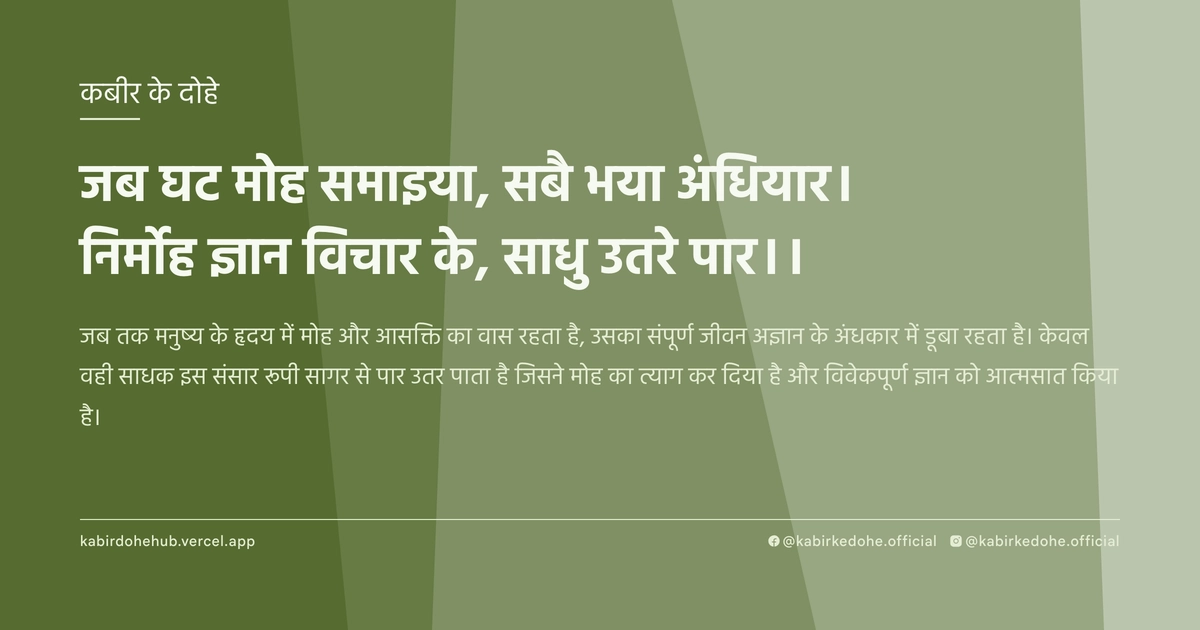
जब घट मोह समाइया, सबै भया अंधियार।
निर्मोह ज्ञान विचार के, साधु उतरे पार।।
Jab ghat moh samaiya, sabai bhaya andhiyar. Nirmoh gyan vichar ke, sadhu utre paar.
इस पृष्ठ पर इस कबीर दोहे का अर्थ (meaning), हिंदी व्याख्या और अंग्रेज़ी अनुवाद, दार्शनिक विश्लेषण और व्यावहारिक जीवन सीख दी गई है। यह दोहा माया (Maya) विषय से जुड़ा है — Kabir doha meaning and explanation in Hindi and English.
अर्थ (Meaning):
जब तक मनुष्य के हृदय में मोह और आसक्ति का वास रहता है, उसका संपूर्ण जीवन अज्ञान के अंधकार में डूबा रहता है। केवल वही साधक इस संसार रूपी सागर से पार उतर पाता है जिसने मोह का त्याग कर दिया है और विवेकपूर्ण ज्ञान को आत्मसात किया है।
As long as attachment and delusion reside within the heart, the entirety of one's existence remains shrouded in the darkness of ignorance. Only the seeker who transcends this clinging attachment through the application of discerning wisdom is able to cross the turbulent ocean of worldly existence.
व्याख्या (Interpretation):
इस दोहे में 'घट' का अर्थ केवल शरीर नहीं, बल्कि चेतना का केंद्र है। मोह वह पर्दा है जो आत्मा को उसके वास्तविक स्वरूप से अलग करता है, जिससे 'अंधियार' यानी अज्ञान उत्पन्न होता है। यह अंधकार बाहरी नहीं, बल्कि आंतरिक है, जो हमें यह विश्वास दिलाता है कि यह नश्वर संसार ही सत्य है। 'निर्मोह' होने का अर्थ संसार को छोड़ना नहीं, बल्कि संसार में रहते हुए उससे अप्रभावित रहना है। जब ज्ञान और विचार (विवेक) का मिलन होता है, तब माया का भ्रम टूटता है। यह प्रक्रिया निर्गुण भक्ति के उस मार्ग को दर्शाती है जहाँ भक्त ईश्वर को किसी मूर्ति में नहीं, बल्कि स्वयं के भीतर की शुद्ध चेतना में खोजता है। अंततः, 'पार उतरना' अहंकार के विसर्जन और ब्रह्म के साथ एकाकार होने की स्थिति है।
In this couplet, 'ghat' refers not merely to the physical body, but to the center of consciousness. Moh (attachment) is the veil that separates the soul from its true essence, creating 'andhiyaar' or the darkness of ignorance. This darkness is not external but internal, fostering the illusion that the transient world is the ultimate reality. To be 'nirmoh' does not imply the physical abandonment of the world, but rather remaining unaffected while existing within it. When knowledge (gyan) and discernment (vichaar) converge, the illusion of Maya is shattered. This process mirrors the path of Nirgun Bhakti, where the devotee seeks the Divine not in idols, but in the pure consciousness within. Ultimately, 'crossing over' signifies the dissolution of the ego and the realization of non-duality between Atman and Brahman.
दार्शनिक विश्लेषण (Philosophical Analysis):
कबीर का यह विचार मध्यकालीन भारत के उस सामाजिक और धार्मिक परिवेश में उपजा था जहाँ कर्मकांड और बाहरी आडंबरों का बोलबाला था। उन्होंने स्पष्ट किया कि मोक्ष किसी तीर्थ यात्रा या कठिन व्रत से नहीं, बल्कि आंतरिक रूपांतरण से मिलता है। यहाँ 'मोह' को सबसे बड़ी बाधा माना गया है, जो अद्वैत वेदांत के 'अविद्या' के सिद्धांत के समान है। अविद्या वह अज्ञान है जो हमें यह भुला देता है कि हम सीमित शरीर नहीं, बल्कि अनंत चेतना हैं।
सूफी मत के 'फना' के सिद्धांत के साथ इसका गहरा संबंध है, जहाँ साधक को अपनी व्यक्तिगत इच्छाओं और अहंकार को मिटाना होता है ताकि वह परमात्मा में विलीन हो सके। कबीर का 'निर्मोह' होना इसी फना की स्थिति है। वे तर्क देते हैं कि जब तक हम 'मेरा' और 'तेरा' के द्वैत में फंसे हैं, हम सत्य को नहीं देख सकते।
यह विश्लेषण हमें बताता है कि ज्ञान केवल सूचनाओं का संग्रह नहीं है, बल्कि एक अनुभव है। 'विचार' शब्द यहाँ विश्लेषण और आत्म-निरीक्षण की प्रक्रिया को दर्शाता है। जब व्यक्ति अपनी आसक्तियों का विश्लेषण करता है, तो उसे पता चलता है कि जिन चीजों से वह चिपका हुआ है, वे वास्तव में उसे बांध रही हैं।
कबीर जाति और धर्म के बंधनों को इसलिए नकारते हैं क्योंकि मोह केवल भौतिक वस्तुओं तक सीमित नहीं है; यह अपनी पहचान, अपनी जाति और अपने धर्म के प्रति अहंकार के रूप में भी होता है। इस पहचान का त्याग ही वास्तविक मुक्ति है।
मनोवैज्ञानिक स्तर पर, यह दोहा संज्ञानात्मक पुनर्गठन की बात करता है। मोह एक मानसिक आदत है, और ज्ञान उस आदत को तोड़ने वाला उपकरण। जब हम मोह के चक्र को पहचान लेते हैं, तो हम भावनात्मक प्रतिक्रियाओं से ऊपर उठकर साक्षी भाव (witness consciousness) में स्थित हो जाते हैं।
Kabir's insight emerged from a medieval Indian milieu dominated by rigid rituals and external piety. He asserts that liberation is not achieved through pilgrimages or austere fasts, but through internal transformation. Here, 'Moh' is identified as the primary obstacle, analogous to the concept of 'Avidya' (ignorance) in Advaita Vedanta. Avidya is the fundamental misconception that we are limited physical entities rather than infinite consciousness.
This aligns closely with the Sufi concept of 'Fana,' where the seeker must annihilate the individual ego and desires to merge with the Divine. Kabir's state of being 'Nirmoh' is this very annihilation. He argues that as long as we are trapped in the duality of 'mine' and 'thine,' the Truth remains obscured.
This analysis reveals that knowledge, for Kabir, is not the accumulation of information but a lived experience. The term 'vichaar' denotes the process of critical analysis and self-inquiry. When an individual dissects their attachments, they realize that the very things they cling to are the chains binding them.
Kabir rejects caste and religious boundaries because attachment is not limited to material objects; it manifests as an egoistic identification with one's caste, creed, or social status. The shedding of this identity is the essence of true liberation.
Psychologically, this Doha advocates for cognitive restructuring. Attachment is a mental habit, and wisdom is the tool to break it. By recognizing the cycle of craving, the individual transcends emotional reactivity and attains the state of 'Sakshi' or witness consciousness.
मूल संदेश (Core Message):
- मोह आत्मा की दृष्टि को धुंधला करने वाला सबसे बड़ा पर्दा है।
- बाहरी अंधकार दीपक से मिटता है, आंतरिक अंधकार केवल विवेक से।
- सच्ची मुक्ति वस्तुओं के त्याग में नहीं, बल्कि उनके प्रति आसक्ति के त्याग में है।
- ज्ञान वह है जो हमें 'स्व' और 'पर' के भ्रम से मुक्त करे।
- जब 'मैं' मिटता है, तभी अनंत सत्य का उदय होता है।
- Attachment is the greatest veil blurring the soul's vision.
- External darkness is dispelled by lamps; internal darkness only by discernment.
- True liberation lies not in renouncing objects, but in renouncing attachment to them.
- Knowledge is that which frees us from the illusion of 'self' and 'other'.
- Only when the 'I' dissolves does the infinite Truth emerge.
व्यावहारिक उदाहरण (Practical Example):
वाराणसी के घाटों पर रहने वाली एक वृद्ध विधवा, जानकी, का जीवन केवल अपने मृत पुत्र की यादों और उसके पुराने कपड़ों के इर्द-गिर्द सिमटा हुआ था। वह हर दिन गंगा किनारे बैठकर अपने पुत्र की पुरानी कमीज को सहलाती और मानती कि यदि वह इस कपड़े को कसकर पकड़े रखेगी, तो उसका पुत्र किसी न किसी रूप में उसके पास रहेगा। यह मोह उसके लिए एक गहरे अंधकार जैसा था, जिसने उसे वर्तमान जीवन की खुशियों और अन्य लोगों के दुख-दर्द से पूरी तरह काट दिया था।
जानकी की स्थिति ऐसी थी कि वह अपने आस-पास के अन्य अनाथ बच्चों की मदद नहीं कर पाती थी, क्योंकि वह अपने व्यक्तिगत शोक के मोह में डूबी थी। वह मानती थी कि उसका दुख ही उसकी एकमात्र सच्चाई है।
एक दिन उसकी मुलाकात एक घुमंतू साधु से हुई, जिसने उसे कबीर के इस दोहे के बारे में बताया। साधु ने उससे पूछा, 'क्या यह कपड़ा तुम्हारे पुत्र को वापस ला सकता है, या यह केवल तुम्हारी आँखों पर पट्टी बांधे हुए है?'
शुरुआत में जानकी क्रोधित हुई, लेकिन धीरे-धीरे उसने विचार करना शुरू किया। उसने महसूस किया कि वह पुत्र को नहीं, बल्कि उस 'अहसास' को पकड़े हुए है जो उसे आगे बढ़ने से रोक रहा है।
उसने अपनी आँखें बंद कीं और विचार किया कि उसका पुत्र भी तो उसी परमात्मा का अंश था, जो अब मुक्त हो चुका है। यदि वह उसे वास्तव में प्रेम करती है, तो उसे उसकी मुक्ति का सम्मान करना चाहिए, न कि उसे अपनी यादों की कैद में रखना चाहिए।
यह 'विचार' उसके लिए एक बिजली की कौंध की तरह था। उसने महसूस किया कि उसका मोह वास्तव में एक अहंकार था—यह भ्रम कि वह अपने दुख से अपने पुत्र को नियंत्रित कर सकती है।
अगले दिन, जानकी ने वह पुरानी कमीज एक गरीब अनाथ बच्चे को दे दी जो ठंड से कांप रहा था। उस क्षण, उसके हृदय का वह भारीपन गायब हो गया और एक असीम शांति का अनुभव हुआ।
उसने अब अपना समय अन्य विधवाओं और अनाथ बच्चों को सहारा देने में लगाना शुरू किया। उसने पाया कि जब उसने 'मेरा पुत्र' के मोह को छोड़ा, तो उसे पूरी दुनिया में अपने बच्चों की झलक मिलने लगी।
जानकी अब भी गंगा किनारे बैठती है, लेकिन अब वह विलाप नहीं करती, बल्कि मुस्कुराते हुए दूसरों के जीवन में प्रकाश भरने का प्रयास करती है।
यह उसका 'पार उतरना' था—शोक के अंधकार से निकलकर करुणा के प्रकाश में प्रवेश करना।
Janaki, an elderly widow living on the ghats of Varanasi, had her entire existence centered around the memories of her deceased son and his old clothes. Every day, she would sit by the Ganges, stroking an old shirt, believing that by clinging to this fabric, she could somehow keep her son close to her. This attachment was like a profound darkness, isolating her from the joys of the present and the suffering of others.
Janaki's state was such that she could not help the other orphaned children around her, as she was drowned in the moh of her personal grief. She believed her sorrow was the only truth.
One day, she met a wandering monk who introduced her to this specific Doha of Kabir. The monk asked her, 'Can this piece of cloth bring your son back, or is it merely a blindfold over your eyes?'
Initially, Janaki reacted with anger, but gradually, she began to contemplate. She realized she wasn't clinging to her son, but to the 'feeling' of loss that prevented her from moving forward.
Closing her eyes, she pondered that her son was a part of the same Divine energy and was now liberated. If she truly loved him, she should honor his liberation rather than imprisoning him in her memories.
This 'vichaar' (contemplation) was like a bolt of lightning. She realized her attachment was actually a form of ego—the illusion that she could control her son's absence through her grief.
The next day, Janaki gave that old shirt to a shivering orphaned child. In that moment, the heaviness in her heart vanished, replaced by an immense sense of peace.
She began spending her time supporting other widows and orphaned children. She discovered that once she let go of the attachment to 'my son,' she began seeing her children in the entire world.
Janaki still sits by the Ganges, but she no longer laments; instead, she smiles, striving to bring light into the lives of others.
This was her 'crossing over'—transitioning from the darkness of grief into the light of universal compassion.
अभ्यास मार्गदर्शन (Practice Guidance):
- दैनिक आत्म-निरीक्षण: प्रतिदिन 15 मिनट मौन बैठें और उन चीजों की सूची बनाएं जिनसे आप अत्यधिक जुड़े हुए हैं (व्यक्ति, वस्तुएं, या विचार)।
- विवेक अभ्यास: जब भी किसी चीज को खोने का डर लगे, स्वयं से पूछें—'क्या यह वस्तु शाश्वत है? क्या मेरा इससे जुड़ाव मुझे मुक्त कर रहा है या बांध रहा है?'
- अनासक्ति का प्रयोग: सप्ताह में एक बार ऐसी वस्तु या विचार का त्याग करें जिसे आप 'अपना' मानते हैं, और उसे निस्वार्थ भाव से दूसरों के लिए समर्पित करें।
- डायग्नोस्टिक चेकलिस्ट: यदि आप छोटी बातों पर अत्यधिक क्रोधित होते हैं, दूसरों की सफलता से जलते हैं, या अतीत की यादों में फंसे रहते हैं, तो यह संकेत है कि 'मोह' का अंधकार अभी बना हुआ है।
- Daily Self-Inquiry: Spend 15 minutes in silence daily, listing the things you are excessively attached to (people, objects, or specific ideas).
- Discernment Practice: Whenever you feel the fear of loss, ask yourself—'Is this object eternal? Is my attachment to it liberating me or binding me?'
- Detachment Experiment: Once a week, consciously let go of an object or an idea you consider 'mine' and dedicate it selflessly to others.
- Diagnostic Checklist: If you experience excessive anger over trivialities, jealousy toward others' success, or a persistent loop of past memories, it is a sign that the darkness of 'Moh' still persists.
चिंतन प्रश्न (Reflection Questions):
- वह कौन सी ऐसी पहचान है जिसे आप दुनिया के सामने गर्व से दिखाते हैं, लेकिन वास्तव में वह आपको अंदर से बांधे हुए है?
- यदि आज आपकी सभी भौतिक उपलब्धियां छीन ली जाएं, तो आपके पास ऐसा क्या बचेगा जिसे आप 'मैं' कह सकें?
- क्या आपका प्रेम वास्तव में दूसरे की मुक्ति चाहता है, या वह केवल आपकी अपनी भावनात्मक जरूरतों को पूरा करने का एक साधन है?
- आपकी डिजिटल पहचान (सोशल मीडिया) आपके वास्तविक स्वरूप को कितना छिपा रही है और कितना बढ़ा-चढ़ाकर पेश कर रही है?
- अंधकार में रहने का डर आपको किस तरह के सुरक्षित लेकिन सीमित जीवन की ओर धकेल रहा है?
- What identity do you proudly project to the world that, in reality, keeps you internally bound?
- If all your material achievements were stripped away today, what would remain that you could call 'I'?
- Does your love truly desire the liberation of the other, or is it merely a tool to satisfy your own emotional needs?
- To what extent does your digital identity mask or exaggerate your true essence?
- How is the fear of remaining in the darkness pushing you toward a safe but limited existence?