
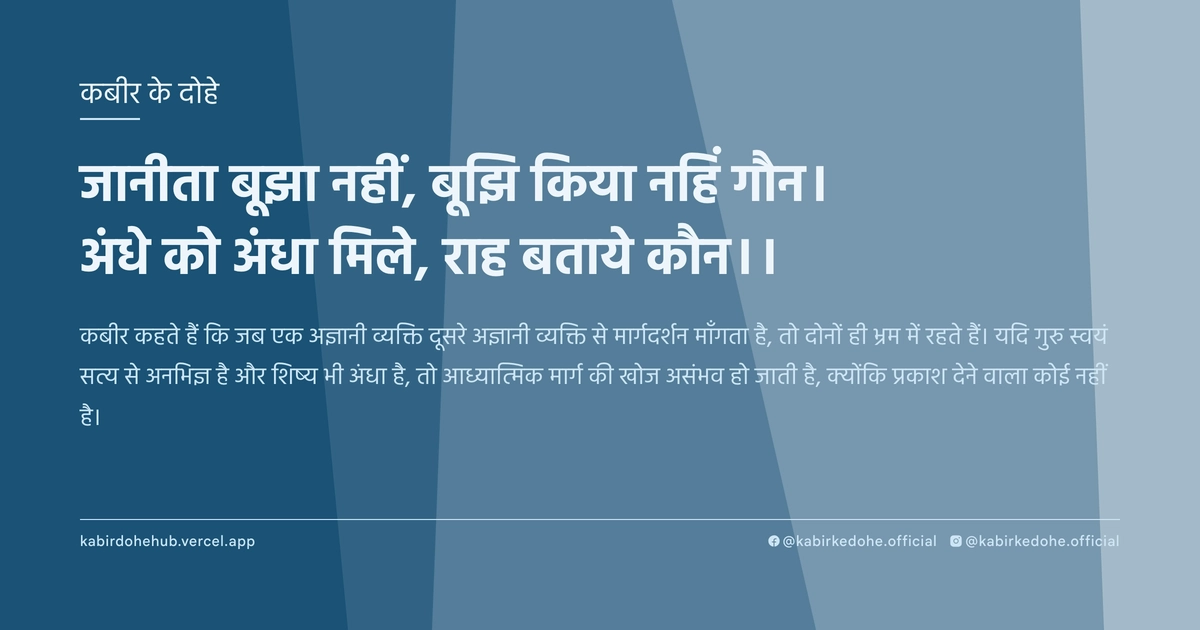
जानीता बूझा नहीं, बूझि किया नहिं गौन।
अंधे को अंधा मिले, राह बताये कौन।।
Jaanita boojha nahin, boojhi kiya nahin gaun. Andhe ko andha mile, raah bataaye kaun.
इस पृष्ठ पर इस कबीर दोहे का अर्थ (meaning), हिंदी व्याख्या और अंग्रेज़ी अनुवाद, दार्शनिक विश्लेषण और व्यावहारिक जीवन सीख दी गई है। यह दोहा गुरु महत्व (The Guru's Importance) विषय से जुड़ा है — Kabir doha meaning and explanation in Hindi and English.
अर्थ (Meaning):
कबीर कहते हैं कि जब एक अज्ञानी व्यक्ति दूसरे अज्ञानी व्यक्ति से मार्गदर्शन माँगता है, तो दोनों ही भ्रम में रहते हैं। यदि गुरु स्वयं सत्य से अनभिज्ञ है और शिष्य भी अंधा है, तो आध्यात्मिक मार्ग की खोज असंभव हो जाती है, क्योंकि प्रकाश देने वाला कोई नहीं है।
Kabir asserts that when an ignorant person seeks guidance from another who is equally uninformed, both remain trapped in delusion. If the teacher is blind to the truth and the seeker is likewise blind, the path to spiritual liberation remains hidden, for there is no one to provide the light of knowledge.
व्याख्या (Interpretation):
शाब्दिक अर्थ यह है कि दो अंधे व्यक्ति एक-दूसरे का मार्ग नहीं खोज सकते। रूपकात्मक रूप से, 'अंधा' वह है जो माया और अहंकार के वश में है। यहाँ 'अंधापन' केवल दृष्टि की कमी नहीं, बल्कि विवेक (Discernment) का अभाव है। यह दोहा निर्गुण भक्ति के उस सिद्धांत पर आधारित है जहाँ केवल आत्म-साक्षात्कार ही वास्तविक ज्ञान है। जब साधक ऐसे गुरु के पास जाता है जो केवल शास्त्रों का रटंत ज्ञान रखता है पर अनुभवहीन है, तो वह द्वैत के जाल में और अधिक उलझ जाता है। यह आत्मा और ब्रह्म की एकता को पहचानने में आने वाली बाधाओं को दर्शाता है, जहाँ अज्ञानता एक अंतहीन चक्र बन जाती है।
Literally, two blind people cannot guide each other. Metaphorically, the 'blind' person is one enslaved by Maya (illusion) and the ego. Here, 'blindness' is not a physical lack of sight but a deficiency of Viveka (spiritual discernment). This couplet is rooted in the Nirgun Bhakti principle where only self-realization constitutes true knowledge. When a seeker approaches a guru who possesses only rote scriptural knowledge without experiential realization, they become further entangled in the web of duality. It illustrates the obstacles in recognizing the non-duality of Atman and Brahman, where ignorance transforms into an endless cycle of confusion.
दार्शनिक विश्लेषण (Philosophical Analysis):
कबीर का यह दोहा मध्यकालीन भारत के उस सामाजिक और धार्मिक परिवेश पर प्रहार करता है जहाँ धर्म केवल कर्मकांडों और बाहरी आडंबरों तक सीमित हो गया था। उन्होंने देखा कि पंडित और मौलवी, जो स्वयं सत्य के अनुभव से शून्य थे, आम जनता को स्वर्ग और नर्क का डर दिखाकर गुमराह कर रहे थे। यह स्थिति 'अंधे द्वारा अंधे को राह दिखाने' जैसी थी। कबीर यहाँ तर्क देते हैं कि ज्ञान केवल पुस्तकों से नहीं, बल्कि आंतरिक अनुभव (Anubhava) से आता है।
अद्वैत वेदांत के परिप्रेक्ष्य में, यह अविद्या (Avidya) की स्थिति है। जब अविद्या से ग्रस्त व्यक्ति दूसरे अविद्याग्रस्त व्यक्ति का अनुसरण करता है, तो वह केवल अपनी गलत धारणाओं की पुष्टि करता है। यह मनोवैज्ञानिक रूप से 'कन्फर्मेशन बायस' जैसा है, जहाँ हम केवल वही सुनना चाहते हैं जो हमारे मौजूदा भ्रमों को सही ठहराए। कबीर इस चक्र को तोड़ने के लिए 'सहज' मार्ग की बात करते हैं।
सूफी मत के 'फना' के सिद्धांत से जोड़कर देखें तो, जब तक अहंकार (नफ्स) जीवित है, मनुष्य अंधा है। यदि मार्गदर्शक का अहंकार अभी भी मौजूद है, तो वह शिष्य को केवल अपने अहंकार के प्रतिबिंब की ओर ले जाएगा। वास्तविक गुरु वह है जिसने स्वयं को मिटा दिया है और अब केवल परमात्मा का दर्पण है।
कबीर का विद्रोह केवल व्यक्तियों के खिलाफ नहीं, बल्कि उस व्यवस्था के खिलाफ था जो बिना अनुभव के अधिकार जताती थी। वे जाति और धर्म की सीमाओं को तोड़कर उस सत्य की बात करते हैं जो सार्वभौमिक है। उनके लिए, एक अनपढ़ बुनकर जो सत्य को अनुभव करता है, उस विद्वान से श्रेष्ठ है जिसने केवल ग्रंथों को पढ़ा है पर स्वयं को नहीं जाना।
अंततः, यह विश्लेषण हमें यह समझने पर मजबूर करता है कि आध्यात्मिक यात्रा में 'संगति' का चुनाव कितना महत्वपूर्ण है। यदि हम ऐसे लोगों के बीच रहते हैं जो केवल भौतिकता और माया को सत्य मानते हैं, तो हम कभी भी उस पारलौकिक सत्य को नहीं देख पाएंगे। मुक्ति का मार्ग केवल तभी प्रशस्त होता है जब प्रकाश (ज्ञान) का मिलन अंधकार (अज्ञान) से होता है, न कि जब दो अंधकार आपस में मिलते हैं।
This couplet by Kabir strikes at the heart of the social and religious climate of medieval India, where spirituality had been reduced to mere rituals and outward displays. He observed that priests and clerics, devoid of actual experiential truth, were misleading the masses with fears of heaven and hell. This situation was akin to 'the blind leading the blind.' Kabir argues that true knowledge does not stem from books, but from internal experience (Anubhava).
From the perspective of Advaita Vedanta, this is the state of Avidya (primordial ignorance). When a person gripped by Avidya follows another in the same state, they merely reinforce their own misconceptions. Psychologically, this mirrors 'confirmation bias,' where one seeks validation for existing delusions rather than the disruptive truth of liberation. Kabir proposes the 'Sahaj' path to break this cycle.
Connecting this to the Sufi concept of 'Fana' (annihilation of the self), as long as the ego (Nafs) persists, the human remains blind. If the guide's ego is still intact, they will lead the disciple only toward a reflection of their own ego. A true Guru is one who has annihilated the self and has become a transparent mirror for the Divine.
Kabir's rebellion was not merely against individuals, but against a systemic authority that claimed spiritual mastery without personal realization. He transcended the boundaries of caste and creed to speak of a universal truth. For him, an illiterate weaver who experiences the Truth is superior to a scholar who has read all the scriptures but has not known himself.
Ultimately, this analysis compels us to realize the critical importance of 'Satsang' (company of the truth). If we surround ourselves with those who perceive only materiality and Maya as reality, we will never glimpse the transcendental truth. The path to liberation opens only when light (Jnana) encounters darkness (Ajñana), not when two darknesses merge.
मूल संदेश (Core Message):
- बाहरी मार्गदर्शन अक्सर आंतरिक अंधकार को बढ़ाता है।
- सत्य पुस्तकों में नहीं, स्वयं के अनुभव में निहित है।
- अहंकार का त्याग ही वास्तविक दृष्टि की प्राप्ति है।
- बिना विवेक के श्रद्धा केवल एक भ्रम है।
- परमात्मा का मार्ग स्वयं के भीतर की यात्रा है।
- External guidance often amplifies internal darkness.
- Truth resides in personal experience, not in books.
- The surrender of ego is the attainment of true vision.
- Faith without discernment is merely a delusion.
- The path to the Divine is an inward journey.
व्यावहारिक उदाहरण (Practical Example):
एक समय की बात है, वाराणसी के घाटों पर माधव नाम का एक वृद्ध बुनकर रहता था। माधव जीवन भर केवल कपड़े बुनता रहा, लेकिन उसके मन में हमेशा यह सवाल रहता था कि जीवन का वास्तविक उद्देश्य क्या है। वह शहर के सबसे बड़े विद्वान पंडित जी के पास गया, जिन्होंने उसे कठिन संस्कृत श्लोक रटा दिए और कई जटिल अनुष्ठानों की सूची थमा दी। पंडित जी स्वयं मानसिक तनाव और क्रोध से ग्रस्त थे, लेकिन वे अपनी विद्वत्ता का प्रदर्शन करते थे। माधव ने वर्षों तक उनका अनुसरण किया, लेकिन उसका मन और अधिक अशांत हो गया। उसे लगा कि वह एक ऐसे अंधे रास्ते पर चल रहा है जहाँ उसे केवल शब्दों का शोर सुनाई देता था, शांति नहीं।
एक दिन माधव की मुलाकात एक साधारण से साधु से हुई जो नदी किनारे मौन बैठे थे। उस साधु ने माधव की आँखों में देखा और केवल एक बात कही, 'पुत्र, बाहर की किताबों को बंद करो और अपने भीतर की खामोशी को सुनो।' माधव को अचानक महसूस हुआ कि पंडित जी और वह स्वयं, दोनों ही बाहरी दुनिया के अंधे थे। पंडित जी शास्त्रों के अंधे थे और माधव दूसरों के भरोसे रहने के अंधेपन में था।
इस 'कबीर ट्विस्ट' ने माधव की पूरी सोच बदल दी। उसने महसूस किया कि वह एक ऐसे व्यक्ति से रास्ता पूछ रहा था जिसे खुद मंजिल का पता नहीं था। उसने अनुष्ठानों को छोड़कर आत्म-निरीक्षण का मार्ग अपनाया। उसने देखा कि जब वह पूरी ईमानदारी से अपना काम करता है और हर धागे में परमात्मा को देखता है, तो वही उसकी प्रार्थना बन जाती है।
माधव ने अब दूसरों को उपदेश देना बंद कर दिया। जब लोग उससे रास्ता पूछने आते, तो वह उन्हें किसी मंदिर या किताब की ओर भेजने के बजाय, उन्हें उनके अपने भीतर झांकने के लिए प्रेरित करता।
उसने सीखा कि अज्ञानता का सबसे बड़ा खतरा यह नहीं है कि हम नहीं जानते, बल्कि यह है कि हम यह मान लेते हैं कि हम जानते हैं।
उसका जीवन अब एक शांत नदी की तरह बहने लगा। वह अब किसी बाहरी प्रमाण का मोहताज नहीं था।
उसने पाया कि जब मार्गदर्शक और अनुयायी दोनों अपनी आंतरिक अंधता को स्वीकार कर लेते हैं, तभी वास्तविक प्रकाश का जन्म होता है।
माधव की कहानी हमें सिखाती है कि अंधभक्ति केवल भ्रम को बढ़ाती है। विवेक ही वह एकमात्र मशाल है जो हमें अंधेरे से बाहर निकाल सकती है।
Once, in the ghats of Varanasi, lived an elderly weaver named Madhav. All his life, Madhav wove cloth, but a question constantly haunted him: what is the true purpose of life? He approached the city's most renowned scholar, a Pandit, who taught him complex Sanskrit shlokas and handed him a list of intricate rituals. The Pandit himself was plagued by mental stress and anger, yet he projected an image of absolute mastery. Madhav followed him for years, but his mind grew more turbulent. He felt he was walking a blind path where he heard only the noise of words, not the silence of peace.
One day, Madhav encountered a simple monk sitting in silence by the river. The monk looked into Madhav's eyes and said only one thing: 'Son, close the external books and listen to the silence within you.' Madhav suddenly realized that both the Pandit and he himself were blind in different ways. The Pandit was blind by his reliance on scriptures, and Madhav was blind in his dependence on others for truth.
This 'Kabir Twist' transformed Madhav's entire perspective. He realized he had been asking for directions from someone who didn't even know the destination. He abandoned the rituals and embraced the path of self-inquiry.
He discovered that when he performed his weaving with total honesty and saw the Divine in every thread, the work itself became his prayer.
Madhav stopped giving lectures to others. When people came to him seeking the path, instead of directing them to a temple or a book, he encouraged them to peer into their own interiority.
He learned that the greatest danger of ignorance is not that we do not know, but that we believe we do.
His life began to flow like a serene river. He was no longer dependent on external validation.
He found that when both the guide and the follower acknowledge their internal blindness, only then is the true light born.
Madhav's story teaches us that blind faith only amplifies delusion. Discernment is the only torch that can lead us out of the dark.
अभ्यास मार्गदर्शन (Practice Guidance):
- प्रतिदिन 20 मिनट 'साक्षी भाव' का अभ्यास करें: अपने विचारों को बिना किसी निर्णय के देखें, जैसे आप किसी और के विचार देख रहे हों।
- आत्म-पूछताछ जर्नल: हर रात लिखें कि आज आपने किस बात पर बिना सोचे-समझे विश्वास किया और वह विश्वास कहाँ से आया?
- व्यवहार परिवर्तन: किसी भी 'विशेषज्ञ' की सलाह मानने से पहले स्वयं से पूछें, 'क्या यह सलाह मेरे आंतरिक सत्य से मेल खाती है या मैं केवल डर/लालच के कारण इसे मान रहा हूँ?'
- नैदानिक चेकलिस्ट (Diagnostic Checklist): यदि आप बार-बार दूसरों से अपनी जीवन की समस्याओं का समाधान खोज रहे हैं और आंतरिक शांति महसूस नहीं कर रहे, तो आप 'अंधे का हाथ' पकड़े हुए हैं।
- Practice 'Witness Consciousness' for 20 minutes daily: Observe your thoughts without judgment, as if you are observing someone else's mind.
- Self-Inquiry Journal: Every night, write down one thing you believed blindly today and trace the origin of that belief.
- Behavioral Shift: Before accepting 'expert' advice, ask yourself, 'Does this align with my inner truth, or am I following it out of fear or greed?'
- Diagnostic Checklist: If you are constantly seeking external solutions for internal problems and feel no lasting peace, you are likely 'holding the hand of the blind'.
चिंतन प्रश्न (Reflection Questions):
- मेरे जीवन में वे कौन से 'गुरु' या प्रभाव हैं जिन्हें मैं बिना प्रश्न किए मान रहा हूँ?
- क्या मेरी आध्यात्मिक खोज वास्तव में सत्य के लिए है, या मैं केवल अपनी मौजूदा मान्यताओं की पुष्टि चाहता हूँ?
- मेरा 'डिजिटल अहंकार' मुझे किन लोगों का अनुसरण करने के लिए प्रेरित करता है, और क्या वे वास्तव में जागृत हैं?
- यदि मैं अपनी सभी उपाधियों और ज्ञान को हटा दूँ, तो मेरे भीतर क्या शेष बचेगा?
- मैं अपनी अज्ञानता को स्वीकार करने से क्यों डरता हूँ?
- क्या मैं दूसरों को राह दिखाने की कोशिश में अपनी स्वयं की अंधता को अनदेखा कर रहा हूँ?
- Who are the 'guides' or influences in my life that I follow without questioning?
- Is my spiritual quest truly for the Truth, or am I merely seeking validation for my existing beliefs?
- How does my 'digital ego' drive me to follow certain people, and are they truly awakened?
- If I strip away all my titles and acquired knowledge, what remains within me?
- Why am I afraid to acknowledge my own ignorance?
- Am I ignoring my own blindness while attempting to show the way to others?