
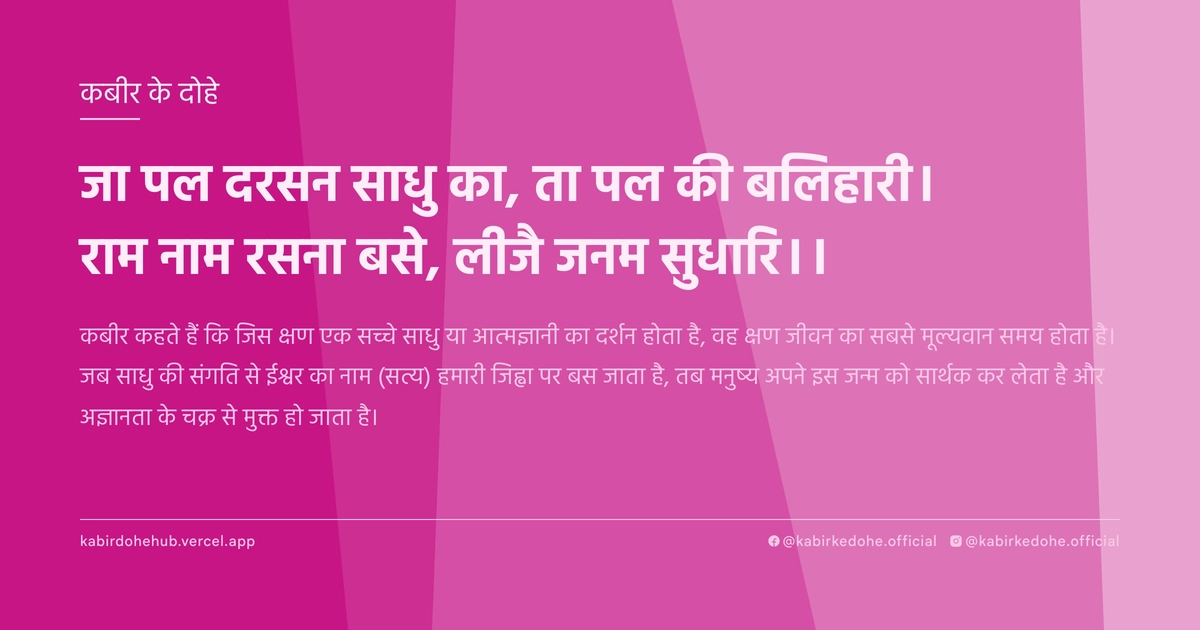
जा पल दरसन साधु का, ता पल की बलिहारी।
राम नाम रसना बसे, लीजै जनम सुधारि।।
Ja pal darasan sadhu ka, ta pal ki balihari. Ram naam rasna base, leeje janam sudhari.
इस पृष्ठ पर इस कबीर दोहे का अर्थ (meaning), हिंदी व्याख्या और अंग्रेज़ी अनुवाद, दार्शनिक विश्लेषण और व्यावहारिक जीवन सीख दी गई है। यह दोहा सत्संग (Satsang) विषय से जुड़ा है — Kabir doha meaning and explanation in Hindi and English.
अर्थ (Meaning):
कबीर कहते हैं कि जिस क्षण एक सच्चे साधु या आत्मज्ञानी का दर्शन होता है, वह क्षण जीवन का सबसे मूल्यवान समय होता है। जब साधु की संगति से ईश्वर का नाम (सत्य) हमारी जिह्वा पर बस जाता है, तब मनुष्य अपने इस जन्म को सार्थक कर लेता है और अज्ञानता के चक्र से मुक्त हो जाता है।
Kabir asserts that the moment one encounters a true Satguru or an enlightened soul is a moment of supreme value. When the divine name—representing the ultimate truth—resides on the tongue through the guidance of such a sage, the seeker transforms their existence and redeems their life from the cycle of ignorance.
व्याख्या (Interpretation):
यहाँ 'साधु' का अर्थ केवल बाहरी वेशभूषा वाले संन्यासी से नहीं, बल्कि उस 'सिद्ध पुरुष' से है जिसने अपनी इंद्रियों पर विजय प्राप्त कर ली है। 'बलिहारी' होना यह दर्शाता है कि अहंकार का विसर्जन ही ज्ञान का द्वार है। यह दोहा निर्गुण भक्ति के उस सिद्धांत को रेखांकित करता है जहाँ गुरु केवल एक माध्यम है जो साधक को उसके भीतर छिपे 'राम' (परमात्मा) से मिलाता है। माया के आवरण को हटाने के लिए एक जीवित प्रमाण (साधु) की आवश्यकता होती है। जब 'राम नाम' रसना पर बसता है, तो यह केवल मंत्रोच्चार नहीं, बल्कि चेतना का रूपांतरण है। यह अद्वैत वेदांत के उस सत्य की ओर संकेत है जहाँ जीव और ब्रह्म की पृथकता समाप्त हो जाती है। अंततः, 'जनम सुधारि' का अर्थ है अपनी निम्न चेतना को उच्च आध्यात्मिक चेतना में बदलना।
The term 'Sadhu' here does not refer to a mere ascetic in saffron robes, but to the 'Siddha'—one who has realized the Absolute. 'Balihari' signifies the total surrender of the ego, which is the only gateway to true gnosis. This verse underscores the Nirgun Bhakti principle where the Guru acts as a catalyst, bridging the gap between the seeker and the immanent 'Ram' (the Universal Consciousness). To pierce the veil of Maya, a living embodiment of truth is essential. When the 'Name' resides on the tongue, it is not mere ritualistic chanting but a profound shift in consciousness. This aligns with Advaita Vedanta, suggesting the dissolution of the perceived duality between the Atman and Brahman. Ultimately, 'redeeming the birth' implies the transmutation of a limited, ego-driven existence into a state of universal awareness.
दार्शनिक विश्लेषण (Philosophical Analysis):
कबीर का यह दोहा उस सामाजिक और धार्मिक परिवेश में लिखा गया था जहाँ कर्मकांड और बाहरी आडंबरों की प्रधानता थी। कबीर ने स्पष्ट किया कि मोक्ष किसी मंदिर, मस्जिद या कठिन तपस्या से नहीं, बल्कि एक जीवंत सत्य के सान्निध्य से मिलता है। यह दृष्टिकोण सूफी मत के 'पीर' और वेदांत के 'गुरु' की अवधारणा का संगम है, जहाँ मार्गदर्शन के बिना आध्यात्मिक यात्रा दिशाहीन हो सकती है।
यहाँ 'राम' शब्द का प्रयोग कबीर ने पारंपरिक अयोध्या के राजा के लिए नहीं, बल्कि उस निराकार, सर्वव्यापी तत्व के लिए किया है जो कण-कण में व्याप्त है। यह निर्गुण भक्ति का सार है—ईश्वर को किसी मूर्ति में नहीं, बल्कि स्वयं के भीतर और सत्य के मार्ग पर चलने वालों में खोजना। कबीर जाति और वर्ग के भेदों को नकारते हुए कहते हैं कि साधुत्व का आधार जन्म नहीं, बल्कि अनुभव और आचरण है।
मनोवैज्ञानिक स्तर पर, यह दोहा 'संक्रमण' (Transformation) की बात करता है। जब एक जिज्ञासु किसी ऐसे व्यक्ति से मिलता है जिसने सत्य को पा लिया है, तो उसके भीतर का संशय समाप्त हो जाता है। यह 'सत्संग' की शक्ति है जो अवचेतन मन में गहरे बैठे भ्रमों को नष्ट करती है। अहंकार का विसर्जन (बलिहारी होना) ही वह बिंदु है जहाँ से वास्तविक विकास शुरू होता है।
कबीर यहाँ यह भी चेतावनी देते हैं कि बिना सही मार्गदर्शन के आध्यात्मिक प्रयास अक्सर अहंकार को और बढ़ा देते हैं। 'जनम सुधारि' का अर्थ केवल मृत्यु के बाद स्वर्ग पाना नहीं है, बल्कि इसी जीवन में जीवित रहते हुए अपनी प्रवृत्तियों को शुद्ध करना है। यह एक सक्रिय आध्यात्मिक क्रांति है, न कि निष्क्रिय प्रतीक्षा।
अंततः, यह दर्शन हमें सिखाता है कि सत्य का मार्ग व्यक्तिगत अनुभव का मार्ग है। जब बाहरी शोर शांत होता है और आंतरिक ध्वनि (अनहद नाद) सुनाई देती है, तब मनुष्य वास्तव में 'सुधरा' हुआ कहलाता है। यह दोहा हमें बाहरी खोजों को छोड़कर आंतरिक सत्य की ओर मुड़ने का आह्वान करता है।
This couplet was composed during an era dominated by rigid ritualism and caste hierarchies. Kabir challenges the notion that liberation is achieved through temple pilgrimages or austere penance, proposing instead that it stems from the proximity to a living embodiment of Truth. This perspective synthesizes the Sufi concept of the 'Pir' and the Vedantic 'Guru,' suggesting that without a realized guide, the spiritual journey remains directionless.
Kabir's use of 'Ram' is intentionally subversive; he does not refer to the historical king of Ayodhya, but to the formless, omnipresent consciousness (Nirguna Brahman) that permeates every atom. This is the essence of Nirgun Bhakti—seeking the Divine not in idols, but within the self and through the company of the awakened. By decoupling holiness from birth or caste, Kabir asserts that 'Sadhutva' (saintliness) is a product of experience and conduct, not lineage.
Psychologically, the verse addresses the process of 'transmutation.' When a seeker encounters a realized soul, the cognitive dissonance and doubts of the ego are shattered. This is the power of 'Satsang' (holy company), which cleanses the subconscious of deep-seated illusions. The act of 'surrendering' (Balihari) is the critical juncture where the ego ceases to be an obstacle and becomes a bridge to the Infinite.
Furthermore, Kabir warns that spiritual pursuits without proper guidance often inflate the ego rather than dissolve it. 'Redeeming the birth' does not imply a post-mortem reward like heaven, but a biological and spiritual alchemy occurring in the present moment—refining one's instincts and perceptions while still alive. It is a call for an active spiritual revolution rather than passive waiting.
Ultimately, this philosophy teaches that the path to Truth is one of personal experience. When the external noise subsides and the internal resonance (Anahad Naad) is heard, the individual is truly 'rectified.' The verse urges a shift from the external search for divinity to the internal realization of the Self.
मूल संदेश (Core Message):
- बाहरी आडंबरों को छोड़कर आंतरिक सत्य की खोज करें।
- अहंकार का विसर्जन ही वास्तविक ज्ञान की पहली शर्त है।
- एक सच्चा मार्गदर्शक जीवन की दिशा बदल सकता है।
- ईश्वर किसी स्थान में नहीं, बल्कि शुद्ध चेतना में है।
- जीवन की सार्थकता स्वयं के रूपांतरण में है, न कि संचय में।
- Abandon external rituals to seek the internal Truth.
- The dissolution of ego is the primary prerequisite for gnosis.
- A true guide can pivot the entire trajectory of a life.
- The Divine resides not in locations, but in pure consciousness.
- The meaning of life lies in transformation, not accumulation.
व्यावहारिक उदाहरण (Practical Example):
वाराणसी के एक पुराने मोहल्ले में माधव नाम का एक बुनकर रहता था। वह अपनी कला में निपुण था, लेकिन उसका मन हमेशा इस बात से परेशान रहता था कि वह समाज में निम्न श्रेणी का माना जाता है। वह दिन-भर करघे पर काम करता, लेकिन उसके भीतर एक खालीपन था जिसे वह समझ नहीं पा रहा था।
एक दिन, उसके मोहल्ले में एक फकीर आया, जिसके पास न कोई आश्रम था और न कोई शिष्य। वह फकीर बस चुपचाप बैठता और उसकी आँखों में एक असीम शांति थी। माधव ने कई बार उसे देखा, लेकिन एक दिन वह फकीर माधव की दुकान के पास रुका और बस उसकी ओर देखकर मुस्कुराया।
माधव ने उस फकीर से पूछा, 'बाबा, मैं जीवन भर मेहनत करता हूँ, लेकिन शांति कहाँ है?' फकीर ने कोई लंबा उपदेश नहीं दिया, बस कहा, 'शांति बाहर खोजने की वस्तु नहीं, बल्कि भीतर की चुप्पी है। तू जिसे अपना दुख मानता है, वह केवल तेरी पहचान का भ्रम है।'
उस एक वाक्य ने माधव के भीतर कुछ तोड़ दिया। उसे महसूस हुआ कि वह अब तक जिस 'बुनकर' की पहचान को ढो रहा था, वह केवल एक बाहरी लिबास था। उसने महसूस किया कि उसकी असली पहचान वह चेतना है जो इस शरीर और पेशे से परे है।
माधव ने उस फकीर के चरणों में अपना अहंकार समर्पित कर दिया। उसने तय किया कि वह अब केवल पैसे कमाने के लिए नहीं, बल्कि अपनी कला को ईश्वर की प्रार्थना मानकर बुनेगा। उसके काम में अब एक नई चमक थी, क्योंकि वह अब 'मैं' के लिए नहीं, 'सबके' लिए बुन रहा था।
धीरे-धीरे माधव का व्यवहार बदल गया। वह अब जातिगत भेदभाव से ऊपर उठ गया था। जब मोहल्ले के अन्य लोग उससे उसकी शांति का राज पूछते, तो वह बस उस फकीर की मुस्कुराहट को याद करता।
उसकी जिह्वा पर अब शिकायतें नहीं, बल्कि एक मौन कृतज्ञता थी। उसने पाया कि जब उसने अपनी छोटी पहचान (अहंकार) को त्याग दिया, तो वह पूरे ब्रह्मांड से जुड़ गया।
यह 'कबीर ट्विस्ट' था—एक साधारण मुलाकात ने माधव को एक कुशल कारीगर से एक आत्मज्ञानी मनुष्य में बदल दिया। उसने जान लिया कि एक सच्चे साधु का एक पल का दर्शन पूरे जीवन की तपस्या से बड़ा हो सकता है।
In an ancient alley of Varanasi lived a weaver named Madhav. He was masterful in his craft, yet his mind was perpetually tormented by the social stigma of his low caste. He spent his days at the loom, but an inexplicable void grew within him, a hunger for something he could not name.
One day, a wandering dervish arrived in the neighborhood. He had no ashram, no disciples, and no scriptures. He simply sat in silence, but his eyes held a depth of peace that was magnetic. Madhav observed him from afar for days, feeling an odd pull toward this silent stranger.
Finally, the dervish stopped by Madhav's shop and smiled. Madhav, overwhelmed, asked, 'Baba, I toil all day, yet where is the peace?' The dervish did not offer a long sermon; he simply said, 'Peace is not a commodity to be hunted outside; it is the silence within. The sorrow you cling to is merely the illusion of your identity.'
That single sentence shattered something inside Madhav. He realized that the 'weaver' identity he had been carrying—and suffering for—was merely an external garment. He felt a spark of consciousness that existed far beyond his body, his profession, and his social standing.
In that moment, Madhav surrendered his ego at the feet of the dervish. He decided that he would no longer weave merely for sustenance, but would treat every thread as a prayer to the Divine. His work took on a new luminosity because he was no longer weaving for 'me,' but for 'the All.'
Gradually, Madhav's behavior transformed. He rose above the petty divisions of caste and creed. When neighbors asked about the secret of his newfound serenity, he would simply recall the dervish's smile.
His tongue, once sharp with complaints, was now seasoned with silent gratitude. He discovered that by shedding his small, fragmented identity, he had merged with the universal whole.
This was the 'Kabir Twist'—a fleeting encounter that transmuted a skilled artisan into an awakened soul. He learned that a single moment's glimpse of a true sage can outweigh a lifetime of misguided effort.
अभ्यास मार्गदर्शन (Practice Guidance):
- प्रतिदिन 20 मिनट मौन अभ्यास करें, जहाँ आप केवल अपनी सांसों और आंतरिक शांति के साक्षी बनें, किसी बाहरी विचार को पकड़ने का प्रयास न करें।
- एक 'अहंकार डायरी' बनाएँ: दिन भर में जब भी आपको लगे कि आप अपनी श्रेष्ठता या हीनता सिद्ध कर रहे हैं, उसे लिखें और विश्लेषण करें कि वह कौन सा 'मुखौटा' था।
- सत्संग का आधुनिक अर्थ खोजें: ऐसे लोगों के साथ समय बिताएं जो आपको चुनौती दें, आपकी मान्यताओं को तोड़ें और आपको सत्य की ओर प्रेरित करें, न कि आपकी चापलूसी करें।
- डायग्नोस्टिक चेकलिस्ट: क्या मैं दूसरों को उनकी पहचान से आंकता हूँ? क्या मैं अभी भी बाहरी मान्यता (Validation) का भूखा हूँ? क्या मैं मौन में असहज महसूस करता हूँ? यदि हाँ, तो समझें कि अहंकार अभी जीवित है।
- Practice 20 minutes of daily silence, acting solely as a witness to your breath and inner stillness, without attempting to grasp any external thought.
- Maintain an 'Ego Journal': Record moments throughout the day when you feel the need to prove your superiority or inferiority, and analyze which 'mask' you were wearing.
- Redefine 'Satsang' for the modern age: Seek company not of those who flatter you, but of those who challenge your biases and push you toward an uncomfortable yet liberating truth.
- Diagnostic Checklist: Do I still judge others by their labels? Am I still craving external validation? Do I feel anxious in absolute silence? If yes, recognize that the ego is still dominant.
चिंतन प्रश्न (Reflection Questions):
- मेरी वह कौन सी 'सामाजिक पहचान' है जिसे मैं अपनी आत्मा से ज्यादा महत्व देता हूँ?
- यदि आज मेरी सारी उपलब्धियां और पद छीन लिए जाएं, तो मेरे भीतर क्या बचेगा?
- मैं जिसे 'सत्य' मानता हूँ, क्या वह मेरा अपना अनुभव है या केवल दूसरों द्वारा दोहराया गया ज्ञान?
- क्या मैं वास्तव में किसी गुरु की तलाश में हूँ, या मैं केवल अपनी मान्यताओं की पुष्टि करने वाला व्यक्ति चाहता हूँ?
- मेरे जीवन का वह कौन सा 'पल' था जिसने मेरी चेतना को झकझोरा, और मैंने उससे क्या सीखा?
- Which 'social identity' do I value more than my own essential soul?
- If all my achievements and titles were stripped away today, what would remain of me?
- Is the 'truth' I hold a result of personal experience or merely a repetition of inherited knowledge?
- Am I truly seeking a guide, or am I merely looking for someone to validate my existing biases?
- What was the single moment in my life that shook my consciousness, and did I allow it to transform me?