
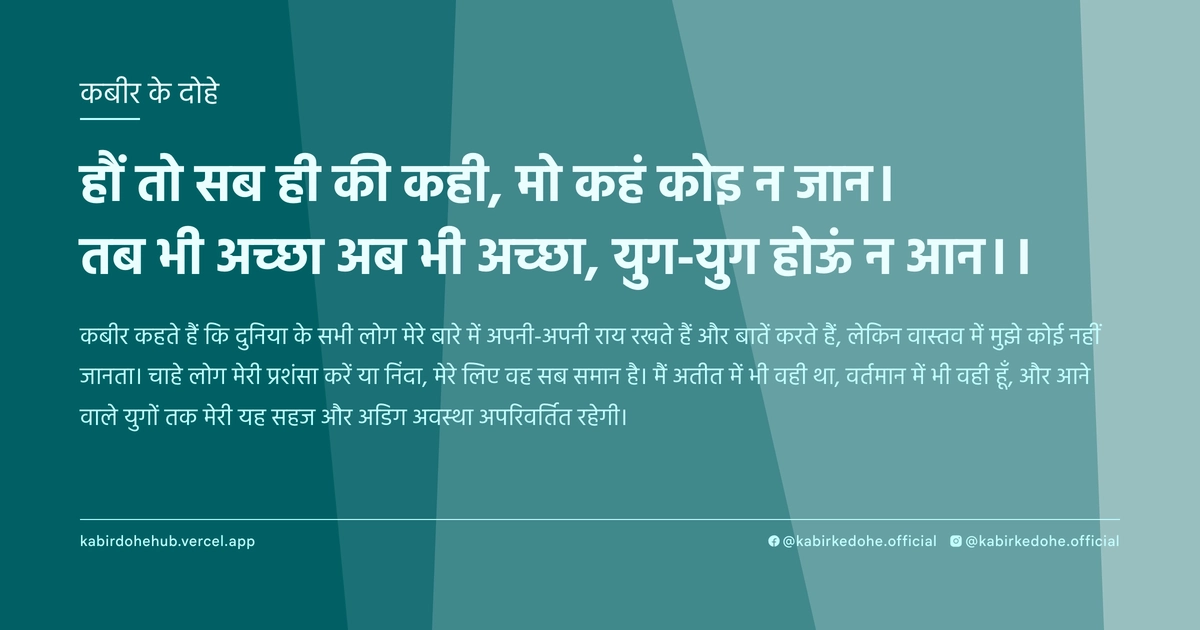
हौं तो सब ही की कही, मो कहं कोइ न जान।
तब भी अच्छा अब भी अच्छा, युग-युग होऊं न आन।।
Haun to sab hi ki kahi, mo kah koi na jaan. Tab bhi achha ab bhi achha, yug-yug houn na aan.
इस पृष्ठ पर इस कबीर दोहे का अर्थ (meaning), हिंदी व्याख्या और अंग्रेज़ी अनुवाद, दार्शनिक विश्लेषण और व्यावहारिक जीवन सीख दी गई है। यह दोहा विनम्रता (Humility) विषय से जुड़ा है — Kabir doha meaning and explanation in Hindi and English.
अर्थ (Meaning):
कबीर कहते हैं कि दुनिया के सभी लोग मेरे बारे में अपनी-अपनी राय रखते हैं और बातें करते हैं, लेकिन वास्तव में मुझे कोई नहीं जानता। चाहे लोग मेरी प्रशंसा करें या निंदा, मेरे लिए वह सब समान है। मैं अतीत में भी वही था, वर्तमान में भी वही हूँ, और आने वाले युगों तक मेरी यह सहज और अडिग अवस्था अपरिवर्तित रहेगी।
Kabir asserts that while the world speaks incessantly about him, projecting their own perceptions, no one truly knows his essence. Whether he is praised or condemned, it remains indifferent to him. He was complete then, is complete now, and shall remain unchanged and steadfast across all coming ages, existing in a state of eternal equanimity.
व्याख्या (Interpretation):
इस दोहे का शाब्दिक अर्थ है कि बाहरी दुनिया की धारणाएं व्यक्ति की वास्तविक पहचान को नहीं पकड़ सकतीं। रूपक के स्तर पर, 'सब ही की कही' माया के उस जाल को दर्शाता है जहाँ समाज व्यक्ति को लेबल देता है। कबीर यहाँ 'साक्षी भाव' की बात कर रहे हैं, जहाँ आत्मा स्वयं को कर्ता या कर्म के फल से अलग देखती है। यह निर्गुण भक्ति का चरम है, जहाँ भक्त अपनी पहचान को ब्रह्म में विलीन कर देता है, जिससे वह द्वंद्वों (अच्छा-बुरा, मान-अपमान) से ऊपर उठ जाता है। यह अद्वैत वेदांत के उस सत्य को पुष्ट करता है कि आत्मा अविनाशी और अपरिवर्तित है। अंततः, यह दोहा अहंकार के विसर्जन और शाश्वत शांति की प्राप्ति का मार्ग दिखाता है।
Literally, the verse suggests that external perceptions fail to capture a person's true essence. Metaphorically, 'everyone's saying' represents the veil of Maya, where society imposes labels and identities. Kabir speaks from the state of the 'Sakshi' or Witness, where the soul detaches itself from the roles of doer and receiver. This is the pinnacle of Nirgun Bhakti, where the devotee merges their identity into the Formless Absolute, transcending dualities like praise and blame. It affirms the Advaita Vedanta truth that the Atman is immutable and eternal. Ultimately, the doha illustrates the annihilation of the ego, leading to a state of timeless stability and peace.
दार्शनिक विश्लेषण (Philosophical Analysis):
कबीर का यह कथन उनके युग के सामाजिक और धार्मिक पाखंडों के विरुद्ध एक सशक्त प्रतिक्रिया है। उस समय धर्म को बाहरी कर्मकांडों और जातिगत श्रेष्ठता से जोड़ा जाता था। कबीर ने इस पूरी व्यवस्था को नकारते हुए यह स्थापित किया कि सत्य किसी बाहरी मान्यता में नहीं, बल्कि आंतरिक अनुभव में है। उन्होंने यह स्पष्ट किया कि जब कोई व्यक्ति 'मैं' (अहंकार) को मिटा देता है, तो समाज की टिप्पणियाँ उसके लिए अर्थहीन हो जाती हैं।
दार्शनिक रूप से, यह सूफी मत के 'फना' (अहंकार का विनाश) और वेदांत के 'ब्रह्म सत्यं जगन्मिथ्या' के करीब है। कबीर यह समझा रहे हैं कि दुनिया केवल शरीर और नाम को जानती है, जबकि वास्तविक तत्व 'अनाम' और 'अदृश्य' है। जब व्यक्ति इस शून्य में स्थित हो जाता है, तो वह समय (काल) की सीमाओं से मुक्त हो जाता है।
यहाँ 'तब भी अच्छा, अब भी अच्छा' का अर्थ नैतिक श्रेष्ठता नहीं, बल्कि 'स्थितप्रज्ञ' होने की अवस्था है। यह वह मानसिक स्थिति है जहाँ व्यक्ति सुख-दुख और लाभ-हानि में विचलित नहीं होता। यह मनोवैज्ञानिक रूपांतरण की वह प्रक्रिया है जहाँ बाहरी सत्यापन (External Validation) की भूख समाप्त हो जाती है।
कबीर का विरोध केवल ब्राह्मणों या मुल्लाओं से नहीं था, बल्कि उस मानसिक जड़ता से था जो मनुष्य को उसकी अपनी दिव्यता से दूर रखती है। वे सिखाते हैं कि जब तक आप दूसरों की नजरों में खुद को ढूंढेंगे, आप कभी मुक्त नहीं होंगे। मुक्ति तब है जब आप स्वयं को उस सार्वभौमिक चेतना का हिस्सा मान लें जो युगों-युगों से अपरिवर्तित है।
अंततः, यह दोहा यह संदेश देता है कि सत्य व्यक्तिपरक नहीं, बल्कि सार्वभौमिक है। जिसे दुनिया 'पागल' या 'विद्रोही' कह सकती है, वह वास्तव में उस परम सत्य का साक्षात्कार कर चुका होता है जिसे शब्दों में बांधना असंभव है। यह मौन की वह भाषा है जिसे केवल वही समझ सकता है जिसने अपने अहंकार की आहुति दे दी हो।
Kabir's statement is a powerful reaction against the social and religious hypocrisies of his era. At a time when religion was tethered to external rituals and caste superiority, Kabir rejected this entire framework, establishing that truth resides in internal experience rather than external validation. He clarifies that once the 'I' (ego) is dissolved, societal commentary becomes meaningless.
Philosophically, this aligns with the Sufi concept of 'Fana' (annihilation of the self) and the Vedantic principle of 'Brahman is the only truth, the world is an illusion.' Kabir explains that the world perceives only the body and the name, while the true essence is 'Anam' (nameless) and 'Adrishya' (invisible). When one resides in this void, they transcend the limitations of time (Kaal).
The phrase 'then also good, now also good' does not refer to moral superiority, but to the state of being a 'Sthitapragya'—one who is emotionally stable. This is a psychological state where the individual is no longer swayed by pleasure or pain, gain or loss. It marks a transformation where the hunger for external validation ceases entirely.
Kabir's opposition was not merely against priests or clerics, but against the mental inertia that separates humans from their own divinity. He teaches that as long as one seeks their identity through the eyes of others, liberation remains elusive. Freedom occurs when one recognizes themselves as part of the universal consciousness that remains unchanged across aeons.
Ultimately, the doha conveys that truth is not subjective but universal. One whom the world may label as 'mad' or 'rebellious' has actually realized the supreme truth that defies linguistic description. It is the language of silence, understood only by those who have sacrificed their ego on the altar of truth.
मूल संदेश (Core Message):
- बाहरी धारणाएं केवल भ्रम हैं, सत्य आंतरिक मौन में है।
- प्रशंसा और निंदा दोनों अहंकार के जाल हैं, इनसे मुक्त हों।
- अपनी पहचान को सामाजिक लेबल से ऊपर उठाएं।
- स्थिरता वह है जो समय और परिस्थिति से अपरिवर्तित रहे।
- जब 'मैं' मिट जाता है, तब केवल 'वह' (ब्रह्म) शेष रहता है।
- सत्य को शब्दों में नहीं, अनुभव में खोजें।
- External perceptions are mere illusions; truth resides in internal silence.
- Both praise and blame are traps of the ego; liberate yourself from both.
- Elevate your identity beyond the labels imposed by society.
- True stability is that which remains unchanged by time or circumstance.
- When the 'I' vanishes, only the 'Absolute' remains.
- Seek truth in direct experience, not in linguistic descriptions.
व्यावहारिक उदाहरण (Practical Example):
वाराणसी के एक पुराने घाट पर रामदीन नाम का एक वृद्ध नाविक रहता था। वह दशकों से नाव चला रहा था, लेकिन उसकी सादगी और शांत स्वभाव के कारण शहर के लोग उसे अलग-अलग नजरों से देखते थे। कुछ उसे 'मूर्ख' कहते थे क्योंकि वह कभी ज्यादा पैसे नहीं मांगता था, जबकि कुछ उसे 'संत' मानते थे क्योंकि वह सबकी मदद करता था।
रामदीन ने कभी किसी की बातों का जवाब नहीं दिया। एक दिन एक अहंकारी विद्वान उसकी नाव पर सवार हुआ और रामदीन के साधारण ज्ञान का मजाक उड़ाते हुए उसे नीचा दिखाने की कोशिश की। विद्वान ने कहा, 'तुम जैसे अनपढ़ लोग केवल दूसरों की दया पर जीते हैं, तुम्हारा कोई अस्तित्व नहीं है।'
रामदीन बस मुस्कुराया और नाव चलाता रहा। उसने महसूस किया कि वह विद्वान वास्तव में रामदीन को नहीं, बल्कि अपनी ही धारणाओं के एक प्रतिबिंब को देख रहा था। रामदीन के भीतर एक गहरा मौन था, जो उसे बाहरी शोर से सुरक्षित रखता था।
उस रात, जब विद्वान अपनी नाव से उतरा, उसने देखा कि रामदीन उसी शांति के साथ एक गरीब बच्चे को मुफ्त में नदी पार करा रहा था, जबकि वह खुद भूखा था। विद्वान को अचानक अहसास हुआ कि उसकी सारी डिग्रियां और ज्ञान उसके अहंकार को बढ़ा रहे थे, जबकि रामदीन की 'मूर्खता' वास्तव में एक उच्च चेतना थी।
रामदीन के लिए, विद्वान की गाली और किसी अन्य की प्रशंसा, दोनों एक ही हवा के झोंके की तरह थे जो आते हैं और चले जाते हैं। उसने अपनी पहचान को नाव चलाने वाले या किसी गरीब व्यक्ति के रूप में नहीं, बल्कि उस अनंत प्रवाह के रूप में देखा जो गंगा की तरह निरंतर है।
विद्वान ने रामदीन के पास जाकर क्षमा मांगी और पूछा, 'आप इतने शांत कैसे रह पाते हैं जब लोग आपके बारे में कुछ भी कहते हैं?' रामदीन ने बस इतना कहा, 'साहब, लोग उस चेहरे को जानते हैं जो वे देखना चाहते हैं, मैं तो बस वह हूँ जो मैं हूँ।'
यह 'कबीर ट्विस्ट' था। विद्वान का अहंकार टूट गया। उसने समझा कि असली ज्ञान वह नहीं है जो दूसरों को छोटा दिखाए, बल्कि वह है जो स्वयं को मिटाकर सबको समान देखे।
रामदीन की यह अवस्था 'तब भी अच्छी' थी जब वह युवा था, और 'अब भी अच्छी' थी जब वह वृद्ध हो गया। उसने समय और परिस्थिति के साथ अपना स्वभाव नहीं बदला, क्योंकि वह बाहरी दुनिया के बजाय अपने आंतरिक केंद्र से जुड़ा हुआ था।
इस अनुभव ने विद्वान के जीवन को बदल दिया। उसने अपनी किताबों को किनारे रखा और रामदीन के मौन से सीखना शुरू किया। उसने जाना कि जब आप दूसरों की राय के गुलाम नहीं रहते, तभी आप वास्तव में स्वतंत्र होते हैं।
अंततः, रामदीन की कहानी हमें सिखाती है कि हमारी असली पहचान वह नहीं है जो दुनिया हमारे बारे में लिखती है, बल्कि वह है जिसे हम अपने एकांत में अनुभव करते हैं।
On an ancient ghat in Varanasi lived an elderly boatman named Ramdeen. He had been rowing for decades, but due to his simplicity and calm nature, the townspeople viewed him through various lenses. Some called him a 'fool' because he never demanded more money, while others hailed him as a 'saint' because he helped everyone.
Ramdeen never responded to these labels. One day, an arrogant scholar boarded his boat and attempted to belittle him, mocking Ramdeen's lack of formal education. The scholar sneered, 'Uneducated people like you live only on the mercy of others; you have no real identity.'
Ramdeen simply smiled and continued rowing. He realized that the scholar was not seeing Ramdeen, but rather a reflection of his own prejudices. Within Ramdeen lay a profound silence that shielded him from the external noise.
That evening, as the scholar disembarked, he witnessed Ramdeen crossing a poor child across the river for free, despite the boatman himself being hungry. The scholar suddenly realized that while his degrees had only inflated his ego, Ramdeen's perceived 'foolishness' was actually a state of higher consciousness.
For Ramdeen, the scholar's insult and another's praise were merely gusts of wind—they arrived and departed without leaving a trace. He did not identify as a boatman or a poor man, but as an eternal flow, much like the river Ganges itself.
Overwhelmed, the scholar approached Ramdeen and asked, 'How do you remain so undisturbed regardless of what people say about you?' Ramdeen replied simply, 'Sir, people only know the face they wish to see; I am simply what I am.'
This was the 'Kabir Twist.' The scholar's ego shattered. He understood that true knowledge is not that which diminishes others, but that which erases the self to see everyone as equal.
Ramdeen's state was 'good then' when he was young, and 'good now' in his old age. He did not alter his nature based on time or circumstance because he was anchored in his internal center rather than the external world.
This encounter transformed the scholar's life. He set aside his books and began learning from Ramdeen's silence. He discovered that one is truly free only when they cease to be a slave to the opinions of others.
Ultimately, Ramdeen's story teaches us that our true identity is not the narrative the world writes about us, but the essence we experience in our own solitude.
अभ्यास मार्गदर्शन (Practice Guidance):
- प्रतिदिन 20 मिनट 'साक्षी ध्यान' का अभ्यास करें, जहाँ आप अपने विचारों और दूसरों की राय को केवल बादलों की तरह आते-जाते देखें, बिना उनसे जुड़े।
- एक 'पहचान जर्नल' बनाएँ। लिखें कि दुनिया आपको क्या मानती है और आप वास्तव में क्या महसूस करते हैं। इन दोनों के बीच के अंतर को स्वीकार करें।
- व्यवहार परिवर्तन: जब कोई आपकी प्रशंसा या आलोचना करे, तो तुरंत प्रतिक्रिया देने के बजाय 10 सेकंड का मौन रखें और स्वयं से पूछें, 'क्या यह टिप्पणी मेरी आत्मा को बदल सकती है?'
- निदान चेकलिस्ट: यदि आप किसी की टिप्पणी के बाद घंटों परेशान रहते हैं या अपनी छवि सुधारने की कोशिश करते हैं, तो समझें कि आप अभी भी 'माया' और 'अहंकार' के प्रभाव में हैं।
- Practice 'Witness Meditation' for 20 minutes daily, observing your thoughts and the opinions of others as passing clouds without attaching yourself to them.
- Maintain an 'Identity Journal.' Document how the world perceives you versus how you experience yourself. Acknowledge the gap between the persona and the essence.
- Behavioral Shift: When receiving praise or criticism, pause for 10 seconds before reacting. Ask yourself, 'Can this comment alter the fundamental nature of my soul?'
- Diagnostic Checklist: If you spend hours ruminating over a comment or feel a desperate need to curate your image, recognize that you are still under the influence of Maya and ego.
चिंतन प्रश्न (Reflection Questions):
- यदि आज आपकी सारी सामाजिक उपलब्धियां और पद छीन लिए जाएं, तो आपके पास क्या बचेगा?
- आप अपनी छवि (Image) को बचाने के लिए अपनी आत्मा की कितनी सच्चाई का बलिदान करते हैं?
- क्या आपका 'अच्छा' होना दूसरों की स्वीकृति पर निर्भर है या आपकी अपनी आंतरिक शांति पर?
- वह कौन सा हिस्सा है आपके व्यक्तित्व का जिसे दुनिया कभी नहीं जान पाएगी, चाहे आप कितनी भी कोशिश करें?
- जब आप अकेले होते हैं, तब आप कौन होते हैं, और जब आप भीड़ में होते हैं, तब आप कौन बनने का नाटक करते हैं?
- क्या आप उस मौन को सहन कर सकते हैं जहाँ आपकी कोई पहचान नहीं होती?
- If all your social achievements and titles were stripped away today, what would remain of you?
- How much of your inner truth do you sacrifice to maintain a curated public image?
- Is your sense of 'being good' dependent on external validation or internal peace?
- What part of your essence remains forever hidden from the world, regardless of your efforts to be known?
- Who are you in absolute solitude, and who do you pretend to be when surrounded by a crowd?
- Can you endure the silence where you possess no identity, no label, and no role?