
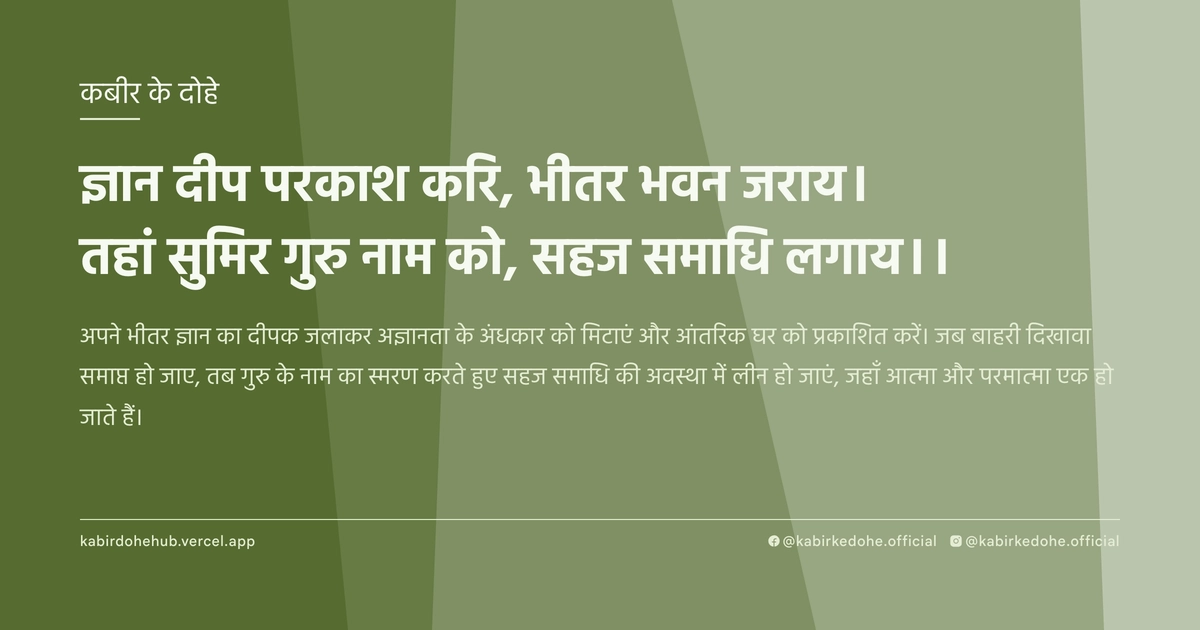
ज्ञान दीप परकाश करि, भीतर भवन जराय।
तहां सुमिर गुरु नाम को, सहज समाधि लगाय।।
Gyan deep parkash kari, bhitar bhavan jaraye. Tahan sumir guru naam ko, sahaj samadhi lagaye.
इस पृष्ठ पर इस कबीर दोहे का अर्थ (meaning), हिंदी व्याख्या और अंग्रेज़ी अनुवाद, दार्शनिक विश्लेषण और व्यावहारिक जीवन सीख दी गई है। यह दोहा सहज योग (Sahaja Yoga) विषय से जुड़ा है — Kabir doha meaning and explanation in Hindi and English.
अर्थ (Meaning):
अपने भीतर ज्ञान का दीपक जलाकर अज्ञानता के अंधकार को मिटाएं और आंतरिक घर को प्रकाशित करें। जब बाहरी दिखावा समाप्त हो जाए, तब गुरु के नाम का स्मरण करते हुए सहज समाधि की अवस्था में लीन हो जाएं, जहाँ आत्मा और परमात्मा एक हो जाते हैं।
Ignite the lamp of true knowledge within yourself to incinerate the darkness of ignorance residing in the inner house. Once the illusions are burned away, remember the Guru's name and enter a state of effortless samadhi, where the individual soul merges seamlessly with the Eternal Truth.
व्याख्या (Interpretation):
यह दोहा आंतरिक रूपांतरण की प्रक्रिया को दर्शाता है। 'ज्ञान दीप' केवल किताबी ज्ञान नहीं, बल्कि आत्म-साक्षात्कार है। 'भीतर भवन जराय' का अर्थ है अहंकार और वासनाओं के पुराने ढांचे को जला देना। यह निर्गुण भक्ति का मार्ग है जहाँ ईश्वर किसी मूर्ति में नहीं, बल्कि चेतना के शुद्ध रूप में भीतर मिलता है। जब माया का पर्दा हटता है, तब 'सहज समाधि' घटित होती है, जो जबरदस्ती की गई तपस्या नहीं बल्कि प्रेम और समर्पण का स्वाभाविक परिणाम है। यहाँ गुरु केवल एक व्यक्ति नहीं, बल्कि वह तत्व है जो अंधकार से प्रकाश की ओर ले जाता है। यह अद्वैत वेदांत की उस स्थिति को दर्शाता है जहाँ ज्ञाता, ज्ञान और ज्ञेय का भेद समाप्त हो जाता है।
This couplet depicts the process of internal alchemy. The 'lamp of knowledge' refers not to intellectual learning, but to the experiential realization of the Self. 'Burning the inner house' symbolizes the total annihilation of the ego and the structures of conditioned desire. This is the path of Nirgun Bhakti, where the Divine is sought not in external idols, but as the pure consciousness within. As the veil of Maya is lifted, 'Sahaj Samadhi' occurs—not as a forced ascetic achievement, but as a natural consequence of love and surrender. Here, the Guru is not merely a human teacher but the illuminating principle that guides the soul from darkness to light. It mirrors the Advaita Vedanta state where the distinction between the knower, the known, and the knowledge dissolves into oneness.
दार्शनिक विश्लेषण (Philosophical Analysis):
कबीर का यह संदेश उस युग की प्रतिक्रिया है जहाँ धर्म केवल बाहरी कर्मकांडों और मंदिर-मस्जिद के चक्करों तक सीमित था। वे तर्क देते हैं कि वास्तविक मंदिर मानव शरीर है। यह दृष्टिकोण सूफी मत के 'इन्सान-ए-कामिल' (पूर्ण मानव) और वेदांत के 'सोहम' (मैं वह हूँ) के करीब है। कबीर ritualism का विरोध करते हुए कहते हैं कि यदि भीतर का घर (अहंकार) नहीं जला, तो बाहरी पूजा व्यर्थ है।
दार्शनिक रूप से, 'भवन जराय' का अर्थ है 'चित्त शुद्धि'। जब तक मन पुराने संस्कारों और पूर्वाग्रहों से भरा है, तब तक सत्य का प्रकाश नहीं पड़ सकता। यह मनोवैज्ञानिक विखंडन की प्रक्रिया है जहाँ व्यक्ति अपनी सामाजिक पहचान (जाति, धर्म, पद) को त्यागकर अपनी मूल पहचान को खोजता है।
निर्गुण भक्ति में, ईश्वर को किसी आकार में नहीं बांधा जाता। कबीर के लिए 'नाम' एक ध्वनि नहीं, बल्कि एक कंपन है जो साधक को उसकी मूल प्रकृति से जोड़ता है। यह 'सहज' मार्ग है, जो कठिन तपस्या के बजाय जागरूकता और निरंतर स्मरण पर बल देता है।
यहाँ गुरु की भूमिका महत्वपूर्ण है क्योंकि बिना मार्गदर्शन के ज्ञान का दीपक जलाना कठिन है। गुरु वह दर्पण है जो साधक को उसकी अपनी अज्ञानता दिखाता है। यह प्रक्रिया अहंकार के पूर्ण विसर्जन की मांग करती है, क्योंकि दीपक तभी जलता है जब वह स्वयं को तेल और बाती के रूप में समर्पित कर देता है।
अंततः, यह दोहा अद्वैत की उस स्थिति की ओर ले जाता है जहाँ द्वैत (मैं और तुम) समाप्त हो जाता है। जब आंतरिक घर जलकर राख हो जाता है, तो जो बचता है वह अविनाशी ब्रह्म है। यह विनाश नहीं, बल्कि एक उच्चतर सृजन है, जहाँ व्यक्ति अपनी सीमितता को छोड़कर अनंतता में विलीन हो जाता है।
Kabir’s message is a direct response to an era where religion was confined to external rituals and the pilgrimage to temples and mosques. He argues that the true temple is the human body. This perspective aligns closely with the Sufi concept of 'Insan-e-Kamil' (the Perfect Human) and the Vedantic realization of 'Soham' (I am That). Kabir rejects ritualism, asserting that if the 'inner house' of ego is not incinerated, external worship remains futile.
Philosophically, 'burning the house' refers to 'Chitta Shuddhi' or the purification of the mind. As long as the mind is cluttered with old impressions and prejudices, the light of truth cannot penetrate. This is a process of psychological dismantling where the individual sheds social identities—caste, creed, and status—to discover their primordial essence.
In Nirgun Bhakti, the Divine is not bound by form. For Kabir, the 'Name' (Naam) is not a mere word but a cosmic vibration that reconnects the seeker with their original nature. This is the 'Sahaj' path, which emphasizes awareness and constant remembrance over rigorous, forced asceticism.
The role of the Guru is pivotal here, as igniting the lamp of knowledge is nearly impossible without guidance. The Guru acts as a mirror, reflecting the seeker's own ignorance back to them. This process demands the total surrender of the ego; just as a lamp consumes its own oil and wick to produce light, the seeker must consume their identity to find Truth.
Ultimately, this couplet leads toward the Advaita state where duality (the 'I' and 'Thou') ceases to exist. When the inner house is reduced to ashes, what remains is the indestructible Brahman. This is not destruction, but a higher creation, where the individual transcends limitation to merge with the Infinite.
मूल संदेश (Core Message):
- बाहरी कर्मकांड केवल भ्रम हैं; वास्तविक पूजा आंतरिक शुद्धि है।
- अहंकार का विनाश ही सत्य के प्रकाश का उदय है।
- ज्ञान वह नहीं जो पढ़ा जाए, बल्कि वह है जो अनुभव किया जाए।
- गुरु का नाम एक सेतु है जो सीमितता से अनंतता की ओर ले जाता है।
- सहजता ही सर्वोच्च साधना है; प्रयासहीनता ही पूर्णता है।
- External rituals are mere illusions; true worship is internal purification.
- The annihilation of ego is the dawn of the light of truth.
- Knowledge is not what is read, but what is lived and experienced.
- The Guru's name is the bridge from limitation to infinity.
- Spontaneity is the highest discipline; effortlessness is perfection.
व्यावहारिक उदाहरण (Practical Example):
वाराणसी के एक पुराने घाट पर रहने वाले माधव नाम के एक वृद्ध बुनकर थे। माधव अपनी कला में निपुण थे, लेकिन उनका मन हमेशा इस बात से भरा रहता था कि वे शहर के सबसे श्रेष्ठ बुनकर हैं। उनकी यह श्रेष्ठता उन्हें दूसरों से अलग करती थी और उनके भीतर एक सूक्ष्म अहंकार पैदा कर देती थी।
एक दिन उनकी मुलाकात एक घुमक्कड़ फकीर से हुई। फकीर ने माधव के सुंदर कपड़ों की प्रशंसा नहीं की, बल्कि उनसे पूछा, 'माधव, तूने बाहर के कपड़े तो बहुत सुंदर बुने, पर क्या तूने अपने भीतर के फटे हुए घर की मरम्मत की?'
माधव को यह बात चुभी। उन्होंने तर्क दिया कि वे धर्म का पालन करते हैं और दान देते हैं। फकीर ने मुस्कुराते हुए कहा, 'तेरा ज्ञान केवल तेरी जुबान पर है, तेरे हृदय में नहीं। तूने ज्ञान का दीपक जलाया ही नहीं, बस उसकी रोशनी की बातें की हैं।'
माधव ने कई दिनों तक इस बात पर विचार किया। उन्होंने महसूस किया कि उनकी 'श्रेष्ठता' ही वह अंधकार था जिसने उन्हें वास्तव में दूसरों से और स्वयं से दूर कर दिया था। उन्होंने अपनी पहचान को 'श्रेष्ठ बुनकर' से बदलकर 'एक साधारण सेवक' के रूप में देखना शुरू किया।
उन्होंने अपनी कला को अब अहंकार की संतुष्टि के लिए नहीं, बल्कि ईश्वर की सेवा के रूप में देखना शुरू किया। उन्होंने उन गरीब बच्चों को मुफ्त में बुनाई सिखानी शुरू की जिन्हें समाज ने ठुकरा दिया था।
जैसे-जैसे उन्होंने दूसरों की सेवा की, उनके भीतर का 'मैं' धीरे-धीरे जलने लगा। वह अहंकार, जो उनके लिए एक सुरक्षित घर की तरह था, अब ढह रहा था।
एक शाम, जब वे शांति से बैठे थे, उन्हें महसूस हुआ कि अब उन्हें किसी बाहरी प्रशंसा की आवश्यकता नहीं है। उनके भीतर एक गहरा मौन छा गया था।
यही वह 'सहज समाधि' थी। माधव अब केवल एक बुनकर नहीं थे; वे उस अनंत चेतना का हिस्सा बन चुके थे, जहाँ न कोई छोटा था, न बड़ा, बस एक अखंड प्रकाश था।
In the ancient ghats of Varanasi lived an elderly weaver named Madhav. Madhav was a master of his craft, but his mind was perpetually clouded by the belief that he was the finest weaver in the city. This sense of superiority separated him from others and fostered a subtle, persistent ego.
One day, he encountered a wandering fakir. The fakir did not praise Madhav's exquisite fabrics; instead, he asked, 'Madhav, you have woven beautiful clothes for the outside, but have you repaired the torn house within?'
Madhav felt stung by the remark. He argued that he followed all religious rites and gave alms to the poor. The fakir smiled and replied, 'Your knowledge exists only on your tongue, not in your heart. You have not lit the lamp of knowledge; you have only spoken of its light.'
Madhav pondered these words for many days. He realized that his 'superiority' was the very darkness that had distanced him from others and from his own true self.
He began to shift his identity from being the 'Greatest Weaver' to being a 'Simple Servant.' He started teaching weaving for free to impoverished children whom society had discarded.
As he served others, the 'I' within him began to slowly incinerate. The ego, which had felt like a secure house protecting his status, was now crumbling.
One evening, as he sat in stillness, he realized he no longer craved external validation. A profound silence descended upon his heart.
This was the state of 'Sahaj Samadhi.' Madhav was no longer just a weaver; he had become a part of that infinite consciousness where there was no high or low, only a single, unbroken light.
अभ्यास मार्गदर्शन (Practice Guidance):
- प्रतिदिन 20 मिनट मौन रहकर 'साक्षी भाव' का अभ्यास करें, जहाँ आप अपने विचारों को बिना किसी निर्णय के केवल देखें।
- आत्म-पूछताछ जर्नल: प्रतिदिन लिखें कि आज किस क्षण मेरा अहंकार (मैं-पन) जागृत हुआ और उसने मुझे सत्य से कैसे दूर किया।
- व्यवहार परिवर्तन: दिन में कम से कम एक बार ऐसा कार्य करें जिसमें आपको कोई श्रेय न मिले और आप अपनी पहचान पूरी तरह गुप्त रखें।
- डायग्नोस्टिक चेकलिस्ट: क्या मैं दूसरों की प्रशंसा पर निर्भर हूँ? क्या मैं अपनी मान्यताओं को दूसरों पर थोपता हूँ? क्या मैं मौन में असहज महसूस करता हूँ? (यदि हाँ, तो आंतरिक घर अभी जलना बाकी है)।
- Practice 'Witness Consciousness' for 20 minutes daily, observing your thoughts as a detached observer without judgment.
- Self-Inquiry Journaling: Record moments each day when the ego ('I-ness') surfaced and how it distorted your perception of truth.
- Behavioral Shift: Perform at least one act of service daily where you receive no credit and keep your identity completely anonymous.
- Diagnostic Checklist: Am I dependent on external validation? Do I impose my beliefs on others? Do I feel uneasy in silence? (If yes, the inner house is yet to be incinerated).
चिंतन प्रश्न (Reflection Questions):
- मेरी वह कौन सी सामाजिक पहचान है जिसे खोने के डर से मैं अपनी आत्मा को दबाए रखता हूँ?
- क्या मेरा 'आध्यात्मिक ज्ञान' वास्तव में मेरा अहंकार बढ़ा रहा है, जिससे मैं दूसरों को तुच्छ समझने लगा हूँ?
- यदि मेरी सारी उपलब्धियाँ और पद आज छीन लिए जाएँ, तो मेरे भीतर क्या बचेगा?
- मैं किन मानसिक दीवारों (पूर्वाग्रहों) के पीछे छिपा हूँ जिन्हें जलाने की हिम्मत मैं नहीं जुटा पा रहा?
- क्या मेरी भक्ति वास्तव में समर्पण है, या यह केवल ईश्वर से कुछ पाने का एक परिष्कृत सौदा है?
- Which social identity am I so afraid of losing that I continue to suppress my authentic soul?
- Is my 'spiritual knowledge' actually inflating my ego, making me view others as inferior?
- If all my achievements and titles were stripped away today, what would remain of me?
- What mental walls (prejudices) am I hiding behind that I lack the courage to incinerate?
- Is my devotion truly a surrender, or is it merely a sophisticated bargain to gain something from the Divine?