
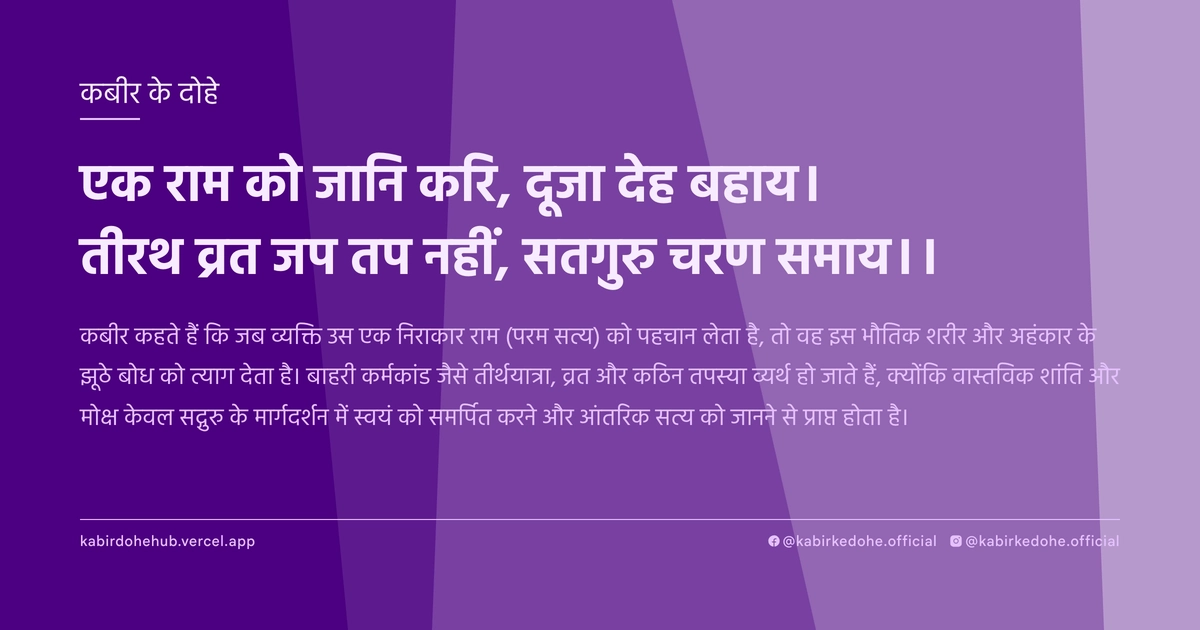
एक राम को जानि करि, दूजा देह बहाय।
तीरथ व्रत जप तप नहीं, सतगुरु चरण समाय।।
Ek Ram ko jaani kari, dooja deh bahaye. Teerath vrat jap tap nahi, satguru charan samaye.
इस पृष्ठ पर इस कबीर दोहे का अर्थ (meaning), हिंदी व्याख्या और अंग्रेज़ी अनुवाद, दार्शनिक विश्लेषण और व्यावहारिक जीवन सीख दी गई है। यह दोहा गुरु महत्व (The Guru's Importance) विषय से जुड़ा है — Kabir doha meaning and explanation in Hindi and English.
अर्थ (Meaning):
कबीर कहते हैं कि जब व्यक्ति उस एक निराकार राम (परम सत्य) को पहचान लेता है, तो वह इस भौतिक शरीर और अहंकार के झूठे बोध को त्याग देता है। बाहरी कर्मकांड जैसे तीर्थयात्रा, व्रत और कठिन तपस्या व्यर्थ हो जाते हैं, क्योंकि वास्तविक शांति और मोक्ष केवल सद्गुरु के मार्गदर्शन में स्वयं को समर्पित करने और आंतरिक सत्य को जानने से प्राप्त होता है।
Kabir asserts that once a seeker recognizes the one true Ram—the formless Absolute Truth—the illusion of the separate physical body and the ego dissolves. External rituals such as pilgrimages, fasting, and rigorous penance become redundant, for true liberation is found only by surrendering to the grace of the Satguru and merging one's consciousness with the eternal essence.
व्याख्या (Interpretation):
इस दोहे का शाब्दिक अर्थ है कि एक ईश्वर को जानकर शरीर का मोह छोड़ देना चाहिए। गहराई में, 'एक राम' यहाँ किसी पौराणिक व्यक्ति नहीं, बल्कि निर्गुण ब्रह्म या शुद्ध चेतना का प्रतीक है। 'दूजा देह' उस द्वैत का संकेत है जहाँ मनुष्य स्वयं को शरीर मानता है, जो माया का सबसे बड़ा भ्रम है। जब साधक इस शरीर-बोध से ऊपर उठता है, तो वह अद्वैत की स्थिति में पहुँचता है जहाँ आत्मा और परमात्मा एक हो जाते हैं। तीर्थ और व्रत केवल बाहरी आवरण हैं; वास्तविक तीर्थ तो वह हृदय है जहाँ अहंकार का विसर्जन हो चुका हो। सद्गुरु के चरणों में समाने का अर्थ है अपनी सीमित बुद्धि को अनंत ज्ञान में विलीन करना। यह विरोधाभास है कि जिसे हम बाहर खोज रहे हैं, वह हमारे भीतर ही है, बस शरीर की पहचान उसे ढंक रही है।
Literally, the verse suggests recognizing one God and abandoning the attachment to the physical form. Metaphorically, 'Ek Ram' does not refer to a mythological figure but to the Nirgun Brahman—the formless, attributeless Absolute. 'Dooja Deh' signifies the duality of the ego, where the human mistakenly identifies the Self with the perishable body, the ultimate veil of Maya. Upon transcending this somatic identity, the seeker enters the state of Advaita (non-duality), where the Atman and Brahman merge. Pilgrimages and rituals are mere external shells; the true pilgrimage is the journey inward to a heart cleansed of ego. Surrendering to the Satguru's feet symbolizes the dissolution of the limited intellect into infinite consciousness. It presents the central paradox: the Truth we seek externally is already within, obscured only by the false identity of the flesh.
दार्शनिक विश्लेषण (Philosophical Analysis):
कबीर का यह दर्शन उनके युग के धार्मिक पाखंडों पर एक कड़ा प्रहार है। 15वीं शताब्दी में, धर्म केवल कर्मकांडों, जातिगत श्रेष्ठता और बाहरी आडंबरों तक सीमित हो गया था। कबीर ने 'निर्गुण भक्ति' का मार्ग प्रशस्त किया, जिसमें ईश्वर को किसी मूर्ति या मंदिर में नहीं, बल्कि अपनी सांसों और चेतना में खोजने की बात कही गई। यह दृष्टिकोण सीधे तौर पर अद्वैत वेदांत से जुड़ा है, जहाँ 'अहं ब्रह्मास्मि' (मैं ही ब्रह्म हूँ) का बोध ही अंतिम सत्य है।
सूफी मत के 'फना' (अहंकार का विनाश) की अवधारणा यहाँ स्पष्ट दिखती है। जब तक 'मैं' (देह) जीवित है, तब तक 'वह' (राम) प्रकट नहीं हो सकता। कबीर तर्क देते हैं कि व्रत और तप यदि अहंकार को बढ़ाने के लिए किए जाएं, तो वे बंधन बन जाते हैं, मुक्ति का मार्ग नहीं। वे शरीर को एक वस्त्र की तरह देखते हैं जिसे उतारना अनिवार्य है ताकि आत्मा की नग्नता और पवित्रता प्रकट हो सके।
यहाँ 'राम' शब्द का प्रयोग एक कोड के रूप में है। कबीर के राम दशरथ के पुत्र नहीं, बल्कि वह सर्वव्यापी ऊर्जा हैं जो कण-कण में व्याप्त है। यह विश्लेषण हमें बताता है कि आध्यात्मिक प्रगति का अर्थ अधिक अनुष्ठान करना नहीं, बल्कि कम भ्रमित होना है।
मनोवैज्ञानिक स्तर पर, यह दोहा 'पहचान के संकट' (Identity Crisis) का समाधान करता है। मनुष्य अपनी पहचान अपने पद, शरीर और नाम से जोड़ता है, जिससे दुख का जन्म होता है। जब वह इस पहचान को 'बहाता' (त्यागता) है, तो वह सार्वभौमिक चेतना का हिस्सा बन जाता है।
अंततः, कबीर सद्गुरु की महत्ता पर बल देते हैं। उनके अनुसार, बिना एक योग्य मार्गदर्शक के, व्यक्ति माया के जाल में और अधिक उलझ सकता है। गुरु वह दर्पण है जो साधक को उसकी अपनी वास्तविक छवि दिखाता है, जिससे वह बाहरी दिखावे की दुनिया से मुक्त होकर आंतरिक सत्य की ओर बढ़ता है।
Kabir's philosophy serves as a visceral critique of the religious hypocrisy prevalent during his era. In the 15th century, spirituality had been reduced to mere ritualism, caste hierarchies, and external displays of piety. Kabir pioneered the path of 'Nirgun Bhakti,' asserting that the Divine is not confined to idols or temples but resides within one's own breath and consciousness. This perspective aligns profoundly with Advaita Vedanta, where the realization of 'Aham Brahmasmi' (I am Brahman) is the ultimate truth.
The Sufi concept of 'Fana' (the annihilation of the ego) is vividly present here. As long as the 'I' (the body-identity) persists, the 'He' (the Absolute) cannot manifest. Kabir argues that fasts and penances, if performed to bolster the ego, become shackles rather than keys to liberation. He views the body as a mere garment that must be discarded to reveal the naked purity of the soul.
It is crucial to note that Kabir uses the word 'Ram' as a metaphysical code. His Ram is not the son of Dasharatha, but the omnipresent energy pervading every atom of existence. This analysis reveals that spiritual progress is not about performing more rituals, but about harboring fewer delusions.
On a psychological level, this verse addresses the 'crisis of identity.' Human suffering stems from attaching one's identity to social status, physical form, and name. By 'flowing away' (bahaye) this false identity, the individual merges into the universal consciousness, ending the cycle of longing and lack.
Finally, Kabir emphasizes the necessity of the Satguru. Without a realized guide, a seeker may become further entangled in the webs of Maya. The Guru acts as a mirror, reflecting the seeker's true nature, thereby liberating them from the theater of external appearances and leading them toward the internal Truth.
मूल संदेश (Core Message):
- बाहरी कर्मकांड केवल मन का भ्रम हैं, आंतरिक बोध ही सत्य है।
- शरीर की पहचान को त्यागना ही वास्तविक आध्यात्मिक जन्म है।
- अहंकार का विसर्जन ही ईश्वर से मिलन का एकमात्र द्वार है।
- सद्गुरु वह प्रकाश है जो देह के अंधेरे को मिटाता है।
- एकता का अनुभव ही अद्वैत का सार और अंतिम लक्ष्य है।
- External rituals are mere mental illusions; internal realization is the only truth.
- Transcending the identity of the body is the true spiritual rebirth.
- The dissolution of the ego is the sole gateway to union with the Divine.
- The Satguru is the light that annihilates the darkness of somatic attachment.
- The experience of Oneness is the essence and ultimate goal of non-duality.
व्यावहारिक उदाहरण (Practical Example):
वाराणसी के घाटों पर रहने वाले एक वृद्ध विधवा, जानकी, का जीवन केवल अनुष्ठानों के इर्द-गिर्द घूमता था। वह प्रतिदिन घंटों गंगा स्नान करती, कठिन व्रत रखती और शास्त्रों के पाठ करती, इस उम्मीद में कि मृत्यु के बाद उसे मोक्ष मिलेगा। लेकिन उसके मन में हमेशा एक बेचैनी रहती थी और वह अपने आस-पास के लोगों के प्रति कठोर थी, क्योंकि उसे लगता था कि वह उनसे अधिक 'पवित्र' है।
एक दिन उसकी मुलाकात एक घुमक्कड़ फकीर से हुई, जिसने उसे देखा और मुस्कुराकर कहा, 'माई, तुम गंगा में शरीर धो रही हो, लेकिन मन की मैल तो अभी भी वहीं है। तुम जिस राम को पत्थरों और मंत्रों में खोज रही हो, वह तो तुम्हारे भीतर ही बैठा तुम्हारा इंतज़ार कर रहा है।'
जानकी को पहले तो यह बात अपमानजनक लगी। उसने अपने वर्षों के तप और व्रतों का हवाला दिया। फकीर ने शांति से पूछा, 'यदि तुम वास्तव में राम को जानती हो, तो यह 'मैं' कौन है जो खुद को दूसरों से श्रेष्ठ मान रहा है? क्या राम शरीर में रहता है या वह शरीर से परे है?'
यह प्रश्न जानकी के भीतर एक बीज की तरह बैठ गया। उसने महसूस किया कि उसके सभी व्रत और तीर्थयात्राएं वास्तव में उसके अहंकार को पोषण दे रही थीं। वह यह सोचने लगी कि वह जिसे 'भक्ति' कह रही थी, वह वास्तव में एक आध्यात्मिक प्रतियोगिता थी।
धीरे-धीरे, जानकी ने बाहरी दिखावे को कम करना शुरू किया। उसने कठिन व्रतों के बजाय करुणा का अभ्यास करना शुरू किया। उसने देखा कि जब वह किसी भूखे को भोजन कराती है, तो उसे वही शांति मिलती है जो उसे घंटों की तपस्या से नहीं मिली थी।
एक शाम, जब वह गंगा किनारे चुपचाप बैठी थी, उसे अचानक अनुभव हुआ कि वह शरीर, वह नाम, वह विधवा की पहचान—सब एक ढोंग थे। वह केवल एक चेतना थी, जो उस अनंत राम में विलीन हो रही थी।
उसका व्यवहार पूरी तरह बदल गया। जो जानकी पहले दूसरों की गलतियां निकालती थी, अब वह सबके प्रति प्रेम और विनम्रता से भर गई। उसने महसूस किया कि सद्गुरु के शब्द (फकीर की वह बात) ने उसकी आँखों से वह पर्दा हटा दिया था जिसे वह धर्म समझ रही थी।
अंत में, जानकी ने जाना कि मोक्ष किसी स्थान पर जाने से नहीं, बल्कि उस 'मैं' को मिटाने से मिलता है जो हमें सत्य से अलग करता है। वह अब केवल एक शरीर नहीं थी, बल्कि उस एक राम का विस्तार बन चुकी थी।
Janaki, an elderly widow living on the ghats of Varanasi, spent her entire existence revolving around rituals. She bathed in the Ganges for hours daily, observed rigorous fasts, and recited scriptures, hoping for salvation after death. However, a constant restlessness plagued her, and she remained stern with others, believing herself to be more 'pure' than her peers.
One day, she encountered a wandering fakir who looked at her and smiled, saying, 'Mother, you are washing your body in the Ganges, but the grime of the mind remains. The Ram you seek in stones and mantras is sitting within you, waiting for your recognition.'
Initially, Janaki found this insulting. She cited her years of penance and austerity. The fakir calmly asked, 'If you truly know Ram, then who is this "I" that considers itself superior to others? Does Ram reside in the body, or is He beyond the body?'
This question planted a seed of doubt within Janaki. She realized that her fasts and pilgrimages were actually nourishing her ego. She began to see that what she called 'devotion' was, in reality, a spiritual competition to prove her piety.
Gradually, Janaki began to diminish her external displays. Instead of rigorous fasts, she practiced compassion. She discovered that feeding a hungry stranger brought her a peace that hours of austerity never could.
One evening, sitting silently by the river, she suddenly experienced that her body, her name, and her identity as a widow were all mere masks. She was simply consciousness, merging into that one infinite Ram.
Her behavior transformed completely. The Janaki who once criticized others was now filled with love and humility. She realized that the words of the Satguru (the fakir's insight) had torn the veil she had mistaken for religion.
Ultimately, Janaki understood that liberation is not achieved by traveling to a place, but by erasing the 'I' that separates the individual from the Truth. She was no longer just a body; she had become an extension of that one Ram.
अभ्यास मार्गदर्शन (Practice Guidance):
- प्रतिदिन 20 मिनट मौन ध्यान करें, जहाँ आप अपने शरीर की पहचान (नाम, पद, संबंध) को धीरे-धीरे विसर्जित करें और केवल 'साक्षी' भाव में रहें।
- आत्म-पूछताछ जर्नल: लिखें कि दिन भर में कितनी बार आपने 'मैं' या 'मेरा' शब्द का प्रयोग अहंकारवश किया और उस भावना का स्रोत क्या था।
- व्यवहार परिवर्तन: किसी ऐसे व्यक्ति की निस्वार्थ सेवा करें जिससे आपका वैचारिक मतभेद हो, ताकि आपके भीतर का 'श्रेष्ठता बोध' समाप्त हो सके।
- निदान चेकलिस्ट: क्या मैं अभी भी बाहरी अनुष्ठानों से शांति खोज रहा हूँ? क्या मेरी धार्मिकता मुझे दूसरों से अलग या श्रेष्ठ महसूस कराती है? यदि हाँ, तो आप अभी भी 'देह' के भ्रम में हैं।
- Practice 20 minutes of silent meditation daily, consciously dissolving your somatic identity (name, status, relations) and remaining solely in the state of the 'Witness'.
- Self-Inquiry Journaling: Record instances throughout the day where you used 'I' or 'Mine' out of ego, and analyze the root of that attachment.
- Behavioral Shift: Perform selfless service for someone with whom you have a deep ideological conflict to dismantle your internal sense of spiritual superiority.
- Diagnostic Checklist: Am I still seeking peace through external rituals? Does my spirituality make me feel separate from or superior to others? If yes, you are still trapped in the illusion of the 'body'.
चिंतन प्रश्न (Reflection Questions):
- यदि मुझसे मेरा नाम, मेरा धर्म और मेरा शरीर छीन लिया जाए, तो वास्तव में 'मैं' कौन हूँ?
- क्या मेरी आध्यात्मिक साधना मुझे विनम्र बना रही है, या यह मेरे सूक्ष्म अहंकार (spiritual ego) को बढ़ा रही है?
- मैं अपनी डिजिटल पहचान और सामाजिक छवि को बनाए रखने के लिए कितनी ऊर्जा नष्ट करता हूँ, और यह मुझे सत्य से कैसे दूर ले जाता है?
- मेरे जीवन का वह कौन सा 'तीर्थ' है जहाँ मैं वास्तव में अपने अहंकार का विसर्जन कर सकता हूँ?
- क्या मैं ईश्वर को एक बाहरी सत्ता मानता हूँ या अपने भीतर की सबसे गहरी गूँज?
- If my name, my religion, and my body were stripped away, who would 'I' truly be?
- Is my spiritual practice making me humble, or is it inflating a subtle 'spiritual ego'?
- How much energy do I waste maintaining my digital persona and social image, and how does this detach me from the Truth?
- What is the 'pilgrimage' in my own life where I can truly surrender my ego?
- Do I perceive the Divine as an external entity or as the deepest resonance within my own being?