
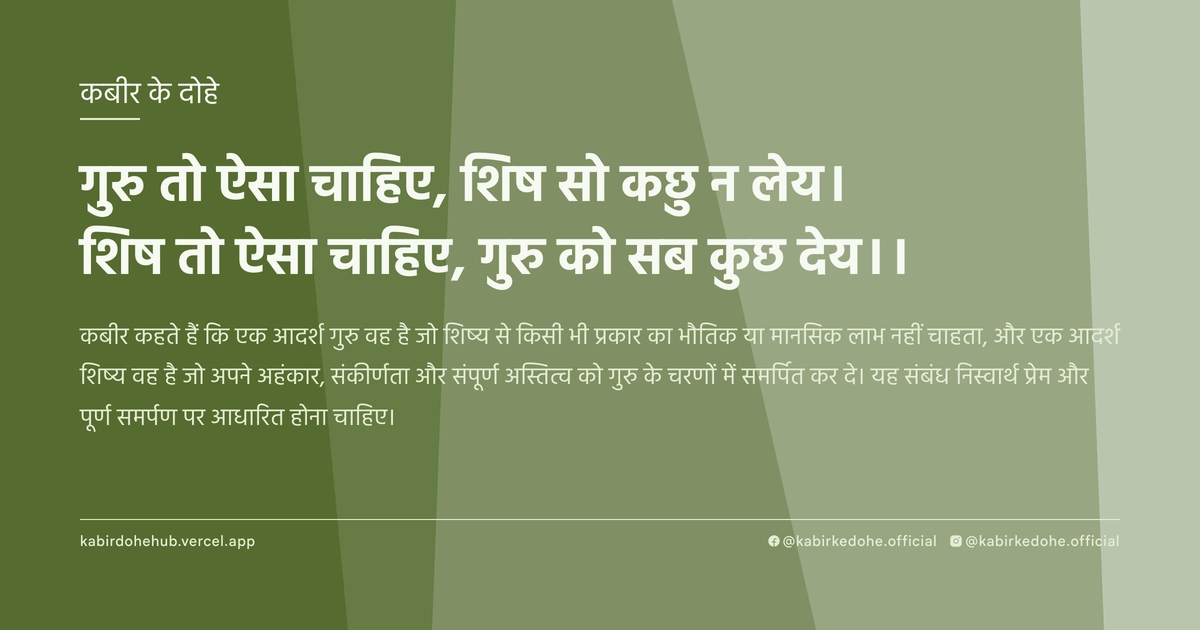
गुरु तो ऐसा चाहिए, शिष सो कछु न लेय।
शिष तो ऐसा चाहिए, गुरु को सब कुछ देय।।
Guru to aisa chahiye, shish so kachu na ley. Shish to aisa chahiye, guru ko sab kuch dey.
इस पृष्ठ पर इस कबीर दोहे का अर्थ (meaning), हिंदी व्याख्या और अंग्रेज़ी अनुवाद, दार्शनिक विश्लेषण और व्यावहारिक जीवन सीख दी गई है। यह दोहा गुरु महत्व (The Guru's Importance) विषय से जुड़ा है — Kabir doha meaning and explanation in Hindi and English.
अर्थ (Meaning):
कबीर कहते हैं कि एक आदर्श गुरु वह है जो शिष्य से किसी भी प्रकार का भौतिक या मानसिक लाभ नहीं चाहता, और एक आदर्श शिष्य वह है जो अपने अहंकार, संकीर्णता और संपूर्ण अस्तित्व को गुरु के चरणों में समर्पित कर दे। यह संबंध निस्वार्थ प्रेम और पूर्ण समर्पण पर आधारित होना चाहिए।
Kabir asserts that an ideal Guru is one who seeks nothing—neither material gain nor psychological validation—from the disciple. Conversely, the ideal disciple is one who offers everything—their ego, prejudices, and entire existence—to the Guru. This sacred bond is predicated on selfless love and absolute surrender.
व्याख्या (Interpretation):
साब्दिक रूप से यह दोहा गुरु और शिष्य के बीच के लेन-देन की बात करता है, लेकिन आध्यात्मिक स्तर पर यह 'अहंकार के विसर्जन' का प्रतीक है। यहाँ 'कुछ न लेना' गुरु की पूर्णता और उसकी निर्लिप्तता को दर्शाता है, जो केवल शिष्य के कल्याण के लिए समर्पित है। 'सब कुछ देना' का अर्थ भौतिक दान नहीं, बल्कि शिष्य के 'मैं' (अहंकार) का पूर्ण समर्पण है। यह निर्गुण भक्ति का सार है जहाँ गुरु केवल एक माध्यम है जो आत्मा को परमात्मा (ब्रह्म) से मिलाता है। जब शिष्य अपना सर्वस्व समर्पित करता है, तो वह वास्तव में अपनी सीमाओं को तोड़ता है। यह द्वैत से अद्वैत की यात्रा है, जहाँ गुरु और शिष्य के बीच की दूरी समाप्त हो जाती है। अंततः, यह शून्यता की अवस्था है जहाँ केवल सत्य शेष रहता है।
Literally, this couplet speaks of the exchange between a teacher and a student, but spiritually, it symbolizes the 'dissolution of the ego.' The phrase 'taking nothing' signifies the Guru's spiritual completeness and detachment, existing solely for the disciple's liberation. 'Giving everything' does not refer to material charity, but to the total surrender of the disciple's 'I-ness' or ego. This is the essence of Nirgun Bhakti, where the Guru acts as a catalyst connecting the Atman to the formless Brahman. By surrendering everything, the disciple shatters their perceived limitations. It is a journey from duality to non-duality (Advaita), where the distinction between the guide and the seeker vanishes. Ultimately, it describes a state of emptiness where only the Absolute Truth remains.
दार्शनिक विश्लेषण (Philosophical Analysis):
कबीर का यह विचार तत्कालीन समाज में व्याप्त पाखंड और व्यावसायिक धर्म के विरुद्ध एक कड़ा प्रहार था। उनके समय में कई तथाकथित गुरु धर्म के नाम पर धन और सम्मान बटोर रहे थे। कबीर ने स्पष्ट किया कि वास्तविक आध्यात्मिक मार्गदर्शन कोई व्यापार नहीं हो सकता। यह दृष्टिकोण सूफी मत के 'पीर-मुरीद' संबंध से मेल खाता है, जहाँ फना (अहंकार का विनाश) ही एकमात्र लक्ष्य होता है।
अद्वैत वेदांत के परिप्रेक्ष्य में, गुरु वह है जो शिष्य को यह एहसास दिलाए कि वह पहले से ही वह ब्रह्म है जिसे वह खोज रहा है। गुरु का कुछ न लेना यह दर्शाता है कि वह पहले ही पूर्ण है; उसे शिष्य से कुछ भी प्राप्त करने की आवश्यकता नहीं है। यह 'निस्पृहता' ही गुरु को विश्वसनीय बनाती है।
शिष्य का 'सब कुछ देना' मनोवैज्ञानिक रूप से एक 'मानसिक मृत्यु' है। जब तक पुराना व्यक्तित्व (अहंकार) जीवित है, तब तक नया आध्यात्मिक जन्म संभव नहीं है। यह समर्पण केवल व्यक्ति के प्रति नहीं, बल्कि उस सत्य के प्रति है जिसे गुरु प्रतिबिंबित करता है।
कबीर यहाँ कर्मकांडों और जातिगत श्रेष्ठता को नकारते हैं। उनके लिए पात्रता केवल समर्पण में है, जन्म या शास्त्र ज्ञान में नहीं। यह एक क्रांतिकारी विचार था जिसने भक्ति आंदोलन को लोकतांत्रिक बनाया और इसे महलों से निकालकर झोपड़ियों तक पहुँचाया।
अंततः, यह दोहा एक आध्यात्मिक विरोधाभास प्रस्तुत करता है: जब शिष्य सब कुछ दे देता है, तब उसे वह सब कुछ प्राप्त होता है जो ब्रह्मांड में है। यह 'शून्यता के माध्यम से पूर्णता' प्राप्त करने की कला है, जो मनुष्य को उसके सीमित अस्तित्व से मुक्त कर अनंतता में विलीन कर देती है।
Kabir's insight is a searing critique of the hypocrisy and commercialization of religion prevalent in his era. During his time, many self-proclaimed gurus amassed wealth and prestige under the guise of spirituality. Kabir clarifies that genuine spiritual guidance cannot be a transaction; it must be a selfless transmission of light.
From the lens of Advaita Vedanta, the Guru is one who mirrors the disciple's own inherent divinity, reminding them that they are already the Brahman they seek. The Guru's refusal to take anything signifies their spiritual wholeness; they lack nothing, and thus, their guidance is untainted by desire or expectation. This 'dispassion' is what renders the Guru authentic.
The disciple's act of 'giving everything' is psychologically a form of 'ego-death.' As long as the old identity—the ego—persists, a new spiritual rebirth is impossible. This surrender is not to a person, but to the Truth that the Guru embodies and reflects.
Kabir rejects ritualism and caste superiority here. For him, eligibility for enlightenment lies solely in surrender, not in birth or scholarly erudition. This was a revolutionary shift that democratized the Bhakti movement, moving spirituality from the ivory towers of the elite to the humble huts of the common folk.
Ultimately, the couplet presents a spiritual paradox: when the disciple gives everything away, they receive everything the universe has to offer. It is the art of achieving 'fullness through emptiness,' liberating the human soul from its finite constraints and merging it into the infinite.
मूल संदेश (Core Message):
- गुरु की पात्रता उसकी निस्पृहता में है।
- शिष्य की सफलता उसके पूर्ण समर्पण में है।
- अहंकार का विसर्जन ही वास्तविक ज्ञान का द्वार है।
- लेन-देन का रिश्ता आध्यात्मिक प्रगति में बाधा है।
- शून्यता ही वह स्थान है जहाँ परमात्मा का वास है।
- A Guru's authenticity lies in their total lack of desire.
- A disciple's liberation depends on absolute surrender.
- The dissolution of ego is the only gateway to Truth.
- Transactional relationships hinder spiritual evolution.
- Emptiness is the only space where the Divine can reside.
व्यावहारिक उदाहरण (Practical Example):
वाराणसी के एक पुराने घाट पर रामदीन नाम का एक वृद्ध नाविक रहता था। वह जीवन भर नाव चलाता रहा, लेकिन उसके मन में शांति नहीं थी। वह कई बड़े पंडितों के पास गया, जिन्होंने उससे भारी दान माँगा और कठिन अनुष्ठान करने को कहा। रामदीन ने बहुत कुछ दिया, लेकिन उसका मन अशांत ही रहा।
एक दिन उसकी मुलाकात एक फकीर से हुई जो घाट की सीढ़ियों पर चुपचाप बैठा रहता था। रामदीन ने उससे पूछा, 'बाबा, मुझे शांति कैसे मिलेगी?' फकीर ने बस मुस्कुराकर कहा, 'जो कुछ तुम्हारे पास है, वह सब मुझे दे दो।'
रामदीन ने सोचा कि उसके पास तो कुछ नहीं है, बस एक पुरानी नाव और कुछ फटे कपड़े हैं। उसने अपनी नाव फकीर के नाम कर दी और अपनी सारी जमा पूँजी भी दे दी। वह अब पूरी तरह कंगाल था, लेकिन उसके मन से 'मेरा' होने का बोझ उतर गया।
शुरुआत में वह घबराया, लेकिन फिर उसने देखा कि जब उसके पास खोने के लिए कुछ नहीं बचा, तो उसका डर भी खत्म हो गया। उसने फकीर की सेवा में खुद को लगा दिया। वह अब केवल नाव नहीं चलाता था, बल्कि लोगों के दुखों को समझने लगा था।
फकीर ने उससे कभी कोई दक्षिणा नहीं ली, न ही उसे कोई मंत्र सिखाया। उसने बस रामदीन को उसके अपने अहंकार से लड़ना सिखाया। रामदीन ने महसूस किया कि वह अब तक अपनी 'संपत्ति' और 'पहचान' को पकड़कर बैठा था, जो वास्तव में उसकी बेड़ियाँ थीं।
एक दिन एक अमीर व्यापारी आया और उसने फकीर से शांति का रास्ता पूछा। फकीर ने रामदीन की ओर इशारा किया। रामदीन अब शांत और आनंदित था। व्यापारी हैरान था कि एक नाविक इतना स्थिर कैसे हो सकता है।
रामदीन ने मुस्कुराकर कहा, 'मैंने सब कुछ दे दिया, इसलिए अब मैं खाली हूँ। और खाली बर्तन में ही नया अमृत भरा जा सकता है।'
यह 'कबीर ट्विस्ट' था—रामदीन ने भौतिक संपत्ति खोई, लेकिन उसने अपनी आत्मा को पा लिया। उसका समर्पण केवल फकीर के प्रति नहीं था, बल्कि उस अहंकार के प्रति था जिसने उसे सालों तक बांध रखा था। अब वह वास्तव में स्वतंत्र था।
On an ancient ghat in Varanasi lived an elderly boatman named Ramdeen. He had spent his life rowing others across the river, yet his own heart was restless. He visited many high priests, who demanded heavy donations and prescribed complex rituals. Ramdeen gave much, but his inner turmoil remained.
One day, he encountered a wandering fakir who sat in silence on the stone steps. Ramdeen asked, 'Baba, how can I find peace?' The fakir simply smiled and replied, 'Give me everything you possess.'
Ramdeen thought he had nothing of value—only an old boat and some tattered clothes. Nevertheless, he signed over his boat to the fakir and handed over his meager savings. He was now utterly destitute, but the burden of 'ownership' had lifted from his soul.
Initially, he felt panic, but he soon realized that when there was nothing left to lose, fear itself vanished. He dedicated his life to serving the fakir, no longer just rowing a boat, but learning to navigate the depths of human suffering.
The fakir never asked for a fee nor taught him any secret mantras. He simply guided Ramdeen in the battle against his own ego. Ramdeen realized that his 'possessions' and 'identity' were actually the chains that had bound him for decades.
One day, a wealthy merchant arrived and asked the fakir for the path to peace. The fakir pointed toward Ramdeen. The merchant was astonished to see such profound stability and joy in a simple boatman.
Ramdeen smiled and said, 'I gave everything away, and thus I became empty. Only an empty vessel can be filled with the nectar of Truth.'
This was the 'Kabir Twist'—Ramdeen lost his material wealth but gained his soul. His surrender was not merely to the fakir, but to the ego that had imprisoned him. He was finally, truly free.
अभ्यास मार्गदर्शन (Practice Guidance):
- प्रतिदिन 20 मिनट मौन साधना करें, जहाँ आप अपने भीतर के 'मैं' (अहंकार) के विचारों को केवल देखें, उन्हें नियंत्रित करने की कोशिश न करें।
- एक 'समर्पण जर्नल' बनाएँ। हर दिन लिखें कि आज आपने किस भावना, विचार या जिद को छोड़ा (जैसे: क्रोध, सही होने की जिद, या प्रशंसा की इच्छा)।
- व्यवहार परिवर्तन: दिन में कम से कम एक बार ऐसा कार्य करें जिसमें आपका कोई व्यक्तिगत लाभ न हो और जिसे करने के बाद आप किसी से प्रशंसा की अपेक्षा न करें।
- निदान चेकलिस्ट: क्या आप अभी भी अपनी उपलब्धियों का श्रेय खुद ले रहे हैं? क्या आप दूसरों से अपनी अपेक्षाओं के कारण दुखी हैं? यदि हाँ, तो समझें कि 'सब कुछ देना' अभी शेष है।
- Practice 20 minutes of silent meditation daily, observing the thoughts of the 'I' (ego) without attempting to control or judge them.
- Maintain a 'Surrender Journal.' Each day, record which emotion, thought, or stubbornness you let go of (e.g., anger, the need to be right, or the craving for validation).
- Behavioral Shift: Perform at least one act of service daily that offers no personal gain and for which you seek absolutely no recognition.
- Diagnostic Checklist: Are you still claiming sole credit for your achievements? Are you suffering because others aren't meeting your expectations? If yes, recognize that the process of 'giving everything' is still incomplete.
चिंतन प्रश्न (Reflection Questions):
- यदि आज आपसे आपकी सामाजिक पहचान और उपलब्धियाँ छीन ली जाएँ, तो आपके भीतर क्या बचेगा?
- आप अपने गुरु या मार्गदर्शक से वास्तव में क्या चाहते हैं—ज्ञान, या केवल अपनी मान्यताओं की पुष्टि?
- क्या आप अपनी 'सही होने की जिद' को त्यागने के लिए तैयार हैं, भले ही वह आपकी सार्वजनिक छवि को नुकसान पहुँचाए?
- आपके जीवन में वह कौन सा 'अदृश्य बोझ' है जिसे आप 'मेरा' कहकर पकड़ कर बैठे हैं?
- क्या आपका समर्पण वास्तविक है, या यह केवल एक और मानसिक खेल है जिससे आप खुद को आध्यात्मिक महसूस कराना चाहते हैं?
- If your social identity and achievements were stripped away today, what would remain of you?
- What do you truly seek from your mentor—genuine transformation, or merely validation of your existing beliefs?
- Are you willing to relinquish the 'need to be right,' even if it damages your public image?
- What is the 'invisible burden' in your life that you cling to by calling it 'mine'?
- Is your surrender authentic, or is it just another mental game to make yourself feel spiritually advanced?