
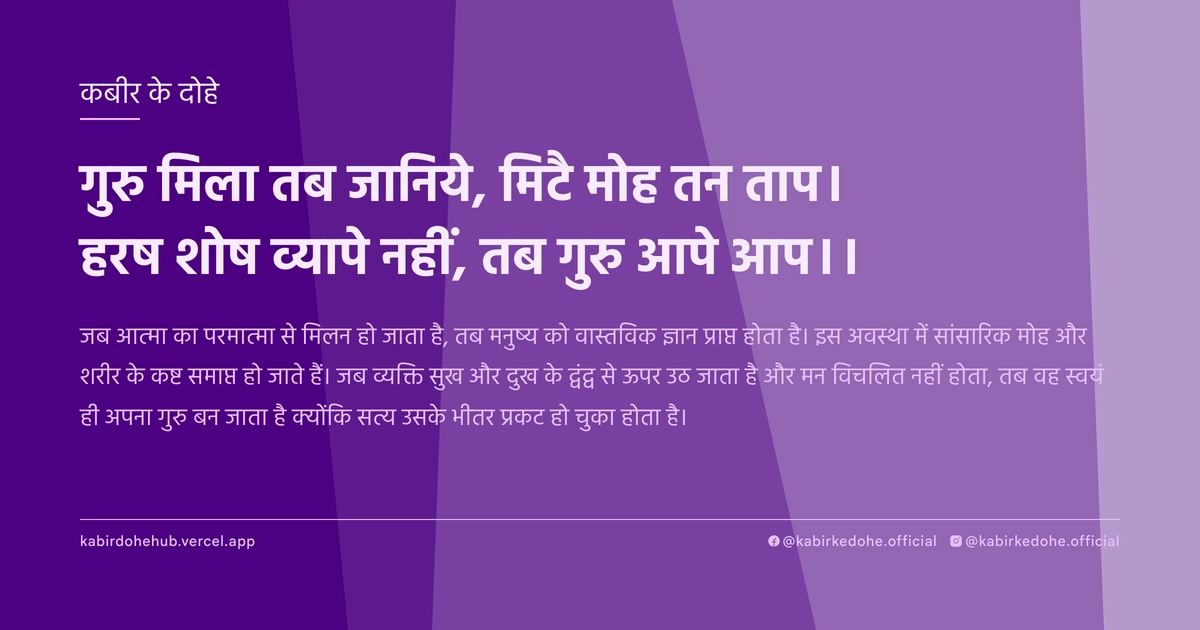
गुरु मिला तब जानिये, मिटै मोह तन ताप।
हरष शोष व्यापे नहीं, तब गुरु आपे आप।।
Guru mila tab jaaniye, mitai moh tan taap. Harash shosh vyaape nahi, tab guru aape aap.
इस पृष्ठ पर इस कबीर दोहे का अर्थ (meaning), हिंदी व्याख्या और अंग्रेज़ी अनुवाद, दार्शनिक विश्लेषण और व्यावहारिक जीवन सीख दी गई है। यह दोहा अंतर ज्योति (The Inner Light) विषय से जुड़ा है — Kabir doha meaning and explanation in Hindi and English.
अर्थ (Meaning):
जब आत्मा का परमात्मा से मिलन हो जाता है, तब मनुष्य को वास्तविक ज्ञान प्राप्त होता है। इस अवस्था में सांसारिक मोह और शरीर के कष्ट समाप्त हो जाते हैं। जब व्यक्ति सुख और दुख के द्वंद्व से ऊपर उठ जाता है और मन विचलित नहीं होता, तब वह स्वयं ही अपना गुरु बन जाता है क्योंकि सत्य उसके भीतर प्रकट हो चुका होता है।
Realize the truth only when the union with the Divine is achieved and the fever of worldly attachment vanishes. When the fluctuations of joy and sorrow no longer grip the soul, and the mind remains undisturbed by external extremes, the individual becomes their own teacher, for the inner light of consciousness has awakened.
व्याख्या (Interpretation):
यह दोहा आध्यात्मिक पूर्णता की उस स्थिति का वर्णन करता है जहाँ साधक और साध्य का भेद समाप्त हो जाता है। 'मोह तन ताप' का अर्थ केवल शारीरिक बीमारी नहीं, बल्कि वह मानसिक व्याकुलता है जो अज्ञानता और आसक्ति से उत्पन्न होती है। जब यह ताप मिटता है, तो साधक 'हरष' (अत्यधिक खुशी) और 'शोष' (गहरे अवसाद) के बीच के झूठे संतुलन से मुक्त हो जाता है। यह स्थिति निर्गुण भक्ति का चरम है, जहाँ ईश्वर किसी बाहरी मूर्ति में नहीं, बल्कि स्वयं के भीतर एक निराकार चेतना के रूप में अनुभव किया जाता है। यहाँ 'गुरु आपे आप' का अर्थ है कि अब किसी बाहरी मार्गदर्शक की आवश्यकता नहीं रही, क्योंकि आत्मा और ब्रह्म की अद्वैत स्थिति प्राप्त हो चुकी है। यह माया के पर्दे के हटने और शुद्ध आत्म-साक्षात्कार की प्रक्रिया है।
This couplet describes the pinnacle of spiritual attainment where the distinction between the seeker and the sought dissolves. 'Moh tan taap' refers not merely to physical ailment, but to the psychic agitation born of ignorance and attachment. Once this fever breaks, the seeker transcends the duality of 'Harash' (exultation) and 'Shosh' (despair), realizing that both are transient ripples on the surface of consciousness. This is the zenith of Nirgun Bhakti, where the Divine is experienced not as an external deity, but as the formless, omnipresent consciousness within. The phrase 'Guru aape aap' signifies the transition from external guidance to internal illumination; the Atman has recognized its non-duality with Brahman. It is the moment Maya's veil is rent asunder, revealing the inherent divinity of the self.
दार्शनिक विश्लेषण (Philosophical Analysis):
कबीर का यह दर्शन अद्वैत वेदांत और सूफी मत के 'फना' (अहंकार का विनाश) के सिद्धांतों का एक अनूठा संगम है। कबीर के समय में धर्म केवल कर्मकांडों और बाहरी आडंबरों तक सीमित था, जिसे उन्होंने कड़ाई से नकारा। उनका तर्क था कि यदि ईश्वर सर्वव्यापी है, तो उसे मंदिर या मस्जिद की दीवारों में खोजना निरर्थक है। यह दोहा इस बात पर जोर देता है कि वास्तविक ज्ञान बौद्धिक नहीं, बल्कि अनुभवात्मक (experiential) होता है।
यहाँ 'मोह' को एक रोग की तरह देखा गया है। जैसे बुखार शरीर को तपाता है, वैसे ही मोह मन को जलाता है। जब तक व्यक्ति स्वयं को शरीर मानता है, वह जन्म-मृत्यु और सुख-दुख के चक्र में फंसा रहता है। कबीर यहाँ मनोवैज्ञानिक रूपांतरण की बात कर रहे हैं, जहाँ अहंकार (Ego) का पूर्ण विलोपन हो जाता है। जब 'मैं' मिटता है, तब केवल 'वह' बचता है।
सूफीवाद के संदर्भ में, यह 'इश्क-ए-हकीकी' की वह अवस्था है जहाँ प्रेमी और प्रियतम एक हो जाते हैं। कबीर यह स्पष्ट करते हैं कि गुरु का कार्य केवल मार्ग दिखाना है; अंतिम गंतव्य तक पहुँचने के लिए साधक को स्वयं के भीतर उतरना होगा। बाहरी गुरु एक उंगली की तरह है जो चंद्रमा की ओर इशारा करती है, लेकिन चंद्रमा (सत्य) को देखने के लिए साधक को अपनी आँखें खुद खोलनी होंगी।
इस दर्शन में जाति और वर्ग का कोई स्थान नहीं है क्योंकि आत्मा की कोई जाति नहीं होती। कबीर ने यह स्थापित किया कि मोक्ष किसी विशेष कुल या शास्त्र पढ़ने से नहीं, बल्कि आंतरिक शुद्धि और द्वंद्वों के त्याग से मिलता है। यह एक क्रांतिकारी विचार था जिसने मध्यकालीन भारत में सामाजिक संरचनाओं को चुनौती दी।
अंततः, यह दोहा हमें सिखाता है कि शांति बाहरी परिस्थितियों के बदलने से नहीं, बल्कि आंतरिक प्रतिक्रियाओं के बदलने से आती है। जब हम सुख में पागल नहीं होते और दुख में टूटते नहीं, तब हम उस शून्य (Sunyata) को प्राप्त करते हैं जहाँ वास्तविक शांति निवास करती है। यही वह बिंदु है जहाँ मनुष्य स्वयं का प्रकाश बन जाता है।
Kabir’s philosophy here represents a profound synthesis of Advaita Vedanta’s non-duality and the Sufi concept of 'Fana' (the annihilation of the ego). During Kabir's era, spirituality was largely reduced to rigid ritualism and caste-based hierarchies, which he vehemently rejected. He asserted that if the Divine is omnipresent, seeking Him within the confines of a temple or mosque is a futile exercise. This doha emphasizes that true knowledge is not intellectual or scriptural, but purely experiential.
'Moh' (attachment) is framed here as a spiritual pathology. Just as a physical fever consumes the body, attachment consumes the mind. As long as an individual identifies with the physical body and the social persona, they remain trapped in the cycle of Samsara—the relentless oscillation between pleasure and pain. Kabir is proposing a psychological transmutation where the ego is not merely suppressed but completely dissolved. When the 'I' vanishes, only the 'Absolute' remains.
In the context of Sufism, this mirrors the state of 'Ishq-e-Haqiqi' (Divine Love), where the lover and the Beloved merge into one. Kabir clarifies that while a Guru is essential for initiation, the final realization is a solitary journey inward. The Guru is like a finger pointing toward the moon; however, the seeker must open their own eyes to behold the moon (Truth) for themselves.
Crucially, this philosophy strips away the relevance of caste and creed, as the Atman possesses no social identity. Kabir posits that liberation is not the reward for reading scriptures or belonging to a high caste, but the result of internal purification and the cessation of duality. This was a revolutionary stance that challenged the socio-religious hegemony of medieval India.
Ultimately, the doha teaches that peace is not the result of changing external circumstances, but of altering one's internal response to them. When one is neither intoxicated by success nor devastated by failure, they enter the 'Shunya' (Void/Zero point) where absolute stillness resides. At this juncture, the human being becomes their own light, evolving from a seeker to the embodiment of the Truth.
मूल संदेश (Core Message):
- बाहरी खोज को छोड़कर आंतरिक मौन को अपनाएं।
- सुख और दुख के बीच का संतुलन ही वास्तविक स्वतंत्रता है।
- अहंकार का विलोपन ही परमात्मा से मिलन का एकमात्र मार्ग है।
- जब आप स्वयं को जान लेते हैं, तब आप स्वयं के मार्गदर्शक बन जाते हैं।
- मोह वह अग्नि है जो आत्मा की शांति को भस्म कर देती है।
- Abandon the external search and embrace the internal silence.
- Equanimity between joy and sorrow is the only true freedom.
- The dissolution of the ego is the sole path to Divine union.
- Once you know yourself, you become your own ultimate guide.
- Attachment is the fire that consumes the peace of the soul.
व्यावहारिक उदाहरण (Practical Example):
एक समय की बात है, वाराणसी के घाटों पर माधव नाम का एक वृद्ध बुनकर रहता था। माधव अपनी पूरी जिंदगी सूत कातने और कपड़े बुनने में बिता चुका था, लेकिन उसका मन हमेशा अशांत रहता था। वह अपनी छोटी सी दुकान और परिवार के प्रति इतना आसक्त था कि यदि कोई धागा टूट जाता या कोई ग्राहक मोल-भाव करता, तो वह घंटों क्रोध में रहता। उसके लिए उसका काम ही उसकी पहचान बन गया था।
माधव अक्सर पास के मंदिर में जाता और घंटों प्रार्थना करता कि उसे शांति मिले। वह दान-पुण्य करता, उपवास रखता, लेकिन उसके भीतर का 'ताप' यानी बेचैनी कम नहीं होती थी। वह जितना अधिक बाहरी अनुष्ठानों में डूबता, उतना ही वह अपनी असफलताओं और इच्छाओं के प्रति संवेदनशील होता गया।
एक दिन उसकी मुलाकात एक घुमक्कड़ फकीर से हुई, जिसने माधव को इस दोहे का सार समझाया। फकीर ने कहा, 'माधव, तुम शांति को बाहर खोज रहे हो, जबकि तुम खुद ही उस अशांति के निर्माता हो। तुम्हारा मोह ही तुम्हारा ताप है।'
शुरुआत में माधव को यह बात समझ नहीं आई। लेकिन फकीर के कहने पर उसने एक प्रयोग किया। उसने तय किया कि वह अब अपने काम के परिणामों से नहीं, बल्कि केवल काम की प्रक्रिया से प्रेम करेगा। जब भी उसे क्रोध आता, वह रुक जाता और खुद से पूछता, 'यह क्रोध किसका है? क्या यह मेरा है या मेरी उस छवि का जिसे मैं दुनिया के सामने बनाए रखना चाहता हूँ?'
धीरे-धीरे माधव ने महसूस किया कि उसकी खुशी इस बात पर निर्भर नहीं होनी चाहिए कि कपड़ा कितना महंगा बिका। उसने अपनी पहचान 'बुनकर' से हटाकर 'साक्षी' (observer) पर केंद्रित करना शुरू किया। उसने देखा कि सुख और दुख केवल मौसम की तरह आते-जाते हैं।
एक दिन उसकी दुकान में आग लग गई और उसका सारा माल जल गया। पुराने माधव के लिए यह प्रलय जैसा होता, लेकिन अब वह शांत था। उसने देखा कि लोग उसके प्रति सहानुभूति दिखा रहे थे, लेकिन उसके भीतर कोई हलचल नहीं थी। उसे महसूस हुआ कि वह अब न तो बहुत खुश था और न ही बहुत दुखी।
उसने महसूस किया कि जिस 'ताप' से वह सालों से लड़ रहा था, वह वास्तव में उसकी अपनी पकड़ (attachment) थी। जैसे ही उसने पकड़ छोड़ी, वह हल्का हो गया। अब उसे किसी मंदिर या किसी बाहरी गुरु की सलाह की जरूरत नहीं थी।
उसने पाया कि शांति कोई मंजिल नहीं है जहाँ पहुँचना है, बल्कि एक नजरिया है जिससे दुनिया को देखना है। वह अब अपने जीवन का स्वयं गुरु बन चुका था, क्योंकि उसने अपने भीतर के द्वंद्वों को जीत लिया था।
माधव अब केवल कपड़े नहीं बुनता था, बल्कि वह अपने जीवन के हर पल को एक ध्यान की तरह जीता था। उसकी शांति अब दूसरों के लिए एक प्रेरणा बन गई थी, और वह बिना कुछ कहे ही सत्य का प्रसार करने लगा।
उसकी कहानी यह सिखाती है कि जब हम अपनी पहचान को बाहरी उपलब्धियों और भावनाओं से अलग कर लेते हैं, तब हम वास्तव में स्वतंत्र होते हैं।
Once in the ancient ghats of Varanasi, there lived an elderly weaver named Madhav. Madhav had spent his entire life spinning yarn and weaving cloth, yet his mind was a storm of restlessness. He was so deeply attached to his small shop and his family's perception of him that a single broken thread or a demanding customer would plunge him into hours of rage. For Madhav, his profession had become his entire identity.
Madhav frequently visited the local temples, spending hours in prayer, begging for peace. He performed charities and observed rigorous fasts, yet the 'Taap'—the inner fever of anxiety—would not subside. The more he immersed himself in external rituals, the more sensitive he became to his failures and unfulfilled desires.
One day, he encountered a wandering fakir who shared with him the essence of this doha. The fakir told him, 'Madhav, you are searching for peace as if it were a lost object, while you are the very architect of your own unrest. Your attachment is your fever.'
Initially, Madhav struggled to grasp this. However, following the fakir's advice, he began an experiment. He decided that he would no longer love the results of his work, but only the process of weaving itself. Whenever anger flared, he would pause and ask himself, 'Whose anger is this? Is it mine, or is it the anger of the image I am trying to maintain in the eyes of the world?'
Slowly, Madhav realized that his happiness should not depend on how expensive his cloth sold for. He shifted his identity from being a 'weaver' to being a 'witness' (Sakshi). He observed that joy and sorrow were merely like weather patterns—passing through, but not defining the sky.
One day, a devastating fire broke out in his shop, destroying all his inventory. For the old Madhav, this would have been a catastrophe. But now, he remained still. He watched as people showered him with sympathy, yet inside, there was no turmoil. He realized he was neither elated nor devastated.
He understood that the 'fever' he had fought for years was actually his own grip—his attachment. The moment he let go of the grip, he became weightless. He no longer needed a temple or the constant guidance of an external teacher.
He discovered that peace is not a destination to be reached, but a lens through which to view existence. He had become his own Guru, for he had conquered the internal dualities of his mind.
Madhav no longer just wove cloth; he wove every moment of his life into a meditation. His stillness became a beacon for others, and he began to spread the truth without uttering a single word.
His story illustrates that when we detach our identity from external achievements and fleeting emotions, we finally attain true liberation.
अभ्यास मार्गदर्शन (Practice Guidance):
- दैनिक साक्षी-भाव: दिन में तीन बार 10 मिनट के लिए बैठें और अपने विचारों को ऐसे देखें जैसे आप किसी अजनबी को देख रहे हों। यह 'मोह' और 'ताप' के बीच की दूरी बढ़ाएगा।
- द्वंद्व विश्लेषण जर्नल: जब आप बहुत खुश या बहुत दुखी महसूस करें, तो उसे लिखें। फिर विश्लेषण करें कि यह भावना किस बाहरी वस्तु या व्यक्ति पर निर्भर है।
- मौन अभ्यास: सप्ताह में एक दिन या दिन में कुछ घंटे पूर्ण मौन रहें। बाहरी शोर को कम करें ताकि आप अपने भीतर के 'गुरु' की आवाज सुन सकें।
- डायग्नोस्टिक चेकलिस्ट: (1) क्या मैं दूसरों की प्रशंसा या आलोचना से विचलित होता हूँ? (2) क्या मेरी शांति मेरी परिस्थितियों पर निर्भर है? (3) क्या मैं अभी भी 'मैं' और 'मेरा' के जाल में उलझा हूँ? यदि हाँ, तो अभ्यास की आवश्यकता है।
- Daily Witness Consciousness: Sit for 10 minutes three times a day and observe your thoughts as if you are watching a stranger. This creates a gap between the 'attachment' and the 'fever'.
- Duality Analysis Journal: Whenever you feel extreme joy or deep sorrow, record it. Then analyze which external object or person this emotion is dependent upon.
- Practice of Silence: Maintain complete silence for one day a week or a few hours a day. Reduce external noise to hear the voice of the 'Inner Guru'.
- Diagnostic Checklist: (1) Do I still react strongly to praise or criticism? (2) Is my peace dependent on my circumstances? (3) Am I still entangled in the web of 'I' and 'Mine'? If yes, deeper practice is required.
चिंतन प्रश्न (Reflection Questions):
- मेरी वह कौन सी 'छवि' है जिसे बचाने के लिए मैं सबसे अधिक मानसिक तनाव झेलता हूँ?
- यदि मेरी सारी सामाजिक उपलब्धियाँ आज छीन ली जाएँ, तो मेरे भीतर क्या बचेगा?
- क्या मेरी भक्ति वास्तव में ईश्वर के लिए है, या यह केवल मेरे डर और इच्छाओं को शांत करने का एक तरीका है?
- मैं किन सूक्ष्म पूर्वाग्रहों को अपनी 'सत्य' की पहचान मानकर बैठा हूँ?
- क्या मैं वास्तव में स्वतंत्र हूँ, या मैं केवल अपनी आदतों का एक गुलाम हूँ जिसे लगता है कि वह चुनाव कर रहा है?
- What is the specific 'image' of myself that I suffer most to protect in the eyes of others?
- If all my social achievements were stripped away today, what would actually remain of me?
- Is my devotion truly for the Divine, or is it merely a mechanism to soothe my fears and desires?
- Which subtle biases have I mistaken for my 'authentic' identity?
- Am I truly free, or am I merely a slave to my habits who believes they are making conscious choices?