
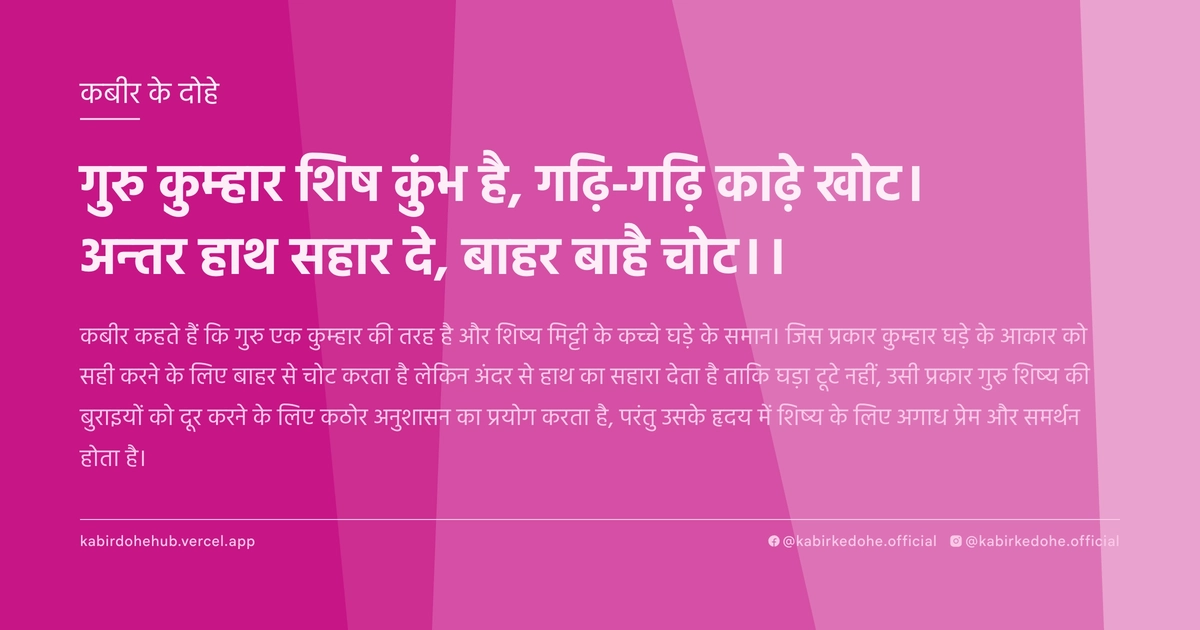
गुरु कुम्हार शिष कुंभ है, गढ़ि-गढ़ि काढ़े खोट।
अन्तर हाथ सहार दे, बाहर बाहै चोट।।
Guru kumhaar shish kumbh hai, gadhi-gadhi kaadhe khot. Antar haath sahaar de, baahar baahe chot.
इस पृष्ठ पर इस कबीर दोहे का अर्थ (meaning), हिंदी व्याख्या और अंग्रेज़ी अनुवाद, दार्शनिक विश्लेषण और व्यावहारिक जीवन सीख दी गई है। यह दोहा गुरु महत्व (The Guru's Importance) विषय से जुड़ा है — Kabir doha meaning and explanation in Hindi and English.
अर्थ (Meaning):
कबीर कहते हैं कि गुरु एक कुम्हार की तरह है और शिष्य मिट्टी के कच्चे घड़े के समान। जिस प्रकार कुम्हार घड़े के आकार को सही करने के लिए बाहर से चोट करता है लेकिन अंदर से हाथ का सहारा देता है ताकि घड़ा टूटे नहीं, उसी प्रकार गुरु शिष्य की बुराइयों को दूर करने के लिए कठोर अनुशासन का प्रयोग करता है, परंतु उसके हृदय में शिष्य के लिए अगाध प्रेम और समर्थन होता है।
Kabir explains that the Guru is like a potter and the disciple is like a clay pot. Just as a potter strikes the pot from the outside to shape it and remove imperfections, while simultaneously supporting it from within with his hand to prevent it from collapsing, the Guru employs strict discipline to remove the disciple's flaws while providing unwavering internal support and love.
व्याख्या (Interpretation):
यह दोहा आध्यात्मिक रूपांतरण की प्रक्रिया का एक गहन रूपक है। यहाँ 'कुंभ' या घड़ा मानव अहंकार और अज्ञानता से निर्मित सीमित व्यक्तित्व का प्रतीक है। 'खोट' वे मानसिक विकार और पूर्वाग्रह हैं जो आत्मा की शुद्धता को रोकते हैं। बाहरी चोट अनुशासन, आलोचना और कठिन परीक्षाओं का प्रतिनिधित्व करती है, जो माया के आवरण को तोड़ती है। आंतरिक सहारा वह करुणा और दैवीय प्रेम है जो शिष्य को मानसिक रूप से टूटने से बचाता है। यह निरगुण भक्ति का सार है, जहाँ गुरु केवल एक व्यक्ति नहीं, बल्कि वह चेतना है जो साधक को द्वैत से अद्वैत की ओर ले जाती है। अंततः, यह प्रक्रिया आत्मा को एक ऐसे पात्र में बदल देती है जो ब्रह्म के प्रकाश को धारण करने में सक्षम हो।
This couplet serves as a profound metaphor for the process of spiritual transformation. Here, the 'kumbh' or pot symbolizes the limited human personality constructed from ego and ignorance. The 'khot' (imperfections) represent the mental distortions and prejudices that obstruct the purity of the soul. The external strikes represent discipline, criticism, and rigorous tests that shatter the veil of Maya. The internal support is the compassion and divine love that prevents the disciple from breaking mentally. This is the essence of Nirgun Bhakti, where the Guru is not merely a person but the consciousness that leads the seeker from duality to non-duality. Ultimately, this process transforms the soul into a vessel capable of holding the light of Brahman.
दार्शनिक विश्लेषण (Philosophical Analysis):
कबीर का यह दर्शन उस युग की प्रतिक्रिया है जहाँ धर्म केवल कर्मकांडों और बाहरी दिखावे तक सीमित था। वे ritualism का खंडन करते हुए आंतरिक शुद्धिकरण पर बल देते हैं। यहाँ कुम्हार का उदाहरण यह दर्शाता है कि आध्यात्मिक प्रगति के लिए 'अहंकार का विखंडन' आवश्यक है। यह अद्वैत वेदांत के उस सिद्धांत से मेल खाता है जहाँ 'मैं' (अहंकार) का विसर्जन ही 'वह' (ब्रह्म) के साक्षात्कार का मार्ग है।
सूफी मत के 'फना' (अस्तित्व का मिटना) के सिद्धांत की तरह, कबीर बताते हैं कि जब तक पुराना ढांचा नहीं टूटेगा, नया स्वरूप नहीं उभर सकता। गुरु की 'चोट' वास्तव में शिष्य के उस मिथ्या अहंकार पर प्रहार है जो उसे सत्य से दूर रखता है। यह कठोरता क्रूरता नहीं, बल्कि एक उच्चतर उद्देश्य की प्राप्ति के लिए आवश्यक शल्य चिकित्सा है।
सामाजिक स्तर पर, कबीर जाति और वर्ग के भेदों को नकारते हैं। मिट्टी का घड़ा एक सार्वभौमिक प्रतीक है—चाहे कोई राजा हो या रंक, आध्यात्मिक अग्नि में सबको तपना पड़ता है। यह संदेश देता है कि मोक्ष किसी विशेष कुल से नहीं, बल्कि सही मार्गदर्शन और आत्म-संयम से प्राप्त होता है।
मनोवैज्ञानिक रूप से, यह दोहा 'कठोर प्रेम' (Tough Love) की अवधारणा को स्पष्ट करता है। एक सच्चा मार्गदर्शक वह नहीं जो केवल प्रशंसा करे, बल्कि वह है जो सत्य का दर्पण दिखाए, भले ही वह सत्य कड़वा हो। यह प्रक्रिया शिष्य को उसकी अपनी सीमाओं से मुक्त कर उसे अनंतता की ओर ले जाती है।
अंततः, यह दोहा यह स्थापित करता है कि गुरु और शिष्य का संबंध केवल ज्ञान के हस्तांतरण का नहीं, बल्कि एक जीवंत रूपांतरण का है। बाहरी अनुशासन और आंतरिक करुणा का यह संतुलन ही साधक को पूर्णता की ओर ले जाता है, जिससे वह स्वयं एक प्रकाश स्तंभ बन जाता है।
Kabir's philosophy is a reaction to an era where religion was confined to rituals and outward displays. Rejecting ritualism, he emphasizes internal purification. The potter's analogy demonstrates that the 'shattering of the ego' is essential for spiritual progress. This aligns with the Advaita Vedanta principle where the dissolution of the 'I' (ego) is the only path to realizing 'That' (Brahman).
Similar to the Sufi concept of 'Fana' (annihilation of the self), Kabir suggests that unless the old structure is broken, a new form cannot emerge. The Guru's 'strike' is actually an attack on the false ego that keeps the disciple away from the Truth. This severity is not cruelty, but a necessary spiritual surgery to achieve a higher purpose.
On a social level, Kabir denies the distinctions of caste and class. The clay pot is a universal symbol—whether a king or a pauper, everyone must undergo the fire of spiritual discipline. This conveys that liberation is attained not through a specific lineage, but through right guidance and self-restraint.
Psychologically, this couplet elucidates the concept of 'Tough Love.' A true guide is not one who merely praises, but one who holds up the mirror of truth, however bitter it may be. This process liberates the disciple from their own limitations and leads them toward infinity.
Ultimately, this couplet establishes that the relationship between Guru and disciple is not merely a transfer of knowledge, but a living transformation. This balance of external discipline and internal compassion is what leads the seeker toward perfection, eventually turning them into a beacon of light themselves.
मूल संदेश (Core Message):
- कठोर अनुशासन अक्सर छिपे हुए प्रेम का ही एक रूप होता है।
- अहंकार का टूटना ही वास्तविक आध्यात्मिक जन्म की शुरुआत है।
- सच्चा मार्गदर्शक वह है जो आपको आपकी सीमाओं से मुक्त करे।
- बाहरी दबाव और आंतरिक समर्थन का संतुलन ही पूर्णता लाता है।
- आलोचना को औषधि समझें, यदि वह सत्य और करुणा पर आधारित हो।
- मिट्टी की विनम्रता ही उसे एक सुंदर आकार प्रदान करती है।
- Strict discipline is often just another form of hidden love.
- The breaking of the ego is the true beginning of spiritual birth.
- A true guide is one who liberates you from your own limitations.
- The balance of external pressure and internal support brings perfection.
- Treat criticism as medicine, provided it is rooted in truth and compassion.
- The humility of clay is what allows it to be given a beautiful form.
व्यावहारिक उदाहरण (Practical Example):
वाराणसी के एक पुराने मोहल्ले में रामदीन नाम का एक वृद्ध बुनकर रहता था। वह अपने पुश्तैनी काम में निपुण था, लेकिन उसका स्वभाव अत्यंत क्रोधी और अहंकारी था। वह मानता था कि उसकी कला सर्वश्रेष्ठ है और दूसरों की सलाह को तुच्छ समझता था।
एक दिन उसकी मुलाकात एक शांत स्वभाव के संन्यासी से हुई। संन्यासी ने रामदीन की कला की प्रशंसा की, लेकिन उसके अहंकार को पहचान लिया। उन्होंने रामदीन को अपना शिष्य बनाने का प्रस्ताव दिया, बशर्ते वह उनके कठोर अनुशासन को स्वीकार करे।
शुरुआत में, संन्यासी ने रामदीन के काम में छोटी-छोटी गलतियाँ निकालनी शुरू कीं। वे सबके सामने उसकी कमियों की आलोचना करते। रामदीन को लगा कि उसका अपमान हो रहा है। वह क्रोधित हुआ और संन्यासी को छोड़कर जाने की कोशिश की।
लेकिन जब भी रामदीन पूरी तरह टूट जाता, संन्यासी उसे एकांत में बुलाते और उसे बताते कि उसकी कला में कितनी गहराई है और वह कैसे दुनिया को बदल सकता है। वे उसे वह प्रेम और विश्वास देते जो उसे कहीं और नहीं मिला था।
रामदीन ने महसूस किया कि संन्यासी की बाहरी आलोचना वास्तव में उसके भीतर के 'अहंकार के घड़े' को तोड़ रही थी, जबकि उनका आंतरिक समर्थन उसे बिखरने नहीं दे रहा था। वह समझ गया कि प्रशंसा उसे अंधा बना रही थी, और आलोचना उसे तराश रही थी।
धीरे-धीरे रामदीन का क्रोध शांत होने लगा। उसने सीखा कि सच्ची कला केवल धागों के मेल में नहीं, बल्कि मन की विनम्रता में है। उसने अपने अहंकार को त्याग दिया और अपनी कला को सेवा का माध्यम बनाया।
एक दिन, जब उसने एक अत्यंत जटिल वस्त्र तैयार किया, तो उसने उसे अपने नाम से नहीं, बल्कि अपने गुरु के चरणों में समर्पित कर दिया। उसकी आँखों में आँसू थे और हृदय में एक असीम शांति थी।
अब रामदीन केवल एक कुशल बुनकर नहीं था, बल्कि एक ऐसा मनुष्य था जिसने स्वयं को पहचान लिया था। उसने सीखा कि जिसे वह 'चोट' समझ रहा था, वह वास्तव में उसे गढ़ने की प्रक्रिया थी।
उसने अपने जीवन के अंतिम वर्षों में गाँव के युवाओं को यह सिखाया कि अनुशासन और प्रेम का संगम ही मनुष्य को पूर्ण बनाता है। वह अब एक ऐसा घड़ा बन चुका था जिसमें करुणा का अमृत भरा था।
रामदीन की कहानी यह सिद्ध करती है कि जब कोई हमें कठोरता से सुधारता है, तो उसके पीछे अक्सर एक गहरा प्रेम छिपा होता है, बशर्ते हमारा मार्गदर्शक सच्चा हो।
In an old neighborhood of Varanasi lived an elderly weaver named Ramdeen. He was masterful in his ancestral craft, but his nature was extremely angry and arrogant. He believed his art was supreme and dismissed the advice of others as trivial.
One day, he met a serene monk. The monk praised Ramdeen's art but recognized his ego. He offered to take Ramdeen as a disciple, provided he accepted a regime of strict discipline.
Initially, the monk began pointing out tiny flaws in Ramdeen's work. He would criticize his shortcomings in front of others. Ramdeen felt insulted. He grew angry and attempted to leave the monk's company.
However, whenever Ramdeen reached a breaking point, the monk would call him in private and tell him how much depth his art possessed and how he could change the world. He gave him a love and faith that he had never found elsewhere.
Ramdeen realized that the monk's external criticism was actually breaking the 'pot of ego' within him, while their internal support was preventing him from shattering completely.
Gradually, Ramdeen's anger subsided. He learned that true art lies not just in the weaving of threads, but in the humility of the mind. He discarded his arrogance and turned his craft into a medium of service.
One day, when he completed an intricately woven garment, he did not claim it as his own but dedicated it to the feet of his Guru. There were tears in his eyes and an infinite peace in his heart.
Now, Ramdeen was not just a skilled weaver, but a man who had recognized his true self. He understood that what he perceived as 'strikes' were actually the process of shaping him.
In the final years of his life, he taught the village youth that the confluence of discipline and love is what makes a human complete. He had become a vessel filled with the nectar of compassion.
Ramdeen's story proves that when someone corrects us with severity, there is often a deep love hidden behind it, provided the guide is genuine.
अभ्यास मार्गदर्शन (Practice Guidance):
- दैनिक आत्म-निरीक्षण: प्रतिदिन 15 मिनट मौन बैठें और विचार करें कि जीवन में कौन सी 'बाहरी चोट' (आलोचना या कठिनाई) आपको वास्तव में बेहतर बना रही है।
- कृतज्ञता जर्नल: उन लोगों की सूची बनाएं जिन्होंने आपकी गलतियों पर आपको कठोरता से टोका, और विश्लेषण करें कि उस समय उनके व्यवहार के पीछे क्या सकारात्मक उद्देश्य था।
- अहंकार विसर्जन अभ्यास: जब भी कोई आपकी आलोचना करे, तुरंत प्रतिक्रिया देने के बजाय 10 सेकंड रुकें और सोचें—'क्या यह मेरी ईगो को चोट पहुँचा रहा है या मेरे चरित्र को सुधार रहा है?'
- निदान चेकलिस्ट: यदि आप आलोचना सुनकर क्रोधित होते हैं, तो आप अभी भी 'कच्चे घड़े' हैं। यदि आप आलोचना को सुधार के अवसर के रूप में देखते हैं, तो आप रूपांतरण की प्रक्रिया में हैं।
- Daily Self-Inquiry: Sit in silence for 15 minutes daily and contemplate which 'external strikes' (criticisms or hardships) in your life are actually refining you.
- Gratitude Journaling: List people who corrected your mistakes harshly and analyze the positive intention that may have been hidden behind their behavior.
- Ego-Dissolution Practice: Whenever you are criticized, instead of reacting immediately, pause for 10 seconds and ask—'Is this hurting my ego or improving my character?'
- Diagnostic Checklist: If you react with anger to criticism, you are still a 'raw pot.' If you view criticism as an opportunity for growth, you are in the process of transformation.
चिंतन प्रश्न (Reflection Questions):
- क्या मैं वास्तव में सुधार चाहता हूँ, या मैं केवल अपनी गलतियों की पुष्टि करने वाली प्रशंसा चाहता हूँ?
- मेरे जीवन में वह कौन है जो मुझे 'चोट' पहुँचाता है, और क्या मैंने कभी उनके आंतरिक सहारे को महसूस करने की कोशिश की?
- मेरा 'डिजिटल ईगो' (सोशल मीडिया छवि) मुझे सत्य को स्वीकार करने से कैसे रोकता है?
- यदि मेरा अहंकार पूरी तरह टूट जाए, तो मेरे व्यक्तित्व का कौन सा हिस्सा बचेगा?
- क्या मैं दूसरों को सुधारते समय उनके भीतर 'हाथ का सहारा' देता हूँ, या केवल चोट पहुँचाता हूँ?
- मेरी कौन सी ऐसी मान्यता है जिसे टूटने की सख्त जरूरत है ताकि मैं सत्य को देख सकूँ?
- Do I truly desire improvement, or do I only seek praise that validates my mistakes?
- Who in my life 'strikes' me, and have I ever tried to feel the internal support they provide?
- How does my 'digital ego' (social media image) prevent me from accepting the truth?
- If my ego were to shatter completely, what part of my personality would remain?
- When I correct others, do I provide 'internal support,' or do I only inflict the strike?
- Which of my core beliefs desperately needs to be broken so that I may see the Truth?