
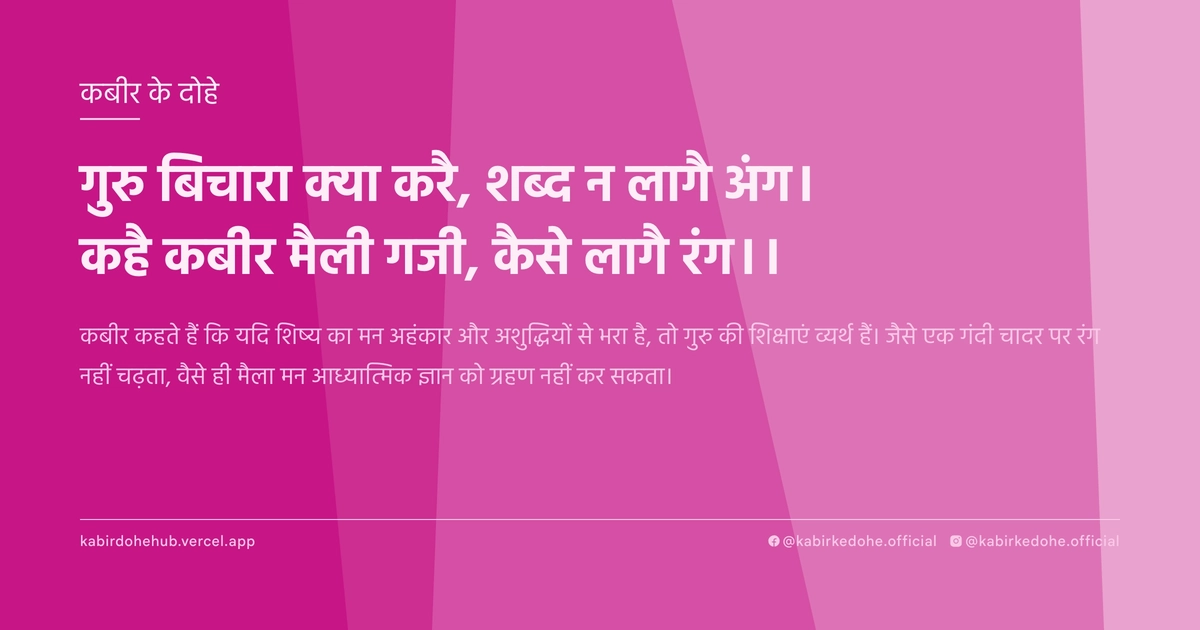
गुरु बिचारा क्या करै, शब्द न लागै अंग।
कहै कबीर मैली गजी, कैसे लागै रंग।।
Guru bichara kya karai, shabd na laagai ang. Kahai Kabir maili gaji, kaise laagai rang.
इस पृष्ठ पर इस कबीर दोहे का अर्थ (meaning), हिंदी व्याख्या और अंग्रेज़ी अनुवाद, दार्शनिक विश्लेषण और व्यावहारिक जीवन सीख दी गई है। यह दोहा गुरु महत्व (The Guru's Importance) विषय से जुड़ा है — Kabir doha meaning and explanation in Hindi and English.
अर्थ (Meaning):
कबीर कहते हैं कि यदि शिष्य का मन अहंकार और अशुद्धियों से भरा है, तो गुरु की शिक्षाएं व्यर्थ हैं। जैसे एक गंदी चादर पर रंग नहीं चढ़ता, वैसे ही मैला मन आध्यात्मिक ज्ञान को ग्रहण नहीं कर सकता।
Kabir asserts that if a disciple's mind is saturated with ego and impurities, the teacher's guidance remains futile. Just as a soiled cloth refuses to absorb dye, a heart clouded by ignorance cannot be colored by the divine light of spiritual wisdom.
व्याख्या (Interpretation):
इस दोहे में 'मैली गजी' (गंदा कपड़ा) मानव अहंकार और सांसारिक मोह का प्रतीक है। गुरु 'शब्द' (ब्रह्म ज्ञान) देने का प्रयास करता है, लेकिन जब तक साधक अपनी आंतरिक गंदगी को नहीं साफ करता, ज्ञान केवल बाहरी शोर बनकर रह जाता है। यह निर्गुण भक्ति के उस सिद्धांत को दर्शाता है जहाँ आत्मा का शुद्धिकरण ही परमात्मा से मिलन की पहली शर्त है। अद्वैत वेदांत के अनुसार, माया का पर्दा ही वह 'मैलापन' है जो हमें हमारी वास्तविक स्वरूप (ब्रह्म) को देखने से रोकता है। यहाँ विरोधाभास यह है कि गुरु मार्ग दिखाता है, लेकिन चलने की पात्रता केवल स्वयं के समर्पण और शुद्धि से आती है।
In this couplet, the 'soiled cloth' (maili gaji) serves as a potent metaphor for human ego and worldly attachments. The Guru attempts to impart the 'Shabd' (the primordial sound or divine knowledge), but as long as the seeker does not cleanse their internal impurities, the wisdom remains external noise. This aligns with Nirgun Bhakti, where the purification of the soul is the prerequisite for union with the Formless. According to Advaita Vedanta, the veil of Maya is the 'dirt' that obscures our true identity as Brahman. The central paradox is that while the Guru provides the map, the capacity to traverse the path is earned only through the seeker's own surrender and internal alchemy.
दार्शनिक विश्लेषण (Philosophical Analysis):
कबीर का यह दोहा मध्यकालीन भारत के धार्मिक पाखंड और यांत्रिक पूजा के विरुद्ध एक सशक्त प्रहार है। उस समय धर्म को केवल कर्मकांडों और बाहरी दिखावे तक सीमित कर दिया गया था। कबीर तर्क देते हैं कि केवल गुरु के पास बैठने या मंत्र रटने से मोक्ष नहीं मिलता; वास्तविक परिवर्तन आंतरिक शुद्धि से आता है।
यह विचार सूफी मत के 'नफ्स' (अहंकार) के विनाश के समान है। सूफीवाद में माना जाता है कि जब तक 'मैं' जीवित है, 'वह' (ईश्वर) प्रकट नहीं हो सकता। कबीर यहाँ इसी मनोवैज्ञानिक सत्य को उजागर कर रहे हैं कि ज्ञान का अवशोषण केवल तभी संभव है जब ग्रहण करने वाला पात्र रिक्त और स्वच्छ हो।
अद्वैत वेदांत के परिप्रेक्ष्य में, यह 'अविद्या' का विश्लेषण है। अविद्या वह धूल है जो आत्मा के दर्पण को धुंधला कर देती है। गुरु का कार्य दर्पण को साफ करना है, लेकिन यदि शिष्य अपनी अविद्या से चिपका रहे, तो गुरु की कृपा भी निष्प्रभावी हो जाती है।
कबीर जाति और वर्ण व्यवस्था को नकारते हुए यह स्पष्ट करते हैं कि आध्यात्मिक पात्रता जन्म से नहीं, बल्कि चित्त की शुद्धि से आती है। एक उच्च कुल का व्यक्ति भी यदि अहंकारी है, तो वह 'मैली गजी' के समान है, जबकि एक साधारण व्यक्ति यदि सरल है, तो वह ज्ञान के रंग को तुरंत आत्मसात कर लेता है।
अंततः, यह दोहा मनोवैज्ञानिक रूपांतरण की बात करता है। यह चेतावनी है कि बिना आत्म-निरीक्षण और अहंकार के विसर्जन के, कोई भी आध्यात्मिक साधना केवल एक बौद्धिक व्यायाम बनकर रह जाएगी। वास्तविक भक्ति वह है जो मनुष्य के स्वभाव को बदल दे, न कि केवल उसकी शब्दावली को।
This couplet is a powerful critique of the religious hypocrisy and mechanical ritualism prevalent in medieval India. During Kabir's era, spirituality had been reduced to outward displays and rote recitation of scriptures. Kabir argues that mere proximity to a teacher or the repetition of mantras does not grant liberation; true transformation is born from internal purification.
This concept mirrors the Sufi doctrine of the annihilation of the 'Nafs' (the lower self/ego). In Sufism, it is believed that as long as the 'I' exists, the 'He' (the Divine) cannot manifest. Kabir highlights this psychological truth: the absorption of wisdom is only possible when the vessel receiving it is empty and clean.
From the lens of Advaita Vedanta, this is an analysis of 'Avidya' (ignorance). Avidya is the dust that clouds the mirror of the soul. While the Guru's role is to polish the mirror, if the disciple clings to their ignorance, even the highest grace remains ineffective.
By rejecting caste and social hierarchy, Kabir clarifies that spiritual eligibility is not a birthright but a result of the purity of consciousness. A person of high social standing, if arrogant, is like the 'soiled cloth,' whereas a humble individual can instantly absorb the colors of divine knowledge.
Ultimately, the verse speaks to psychological metamorphosis. It warns that without rigorous self-inquiry and the dissolution of the ego, any spiritual practice remains a mere intellectual exercise. True devotion is that which alters one's fundamental nature, not just their vocabulary.
मूल संदेश (Core Message):
- अहंकार ज्ञान के मार्ग में सबसे बड़ी बाधा है।
- पात्रता के बिना शिक्षा केवल सूचना बनकर रह जाती है।
- आंतरिक शुद्धि ही वास्तविक आध्यात्मिक प्रगति की कुंजी है।
- विनम्रता वह द्वार है जिससे दिव्य ज्ञान प्रवेश करता है।
- स्वयं को शून्य करना ही पूर्णता की ओर पहला कदम है।
- Ego is the primary obstruction on the path to enlightenment.
- Without receptivity, education remains mere information.
- Internal purification is the only key to genuine spiritual progress.
- Humility is the portal through which divine wisdom enters.
- Emptying the self is the first step toward becoming whole.
व्यावहारिक उदाहरण (Practical Example):
वाराणसी के एक पुराने घाट पर रामदीन नाम का एक वृद्ध नाविक रहता था। वह स्वभाव से अत्यंत क्रोधी और अभिमानी था। उसे लगता था कि वह शहर का सबसे कुशल नाविक है और दूसरों को नीचा दिखाना उसकी आदत बन गई थी।
एक दिन उसकी भेंट एक शांत स्वभाव के संत से हुई। संत ने रामदीन को जीवन की नश्वरता और प्रेम के बारे में कई बातें बताईं। संत के शब्द गहरे थे, लेकिन रामदीन उन्हें सुनकर मन ही मन उनका मजाक उड़ाता रहा।
वह सोचता, 'यह साधु क्या मुझे नाव चलाना सिखाएगा? मुझे सब पता है।' वह संत की बातों को सुनता तो था, लेकिन उसका अहंकार एक दीवार बनकर खड़ा था।
महीनों बीत गए, संत उसे ज्ञान देते रहे, लेकिन रामदीन के व्यवहार में कोई बदलाव नहीं आया। वह अब भी उतना ही कड़वा और अहंकारी था।
एक शाम, एक भीषण तूफान आया और रामदीन की नाव पलट गई। उसने अपनी पूरी ताकत लगा दी, लेकिन वह डूबने लगा। तभी उसने देखा कि वही संत, जिन्हें वह तुच्छ समझता था, अपनी जान जोखिम में डालकर उसे बचाने आए।
जब रामदीन की जान बची, तो वह फूट-फूट कर रोने लगा। उसने महसूस किया कि उसकी कुशलता और अहंकार उस तूफान के सामने शून्य थे।
उस पल उसका अहंकार टूट गया। उसने महसूस किया कि वह अब तक 'मैली गजी' की तरह था—उसने संत के शब्दों को सुना तो था, पर उन्हें महसूस नहीं किया क्योंकि उसका मन घमंड से भरा था।
अब जब उसका मन शांत और विनम्र हुआ, तो संत के वही पुराने शब्द उसके हृदय में उतरने लगे। उसे समझ आया कि ज्ञान सुनने की चीज नहीं, बल्कि पात्रता विकसित करने की चीज है।
रामदीन ने अपनी नाव चलाने की कला को सेवा में बदल दिया। अब वह केवल पैसे के लिए नहीं, बल्कि प्रेम के लिए लोगों को पार लगाता था।
उसका जीवन अब उस रंग में रंग चुका था जिसे वह पहले कभी देख ही नहीं पाया था, क्योंकि अब उसका 'कपड़ा' साफ हो चुका था।
On an ancient ghat in Varanasi lived an elderly boatman named Ramdeen. He was naturally volatile and deeply arrogant, believing himself to be the most skilled navigator in the city, often belittling others.
One day, he encountered a serene saint. The saint spoke to Ramdeen about the transience of life and the power of universal love. The words were profound, but Ramdeen dismissed them with internal mockery.
He thought, 'Will this monk teach me how to steer a boat? I already know everything.' He listened to the saint, but his ego stood like an impenetrable wall.
Months passed; the saint continued to offer wisdom, yet Ramdeen's behavior remained unchanged. He was as bitter and haughty as ever.
One evening, a violent storm erupted, and Ramdeen's boat capsized. Despite his supposed skill, he began to drown. In his desperation, he saw the same saint, whom he had deemed insignificant, risking his own life to rescue him.
Once safe on shore, Ramdeen broke down in tears. He realized that his skill and arrogance were meaningless against the fury of the storm.
In that moment of total vulnerability, his ego shattered. He realized he had been like the 'soiled cloth'—he had heard the words, but they couldn't penetrate his heart because it was clogged with pride.
Now that his mind was quiet and humble, the saint's old words began to resonate deeply within him. He understood that wisdom is not something to be heard, but something to be received through readiness.
Ramdeen transformed his craft into a service. He no longer ferried people merely for coin, but out of a sense of love and kinship.
His life was finally dyed in the colors of spirituality that he had been blind to, for his 'cloth' had finally been cleansed.
अभ्यास मार्गदर्शन (Practice Guidance):
- प्रतिदिन 20 मिनट मौन का अभ्यास करें, जहाँ आप केवल अपने विचारों के आने और जाने को देखें, बिना किसी निर्णय के।
- एक 'अहंकार डायरी' बनाएँ: दिन भर में उन क्षणों को लिखें जब आपको लगा कि आप दूसरों से श्रेष्ठ हैं या आपने किसी की सलाह को अहंकारवश ठुकरा दिया।
- सेवा का अभ्यास: सप्ताह में एक बार ऐसा कार्य करें जिसमें आपको अपनी पहचान छिपानी पड़े और केवल निस्वार्थ भाव से मदद करनी हो।
- निदान चेकलिस्ट: क्या मैं दूसरों की बात सुनते समय जवाब तैयार कर रहा हूँ? क्या मुझे लगता है कि मैं सब जानता हूँ? क्या मेरी आध्यात्मिक पढ़ाई मेरे व्यवहार में बदलाव ला रही है? यदि उत्तर 'हाँ' है, तो आपका 'कपड़ा' अभी भी मैला है।
- Practice 20 minutes of daily silence, observing the flow of thoughts without judgment or attachment.
- Maintain an 'Ego Journal': Record moments throughout the day when you felt superior to others or dismissed advice due to pride.
- Practice Anonymity in Service: Once a week, perform an act of kindness where your identity remains hidden, ensuring the act is purely selfless.
- Diagnostic Checklist: Am I preparing a rebuttal while others are speaking? Do I believe I already possess all the answers? Is my spiritual study translating into behavioral change? If 'Yes', your 'cloth' remains soiled.
चिंतन प्रश्न (Reflection Questions):
- मेरे जीवन का वह कौन सा 'मैलापन' है जिसे मैं स्वीकार करने से डरता हूँ?
- क्या मैं वास्तव में सत्य की खोज में हूँ, या मैं केवल अपनी मान्यताओं की पुष्टि करना चाहता हूँ?
- मेरी डिजिटल पहचान (सोशल मीडिया) मेरे वास्तविक आंतरिक स्वरूप को कितना ढक रही है?
- जब कोई मेरी गलती बताता है, तो मेरा पहला रिएक्शन रक्षात्मक होता है या जिज्ञासु?
- क्या मेरा 'ज्ञान' मुझे दूसरों के प्रति अधिक दयालु बनाता है या अधिक निर्णयशील?
- यदि आज मेरा सारा सामाजिक दर्जा छीन लिया जाए, तो मेरे पास क्या बचेगा?
- What is the specific 'soil' in my life that I am too afraid to acknowledge?
- Am I truly seeking the Truth, or am I merely seeking confirmation of my existing beliefs?
- To what extent does my digital persona obscure my authentic internal state?
- When corrected, is my immediate reaction defensive or curious?
- Does my 'knowledge' make me more compassionate toward others, or more judgmental?
- If all my social status were stripped away today, what would actually remain of me?