
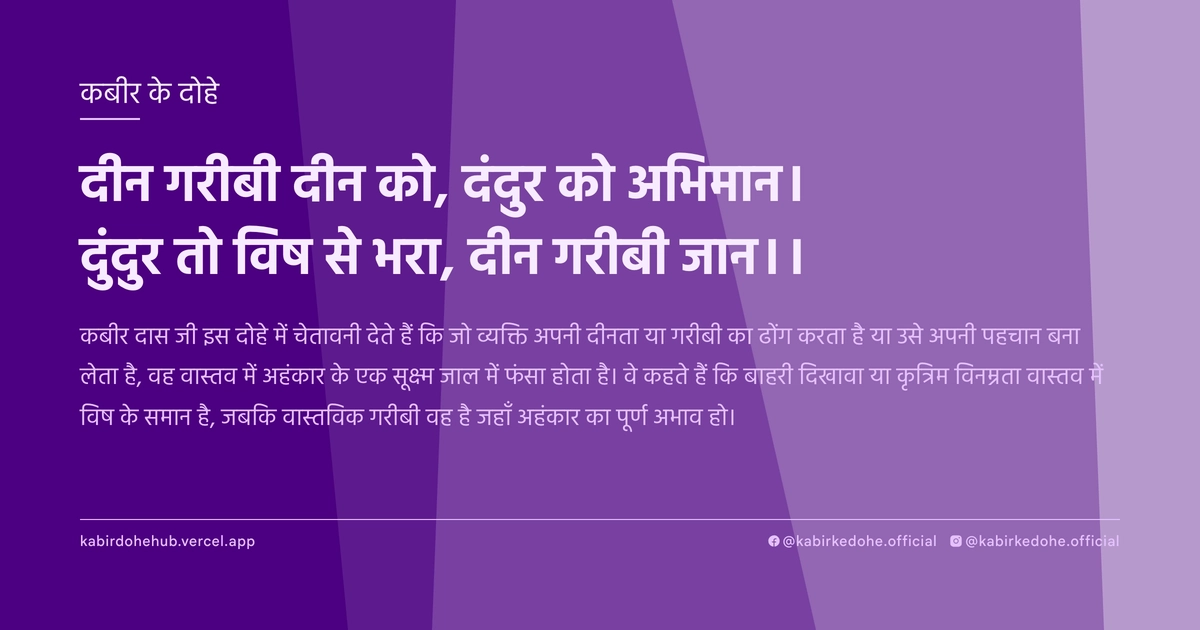
दीन गरीबी दीन को, दंदुर को अभिमान।
दुंदुर तो विष से भरा, दीन गरीबी जान।।
Deen gareebi deen ko, dandur ko abhimaan. Dundur to vish se bhara, deen gareebi jaan.
इस पृष्ठ पर इस कबीर दोहे का अर्थ (meaning), हिंदी व्याख्या और अंग्रेज़ी अनुवाद, दार्शनिक विश्लेषण और व्यावहारिक जीवन सीख दी गई है। यह दोहा अभिमान (Pride) विषय से जुड़ा है — Kabir doha meaning and explanation in Hindi and English.
अर्थ (Meaning):
कबीर दास जी इस दोहे में चेतावनी देते हैं कि जो व्यक्ति अपनी दीनता या गरीबी का ढोंग करता है या उसे अपनी पहचान बना लेता है, वह वास्तव में अहंकार के एक सूक्ष्म जाल में फंसा होता है। वे कहते हैं कि बाहरी दिखावा या कृत्रिम विनम्रता वास्तव में विष के समान है, जबकि वास्तविक गरीबी वह है जहाँ अहंकार का पूर्ण अभाव हो।
Kabir warns that those who cling to their poverty or misery as a badge of identity are trapped in a subtle web of ego. He asserts that artificial humility or the performative display of suffering is filled with spiritual poison, whereas true 'poverty' is the state of complete ego-annihilation and genuine surrender.
व्याख्या (Interpretation):
शाब्दिक अर्थ यह है कि गरीबी का अहंकार भी एक अहंकार है। रूपक के स्तर पर, 'दंदुर' या ढोल की तरह बजने वाला व्यक्ति वह है जो अपनी दुर्दशा का शोर मचाता है। यह निरगुण भक्ति के उस सिद्धांत से जुड़ा है जहाँ 'मैं' का विसर्जन अनिवार्य है। माया यहाँ केवल भौतिक अभाव नहीं, बल्कि वह मानसिक स्थिति है जहाँ व्यक्ति अपनी कमी को अपनी श्रेष्ठता का आधार बना लेता है। जब तक साधक यह सोचता है कि 'मैं गरीब हूँ', तब तक वह द्वैत में है। अद्वैत वेदांत के अनुसार, आत्मा पूर्ण है; इसलिए अभाव का बोध ही सबसे बड़ा भ्रम है। यह विरोधाभास है कि विनम्रता का प्रदर्शन वास्तव में अहंकार की सबसे परिष्कृत अवस्था है।
Literally, the doha suggests that pride in one's poverty is still pride. Metaphorically, the 'dandur' (drum) represents the noise of the ego masquerading as misery. This aligns with Nirgun Bhakti, where the dissolution of the 'I' is paramount. Maya here is not just material lack, but the psychological state where one uses their deficiency as a source of moral superiority. As long as the seeker thinks 'I am poor,' they remain in duality. According to Advaita Vedanta, the Atman is inherently complete; thus, the perception of lack is the ultimate illusion. The central paradox is that the performance of humility is often the most refined form of arrogance.
दार्शनिक विश्लेषण (Philosophical Analysis):
कबीर का यह प्रहार उनके समय के उन पाखंडों पर है जहाँ धर्म और गरीबी को एक हथियार की तरह इस्तेमाल किया जाता था। उन्होंने देखा कि कैसे कुछ लोग अपनी सामाजिक स्थिति का उपयोग दूसरों से सहानुभूति बटोरने और आध्यात्मिक श्रेष्ठता का दावा करने के लिए करते थे। यह दृष्टिकोण सूफीवाद के 'फना' (अहंकार का विनाश) के करीब है, जहाँ साधक को अपनी हर पहचान, यहाँ तक कि अपनी दीनता को भी मिटाना पड़ता है।
कबीर यहाँ कर्मकांडीय पवित्रता के बजाय आंतरिक शुद्धि पर जोर देते हैं। उनके लिए, जाति या वर्ग का त्याग केवल बाहरी क्रिया नहीं, बल्कि एक मानसिक क्रांति है। वे तर्क देते हैं कि यदि आप खुद को 'दीन' (गरीब/असहाय) कहते हैं, तो आप अभी भी एक पहचान से चिपके हुए हैं। वास्तविक मुक्ति उस स्थिति में है जहाँ न कोई अमीर है, न कोई गरीब, केवल शुद्ध चेतना है।
अद्वैत वेदांत के परिप्रेक्ष्य में, यह दोहा 'अविद्या' पर प्रहार करता है। जब मनुष्य स्वयं को शरीर या सामाजिक स्थिति के साथ जोड़ता है, तो वह दुख का अनुभव करता है। यह दुख जब अहंकार बन जाता है, तो वह आध्यात्मिक प्रगति में सबसे बड़ी बाधा बन जाता है। कबीर इसे 'विष' कहते हैं क्योंकि यह साधक को आत्म-साक्षात्कार से दूर ले जाता है।
मनोवैज्ञानिक रूप से, यह 'विक्टिम कॉम्प्लेक्स' (पीड़ित मानसिकता) का विश्लेषण है। जब कोई व्यक्ति अपनी लाचारी को अपनी पहचान बना लेता है, तो वह अनजाने में खुद को दूसरों से अलग और विशेष महसूस करने लगता है। यह सूक्ष्म अहंकार व्यक्ति को परिवर्तन के प्रयास से रोकता है क्योंकि वह अपनी 'बेचारगी' में ही सुरक्षा और ध्यान खोजता है।
अंततः, कबीर हमें यह सिखाते हैं कि सच्ची विनम्रता वह है जिसे महसूस नहीं किया जाता, बल्कि वह है जो स्वाभाविक रूप से तब प्रकट होती है जब अहंकार पूरी तरह समाप्त हो जाता है। यह शून्य की अवस्था है, जहाँ कोई लेबल नहीं बचता, केवल सत्य शेष रहता है।
Kabir’s critique targets the hypocrisies of his era, where poverty and piety were often weaponized to gain social leverage. He observed how individuals used their social standing to elicit sympathy and claim a false spiritual superiority. This perspective closely mirrors the Sufi concept of 'Fana' (annihilation of the self), where the seeker must erase every identity, including that of the sufferer.
Kabir emphasizes internal purification over ritualistic purity. For him, the rejection of caste or class is not merely an external act but a mental revolution. He argues that if one identifies as 'deen' (poor/helpless), they are still clinging to a label. True liberation occurs when there is no rich or poor, only pure consciousness.
From the lens of Advaita Vedanta, this doha attacks 'Avidya' (ignorance). When a human identifies with the body or social status, they experience suffering. When this suffering transforms into an identity, it becomes the greatest obstacle to spiritual progress. Kabir calls this 'poison' because it diverts the seeker from self-realization.
Psychologically, this is an analysis of the 'victim complex.' When a person makes their helplessness their identity, they unconsciously feel distinct and special. This subtle ego prevents transformation because the individual finds a perverse sense of security and attention in their misery.
Ultimately, Kabir teaches that true humility is not something felt or performed; it is what naturally emerges when the ego is completely extinguished. It is the state of Shunya (void), where no labels remain, and only the Truth persists.
मूल संदेश (Core Message):
- अहंकार केवल श्रेष्ठता में नहीं, बल्कि अपनी हीनता में भी छिपा होता है।
- दिखावे की विनम्रता वास्तव में आत्मा के लिए एक विष है।
- सच्ची मुक्ति अपनी पहचान के हर लेबल को मिटाने में है।
- अभाव का बोध ही सबसे बड़ा मानसिक बंधन है।
- जब 'मैं' मिटता है, तभी वास्तविक पूर्णता का अनुभव होता है।
- Ego hides not only in superiority but also in one's own perceived inferiority.
- Performative humility is actually a poison for the soul.
- True liberation lies in erasing every label of identity.
- The perception of lack is the greatest mental bondage.
- Only when the 'I' vanishes does true wholeness emerge.
व्यावहारिक उदाहरण (Practical Example):
एक समय की बात है, वाराणसी के घाटों पर माधव नाम का एक वृद्ध बुनकर रहता था। माधव अपनी गरीबी के लिए पूरे शहर में प्रसिद्ध था। वह अक्सर लोगों को बताता था कि कैसे उसने सब कुछ खो दिया और अब वह केवल ईश्वर के भरोसे है। लोग उसकी 'सादगी' और 'वैराग्य' की प्रशंसा करते थे, और माधव को इस प्रशंसा में एक अजीब सा सुख मिलता था। वह अपनी फटी हुई धोती और खाली थाली को एक पदक की तरह पहनता था।
एक दिन, एक मौन साधु उसके पास आए। उन्होंने देखा कि माधव अपनी गरीबी का वर्णन करते समय अपनी आवाज़ में एक गर्व का स्वर रखता था। साधु ने उससे पूछा, 'माधव, तुम इस गरीबी को इतनी मजबूती से क्यों पकड़े हुए हो?' माधव चौंक गया और बोला, 'महाराज, मैं तो दीन हूँ, मेरे पास क्या है?'
साधु मुस्कुराए और बोले, 'तुम्हारे पास तुम्हारी गरीबी का अहंकार है। तुम गरीब नहीं हो, तुम तो अपनी गरीबी के मालिक बन बैठे हो। जिस दिन तुम यह भूल जाओगे कि तुम गरीब हो, उस दिन तुम वास्तव में मुक्त हो जाओगे।'
माधव को पहले तो यह बात समझ नहीं आई। वह सोचने लगा कि कोई अपनी गरीबी पर गर्व कैसे कर सकता है? लेकिन फिर उसने गौर किया कि जब कोई उसकी गरीबी की प्रशंसा नहीं करता था, तो उसे गुस्सा आता था। उसे एहसास हुआ कि वह अपनी लाचारी का उपयोग लोगों का ध्यान खींचने के लिए कर रहा था।
उस रात माधव सो नहीं सका। उसने महसूस किया कि वह जिस 'दीनता' का ढोंग कर रहा था, वह वास्तव में उसके अहंकार का एक नया रूप था। वह अब तक खुद को 'सबसे बड़ा गरीब' मानकर एक मानसिक श्रेष्ठता का अनुभव कर रहा था।
अगले दिन से माधव ने अपनी स्थिति के बारे में बात करना बंद कर दिया। उसने चुपचाप अपना काम करना शुरू किया। उसने अब अपनी फटी धोती को अपनी पहचान नहीं, बल्कि केवल एक वस्त्र माना।
धीरे-धीरे, उसके मन से वह शोर कम होने लगा जो उसे दूसरों से अलग करता था। उसने पाया कि जब उसने अपनी 'गरीबी' की पहचान छोड़ी, तो उसे वह शांति मिली जो उसे प्रशंसा के शब्दों में कभी नहीं मिली थी।
अब वह केवल एक बुनकर था, न अमीर, न गरीब। उसने पाया कि वास्तविक संतोष अभाव में नहीं, बल्कि अभाव के बोध से मुक्ति में है।
माधव का जीवन बदल गया। उसकी गरीबी अभी भी थी, लेकिन उसका 'दुख' गायब हो गया था क्योंकि अब वह उस दुख को ढोने वाला 'मैं' नहीं रहा था।
यह माधव की वह यात्रा थी जहाँ उसने 'दीन' होने के अहंकार को त्यागकर वास्तव में शून्य होना सीखा।
Once, on the ghats of Varanasi, lived an elderly weaver named Madhav. Madhav was famous throughout the city for his poverty. He often told people how he had lost everything and now lived solely by the grace of God. People praised his 'simplicity' and 'detachment,' and Madhav found a strange pleasure in this admiration. He wore his torn loincloth and empty plate like a medal of honor.
One day, a silent monk approached him. The monk noticed that while describing his poverty, Madhav’s voice carried a distinct tone of pride. The monk asked, 'Madhav, why are you clinging to this poverty so tightly?' Madhav was startled and replied, 'Maharaj, I am a poor man, what else do I have?'
The monk smiled and said, 'You have the ego of poverty. You are not poor; you have become the master of your poverty. The day you forget that you are poor, you will truly be free.'
Madhav didn't understand at first. He wondered how anyone could be proud of being poor. But then he noticed that whenever someone failed to praise his misery, he felt irritated. He realized he was using his helplessness to attract attention.
Madhav could not sleep that night. He realized that the 'meekness' he was projecting was actually a new form of ego. He had been experiencing a sense of mental superiority by considering himself the 'poorest of all.'
The next day, Madhav stopped talking about his condition. He began to work in silence. He no longer viewed his torn clothes as his identity, but simply as fabric.
Gradually, the noise in his mind that separated him from others subsided. He found that when he let go of the identity of 'the poor man,' he attained a peace that the words of praise had never provided.
He was now just a weaver—neither rich nor poor. He discovered that true contentment lay not in the absence of lack, but in the liberation from the awareness of lack.
Madhav's life changed. His material poverty remained, but his 'suffering' vanished because the 'I' who carried that suffering was gone.
This was Madhav's journey from the pride of being 'lowly' to the realization of being nothing, and thus, everything.
अभ्यास मार्गदर्शन (Practice Guidance):
- दैनिक आत्म-निरीक्षण: दिन के अंत में विचार करें कि क्या आपने अपनी किसी कमी या दुख का उपयोग दूसरों से सहानुभूति पाने या खुद को 'विशेष' महसूस कराने के लिए किया।
- मौन अभ्यास: प्रतिदिन 30 मिनट ऐसे रहें जहाँ आप अपनी सामाजिक पहचान (पेशा, जाति, आर्थिक स्थिति) को पूरी तरह भुला दें और केवल एक साक्षी के रूप में रहें।
- जर्नलिंग प्रॉम्प्ट: 'यदि मेरी वर्तमान समस्याएँ और मेरी पहचान पूरी तरह मिटा दी जाएँ, तो मेरे भीतर क्या बचेगा?' इस पर गहराई से लिखें।
- व्यवहार परिवर्तन: जब आप किसी के सामने अपनी कठिनाइयाँ साझा करें, तो यह जाँचें कि क्या आपका उद्देश्य समाधान खोजना है या अपनी 'बेचारगी' के माध्यम से ध्यान आकर्षित करना।
- डायग्नोस्टिक चेकलिस्ट: क्या मुझे तब बुरा लगता है जब कोई मेरी कठिनाइयों को अनदेखा करता है? क्या मैं खुद को दूसरों से अधिक 'त्यागी' या 'पीड़ित' महसूस करता हूँ? यदि हाँ, तो यह 'दीनता का अहंकार' है।
- Daily Self-Inquiry: At the end of the day, reflect on whether you used any deficiency or suffering to elicit sympathy or make yourself feel 'special.'
- Silence Practice: Spend 30 minutes daily where you completely discard your social identities (profession, caste, economic status) and remain only as a witness.
- Journaling Prompt: Write deeply on the question: 'If my current problems and my identity were completely erased, what would remain within me?'
- Behavioral Shift: When sharing your hardships with others, examine if your goal is to find a solution or to attract attention through your 'helplessness.'
- Diagnostic Checklist: Do I feel resentful when someone ignores my struggles? Do I feel more 'sacrificial' or 'victimised' than others? If yes, this is the 'ego of poverty.'
चिंतन प्रश्न (Reflection Questions):
- क्या मेरी 'सादगी' वास्तव में सादगी है, या यह दूसरों को प्रभावित करने का एक तरीका है?
- मैं अपनी उन कमियों को क्यों नहीं छोड़ पाता जो मुझे दूसरों की नज़रों में 'बेचारा' बनाती हैं?
- मेरे डिजिटल व्यक्तित्व (Social Media) में मैं अपनी किस 'कमी' का प्रदर्शन कर अपनी श्रेष्ठता सिद्ध करता हूँ?
- यदि दुनिया से मेरी सारी दुखभरी कहानियाँ छीन ली जाएँ, तो क्या मेरी कोई पहचान बचेगी?
- क्या मैं वास्तव में विनम्र हूँ, या मैं केवल विनम्र दिखने का अभिनय कर रहा हूँ?
- Is my 'simplicity' truly simplicity, or is it a tool to influence others?
- Why can I not let go of the deficiencies that make me look 'pitiful' in the eyes of others?
- In my digital persona, which 'lack' do I perform to prove my moral superiority?
- If all my tragic stories were stripped away from me, would any identity remain?
- Am I truly humble, or am I merely acting the part of the humble?