
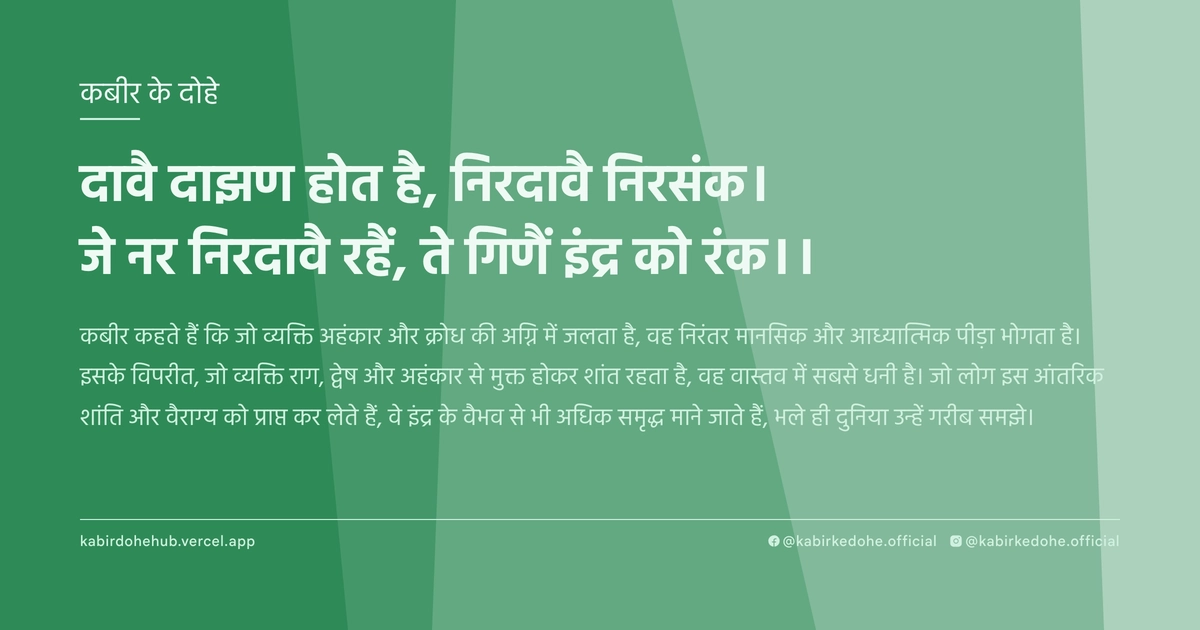
दावै दाझण होत है, निरदावै निरसंक।
जे नर निरदावै रहैं, ते गिणैं इंद्र को रंक।।
Davai dajhan hot hai, nirdavai nirasank. Je nar nirdavai rahain, te ginain indra ko rank.
इस पृष्ठ पर इस कबीर दोहे का अर्थ (meaning), हिंदी व्याख्या और अंग्रेज़ी अनुवाद, दार्शनिक विश्लेषण और व्यावहारिक जीवन सीख दी गई है। यह दोहा संयम (Self-discipline) विषय से जुड़ा है — Kabir doha meaning and explanation in Hindi and English.
अर्थ (Meaning):
कबीर कहते हैं कि जो व्यक्ति अहंकार और क्रोध की अग्नि में जलता है, वह निरंतर मानसिक और आध्यात्मिक पीड़ा भोगता है। इसके विपरीत, जो व्यक्ति राग, द्वेष और अहंकार से मुक्त होकर शांत रहता है, वह वास्तव में सबसे धनी है। जो लोग इस आंतरिक शांति और वैराग्य को प्राप्त कर लेते हैं, वे इंद्र के वैभव से भी अधिक समृद्ध माने जाते हैं, भले ही दुनिया उन्हें गरीब समझे।
Kabir asserts that one who is consumed by the fire of ego and anger suffers continuous mental and spiritual agony. Conversely, those who remain detached from passion, hatred, and pride dwell in a state of profound peace. Those who master this inner stillness are considered wealthier than Indra, the king of gods, regardless of their material poverty in the eyes of the world.
व्याख्या (Interpretation):
इस दोहे का शाब्दिक अर्थ है कि क्रोध और अहंकार मनुष्य को भीतर से जलाते हैं, जबकि इनसे मुक्ति शांति लाती है। रूपकात्मक रूप से, 'दाझण' (जलना) उस मानसिक अशांति का प्रतीक है जो 'मैं' और 'मेरा' की भावना से उत्पन्न होती है। यह निरगुण भक्ति के उस सिद्धांत को दर्शाता है जहाँ ईश्वर किसी मूर्ति में नहीं, बल्कि अहंकार के विसर्जन में मिलता है। माया का जाल व्यक्ति को बाहरी सुखों की दौड़ में लगाता है, जिससे वह अपनी वास्तविक आत्मा (ब्रह्म) को भूल जाता है। जब साधक द्वैत (दोहराव) को त्यागकर अद्वैत (एकता) को अपनाता है, तब वह 'निरसंक' हो जाता है। यहाँ विरोधाभास यह है कि भौतिक अभाव में भी आध्यात्मिक पूर्णता ही वास्तविक संपदा है। अंततः, यह दोहा सिखाता है कि इंद्र का सिंहासन भी उस शांति के सामने तुच्छ है जो आत्म-साक्षात्कार से प्राप्त होती है।
Literally, the verse suggests that anger and ego incinerate the soul, while liberation from them brings peace. Metaphorically, 'dajhan' (burning) symbolizes the psychic turbulence born from the delusions of 'I' and 'mine'. This aligns with Nirgun Bhakti, where the Divine is found not in idols, but in the dissolution of the ego. Maya lures the individual into a relentless pursuit of external acquisitions, obscuring the realization of the Atman-Brahman non-duality. When the seeker transcends duality and embraces oneness, they become 'nirsank' or free from doubt and desire. The central paradox presented is that spiritual abundance in the midst of material scarcity is the only true wealth. Ultimately, the poem posits that even the celestial throne of Indra is insignificant compared to the serenity achieved through self-realization.
दार्शनिक विश्लेषण (Philosophical Analysis):
कबीर का यह दोहा उस सामाजिक और धार्मिक परिवेश में लिखा गया था जहाँ कर्मकांड और बाहरी आडंबरों का बोलबाला था। कबीर ने स्पष्ट रूप से उन परंपराओं को चुनौती दी जो व्यक्ति को बाहरी दिखावे और जातिगत श्रेष्ठता के अहंकार में बांधती थीं। उनका दर्शन अद्वैत वेदांत से गहराई से प्रभावित है, जो मानता है कि आत्मा और परमात्मा एक ही हैं, और केवल अहंकार ही इस सत्य के बीच की दीवार है।
सूफीवाद के 'फना' (अहंकार का विनाश) के सिद्धांत की तरह, कबीर यहाँ 'निरदावै' होने की बात करते हैं, जिसका अर्थ है अपनी व्यक्तिगत पहचान को सार्वभौमिक चेतना में विलीन कर देना। उनके लिए, वास्तविक गरीबी वह नहीं है जिसके पास धन नहीं है, बल्कि वह है जो अपनी आंतरिक शांति खो चुका है। यह मनोवैज्ञानिक रूपांतरण की एक प्रक्रिया है जहाँ व्यक्ति अपनी इच्छाओं के प्रति उदासीन होकर साक्षी भाव में स्थित हो जाता है।
कबीर का प्रहार उन लोगों पर है जो धर्म को केवल बाहरी नियमों का पालन मानते हैं। वे तर्क देते हैं कि यदि हृदय में क्रोध और ईर्ष्या है, तो हज़ारों तीर्थ यात्राएं भी व्यर्थ हैं। यह दृष्टिकोण भक्ति आंदोलन की उस धारा को पुष्ट करता है जो व्यक्तिगत अनुभव और आंतरिक शुद्धि को शास्त्रोक्त ज्ञान से ऊपर रखती है।
अहंकार का दहन केवल दंड नहीं है, बल्कि एक आवश्यक प्रक्रिया है। जैसे सोने को शुद्ध करने के लिए उसे आग में तपाया जाता है, वैसे ही मनुष्य को अपने अहंकार की अग्नि को पहचानकर उससे मुक्त होना पड़ता है। यह 'अहं' से 'सोऽहम्' (वह मैं हूँ) की यात्रा है।
अंततः, कबीर यह स्थापित करते हैं कि वास्तविक समृद्धि मानसिक स्वतंत्रता है। जब मनुष्य बाहरी प्रशंसा और आलोचना से ऊपर उठ जाता है, तब वह उस स्थिति में पहुँचता है जिसे उन्होंने 'इंद्र का रंक' कहा है—अर्थात वह जो दुनिया की नज़र में गरीब है, लेकिन आध्यात्मिक रूप से ब्रह्मांड का स्वामी है।
This couplet was composed during an era dominated by rigid ritualism and outward religious displays. Kabir explicitly challenged traditions that shackled individuals to external appearances and the ego of caste superiority. His philosophy is deeply rooted in Advaita Vedanta, which posits that the Atman (individual soul) and Brahman (universal soul) are identical, and only the ego acts as a veil over this truth.
Mirroring the Sufi concept of 'Fana' (the annihilation of the self), Kabir speaks of becoming 'nirdavai', meaning the dissolution of the individual identity into the universal consciousness. For him, true poverty is not the absence of wealth, but the loss of inner peace. This represents a psychological transformation where the individual moves from being a driven desirer to a detached witness.
Kabir targets those who perceive religion as a mere adherence to external rules. He argues that if the heart is consumed by anger and jealousy, thousands of pilgrimages remain futile. This perspective reinforces the Bhakti movement's emphasis on personal experience and internal purification over scriptural erudition.
The 'burning' of the ego is not merely a punishment but a necessary alchemical process. Just as gold is purified in fire, the human spirit must recognize and transcend the fire of its own pride. It is the journey from 'Aham' (I am this body/ego) to 'So-ham' (I am That).
Ultimately, Kabir establishes that true prosperity is mental liberation. When a person rises above external praise and criticism, they attain the state of the 'beggar of Indra'—one who appears destitute to the world but is spiritually the sovereign of the universe.
मूल संदेश (Core Message):
- क्रोध और अहंकार आत्मा को भस्म करने वाली आंतरिक अग्नि हैं।
- शांति बाहरी परिस्थितियों में नहीं, बल्कि आंतरिक वैराग्य में निहित है।
- अहंकार का त्याग ही वास्तविक आध्यात्मिक समृद्धि का एकमात्र द्वार है।
- भौतिक अभाव और आध्यात्मिक पूर्णता के बीच का विरोधाभास ही सत्य है।
- जब 'मैं' मिटता है, तब ब्रह्मांडीय चेतना का अनुभव होता है।
- सच्ची अमीरी वह है जहाँ व्यक्ति को किसी बाहरी वस्तु की आवश्यकता न रहे।
- Anger and ego are internal fires that incinerate the spiritual essence.
- Peace resides not in external circumstances, but in inner detachment.
- The surrender of the ego is the only gateway to true spiritual abundance.
- The paradox between material lack and spiritual fullness is the ultimate truth.
- When the 'I' dissolves, the experience of universal consciousness begins.
- True wealth is the state where one no longer depends on external validation.
व्यावहारिक उदाहरण (Practical Example):
वाराणसी के घाटों पर रहने वाला एक वृद्ध बुनकर था, जिसका नाम माधव था। माधव अपनी कला में निपुण था, लेकिन उसका स्वभाव अत्यंत क्रोधी था। वह छोटी-छोटी बातों पर अपने शिष्यों और परिवार पर चिल्लाता था। उसका मानना था कि उसका क्रोध उसकी श्रेष्ठता का प्रमाण है।
एक दिन माधव ने एक युवा साधु को देखा जो फटे कपड़ों में था, लेकिन उसके चेहरे पर एक ऐसी शांति थी जिसे माधव ने अपने जीवन के वैभव में कभी नहीं पाया था। माधव ने उससे पूछा, "तुम्हारे पास कुछ नहीं है, फिर भी तुम इतने प्रसन्न कैसे हो?"
साधु ने मुस्कुराते हुए कहा, "मैं वह सब कुछ त्याग चुका हूँ जो मुझे जलाता था। मेरा अहंकार, मेरी अपेक्षाएं और मेरा क्रोध अब राख हो चुके हैं। अब मैं खाली हूँ, इसलिए मैं पूर्ण हूँ।"
माधव को यह बात समझ नहीं आई। उसने सोचा कि बिना धन और सम्मान के शांति कैसे संभव है। लेकिन उस रात, जब माधव का एक प्रिय शिष्य उसकी एक गलती पर उसे टोकता है, तो माधव के भीतर क्रोध की वही पुरानी अग्नि भड़क उठी।
उस क्षण उसे साधु के शब्द याद आए। उसने महसूस किया कि उसका क्रोध वास्तव में उसकी अपनी आत्मा को जला रहा है। वह जितना अधिक चिल्लाता, उसका मन उतना ही अशांत होता। वह अपनी श्रेष्ठता सिद्ध करने की कोशिश में खुद को नष्ट कर रहा था।
अगले कुछ महीनों तक, माधव ने एक कठिन अभ्यास शुरू किया। जब भी क्रोध आता, वह चुप हो जाता और खुद से पूछता, "यह कौन है जो जल रहा है? क्या यह मेरी आत्मा है या मेरा अहंकार?"
धीरे-धीरे, उसका व्यवहार बदलने लगा। उसने महसूस किया कि जब वह दूसरों को नियंत्रित करने की इच्छा छोड़ देता है, तो उसका मन हल्का हो जाता है। उसने अपने शिष्यों को सम्मान देना शुरू किया और अपनी गलतियों को स्वीकार करना सीखा।
एक समय ऐसा आया जब माधव के पास भौतिक संपत्तियां कम हो गईं क्योंकि उसने अब केवल आवश्यकतानुसार काम करना शुरू किया था। लोग उसे 'पागल' और 'गरीब' कहने लगे क्योंकि उसने अब महंगे रेशमी वस्त्र पहनना छोड़ दिया था।
लेकिन माधव के भीतर एक ऐसा आनंद जागृत हुआ जिसे शब्दों में व्यक्त करना कठिन था। वह अब घाट पर बैठकर घंटों मौन रहता और उसकी उपस्थिति मात्र से लोग शांति महसूस करते थे।
माधव अब वास्तव में 'इंद्र का रंक' बन चुका था। उसके पास अब कोई महल नहीं था, लेकिन उसका हृदय संपूर्ण ब्रह्मांड का विस्तार बन चुका था। उसने जान लिया था कि शांति का मार्ग त्याग में नहीं, बल्कि अहंकार के विसर्जन में है।
In the ghats of Varanasi lived an elderly weaver named Madhav. Madhav was a master of his craft, but his temperament was volatile and angry. He would scream at his apprentices and family over the smallest mistakes, believing his anger was a sign of his authority and superiority.
One day, Madhav encountered a young monk clad in tattered rags, yet possessing a serenity on his face that Madhav had never found in all his professional success. Madhav asked, "You have nothing, yet how are you so content?"
The monk smiled and replied, "I have discarded everything that used to burn me. My ego, my expectations, and my anger have all turned to ash. Now that I am empty, I am complete."
Madhav could not grasp this. He wondered how peace was possible without wealth or status. However, that night, when a favorite apprentice corrected a mistake in his weave, the old fire of rage flared up within Madhav.
In that moment, the monk's words echoed in his mind. He realized that his anger was not a weapon against others, but a fire consuming his own soul. The more he shouted to assert dominance, the more fragmented his own peace became.
Over the next few months, Madhav began a rigorous practice. Whenever anger surfaced, he would remain silent and ask himself, "Who is it that is burning? Is it my soul, or is it my ego?"
Slowly, his behavior shifted. He discovered that by relinquishing the need to control others, his mind became light. He began treating his apprentices with genuine respect and learned the art of admitting his own flaws.
Eventually, Madhav's material wealth dwindled as he stopped chasing profit and began weaving only what was necessary. People began calling him 'mad' or 'destitute' because he abandoned his expensive silk robes for simple cotton.
But within Madhav, a joy awakened that defied description. He would sit for hours in silence by the river, and his mere presence began to soothe those around him.
Madhav had truly become the 'beggar of Indra'. He no longer owned a palace, but his heart had expanded to encompass the entire universe. He understood that the path to peace lay not in the abandonment of things, but in the dissolution of the ego.
अभ्यास मार्गदर्शन (Practice Guidance):
- दैनिक अवलोकन: दिन भर में जब भी क्रोध या चिड़चिड़ापन महसूस हो, तो उसे दबाने के बजाय एक 'साक्षी' (witness) की तरह देखें। स्वयं से पूछें, "यह जलन कहाँ से आ रही है?"।
- अहंकार का विसर्जन: प्रतिदिन 15 मिनट मौन बैठें और कल्पना करें कि आपकी पहचान, आपकी उपलब्धियां और आपका नाम धीरे-धीरे धुंधला हो रहा है, और केवल एक शुद्ध चेतना शेष है।
- आत्म-पूछताछ जर्नल: हर रात लिखें कि आज किस बात ने आपको 'जलाया' (क्रोधित किया) और उस भावना के पीछे कौन सी छिपी हुई इच्छा या अहंकार था।
- निदान चेकलिस्ट: यदि आप दूसरों की आलोचना पर विचलित होते हैं, या अपनी श्रेष्ठता सिद्ध करने की आवश्यकता महसूस करते हैं, तो समझें कि आप अभी भी 'दाझण' (जलने) की स्थिति में हैं। यदि आप विपरीत परिस्थितियों में भी तटस्थ रह पाते हैं, तो आप 'निरसंक' की ओर बढ़ रहे हैं।
- Daily Observation: Whenever anger or irritability arises during the day, do not suppress it; instead, observe it as a 'witness'. Ask yourself, "Where is this burning sensation originating from?"
- Ego Dissolution: Spend 15 minutes in silence daily, visualizing your identity, your achievements, and your name gradually fading away, leaving only a pure, formless consciousness.
- Self-Inquiry Journal: Every night, record the instances that 'burned' you (triggered anger) and identify the hidden desire or ego-driven expectation behind that emotion.
- Diagnostic Checklist: If you feel disturbed by others' criticism or feel a compulsive need to prove your superiority, recognize that you are still in the state of 'dajhan' (burning). If you can remain neutral amidst adversity, you are moving toward becoming 'nirsank'.
चिंतन प्रश्न (Reflection Questions):
- मेरी कौन सी ऐसी मान्यताएं हैं जिन्हें मैं इतनी मजबूती से पकड़ कर बैठा हूँ कि उनके विपरीत कुछ भी होने पर मैं क्रोधित हो जाता हूँ?
- क्या मेरी 'विनम्रता' वास्तव में विनम्रता है, या यह दूसरों से प्रशंसा पाने का एक सूक्ष्म तरीका (digital ego) है?
- यदि आज मेरी सारी सामाजिक पहचान और उपलब्धियां छीन ली जाएं, तो मेरे भीतर क्या बचेगा?
- मैं किन लोगों को खुद से 'कमतर' मानता हूँ, और यह धारणा मेरे अपने मानसिक सुकून को कैसे प्रभावित कर रही है?
- क्या मैं शांति की तलाश कर रहा हूँ, या मैं केवल अपनी इच्छाओं की पूर्ति के बाद मिलने वाले अस्थायी सुख को शांति समझ रहा हूँ?
- मेरे जीवन का वह कौन सा क्षेत्र है जहाँ मैं अभी भी 'इंद्र' बनने की कोशिश कर रहा हूँ, जबकि मैं 'रंक' बनकर मुक्त हो सकता हूँ?
- What beliefs am I clinging to so rigidly that any contradiction triggers an immediate fire of anger within me?
- Is my 'humility' genuine, or is it a subtle strategy to elicit praise and validation from others (digital ego)?
- If all my social identities and achievements were stripped away today, what would actually remain of me?
- Who are the people I subconsciously consider 'inferior', and how does this bias disturb my own mental peace?
- Am I truly seeking peace, or am I mistaking the temporary satisfaction of fulfilled desires for lasting serenity?
- In which area of my life am I still striving to be 'Indra', while I could find liberation by becoming a 'beggar'?