
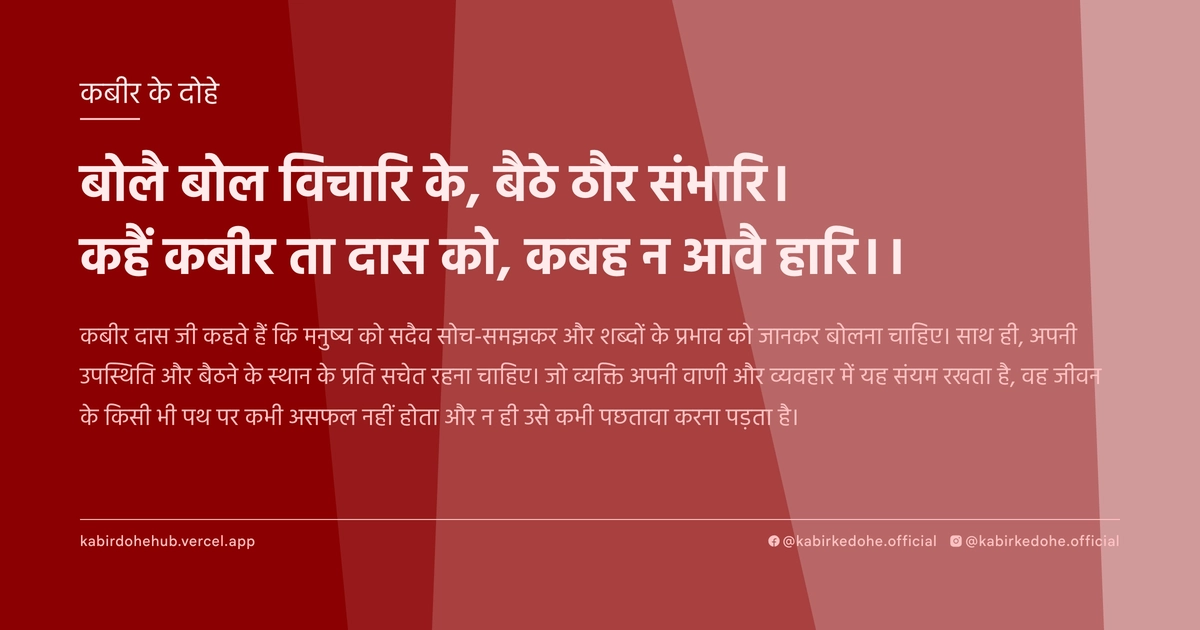
बोलै बोल विचारि के, बैठे ठौर संभारि।
कहैं कबीर ता दास को, कबह न आवै हारि।।
Bolai bol vichari ke, baithe thaur sambhari. Kahain Kabir ta das ko, kabah na aavai haari.
इस पृष्ठ पर इस कबीर दोहे का अर्थ (meaning), हिंदी व्याख्या और अंग्रेज़ी अनुवाद, दार्शनिक विश्लेषण और व्यावहारिक जीवन सीख दी गई है। यह दोहा संयम (Self-discipline) विषय से जुड़ा है — Kabir doha meaning and explanation in Hindi and English.
अर्थ (Meaning):
कबीर दास जी कहते हैं कि मनुष्य को सदैव सोच-समझकर और शब्दों के प्रभाव को जानकर बोलना चाहिए। साथ ही, अपनी उपस्थिति और बैठने के स्थान के प्रति सचेत रहना चाहिए। जो व्यक्ति अपनी वाणी और व्यवहार में यह संयम रखता है, वह जीवन के किसी भी पथ पर कभी असफल नहीं होता और न ही उसे कभी पछतावा करना पड़ता है।
Kabir suggests that one must speak only after careful deliberation, weighing the impact of every word. Similarly, one should be mindful of their posture and the space they occupy. He asserts that the seeker or servant who masters this conscious awareness of speech and presence will never face spiritual or worldly defeat, nor will they succumb to the agony of regret.
व्याख्या (Interpretation):
इस दोहे का शाब्दिक अर्थ वाणी के संयम से है, परंतु इसका गहरा आध्यात्मिक अर्थ 'सजगता' (Mindfulness) है। 'विचारि के' का अर्थ केवल शब्दों का चयन नहीं, बल्कि उस आंतरिक मौन से है जहाँ अहंकार विलीन हो जाता है। जब हम बिना सोचे बोलते हैं, तो हम माया के प्रभाव में होते हैं, जहाँ हमारी वाणी अहंकार का विस्तार बन जाती है। 'ठौर संभारि' का संकेत आत्म-साक्षात्कार की उस स्थिति की ओर है जहाँ साधक जानता है कि वह शरीर नहीं, बल्कि शुद्ध चेतना है। यह निर्गुण भक्ति का मार्ग है, जहाँ बाहरी आडंबरों के बजाय आंतरिक अनुशासन को प्राथमिकता दी जाती है। यहाँ 'हारि' का अर्थ केवल भौतिक पराजय नहीं, बल्कि आत्मा का परमात्मा से विमुख होना है। अतः, वाणी और उपस्थिति का संतुलन ही अद्वैत की ओर पहला कदम है।
Literally, the verse advocates for mindful speech, but metaphorically, it points toward the state of 'Sajagta' or absolute mindfulness. 'Vichari ke' does not merely imply linguistic caution but refers to the silence that precedes speech, where the ego is dissolved. When we speak impulsively, we are puppets of Maya, and our words become extensions of our pride. 'Thaur sambhari' suggests a conscious anchoring of the self, reminding the seeker that they are not the transient body but the eternal Atman. This aligns with Nirgun Bhakti, prioritizing internal discipline over external rituals. The 'defeat' mentioned is not a worldly loss but the spiritual failure of the soul to remain aligned with the Brahman. Thus, the harmony of speech and presence is the gateway to non-duality.
दार्शनिक विश्लेषण (Philosophical Analysis):
कबीर का यह दोहा उस युग की उपज है जब धर्म केवल कर्मकांडों और बाहरी दिखावे तक सीमित हो गया था। कबीर ने पंडितों और मौलवियों के उस वर्चस्व को चुनौती दी जो केवल शब्दों के जाल बुनते थे लेकिन आचरण में शून्य थे। उनके लिए 'शब्द' केवल ध्वनि नहीं, बल्कि 'शब्द' (Shabad) वह ईश्वरीय कंपन है जो सृष्टि का आधार है। यदि वाणी अनियंत्रित है, तो वह आध्यात्मिक पतन का कारण बनती है।
अद्वैत वेदांत के परिप्रेक्ष्य में, जब व्यक्ति 'मैं' और 'मेरा' के भाव से बोलता है, तो वह स्वयं को ब्रह्मांड से अलग मानता है। यह द्वैत ही समस्त दुखों का मूल है। कबीर यहाँ उस 'साक्षी भाव' की बात कर रहे हैं जहाँ बोलने वाला और सुना जाने वाला एक ही चेतना के दो छोर बन जाते हैं। जब वाणी विचारित होती है, तो वह अहंकार को मिटाकर सत्य का प्रतिबिंब बनती है।
सूफी मत के 'नफ्स' (नफ़्स-ए-अम्मारा या निम्न प्रवृत्तियाँ) के सिद्धांत से जोड़कर देखें तो, वाणी पर नियंत्रण वास्तव में इच्छाओं और आवेगों पर नियंत्रण है। जो अपनी जीभ को वश में कर लेता है, वह अपने मन को वश में कर लेता है। यह एक मनोवैज्ञानिक रूपांतरण है जहाँ प्रतिक्रिया (Reaction) का स्थान प्रत्युत्तर (Response) ले लेता है।
कबीर का 'दास' होना वास्तव में पूर्ण समर्पण का प्रतीक है। जब साधक स्वयं को ईश्वर का दास मान लेता है, तो उसका अहंकार समाप्त हो जाता है। तब उसकी वाणी में विनम्रता और सत्य का वास होता है। यह समर्पण ही उसे 'हार' से बचाता है क्योंकि वह अब व्यक्तिगत लाभ के लिए नहीं, बल्कि सार्वभौमिक सत्य के लिए बोलता है।
अंततः, यह दोहा हमें सिखाता है कि आध्यात्मिकता केवल गुफाओं में ध्यान लगाने का नाम नहीं है, बल्कि दैनिक जीवन के सबसे साधारण कार्य—जैसे बोलना और बैठना—में जागरूकता लाना ही वास्तविक साधना है। यह कर्मयोग और ज्ञानयोग का एक सुंदर समन्वय है।
This couplet emerges from an era where religion had devolved into mere ritualism and superficial displays. Kabir challenged the hegemony of the priestly class who wove intricate webs of words but remained void in conduct. For Kabir, 'Shabad' is not just sound but the divine vibration that sustains the universe. Uncontrolled speech is seen as a primary cause of spiritual leakage and descent.
From the lens of Advaita Vedanta, when a person speaks from the 'I' and 'Mine' perspective, they reinforce the illusion of separation from the Brahman. This duality is the root of all suffering. Kabir advocates for the 'Sakshi' (Witness) consciousness, where the speaker and the listener merge into a single stream of awareness. Mindful speech is the process of erasing the ego to let the Truth reflect through the voice.
Connecting this to the Sufi concept of 'Nafs' (the lower self), controlling the tongue is equivalent to disciplining the impulsive desires of the soul. One who masters their speech masters their mind. This represents a psychological shift from instinctive reaction to conscious response, moving the practitioner from a state of turbulence to tranquility.
Kabir’s identification as a 'Das' (servant) symbolizes total surrender. When the seeker views themselves as a servant of the Divine, the ego vanishes. Their words then carry humility and truth. This surrender protects them from 'defeat' because they no longer speak for personal gain but as a conduit for universal truth.
Ultimately, this verse teaches that spirituality is not confined to secluded meditation but is found in the most mundane acts—speaking and sitting. Bringing awareness to these simple actions is the highest form of Sadhana, blending the paths of Karma Yoga and Jnana Yoga into a lived experience.
मूल संदेश (Core Message):
- असंयमित वाणी अहंकार का दर्पण है।
- मौन और विचार ही सत्य की जननी हैं।
- सजग उपस्थिति ही वास्तविक साधना है।
- शब्दों का संयम मानसिक शांति का द्वार है।
- अहंकार का विसर्जन ही अंतिम विजय है।
- Unbridled speech is the mirror of the ego.
- Silence and deliberation are the parents of truth.
- Mindful presence is the only true spiritual practice.
- Restraint of words is the gateway to mental peace.
- The dissolution of ego is the ultimate victory.
व्यावहारिक उदाहरण (Practical Example):
एक समय की बात है, वाराणसी के घाटों पर रामदीन नाम का एक वृद्ध बुनकर रहता था। वह अपनी कला में निपुण था, लेकिन उसका स्वभाव अत्यंत क्रोधी था। वह अक्सर अपने ग्राहकों और पड़ोसियों पर चिल्लाता था, जिससे उसकी सामाजिक प्रतिष्ठा गिरती जा रही थी। वह जितना अधिक क्रोध करता, उतना ही अकेला महसूस करता।
एक दिन वह एक संत के पास गया और अपनी मानसिक अशांति का कारण पूछा। संत ने उसे कोई मंत्र नहीं दिया, बल्कि केवल एक बात कही: 'अगली बार जब तुम कुछ बोलो, तो शब्दों को अपनी जीभ पर तीन बार तौलना और यह देखना कि तुम कहाँ बैठे हो।'
शुरुआत में रामदीन को यह बहुत सरल और व्यर्थ लगा। लेकिन जब उसने इसे लागू करना शुरू किया, तो उसे एक अजीब अनुभव हुआ। एक दोपहर, एक ग्राहक ने उसके कपड़े में कमी निकाली और उसे भला-बुरा कहा। रामदीन का पुराना स्वभाव उसे चिल्लाने के लिए उकसा रहा था।
तभी उसे संत की बात याद आई। उसने अपनी स्थिति को देखा—वह अपने करघे के पास बैठा था, जो उसके जीवन का आधार था। उसने महसूस किया कि उसका क्रोध उस करघे की लय को बिगाड़ रहा है। उसने तीन सेकंड का मौन रखा और विचार किया: 'क्या मेरा क्रोध इस कपड़े की कमी को ठीक करेगा?'
उसने शांत स्वर में कहा, 'क्षमा करें, मैं इसे अभी ठीक कर देता हूँ।' ग्राहक उसकी विनम्रता देखकर दंग रह गया और उसने न केवल वह कपड़ा खरीदा, बल्कि रामदीन का सम्मान भी किया।
धीरे-धीरे रामदीन ने पाया कि जब वह 'विचारि के' बोलता है, तो उसके मन का शोर कम हो जाता है। उसने महसूस किया कि उसका क्रोध वास्तव में उसके अहंकार की एक चीख थी जो चाहती थी कि सब उसकी प्रशंसा करें।
उसने अपनी बैठने की मुद्रा में भी बदलाव किया। वह अब केवल काम के लिए नहीं, बल्कि शांति के लिए बैठता था। वह अपने आस-पास के वातावरण के प्रति सजग रहने लगा।
एक दिन गाँव में एक बड़ा विवाद हुआ। दोनों पक्ष चिल्ला रहे थे। रामदीन वहाँ गया और उसने केवल शांत रहकर और सोच-समझकर दो वाक्य कहे, जिससे पूरा विवाद सुलझ गया।
गाँव वालों ने उसे एक नया सम्मान दिया। रामदीन अब केवल एक बुनकर नहीं था, बल्कि एक मार्गदर्शक बन गया था। उसने सीखा कि शब्दों का सही चयन और उपस्थिति की सजगता ही जीवन की सबसे बड़ी जीत है।
उसने पाया कि जब उसने अपनी वाणी को जीता, तो उसने वास्तव में अपने जीवन की परिस्थितियों को जीत लिया। वह अब कभी 'हार' नहीं मानता था, क्योंकि उसकी जीत बाहरी दुनिया में नहीं, बल्कि उसके अपने भीतर थी।
Once, on the ghats of Varanasi, lived an elderly weaver named Ramdeen. He was a master of his craft, but his temperament was volatile. He frequently shouted at customers and neighbors, causing his social standing to dwindle. The more he raged, the more isolated he became.
Seeking peace, he approached a wandering saint. The saint gave him no complex mantra, only a simple instruction: 'Next time you speak, weigh your words three times on your tongue, and be mindful of where you are sitting.'
Initially, Ramdeen found this trivial. However, as he began to implement it, he noticed a shift. One afternoon, a customer found a flaw in a garment and began insulting him. Ramdeen's old nature urged him to scream back in defense.
Suddenly, he remembered the saint's words. He observed his physical state—he was sitting at his loom, the very source of his livelihood. He realized his anger was disrupting the rhythmic harmony of the weaving process. He paused for three seconds and asked himself: 'Will my anger fix the flaw in the fabric?'
He replied in a calm tone, 'I apologize; I shall rectify this immediately.' The customer, stunned by this unexpected humility, not only bought the cloth but developed a deep respect for Ramdeen.
Gradually, Ramdeen discovered that when he spoke 'after deliberation,' the noise in his mind subsided. He realized his anger was merely the scream of an ego that demanded constant validation.
He also changed how he occupied space. He no longer sat merely to work, but sat to be present. He became acutely aware of the energy of his surroundings.
One day, a fierce dispute broke out in the village. Both parties were screaming. Ramdeen entered the fray and, after a long silence, spoke only two carefully weighed sentences that resolved the entire conflict.
The villagers began to view him not just as a weaver, but as a guide. Ramdeen learned that the correct choice of words and a mindful presence are the greatest victories in life.
He found that by conquering his speech, he had conquered his circumstances. He no longer felt 'defeated' because his victory was no longer external, but internal.
His life became a living testament to the Doha: by anchoring his presence and refining his voice, he attained a state of grace that no worldly storm could shake.
अभ्यास मार्गदर्शन (Practice Guidance):
- दैनिक अभ्यास: दिन में कम से कम एक घंटा 'मौन व्रत' का पालन करें, जहाँ आप न बोलें और न ही संकेत दें।
- आत्म-पूछताछ: बोलने से पहले स्वयं से पूछें—'क्या यह सत्य है? क्या यह आवश्यक है? क्या यह दयालु है?'
- सजग उपस्थिति: दिन में तीन बार अलार्म सेट करें और जब अलार्म बजे, तो अपनी बैठने की मुद्रा और सांसों पर ध्यान दें।
- डायरी लेखन: रात को उन क्षणों को लिखें जब आपने बिना सोचे कुछ कहा और उसका क्या परिणाम हुआ।
- डायग्नोस्टिक चेकलिस्ट: यदि आप दूसरों की बातों पर तुरंत प्रतिक्रिया दे रहे हैं या बात करते समय बेचैन महसूस करते हैं, तो समझें कि आप सजगता खो रहे हैं।
- Daily Practice: Observe a 'Mauna Vrat' (vow of silence) for at least one hour a day, avoiding both speech and gesturing.
- Self-Inquiry: Before speaking, ask yourself three questions: 'Is it true? Is it necessary? Is it kind?'
- Mindful Presence: Set three random alarms during the day; when they ring, immediately observe your posture and the rhythm of your breath.
- Journaling: Record instances where you spoke impulsively and analyze the subsequent emotional and social fallout.
- Diagnostic Checklist: If you find yourself reacting instantly to triggers or feeling physically restless while speaking, recognize it as a sign of lost mindfulness.
चिंतन प्रश्न (Reflection Questions):
- मेरी वाणी अक्सर दूसरों को नियंत्रित करने का साधन बनती है या सत्य को प्रकट करने का?
- जब मैं चुप होता हूँ, तो क्या मैं वास्तव में शांत होता हूँ या भीतर एक युद्ध चल रहा होता है?
- मेरे डिजिटल व्यक्तित्व (सोशल मीडिया) की वाणी मेरे वास्तविक आंतरिक स्वभाव से कितनी भिन्न है?
- क्या मेरी 'उपस्थिति' दूसरों के लिए सुकून लाती है या तनाव पैदा करती है?
- मैं किन परिस्थितियों में अपनी सजगता खो देता हूँ और क्यों?
- Does my speech often serve as a tool for control or as a medium for truth?
- When I am silent, am I truly at peace or is there an internal war raging?
- How different is the voice of my digital persona from my authentic internal nature?
- Does my physical presence bring comfort to others or does it create tension?
- In which specific situations do I lose my mindfulness, and what is the root cause?